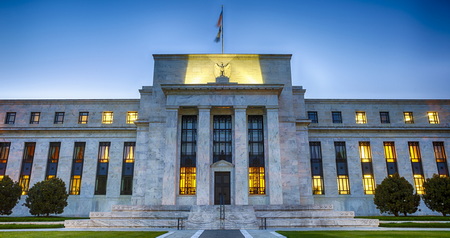
After the Federal Reserve’s Federal Open Market Committee (FOMC) concluded its January meeting on Wednesday by holding rates steady at 3.5 percent to 3.75 percent, President Donald Trump announced today he is nominating former Fed governor Kevin Warsh as the next Fed chair. (Axios, Jan. 30 | CBS News, Jan. 28)
Fed Chair
“I have known Kevin for a long period of time, and have no doubt that he will go down as one of the GREAT Fed Chairmen, maybe the best,” said Trump in a Truth Social post announcing the selection. (CNBC, Jan. 30)
Warsh still needs Senate confirmation and, if approved, would take over in May when Powell’s term expires.
Key Takeaways
The FOMC voted 10-2 to maintain rates, with Governors Stephen Miran and Christopher Waller dissenting in favor of an additional quarter-point cut. While most Fed officials still expect further reductions in 2026, Chair Powell emphasized that decisions will remain "data dependent." (Fed statement, Jan. 28)
Fed Chair Jerome Powell said the economic outlook has "clearly improved" since the Committee's December meeting.
Fed Chair Jerome Powell said the economic outlook has "clearly improved" since the Committee's December meeting.
He cited growth and signs of stabilization in the labor market, while emphasizing that policymakers want greater confidence that inflation is moving toward the Fed's 2 percent target before resuming rate cuts.
The U.S. economy grew at a 4.4 percent annual rate in the third quarter of 2025. Chair Powell noted that this performance suggests that interest rates are not currently restrictive enough to materially slow economic activity. (AP, Jan. 28)
Inflation remains above target, with the Fed's preferred measure running near 2.8 percent late last year. Chair Powell acknowledged that recent tariff-related price pressures have lifted goods inflation but suggested those effects are likely temporary and could begin easing later this year. (AP, Jan. 28)
The Fed's decision to hold rates steady reinforces expectations that borrowing costs will remain elevated through at least mid-year.
For commercial real estate, sustained higher-for-longer rates continue to place pressure on refinancing, valuations, and transaction activity.
Institutional Investor Legislation Introduced
Against this backdrop of a pause in rate cuts and broader concerns about housing affordability, lawmakers have renewed efforts to target institutional participation in the single-family housing market.
On Jan. 20, Reps. Summer Lee (D-PA), Ro Khanna (D-CA), Mark Takano (D-CA), and Jill Tokuda (D-HI) reintroduced the Stop Wall Street Landlords Act (H.R. 7138). (Press Release, Jan. 20)
The bill would deny mortgage interest, insurance, and depreciation deductions for large institutional investors that own single-family homes and impose a 100 percent federal real estate transfer tax on covered properties that are not sold within 18 months of enactment, with proceeds used to fund the federal Housing Trust Fund.
The proposal would also bar the Federal Housing Financial Agency, Fannie Mae, Freddie Mac, and Ginnie Mae from supporting single-family mortgages tied to large institutional investors. (CNBC, Jan. 18)
Other legislation aimed at restricting institutional investment in the single family rental market include:
Rep. Mary Miller (R-IL) introduced the American Family Housing Act (H.R. 7186), co-sponsored by Rep. Buddy Carter (R-GA), which would direct the SEC to enforce restrictions on large institutional investors (those with more than $100 billion in assets under management) from purchasing single-family homes. Rep. Miller serves on the House Agriculture Committee and Rep. Carter on the House Budget Committee.
Rep. Pat Harrigan (R-NC) introduced Families First Housing Act of 2026 (H.R.6962). The bill is co-sponsored by Rep. Josh Riley (D-NY). The co-sponsors are members of the House Science Committee.
The debate has taken on added political significance following President Trump's recent statements and Executive Order on curtailing institutional ownership of single-family homes. (CNBC, Jan. 18 | Roundtable Weekly, Jan. 23)
Looking Ahead
Proposals such as the Stop Wall Street Landlords Act risk could further restrict housing supply and access to capital at a time when liquidity and investment are already under pressure.
As The Real Estate Roundtable (RER) and partners have emphasized, targeting institutional investment does not address the core drivers of unaffordability: high mortgage rates, rising construction costs, labor shortages, and restrictive zoning that limits housing supply. (Roundtable Weekly, Jan. 9)
RER will continue to engage policymakers about the importance of expanding housing supply, preserving access to capital, and maintaining regulatory flexibility to support long-term stability for the commercial real estate industry and the overall economy.


 Menu
Close
Menu
Close
 About Us