The bipartisan 21st Century ROAD to Housing Act remains in limbo in the House, where lawmakers are still weighing how to reconcile the Senate-passed package with the chamber’s own housing bill. The Senate approved its version two weeks ago after combining House priorities with the upper chamber’s broader housing agenda, but House members have raised concerns about several provisions added or revised in the Senate package—most notably the bill’s treatment of build-to-rent (BTR) housing.
State of Play
The House and Senate remain at odds over how to advance the housing package after the Senate passed its bill with overwhelming bipartisan support earlier this month. (PoliticoPro, Mar. 23)
House Financial Services Ranking Member Maxine Waters (D-CA) urged House Democrats this week to support a formal conference committee, arguing that the final bill should restore House priorities and address stakeholder concerns—an apparent reference to the Senate bill’s restrictions on large institutional investors in single-family housing.
Rep. Mike Flood (R-NE) said Wednesday that Senate Banking and House Financial Services leaders need to meet to resolve key differences between the two packages.
Rep. Flood identified three major House concerns with the Senate bill: the need to preserve but revise the provision restricting institutional investors from purchasing single-family homes, the omission of environmental review changes for certain affordable housing programs, and the Senate’s inclusion of a temporary rather than permanent restriction on a Federal Reserve central bank digital currency. (PoliticoPro | Watch Rep. Flood Remarks, Mar. 25)
Build-to-Rent
The biggest sticking point remains the Senate bill’s requirement that rental homes developed by large investors be sold to individual homebuyers after seven years. (The Urban Institute, Mar. 17)
House Republicans have raised concerns that the provision could undercut new rental housing production, disrupt financing, and introduce significant long-term uncertainty into the market.
The Real Estate Roundtable (RER) has warned that the bill’s forced-sale structure raises serious constitutional concerns and could trigger years of litigation involving property owners, tenants, and the federal government.
Based on a March 19 discussion with 146 BTR executives, developers, and capital partners, the firm reported this week that the Senate bill’s seven-year disposal requirement has already frozen capital and halted new development ahead of enactment. Some capital will not return even if the bill is altered, reflecting ongoing concerns about future policy risk. (John Burns Research & Consulting, Mar. 24)
RER Advocacy
RER and a broad real estate coalition have spent weeks urging lawmakers to preserve the housing bill’s supply-focused provisions while removing language that would force large investors to sell newly built single-family rental homes after seven years. (Roundtable Weekly, Jan. 9 | Jan. 16 | Jan. 23 | Feb. 27| Mar. 6 | Mar. 13 | Mar. 20)
In March, RER joined a series of coalition letters urging senators to remove or revise Section 901, warning that the seven-year sale requirement would effectively eliminate the production of BTR housing. (Roundtable Weekly, Mar. 20) (Letter, Mar. 5 | Letter, Mar. 13)
That message was reinforced again this week in an open letter from housing policy researchers, who warned that the Senate-passed ROAD to Housing Act would undermine BTR housing, which represents a growing source of new supply in markets where housing is already out of reach for many households. (Letter, Mar. 26)
The researchers said BTR has helped expand the housing stock, particularly for middle-income renters seeking single-family-style housing, and cautioned that the bill’s seven-year sale mandate would disrupt the model’s economics and reduce future production.
The letter also noted that many BTR communities are not structured to be sold off unit-by-unit, making the requirement especially problematic in practice.
What’s Next
The House and Senate are out on recess and do not return to Washington until April 14, leaving the future of the broader housing package uncertain. (NYT, Mar. 25)
Whether lawmakers pursue a formal conference or a narrower compromise, RER will continue urging Congress to preserve the bill’s pro-supply provisions while removing language that would reduce rental-housing production and make it more difficult to meet the nation’s growing housing needs.
Tax Policy
Cost Recovery Reform to Spur New Housing Supply Gains Traction in Washington
A new report from the influential Center for American Progress (CAP) suggests that allowing immediate expensing for new multifamily rental housing could spur a major increase in multifamily construction and bring down housing costs over the next decade. (CAP Report, March 11)
Report Findings
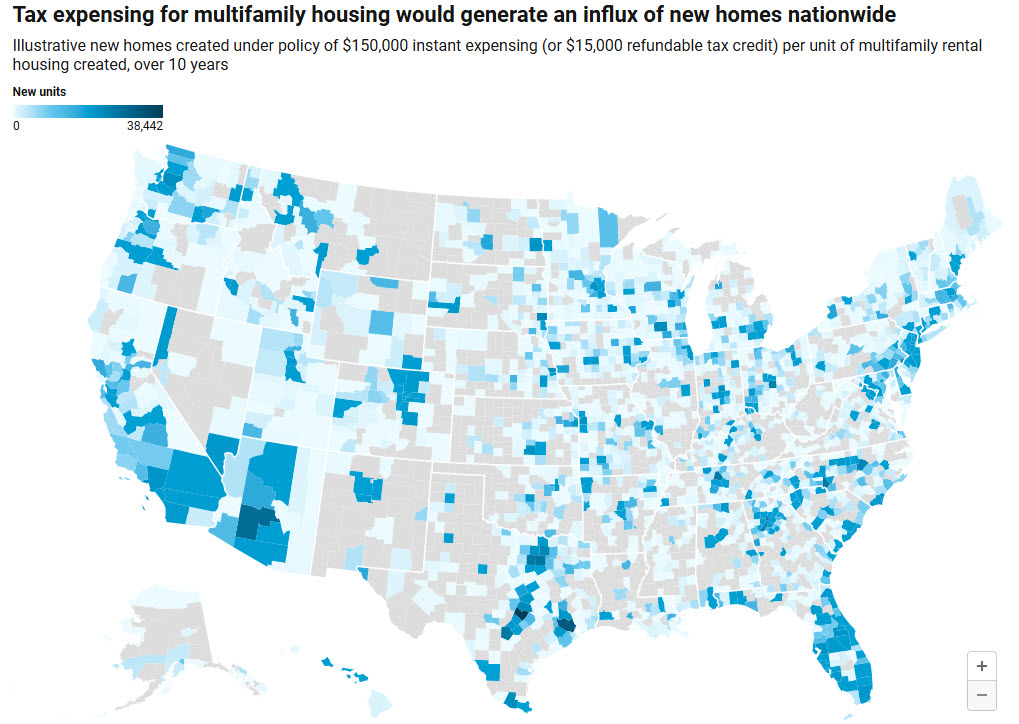
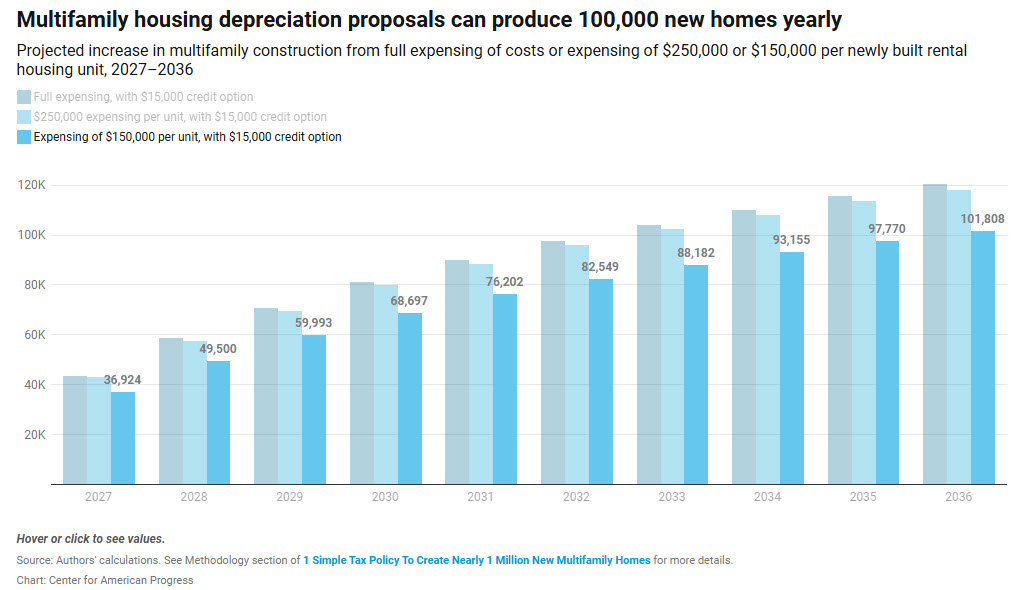
The CAP report found that immediate expensing for new multifamily rental housing, with a per-unit cap of $150K-$250K, could spur the creation of 706,000 to 1.06 million new homes over 10 years, at a cost of up to $206 billion. (PoliticoPro, March 12)
The researchers claim that faster cost recovery would lower the cost of capital, improve project cash flow, and help move more rental developments from infeasible to financeable.
The research also shows that full or partial expensing could increase housing supply at a lower cost per unit than many direct subsidy programs. (Tax Policy Center, March 17)
The researchers’ preferred approach would cap immediate expensing at $150,000 per unit, paired with a refundable credit option to address the fact that many real estate investors are tax-exempt or otherwise unable to use additional tax deductions. They estimate the proposal could produce roughly 755,000 new homes over a decade for about $154 billion.
The proposal also parallels last year’s One Big Beautiful Bill Act, which provided full expensing for new factories. The Tax Foundation called that change a step forward, but said its economic benefits would be limited because it is temporary and narrowly targeted. (Tax Foundation, Oct. 27, 2025)
The Tax Foundation published a reply to the CAP report that generally supports the approach while outlining a variety of cost recovery reform options for policymakers to consider, including: neutral cost recovery, and investment tax credit, tax deduction transferability, shorter asset lives, and partial expensing. (The Tax Foundation, Mar. 23)
The recent reports by the two influential think tanks are further evidence that policymakers are open to new approaches aimed at addressing housing affordability challenges.
On the Hill
Sen. Lisa Blunt Rochester (D-DE) introduced the Rental Housing Investment Act on March 12, which would allow builders to immediately deduct a portion of new multifamily construction costs rather than recover them over 27.5 years. (Sen. Rochester News Release, Mar. 12)
The bill would allow builders to immediately deduct up to $150,000 per unit in construction costs, with an enhanced deduction of up to $250,000 per unit for projects that include income-restricted units under long-term attainability commitments. The incentive would apply only to newly constructed multifamily rental housing. (USA Today, Mar. 11)
The measure is intended to support efforts to expand rental supply and address affordability pressures by improving the tax treatment of new multifamily development, as high interest rates and rising construction costs continue to weigh on housing production.
Property Conversions
Office conversions now account for nearly half of all future adaptive reuse projects. (CRE Daily, Mar. 25)
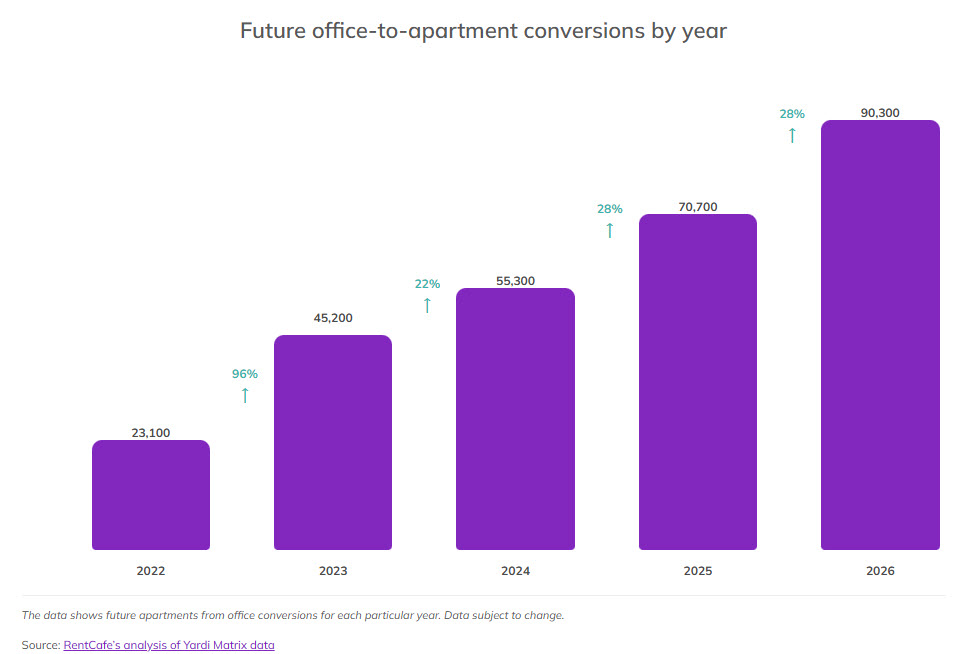
RentCafe reported that 90,300 apartments were in the conversion pipeline nationwide at the start of 2026, up 28% from 70,600 a year earlier, as the trend continues to gain momentum in both major and mid-sized markets. (RentCafe, Mar. 24)
New York leads the pipeline, followed by Washington, D.C., and Chicago. (Bisnow, March 26 | Cushman & Wakefield, Feb. 2026)
New research from Pew and Gensler highlights office-to-residential conversions, particularly lower-cost co-living microapartments in underused downtown buildings. (Pew Research, Mar. 24)
Pew found the model could cut per-unit development costs by more than half in some markets and deliver nearly four times as many affordable homes per subsidy dollar compared to traditional studio development. (Pew Research, Mar. 24)
RER has strongly backed the bipartisan Revitalizing Downtowns and Main Streets Act of 2025 (H.R. 2410), which would create a market-based tax incentive for converting older commercial buildings to residential use to help expand housing and support the recovery of downtowns and neighborhoods still feeling the effects of the pandemic. (Roundtable Weekly, Mar. 2025)
RER will continue working with policymakers to advance tax and regulatory policies that encourage property conversions, reduce barriers to development, and help expand the nation’s housing supply.
Energy Policy
Policymakers Continue Focus on Grid Reliability, Electricity Affordability
Congress and the White House are elevating questions around energy infrastructure, cost allocation, and the ability of the power sector to meet the needs of AI in a rapidly evolving economy.
Hearing Spotlights Grid Strain
On March 25, the Senate Energy and Natural Resources (ENR) Committee held a hearing on the state of the U.S. bulk power system. Lawmakers and witnesses pointed to growing strain from rising electricity demand, infrastructure delays, and reliability concerns. (Senate ENR Hearing, Mar. 25)
Witnesses agreed the U.S. is entering a new phase of electricity demand growth not seen in decades—driven by a combination of AI applications, domestic manufacturing, and electrification—creating both reliability risks and investment uncertainty. (Senate ENR Hearing, Mar. 25)
Lawmakers and witnesses suggested several solution pathways, including permitting reform to accelerate project approvals, expanded transmission buildout to relieve congestion, and improved interconnection processes to bring new generation online faster. (Senate ENR Hearing, Mar. 25)
Dr. Liza Reed (Niskanen Center) emphasized the central role of transmission, stating, “We need more energy and transmission to move that energy,” and warning that “a shortage of grid capacity is the primary barrier to the cost-effective and swift deployment of AI in this country.” (Reed Testimony, Mar. 25)
As The Real Estate Roundtable’s (RER) Policy Guide on building performance standards states, the transition to a digital economy raises serious concerns about electricity availability, as “[v]ast swaths of the U.S. are at risk of running short of power.” (Roundtable Weekly, Oct. 11, 2024)
Executive Action
On March 20, the White House released its National Policy Framework for Artificial Intelligence, accelerating congressional attention on these issues by directly linking data center growth to energy policy. (White House AI Framework, Mar. 20)
The framework calls on Congress to “ensure that residential ratepayers do not experience increased electricity costs as a result of new AI data center construction and operation” while also urging policymakers to “streamline federal permitting for AI infrastructure construction and operation.” (White House AI Framework, Mar. 20)
The administration’s approach builds on its earlier ratepayer protection pledge, which requires major technology companies to provide or pay for their own power. White House officials have urged Congress to codify that commitment into law. (E&E News, Mar. 23)
Congressional leaders quickly signaled alignment with the framework. In a joint statement, House Republican leaders said Congress must “enact a national framework that unleashes the full potential of AI… and provides important protections for American families.” (E&E News, Mar. 23)
At the same time, divisions remain, with some lawmakers raising concerns about federal preemption and the broader scope of the proposal. (E&E News, March 23)
State of Play – Permitting Reform
Lawmakers have been advancing multiple legislative approaches to address permitting delays, transmission bottlenecks, and the growing energy demands of data centers.
Notably, the RER-backed, bipartisan SPEED Act(H.R. 4776,), which passed the House in December 2025, would provide permitting certainty, codify certain NEPA reforms, and streamline environmental reviews for energy infrastructure. (Roundtable Weekly, Dec. 19, 2025)
RER believes permitting reform is essential for advancing our economy’s energy transition. The current fragmented system of administrative reviews and approvals hinders the delivery of quick, low-cost, reliable electricity to our nation’s homes and commercial buildings. (Roundtable Weekly, Oct. 10, 2025)
Permitting reform talks remain active but unsettled. Bipartisan negotiations continue and some Republicans consider narrower reconciliation options, though procedural constraints and the GOP’s narrow majority leave the path forward uncertain. (E&E News, Mar. 26)
Data Centers
Separately, lawmakers have introduced a range of proposals addressing data center energy use and cost allocation.
Recently introduced bills would require federal studies on ratepayer impacts (H.R. 6529), expand FERC oversight (H.R. 8033), ensure large-load customers cover their electricity costs (H.R. 7977), and mandate dedicated power sources for new data centers (S. 3852)—reflecting growing congressional focus on preventing cost shifts to consumers. (E&E News, Mar. 23)
On March 25, Sen. Dick Durbin (D-IL) introduced the Data Center Water and Energy Transparency Act, which would require data center developers and operators to disclose energy and water use to state and local officials considering new projects. (Sen. Durbin Press Release, Mar. 25)
Meanwhile, Senators Elizabeth Warren (D-MA) and Josh Hawley (R-MO) joined in a letter to the Energy Department’s data gathering arm, urging the agency to “establish a mandatory annual reporting requirement for data centers and other large loads.” (Sens. Warren, Hawley press release | The Verge, Mar. 26)
RER will continue to engage with members of Congress and the administration to advance policies that streamline project approvals, support efficient cost allocation, and enable the energy infrastructure needed to power the real estate sector and the broader economy.
In Memoriam
David Simon, Transformative Leader in Retail Real Estate
The Real Estate Roundtable mourns the passing of David Simon, the longtime chairman, chief executive officer, and president of Simon Property Group, who died on March 22. Simon transformed his family’s business into the world’s leading retail property company and was one of the most influential figures in modern retail real estate. (WSJ | Simon Property Group Press Release, March 23)


 Menu
Close
Menu
Close
 About Us