Cost Recovery Reform to Spur New Housing Supply Gains Traction in Washington
March 27, 2026
A new report from the influential Center for American Progress (CAP) suggests that allowing immediate expensing for new multifamily rental housing could spur a major increase in multifamily construction and bring down housing costs over the next decade. (CAP Report, March 11)
Report Findings
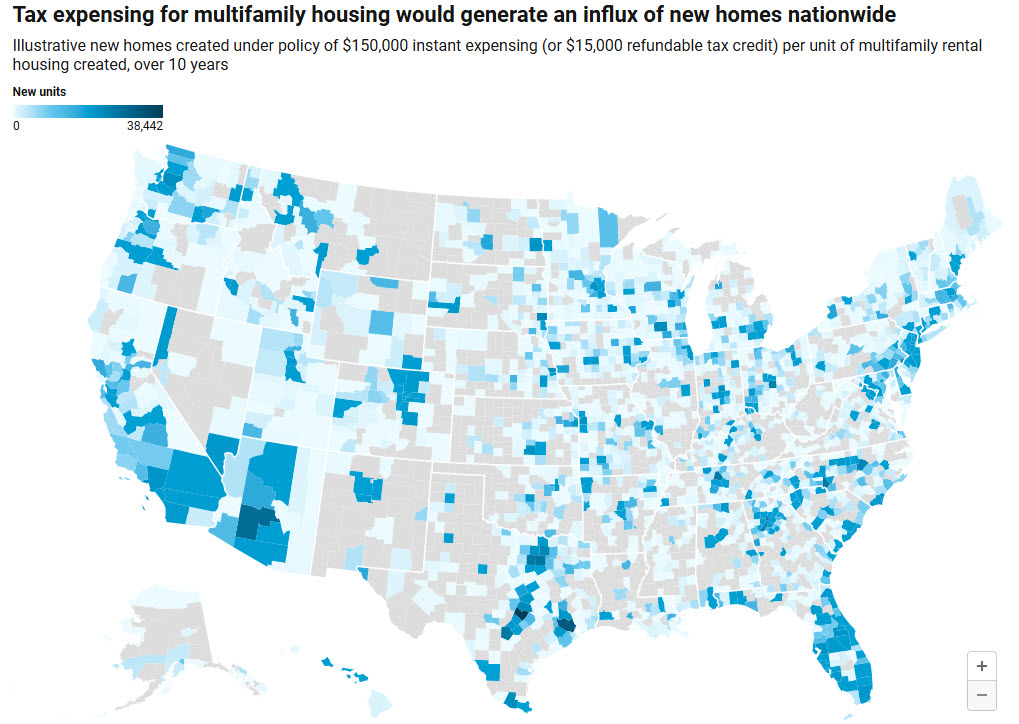
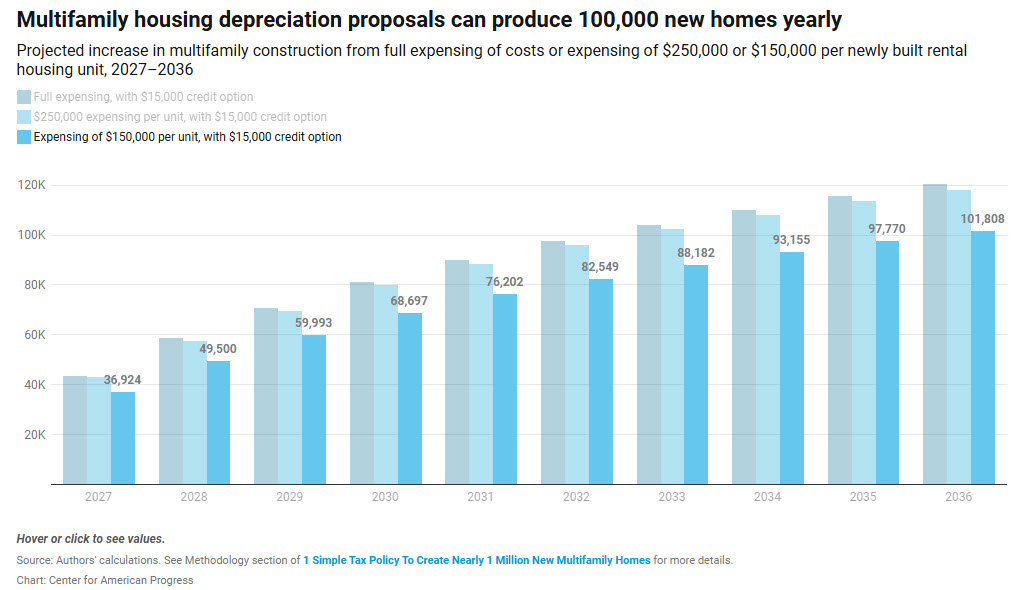
The CAP report found that immediate expensing for new multifamily rental housing, with a per-unit cap of $150K-$250K, could spur the creation of 706,000 to 1.06 million new homes over 10 years, at a cost of up to $206 billion. (PoliticoPro, March 12)
The researchers claim that faster cost recovery would lower the cost of capital, improve project cash flow, and help move more rental developments from infeasible to financeable.
The research also shows that full or partial expensing could increase housing supply at a lower cost per unit than many direct subsidy programs. (Tax Policy Center, March 17)
The researchers’ preferred approach would cap immediate expensing at $150,000 per unit, paired with a refundable credit option to address the fact that many real estate investors are tax-exempt or otherwise unable to use additional tax deductions. They estimate the proposal could produce roughly 755,000 new homes over a decade for about $154 billion.
The proposal also parallels last year’s One Big Beautiful Bill Act, which provided full expensing for new factories. The Tax Foundation called that change a step forward, but said its economic benefits would be limited because it is temporary and narrowly targeted. (Tax Foundation, Oct. 27, 2025)
The Tax Foundation published a reply to the CAP report that generally supports the approach while outlining a variety of cost recovery reform options for policymakers to consider, including: neutral cost recovery, and investment tax credit, tax deduction transferability, shorter asset lives, and partial expensing. (The Tax Foundation, Mar. 23)
The recent reports by the two influential think tanks are further evidence that policymakers are open to new approaches aimed at addressing housing affordability challenges.
On the Hill
Sen. Lisa Blunt Rochester (D-DE) introduced the Rental Housing Investment Act on March 12, which would allow builders to immediately deduct a portion of new multifamily construction costs rather than recover them over 27.5 years. (Sen. Rochester News Release, Mar. 12)
The bill would allow builders to immediately deduct up to $150,000 per unit in construction costs, with an enhanced deduction of up to $250,000 per unit for projects that include income-restricted units under long-term attainability commitments. The incentive would apply only to newly constructed multifamily rental housing. (USA Today, Mar. 11)
The measure is intended to support efforts to expand rental supply and address affordability pressures by improving the tax treatment of new multifamily development, as high interest rates and rising construction costs continue to weigh on housing production.
Property Conversions
Office conversions now account for nearly half of all future adaptive reuse projects. (CRE Daily, Mar. 25)
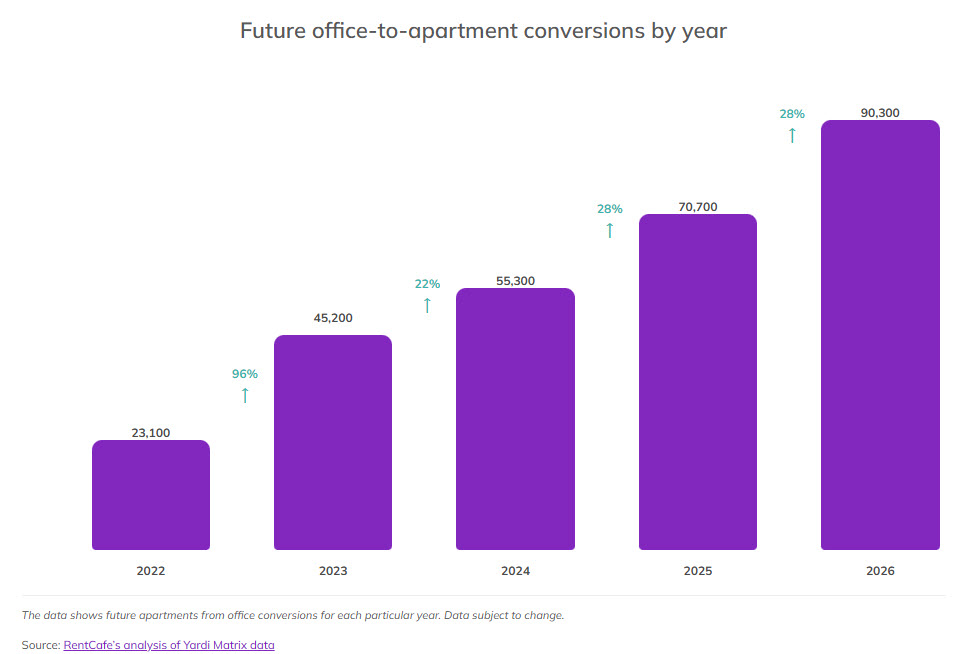
RentCafe reported that 90,300 apartments were in the conversion pipeline nationwide at the start of 2026, up 28% from 70,600 a year earlier, as the trend continues to gain momentum in both major and mid-sized markets. (RentCafe, Mar. 24)
New York leads the pipeline, followed by Washington, D.C., and Chicago. (Bisnow, March 26 | Cushman & Wakefield, Feb. 2026)
New research from Pew and Gensler highlights office-to-residential conversions, particularly lower-cost co-living microapartments in underused downtown buildings. (Pew Research, Mar. 24)
Pew found the model could cut per-unit development costs by more than half in some markets and deliver nearly four times as many affordable homes per subsidy dollar compared to traditional studio development. (Pew Research, Mar. 24)
RER has strongly backed the bipartisan Revitalizing Downtowns and Main Streets Act of 2025 (H.R. 2410), which would create a market-based tax incentive for converting older commercial buildings to residential use to help expand housing and support the recovery of downtowns and neighborhoods still feeling the effects of the pandemic. (Roundtable Weekly, Mar. 2025)
RER will continue working with policymakers to advance tax and regulatory policies that encourage property conversions, reduce barriers to development, and help expand the nation’s housing supply.


 Menu
Close
Menu
Close
 About Us