The North American Electric Reliability Corporation (NERC) issued its highest-level grid alert this week, warning that data centers, crypto mining operations, and other large “computational loads” are creating new reliability risks as electricity demand accelerates across the country. (NERC, May 4)
Why It Matters
NERC is the international regulatory “grid watchdog” that ensures reliability and security of North America’s bulk electricity system.
NERC’s Level 3 Essential Action Alert directs grid operators, transmission planners, and utilities to address risks from large loads that can unexpectedly disconnect from the grid or create significant power swings within seconds. (NERC, May 4)
The alert follows incidents involving data centers across the East Coast and Texas, where large loads unexpectedly dropped off the grid, raising concerns about frequency, voltage, and overall power system reliability. (Utility Dive, May 5)
A Union of Concerned Scientists representative called the alert a “big deal,” noting it is only the third Level 3 alert in NERC’s history. (PoliticoPro, May 4)
The alert signals a broader shift toward future data center regulations that could require such large power users to register with NERC, just as entities that own and operate the electric grid must currently do. (PoliticoPro, May 4). Entities that register with NERC must comply with its grid reliability standards.
NERC also released voluntary risk-mitigation guidelines while it develops formal reliability standards for data centers and other large loads. (E&E News May 4)
Meanwhile, the alert outlines “essential actions” for current NERC registrants, such as stronger modeling of computational loads, more frequent stability studies, and installation of fault-recording equipment to better understand how data centers behave during grid disturbances. Grid planners are asked to respond by Aug. 3. (NERC, May 4)
Separately, the Federal Energy Regulatory Commission (FERC) is drafting a proposal that could provide more federal oversight on how large data centers must connect to the power grid. (Latitude Media | E&E News, May 4)
Data Centers & Electricity Demand Growth
NERC’s warning comes as data centers face growing scrutiny over their energy use, infrastructure impacts, and effects on electricity costs. (NYT, April 27)
Eleven states have proposed legislation since late 2025 to restrict or ban data center development, while Sen. Bernie Sanders (I-VT) and Rep. Alexandria Ocasio-Cortez (D-NY) have introduced legislation to pause new data center construction nationwide. (Axios, April 5)
At a House Energy subcommittee hearing last week, witnesses argued that large-load customers such as data centers should cover the full incremental costs of the generation, transmission, and distribution upgrades needed to serve them. (Politico | Hearing, April 30)
Separately, the U.S. Green Building Council (USBGC) and eight partner organizations launched the Greening AI Data Centers Coalition to coordinate on non-governmental sustainability standards for AI data centers, including performance criteria for energy, carbon, water, waste, biodiversity, and community impact. (USGBC, April 22)
Data centers are not the only source of rising power demand, but they are accelerating a broader challenge: the nation needs more generation, more transmission, faster permitting, and better grid planning to support economic growth, housing development, and U.S. technological leadership. (NYT, April 27)
Electricity Costs & Infrastructure
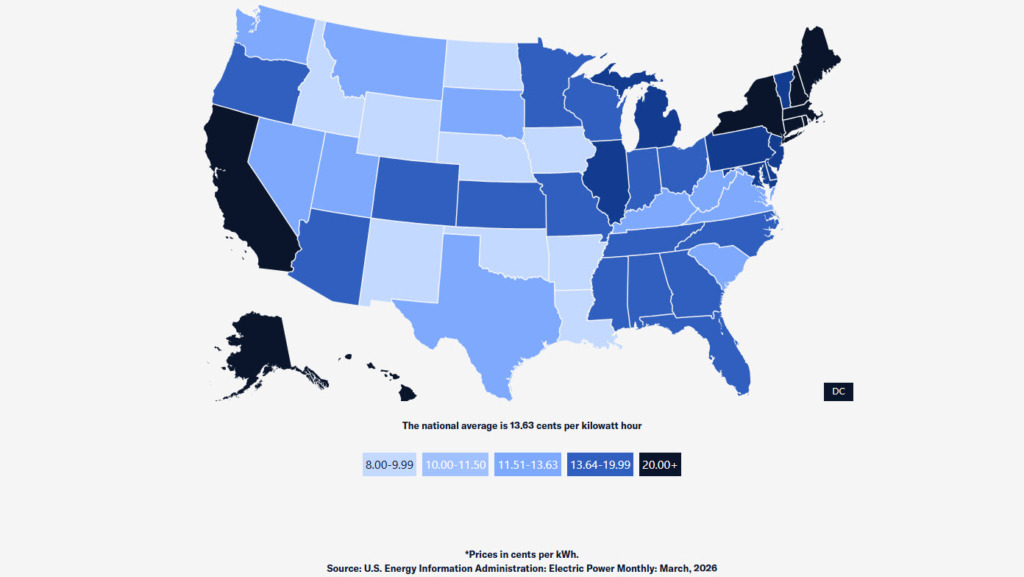
Electricity costs are rising nationwide. The U.S. Chamber of Commerce’s 2026 Electricity Price Map, using 2025 data from the U.S. Energy Information Administration (EIA), shows Americans now pay an average of 13.63 cents per kilowatt-hour, up 5 percent from 2024 and 22 percent over the past five years. (Chamber of Commerce, May 5)
The Chamber noted that rising demand alone does not determine electricity costs. States with major data center hubs, including Virginia, Texas, and North Carolina, continue to have electricity rates below the national average, underscoring the importance of generation mix, infrastructure capacity, and state-level policy decisions. (Chamber of Commerce, May 5)
Infrastructure bottlenecks are adding to the challenge. Wood Mackenzie estimates the U.S. electrical equipment market tied to data centers could more than triple from $20 billion to $65 billion by 2030, while shortages of transformers and other equipment have stretched lead times to 18 to 36 months and pushed prices up as much as 20 percent. (Wood Mackenzie, April 28)
Roundtable View
The Real Estate Roundtable (RER) has consistently emphasized that grid reliability is essential to expanding the nation’s housing supply, spurring new real estate development, supporting economic growth, and advancing U.S. technological leadership.
RER supports a national “all of the above” energy strategy that invests in building efficiency, grid modernization, faster permitting, and innovation across all energy sources. (RER’s Spring Policy Priorities-Energy)
Policymakers should continue advancing permitting reforms to accelerate construction of transmission lines, pipelines, and generation plants—helping reduce delays, expand


 Menu
Close
Menu
Close
 About Us