Higher Rates and Global Uncertainty Weigh on CRE Confidence in Q4
November 20, 2026
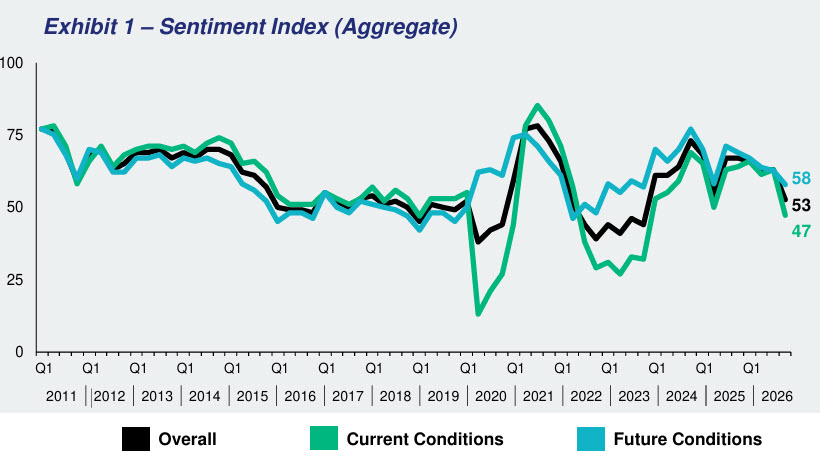
The Real Estate Roundtable (RER) released its Fourth Quarter 2026 Sentiment Index Report this week, revealing a decline in confidence among senior commercial real estate (CRE) executives as higher interest rates and geopolitical uncertainty weigh on valuations and investment decisions. The overall index fell 10 points to 53, even as property operations remained healthy across most sectors. (Q4 Sentiment Index Report)
By the Numbers
Overall Sentiment: The Q4 index declined 10 points to 53 from 63 in Q3.
Current Conditions: The Current Index fell 16 points to 47, while the Future Index declined 5 points to 58.
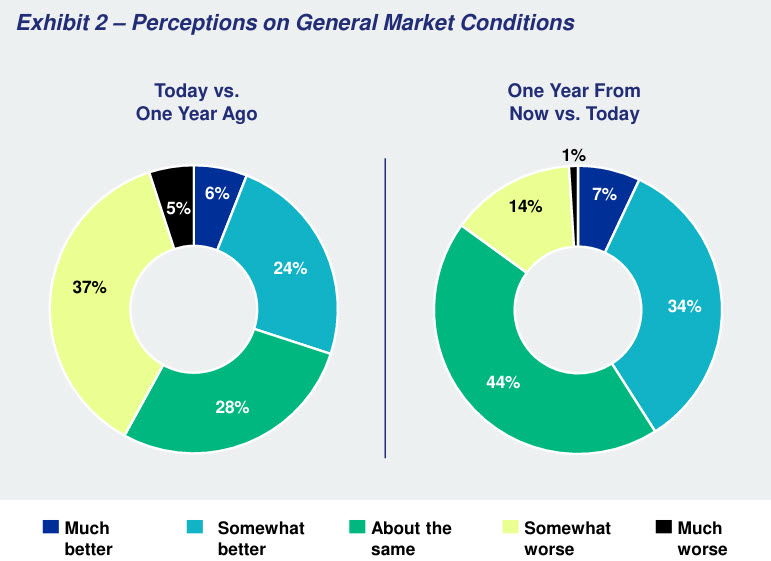
Market Outlook: 42% of respondents said market conditions were worse than a year ago, while 41% expect conditions to improve over the next year.
Expectations vs. Reality: A year ago, 70% of respondents anticipated improving market conditions. However, only 30% of Q4 2026 respondents believe conditions have improved.
Topline Findings
The Q4 2026 Real Estate Roundtable Sentiment Index registered an overall score of 53, a 10-point drop from the previous quarter. The Current Index registered 47, a 16-point decrease from Q3 2026. The Future Index posted a score of 58 points, a decrease of 5 points from the previous quarter. The decreased sentiment this quarter can be attributed to rising interest rates and ongoing geopolitical uncertainty weighing on the market. Interviewees noted a widening gap between how properties are performing and how the market is pricing them, and although operating conditions remain healthy across most sectors, higher rates have unsettled valuations and sent investors back to the sidelines. Most participants expect the setback to pass once rates stabilize. Some see the dislocation as a buying opportunity, though few are ready to commit capital until then.
Views continue to vary widely by property type. Open-air retail and industrial have held their value, supported by limited new supply. Office sentiment is improving in select gateway markets, helped in part by leasing from AI companies and the firms benefiting from them. Data centers continue to attract strong demand, though interviewees flagged growing political resistance and questions about long-term need. Multifamily drew the most divided views. Some participants pointed to oversupply in the Sun Belt and the risk that job losses could pressure rents. Others see the recent price declines and early occupancy gains as an attractive entry point.
More than half (56%) of respondents believe asset values are lower compared to a year ago, while 29% feel they are unchanged and 15% feel values have increased. Asset values continue to face downward pressure amid interest rate volatility and pricing uncertainty, though the extent of further declines varies by asset quality and sector, with sellers adjusting expectations to facilitate transactions. Looking ahead, the outlook is mixed: 27% expect asset prices to rise over the next year, 42% believe asset values will remain stable, and 31% anticipate that values will decrease.
Perceptions on equity capital are down, with 51% believing availability is worse compared to a year ago, 15% thinking it is better, and 34% feeling it is the same. On the other hand, sentiment around debt capital is somewhat positive, as 44% said the availability of debt capital has improved from last year. Looking forward, 28% of respondents believe that equity capital availability will be better in one year and 17% believe debt capital availability will be better.
Roundtable View
“Higher interest rates, tariffs and geopolitical uncertainty are weighing on investment decisions,” said Jeffrey DeBoer, President and CEO of RER. “With the midterm elections behind us, both parties have a chance to give businesses a clearer sense of what to expect from Washington.
He added, “Affordability, energy prices, and data center growth will stay high on the policy agenda. Preserving key tax and regulatory rules, and streamlining permitting would give businesses more confidence to commit capital to new housing and infrastructure.”
Roundtable on the Road
RER SVP and Counsel Ryan McCormick presented at PwC and Maryland Association of CPAs (MACPA) conferences this week, discussing federal tax developments and how the midterm elections could shape the legislative agenda for the remainder of the year and in the next Congress.
Looking Ahead
While most respondents expect the current market setback to ease once interest rates stabilize, uncertainty over valuations and the broader economic outlook continues to delay investment decisions.
The post-election policy agenda, including housing affordability, energy costs, data center growth, and permitting reform, could help restore investor confidence.
Data for the Q4 survey was gathered by Chicago-based Ferguson Partners on RER’s behalf in October. See the full Q4 report.


 Menu
Close
 About Us