

 Menu
Close
Menu
Close
 About Us Issues News Resources Members
 Menu
Close
About Us Issues News Resources Members
Menu
Close
About Us Issues News Resources Members
Commercial Real Estate Sentiment Steady in Q1 2026 as Debt Availability Improves
(WASHINGTON, D.C.) — The Real Estate Roundtable (RER) today released its First Quarter 2026 Sentiment Index, a quarterly measure of confidence among senior commercial real estate (CRE) executives. The overall index registered 66, down one point from Q4 2025, as respondents described a market in the early stages of a tentative, uneven recovery. Tariffs and interest-rate uncertainty continue to widen buyer-seller spreads and slow price discovery.
The Current Index rose two points to 66, while the Future Index decreased two points to 67, reflecting cautious optimism for improved conditions in 2026 despite ongoing volatility.
“This quarter’s survey shows the market is stabilizing, with improving debt availability and growing optimism about the year ahead—even as uncertainty continues to keep transaction volume below potential,” said Jeffrey DeBoer, RER President and CEO.
“The industry is positioned for a more constructive 2026, but sustained momentum will depend on a stable policy environment,” DeBoer added. “That stability supports investment decisions that drive jobs, housing, and economic activity in communities nationwide.”
The Q1 Sentiment Index topline findings include:
Sample responses from participants in the Sentiment Index’s Q1 survey include:
“The market is stagnant but promising; there’s a lot of pent-up demand and capital that needs to be deployed. Banks that were previously on the sidelines are looking to replenish balance sheets.”
“The real estate sector is in the early stages of a new cycle: Debt and equity are open, people have accepted the higher-for-longer interest rate environment, and now the focus is on relative value and income across all asset classes.”
“The real estate market is largely still locked up. People need certainty; when certainty returns, transaction volume will skyrocket.”
Data for the Q1 survey was gathered by Chicago-based Ferguson Partners on RER’s behalf in January. See the full Q1 report.
The Real Estate Roundtable (RER) brings together leaders of the nation’s top publicly-held and privately-owned real estate ownership, development, lending and management firms with the leaders of major national real estate trade associations to jointly address key national policy issues relating to real estate and the overall economy.
# # #
The Real Estate Roundtable Q2 2026 Sentiment Index Shows Market in Holding Pattern as Capital Conditions Improve but Transactions Lag
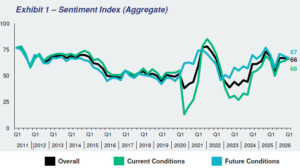
(WASHINGTON, D.C.) — The Real Estate Roundtable (RER) today released its Q2 2026 Sentiment Index, which registered an overall score of 63, down three points from the previous quarter. The survey shows a CRE market with improving capital conditions and steady fundamentals, but one still constrained by limited transaction activity, pricing uncertainty, and uneven momentum across sectors.
Compared to one year ago, sentiments of current conditions are up by 11 points, perceptions of future conditions are up by 6 points, and overall conditions are up by 9 points.
“Commercial real estate is on stronger footing than it was a year ago, but the recovery is still uneven,” said Jeffrey D. DeBoer, President and CEO of The Real Estate Roundtable. “Debt is available, values are stabilizing, and fundamentals are holding in many sectors. But transactions remain limited, equity capital is still cautious, and performance varies sharply by market and asset class.”
“Now is the time for policies that encourage investment and capital formation—not new barriers that make it harder to build, finance, and modernize the real estate that supports housing, jobs, communities, and economic growth,” DeBoer added.
The Q2 Sentiment Index topline findings include:
Sample responses from participants in the Sentiment Index’s Q2 survey include:
“If I had to sum it up in one word, I would say ‘stalemate’. Two years ago, I would have said ‘bear market’–not distress, but some stress.”
“It’s a decaffeinated capital markets recovery. It’s there fundamentally, but it’s not allowing for full transactions. It’s a rising tide, but there are certainly some ships with holes in their hulls.”
“The top quartile of U.S. markets in each property type are showing a lot more strength than the other quartiles. There’s more differentiation in performance across markets, property types, and within sectors.”
“AI is providing tremendous support to the economy. We feel strongly about digital companies investing in hard assets such as data centers, energy generation, storage, and transmission.”
Data for the Q2 survey was gathered in by Chicago-based Ferguson Partners on RER’s behalf in April. See the full Q2 report.
RER brings together leaders of the nation’s top publicly-held and privately-owned real estate ownership, development, lending and management firms with the leaders of major national real estate trade associations to jointly address key national policy issues relating to real estate and the overall economy.
# # #
Q3 Sentiment Index Shows Healthier Conditions, Persistent Capital Challenges
Q3 Sentiment Index Shows Healthier Conditions, Persistent Capital Challenges
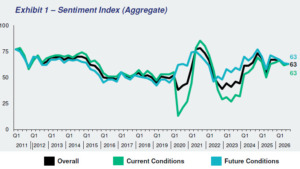
(WASHINGTON, D.C.) — The Real Estate Roundtable (RER) released its Third Quarter 2026 Sentiment Index, a quarterly measure of confidence among senior commercial real estate (CRE) executives. The overall index registered 63, unchanged from the previous quarter, as improving property fundamentals and strong debt availability were offset by persistent challenges raising equity capital and subdued transaction activity.
More than half of respondents (56%) say current market conditions are better than a year ago, while 54% expect a more favorable market environment one year from now.
“Commercial real estate fundamentals are improving, supported by stronger leasing, healthier debt markets, and greater stability in asset values. However, limited equity capital and high costs continue to constrain transactions and development,” said Jeffrey DeBoer, RER President and CEO.
The Q3 Sentiment Index topline findings include:
“Data centers continue to outperform other property sectors, as AI reshapes commercial real estate and drives unprecedented demand for reliable, affordable energy, DeBoer added. Policymakers must ensure that energy infrastructure, permitting, tax, and regulatory policies keep pace with this growth. A coordinated approach that expands power generation and transmission, modernizes the grid, and preserves a stable investment environment will help support data center development while protecting ratepayers and meeting the needs of communities and the broader economy.”
Sample responses from participants in the Sentiment Index’s Q3 survey include:
Data for the Q3 survey was gathered by Chicago-based Ferguson Partners on RER’s behalf in July. See the full Q3 report.
The Real Estate Roundtable (RER) brings together leaders of the nation’s top publicly-held and privately-owned real estate ownership, development, lending and management firms with the leaders of major national real estate trade associations to jointly address key national policy issues relating to real estate and the overall economy.
# # #


