House Weighs Next Steps on ROAD to Housing Act as White House Issues Housing Executive Orders
IRS Relief Expands Real Estate’s Access to Bonus Depreciation Tax Benefit
Federal Regulators Release Revised Basel III Endgame Proposal
Fed Holds Rates Steady Amid Heightened Uncertainty and Inflation Risks
Roundtable Weekly
March 20, 2026
House Weighs Next Steps on ROAD to Housing Act as White House Issues Housing Executive Orders

The Senate’s overwhelming passage of the bipartisan 21st Century ROAD to Housing Act last week has shifted attention to the House, where lawmakers are weighing how to reconcile the Senate bill with the House-passed housing package approved in February.  (PoliticoPro, March 17 | Politico, March 19)

State of Play
  • The House and Senate remain at odds over how to advance the 21st Century ROAD to Housing Act, with House Republicans threatening a formal conference to force negotiations while Senate leaders hope the House will ultimately accept the Senate-passed bill.
  • The Senate passed the bill 89-10 on March 12. They then sent it back to the House, which had already passed its own bipartisan housing package—the Housing for the 21st Century Act—by 390-9 on February 9.
  • The Senate-passed bill preserves much of the prior ROAD to Housing bill’s framework and includes several provisions intended to boost housing supply.
  • The Senate version also includes Section 901, which would restrict additional single-family home acquisitions by institutional investors that directly or indirectly own at least 350 homes and require owners to sell build-to-rent (BTR) homes within seven years or face an onerous penalty. The Section also provides unusually broad regulatory authority to the Treasury Department to address “market disruptions” and other situations that could create troubling future regulatory actions. (Roundtable Weekly, March 13 | Forbes, March 17)
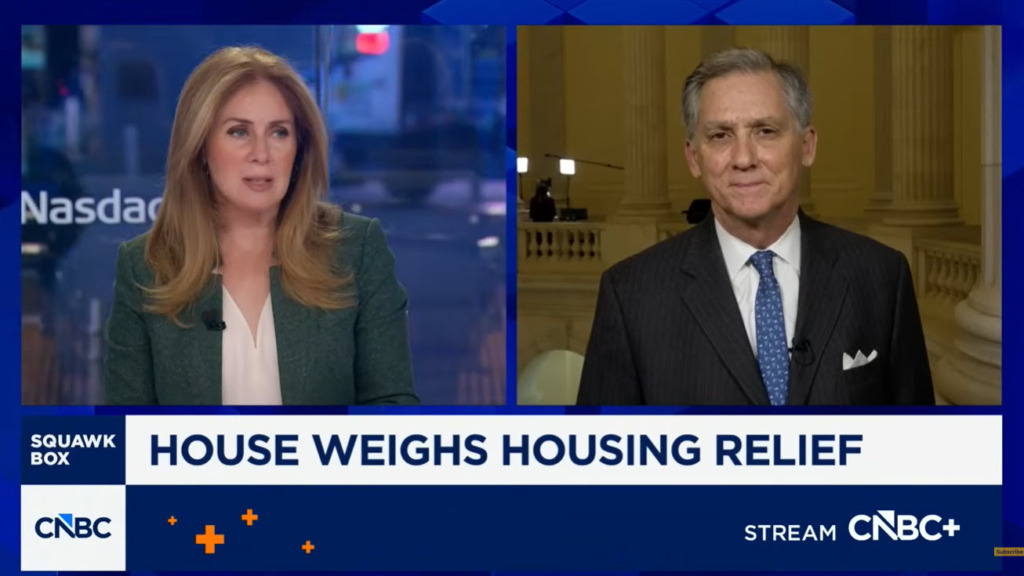
  • House Financial Services Chairman French Hill (R-AR) told CNBC’s Squawk Box he is optimistic the House and Senate can work through differences in their housing bills, but stressed that the Senate text contains “some real problems” that need to be corrected. He pointed specifically to the build-to-rent provision requiring homes to be sold within seven years, which he said would undermine efforts to increase housing supply. (Watch Squawk Box CNBC, March 18)

Executive Orders – Housing

  • President Trump issued two executive orders aimed at boosting housing construction and expanding mortgage access, as the House and Senate work through differences over the ROAD Act. (EO-Construction | EO Mortgage, March 13)
  • The administration said the orders are intended to reduce regulatory burdens, increase supply, and improve credit access for qualified borrowers. (WSJ, March 13)
  • The construction order, “Removing Regulatory Barriers to Affordable Home Construction,” directs federal agencies to revise or eliminate requirements related to environmental reviews, energy conservation standards for manufactured and federally financed housing, and historic preservation, while directing HUD and the White House Domestic Policy Council to develop best practices for state and local governments to increase housing supply and affordability. (EO-Construction, Mar. 13)
  • The mortgage order, “Promoting Access to Mortgage Credit,” is intended to expand access to mortgage credit, particularly through community banks and smaller lenders. (EO Mortgage, March 13)
  • The EOs reinforce the administration’s broader housing message and overlap with parts of both congressional bills focused on cutting red tape, supporting community banks, and expanding supply. (PoliticoPro, March 13)

RER & Industry Advocacy

  • In March, RER joined a series of coalition letters urging senators to remove or revise Section 901, warning that the seven-year sale requirement would effectively eliminate the production of BTR housing. (PoliticoPro, March 10 | BisNow, March 12; Letter | Bisnow | Politico, March 5; Letter, March 9, March 13)
  • Last week, RER President and CEO Jeffrey D. DeBoer sent senators an analysis warning that the bill’s forced-sale provision raises serious constitutional concerns and would likely trigger years of litigation. (RER Analysis, March 10)
  • DeBoer stated, “RER supports many provisions in the Senate-passed 21st Century ROAD to Housing Act that would help expand housing supply and reduce barriers to homeownership. But the bill’s forced-disposition provision for build-to-rent would discourage investment in new rental housing and raise serious constitutional concerns. As the House takes up the bill, RER urges lawmakers to remove that language and keep the focus on increasing housing supply and affordability. (NMHC & NAA Statement | NAHB Statement, March 12)

RER will continue urging lawmakers to preserve the bill’s pro-supply provisions while removing language that would reduce rental housing production and chill the capital formation needed to address the nation’s housing shortage.

IRS Relief Expands Real Estate’s Access to Bonus Depreciation Tax Benefit
IRS building in Washington, DC

The IRS and Treasury Department this week issued new guidance allowing real estate companies to withdraw prior elections that had prevented many from fully benefiting from the One Big Beautiful Bill Act’s (OB3 Act) restored 100% bonus depreciation provision. Revenue Procedure 2026-17 outlines how taxpayers may revoke those elections under Section 163(j), clearing the way for broader use of immediate expensing across commercial real estate. (Bloomberg, March 18)

Why It Matters

  • The Real Estate Roundtable (RER) has urged Treasury to allow real estate owners who previously elected out of strict limitations on the deductibility of business interest to withdraw or amend those elections so they can fully benefit from the OB3 Act’s restored bonus depreciation benefit. (Roundtable Weekly, Feb. 6)
  • Under the Tax Cuts and Jobs Act of 2017 (TCJA), an electing real property trade or business (RPTOB) is exempt from the Section 163(j) limit on business interest deductibility, but must use the alternative depreciation system to recover the cost of its investment. As a result, electing RPTOBs are ineligible for bonus depreciation on leasehold and nonresidential interior property improvements.
  • Beginning in 2022, the Section 163(j) business interest limitation tightened, and starting in 2023, bonus depreciation began to phase out. Those two changes led many real estate owners to make the RPTOB election.
  • The OB3 Act reversed both provisions by restoring the original TCJA parameters for Section 163(j) and permanently extending 100% bonus depreciation. While that was a major positive development for new real estate investment, it left existing property owners locked into irrevocable RPTOB elections made under prior law.
  • Revenue Procedure 2026-17 addresses that problem by allowing taxpayers to retroactively withdraw an RPTOB election for taxable years 2022, 2023, or 2024. If a real estate owner withdraws the election under the revenue procedure, the owner is treated as if the election had never been made.
  • This change makes 100% bonus depreciation available to a much larger share of U.S. commercial real estate, ensures that property owners are not penalized for elections made under a tax regime that no longer applies, and should support additional capital formation.
  • The revenue procedure also provides guidance on the administrative steps for withdrawing an election, partnership filing requirements, and procedures for amending returns for intervening years.

RER Advocacy

  • In an Oct. 17, 2025, letter, RER wrote to Treasury urging guidance allowing real estate businesses to amend or revoke prior RPTOB elections to ensure the OB3 Act’s restored 100 percent bonus depreciation provision supports real estate investment, job creation, and economic growth. (Roundtable Weekly, Feb. 6)
  • The letter emphasized that clear implementing rules will help bonus depreciation “facilitate the modernization and repurposing of real estate assets,” including underutilized offices, shopping centers, hotels, and mixed-use properties. (Roundtable Weekly, Oct. 17)

Treasury’s action addresses a key transition issue created by the new law and helps ensure that restored bonus depreciation can work as intended across a broader share of commercial real estate investment.
Federal Regulators Release Revised Basel III Endgame Proposal

The Federal Reserve, Federal Deposit Insurance Corporation (FDIC), and Office of the Comptroller of the Currency (OCC) on Thursday unveiled a substantially revised Basel III endgame proposal, replacing the 2023 framework that drew broad industry opposition. (WSJ, March 19 | Fed Board Memo)

State of Play

  • The revised proposal would reduce capital requirements for the largest U.S. banks by 2.4% overall. (PoliticoPro, March 19)
  • The package would also replace the dual-track capital framework for the largest banks with a single approach, revise the G-SIB surcharge, and lower risk weights for mortgages and mortgage servicing assets. (ABA Banking Journal, March 19)
  • Regulators said the changes are intended to better align capital with risk, preserve safety and soundness, and support lending and other financial intermediation activities across economic conditions. (Fed Board Memo, March 19)
  • The interagency proposal would raise capital requirements by an estimated 1.4% under the revised Basel framework, but that increase would be more than offset by a 3.8% reduction in the G-SIB surcharge for the largest U.S. banks, for a net 2.4% decline overall.
  • Midsize banks would be allowed to decrease their capital buffers by an average of 5.2%, including stress-test revisions, and smaller banks by 7.8%. (WSJ, March 19 | AAF, March 20)
  • Regulators said the revised framework would also better support traditional lending and reduce incentives for activity to migrate outside the regulated banking system, including through lower risk weights for mortgages and mortgage servicing assets. (OCC News Release, Mar. 19)

Why It Matters

  • For commercial real estate, the reset could ease regulatory pressure that threatened to constrain credit for real estate lending, mortgage activity, and other capital-intensive transactions.
  • “Lowering the amount of capital held by banks would give them more money to deploy into the economy, potentially boosting growth, said Federal Reserve vice chair for supervision Michelle Bowman, who led the central bank’s efforts to craft the proposal. (Fed Press Release, March 19)
  • House Committee on Financial Services Chairman French Hill (R-AR) and Subcommittee on Financial Institutions Chairman Andy Barr (R-KY) said the agencies had moved toward a “more balanced Basel III framework,” adding that right-sized capital standards are critical to preserving lending capacity, competitiveness, and access to credit. (Reps. Hill, Barr Statement, March 20)

Roundtable Advocacy

  • RER has consistently opposed the original Basel III proposal, citing its potential negative impact on available credit capacity for commercial real estate transactions, market liquidity, and economic growth. (Roundtable Weekly, Nov. 2023; Jan. 2024; Mar. 2024)
  • In December, RER and a coalition of leading business trade organizations urged prudential regulators to examine and modernize large bank capital requirements so they continue supporting consumers, businesses, and the broader U.S. economy. (Letter, Dec. 2) (Roundtable Weekly, Dec. 5)
  • The coalition letter underscored the negative economic impacts of inappropriately calibrated capital rules, highlighted risks to American competitiveness, and commended ongoing agency efforts to improve the framework. (Roundtable Weekly, Feb. 20)

The agencies will accept comments on the proposed rules until June 18, and RER's Real Estate Capital Policy Advisory Committee (RECPAC) looks forward to members' input as it prepares comments on the proposal.

Fed Holds Rates Steady Amid Heightened Uncertainty and Inflation Risks

The Federal Reserve's Federal Open Market Committee (FOMC) voted this week to hold its benchmark interest rate steady at 3.5 percent to 3.75 percent, as policymakers weigh persistent inflation, geopolitical risks, and mixed economic signals.

Key Takeaways

  • Fed Chair Jerome Powell emphasized that the current stance on monetary policy is "appropriate" as the economy continues to expand at a solid pace. (Powell press conference, March 18)
  • Price pressures remain above target. The Fed's preferred inflation gauge shows Personal Consumption Expenditures (PCE) rising 2.8 percent annually, with core inflation at 3.0 percent, reflecting ongoing impacts from tariffs and price increases for goods. (Powell press conference, March 18)
  • Labor market conditions have stabilized but softened at the margins. Job growth remains subdued while unemployment has held at 4.4 percent in recent months. (Powell press conference, March 18)

Policy Outlook

  • Fed officials reiterated that future rate decisions will remain "data dependent" and emphasized that monetary policy is not on a preset course. (Federal Reserve statement, March 18)
  • Markets now expect a later timeline for any additional easing. Current pricing points to late 2026 as the earliest likely window for another cut, given persistent inflation and broader global uncertainty. (CNBC, March 17)
  • Policymakers also signaled they will be cautious in reacting to short-term shocks. Recent energy price increases may lift headline inflation in the near term, but the Fed appears inclined to wait for clearer evidence before changing course. (Reuters, March 18)
  • Political pressure continues to surround the central bank, including renewed calls from President Trump for lower rates. Even so, Fed leaders have maintained that economic conditions, not politics, will guide policy decisions. (CNBC, March 17 | Reuters, March 18)
  • For commercial real estate, this environment continues to present challenges. Higher interest rates are weighing on valuations, constraining refinancing activity, and limiting transaction volume.

Congressional Hearing on Fed Independence and Debt Pressures
  • The House Financial Services Task Force on Monetary Policy, Treasury Market Resilience, and Economic Prosperity held a hearing this week titled, "Revisiting the Treasury-Fed Accord." The discussion focused on the historical framework governing Fed independence, the risks of fiscal dominance, and whether updated coordination between the Treasury and the Fed is needed. (Press release, March 19)
  • Task Force Chairman Frank Lucas (R-OK) emphasized the need to clarify institutional boundaries, stating Congress should encourage "a formal dialogue between the Fed and Treasury on the appropriate boundaries of their authority… while reinforcing monetary policy independence." (Press release, March 19)
  • Lawmakers and witnesses also warned that rising federal debt could pressure interest rates and inflation. As Thomas Hoenig, Distinguished Senior Fellow, The Mercatus Center at George Mason University, noted, continued deficits put "strain on the markets" and "upward pressure on interest rates." (Press release, March 19)

RER will continue to track monetary policy developments and engage policymakers on the need for stable capital markets, access to credit, and policy solutions that support long-term economic growth and real estate investment.