Fifth Circuit Reverses Tax Court, Sides with Taxpayer and Roundtable in Limited Partnership Tax Dispute
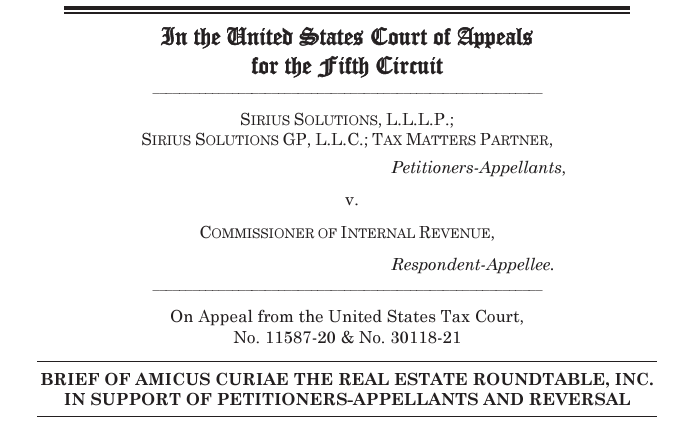
The U.S. Court of Appeals for the Fifth Circuit issued a 2-1 decision in Sirius Solutions, L.L.L.P. v. Commissioner (No. 24-60240) on Jan. 16, restricting the federal government’s effort to extend self-employment taxes to a broad range of limited partners in limited partnerships. The Real Estate Roundtable (RER) submitted an amicus brief in the case, and the Court’s ruling closely aligns with the RER's position.
Court Ruling
Since 1977, the tax code has exempted limited partners from self-employment taxes. In recent years, the IRS has asserted a new and more restrictive test to determine whether a limited partner qualifies for the exclusion.
The Fifth Circuit held that the Section 1402(a)(13) “limited partner” exception from self-employment (SECA) tax applies to a partner in a state-law limited partnership who has limited liability. (TaxNotes, Jan. 27)
The ruling vacates and remands the Tax Court decision that followed Soroban Capital Partners LP v. Commissioner (No. 25-2079), and applied a “functional analysis” of partner roles and activities to determine whether the SECA exclusion applies. (Sullivan Cromwell, Jan. 27)
The Fifth Circuit rejected that approach and held that “limited partner” in Section 1402(a)(13) is a status-based, state-law concept tied to limited liability, not an activity test.
The decision is the first appellate ruling to reach the issue and reverse the Tax Court’s restrictive interpretation. (Reuters, Jan. 21)
This ruling has set a precedent for future SECA tax cases, with significant consequences for real estate and other industries that use limited partnerships for business purposes.
Roundtable Advocacy
In August 2024, RER submitted an amicus brief to the Fifth Circuit. The brief argued that the IRS's interpretation was flawed and inconsistent with decades of state law recognizing that limited partners can provide services while retaining limited partner status. (Roundtable Weekly, Sept. 6, 2024)
The brief emphasized that pre-1977 state court decisions and the IRS’s own 1994 proposed regulations contradict the government’s position that limited partners must be passive to avoid SECA taxes.
RER argued the Tax Court’s “passive investor” test is found nowhere in the statute and reflects a misunderstanding of partnership law that real estate and other businesses have relied on for decades.
RER has continued this advocacy across the circuits. In Dec. 2025, RER filed an amicus brief with the Second Circuit in Soroban, challenging the IRS’s restrictive interpretation of the “limited partner exception” under Section 1402(a)(13). (Roundtable Weekly, Dec. 19, 2025)
RER also filed an amicus brief in August with the First Circuit in a related case, Denham Capital Management LP v. Commissioner (No. 25-1349). (Roundtable Weekly, Sept. 12, 2025)
This successful outcome in the Sirius case supports RER’s position and could reduce momentum for formal tax guidance that would broaden the reach of SECA taxes.
What’s Next
Related appeals are pending in the First Circuit (Denham) and Second Circuit (Soroban). (TaxNotes, Jan. 27)
Divergent outcomes could create a circuit split and increase the odds of Supreme Court review. (Skadden Arps, Jan. 27)
The First Circuit is scheduled to hear oral arguments in Denham on Feb. 5. (TaxNotes, Jan. 27)
RER remains committed to protecting entrepreneurs’ ability to flexibly organize in partnerships and other pass-through entities that promote capital formation, risk-taking, and economic growth, and it will remain engaged as the SECA dispute moves forward.
After the Federal Reserve’s Federal Open Market Committee (FOMC) concluded its January meeting on Wednesday by holding rates steady at 3.5 percent to 3.75 percent, President Donald Trump announced today he is nominating former Fed governor Kevin Warsh as the next Fed chair. (Axios, Jan. 30 | CBS News, Jan. 28)
Fed Chair
“I have known Kevin for a long period of time, and have no doubt that he will go down as one of the GREAT Fed Chairmen, maybe the best,” said Trump in a Truth Social post announcing the selection. (CNBC, Jan. 30)
Warsh still needs Senate confirmation and, if approved, would take over in May when Powell’s term expires.
Key Takeaways
The FOMC voted 10-2 to maintain rates, with Governors Stephen Miran and Christopher Waller dissenting in favor of an additional quarter-point cut. While most Fed officials still expect further reductions in 2026, Chair Powell emphasized that decisions will remain "data dependent." (Fed statement, Jan. 28)
Fed Chair Jerome Powell said the economic outlook has "clearly improved" since the Committee's December meeting.
Fed Chair Jerome Powell said the economic outlook has "clearly improved" since the Committee's December meeting.
He cited growth and signs of stabilization in the labor market, while emphasizing that policymakers want greater confidence that inflation is moving toward the Fed's 2 percent target before resuming rate cuts.
The U.S. economy grew at a 4.4 percent annual rate in the third quarter of 2025. Chair Powell noted that this performance suggests that interest rates are not currently restrictive enough to materially slow economic activity. (AP, Jan. 28)
Inflation remains above target, with the Fed's preferred measure running near 2.8 percent late last year. Chair Powell acknowledged that recent tariff-related price pressures have lifted goods inflation but suggested those effects are likely temporary and could begin easing later this year. (AP, Jan. 28)
The Fed's decision to hold rates steady reinforces expectations that borrowing costs will remain elevated through at least mid-year.
For commercial real estate, sustained higher-for-longer rates continue to place pressure on refinancing, valuations, and transaction activity.
Institutional Investor Legislation Introduced
Against this backdrop of a pause in rate cuts and broader concerns about housing affordability, lawmakers have renewed efforts to target institutional participation in the single-family housing market.
On Jan. 20, Reps. Summer Lee (D-PA), Ro Khanna (D-CA), Mark Takano (D-CA), and Jill Tokuda (D-HI) reintroduced the Stop Wall Street Landlords Act (H.R. 7138). (Press Release, Jan. 20)
The bill would deny mortgage interest, insurance, and depreciation deductions for large institutional investors that own single-family homes and impose a 100 percent federal real estate transfer tax on covered properties that are not sold within 18 months of enactment, with proceeds used to fund the federal Housing Trust Fund.
The proposal would also bar the Federal Housing Financial Agency, Fannie Mae, Freddie Mac, and Ginnie Mae from supporting single-family mortgages tied to large institutional investors. (CNBC, Jan. 18)
Other legislation aimed at restricting institutional investment in the single family rental market include:
Rep. Mary Miller (R-IL) introduced the American Family Housing Act (H.R. 7186), co-sponsored by Rep. Buddy Carter (R-GA), which would direct the SEC to enforce restrictions on large institutional investors (those with more than $100 billion in assets under management) from purchasing single-family homes. Rep. Miller serves on the House Agriculture Committee and Rep. Carter on the House Budget Committee.
Rep. Pat Harrigan (R-NC) introduced Families First Housing Act of 2026 (H.R.6962). The bill is co-sponsored by Rep. Josh Riley (D-NY). The co-sponsors are members of the House Science Committee.
The debate has taken on added political significance following President Trump's recent statements and Executive Order on curtailing institutional ownership of single-family homes. (CNBC, Jan. 18 | Roundtable Weekly, Jan. 23)
Looking Ahead
Proposals such as the Stop Wall Street Landlords Act risk could further restrict housing supply and access to capital at a time when liquidity and investment are already under pressure.
As The Real Estate Roundtable (RER) and partners have emphasized, targeting institutional investment does not address the core drivers of unaffordability: high mortgage rates, rising construction costs, labor shortages, and restrictive zoning that limits housing supply. (Roundtable Weekly, Jan. 9)
RER will continue to engage policymakers about the importance of expanding housing supply, preserving access to capital, and maintaining regulatory flexibility to support long-term stability for the commercial real estate industry and the overall economy.
Energy
Energy Policy Update: Permitting Push, ENERGY STAR Preserved, Grid Stressed
In Washington this week, President Donald Trump signed a bipartisan FY 2026 appropriations bill preserving ENERGY STAR funding, lawmakers refocused on permitting reform, and Winter Storm Fern exposed challenges to electric grid reliability driven by extreme weather.
ENERGY STAR
President Trump signed the bipartisan FY 2026 appropriations bill (H.R. 6938) into law on Jan. 23, securing approximately $33 million in funding for EPA’s ENERGY STAR program through Sept. 30. (E&E News, Jan. 29)
The agreement preserves the voluntary efficiency labeling initiative after earlier proposals to eliminate it and sets, for the first time, a specific mandatory annual funding level.
ENERGY STAR is a long-standing, market-based program that helps lower energy costs and supports “retrofit” investments for all commercial real estate asset classes. (Roundtable Weekly, Jan. 9)
The Real Estate Roundtable (RER) has long urged the “business case” to support the ENERGY STAR program. RER is working with a coalition of multi-industry partners in the real estate, manufacturing, consumer tech, and retail sectors to explain to Congress and the administration why ENERGY STAR is critical to the national “energy dominance” agenda. (Roundtable Weekly, June 6; May 23).
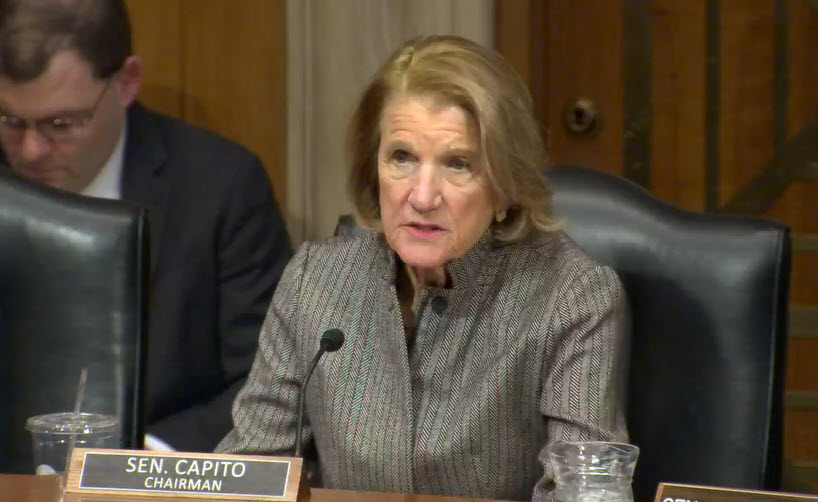
Senate EPW Committee Chair Shelley Moore Capito (R-WV) said permitting reform must be bipartisan, “project neutral,” and provide developers “predictability, consistency and finality” in securing permits in order to be effective. (E&E News, Jan. 29)
Abigail Ross Hopper (President and CEO of the Solar Energy Industries Association), testified that permitting reform should rest on three core principles: project certainty for approved projects, reduced timelines through streamlined and coordinated reviews, and a faster transmission buildout supported by stronger planning, permitting authority, and grid modernization. (UtilityDive, Jan. 29)
Faster permitting remains central to accelerating the buildout of the generation and transmission needed to meet rising electricity demand and improve reliability.
Winter Storm & Electric Grid
Ahead of Winter Storm Fern, the Department of Energy directed grid operators to be prepared to tap backup generation from large facilities—including data centers—to prevent outages and limit price spikes.
Energy Secretary Chris Wright framed the directive as part of a response to a “national energy emergency,” reflecting heightened reliability concerns as extreme weather collides with rapidly rising electricity demand from AI and other large loads. (WSJ, Jan. 22)
In the wake of this week’s winter storm, the North American Electric Reliability Corp. (NERC) warned that power generation and transmission are not growing fast enough to meet accelerating demand. NERC cautioned that several regions may lack sufficient energy supplies during extreme winter conditions, raising the stakes for grid expansion and resilience planning. (PoliticoPro, Jan. 29 | PoliticoPro, Jan 25)
RER will continue advocating for policies that remove permitting bottlenecks and support cost-effective grid modernization to ensure a robust supply of affordable power and a safe, reliable electric grid.


 Menu
Close
Menu
Close
 About Us