Senate Passes ROAD to Housing Act as Industry Urges Changes to BTR Language
The Senate passed the bipartisan 21st Century ROAD to Housing Act on Thursday in an 89-10 vote, advancing one of the most significant federal housing packages in years and setting up the next phase of negotiations with the House. (Multi-Housing News, March 13 | BisNow, March 12)
State of Play
The Senate-passed bill preserves much of the prior ROAD to Housing bill’s framework and includes several provisions intended to boost housing supply. (Politico, March 12)
The package would streamline project reviews, raise FHA multifamily loan limits, support manufactured housing, and encourage additional housing development in designated Opportunity Zones. (Roundtable Weekly, March 6)
The final Senate text includes Section 901, which would restrict additional single-family home acquisitions by institutional investors defined as entities that directly or indirectly own at least 350 homes. (Multifamily Dive, March 12)
It also includes a seven-year forced disposition requirement that would require owners to sell build-to-rent (BTR) homes they develop to another private party or pay an onerous penalty. (PoliticoPro, March 10)
Real Estate Roundtable (RER) President and CEO Jeffrey D. DeBoer stated, “RER supports many provisions in the Senate-passed 21st Century ROAD to Housing Act that would help expand housing supply and reduce barriers to homeownership. But the bill’s build-to-rent forced disposition provision would discourage investment in new rental housing and raise serious constitutional concerns. As the House takes up the bill, RER urges lawmakers to remove that language and keep the focus on increasing housing supply and affordability. (NMHC & NAA Statement | NAHB Statement, March 12)
RER has warned that the bill’s treatment of BTR housing raises significant concerns under the Fifth Amendment Takings Clause and the Supreme Court’s decision in Kelo v. City of New London. (RER Analysis, March 10 | WSJ, March 9)
A federal law compelling one private party to sell property it owns directly to another private party, without government initiation of eminent domain proceedings, would be without precedent.
If enacted, the BTR language would almost certainly invite years of constitutional litigation involving property owners, renters, and the federal government.
Congressional Concerns
House Financial Services Chairman French Hill (R-AR) called the Senate vote an “important step,” while cautioning that lawmakers still need to “get the details right” and address concerns raised by House members. (Politico, March 12)
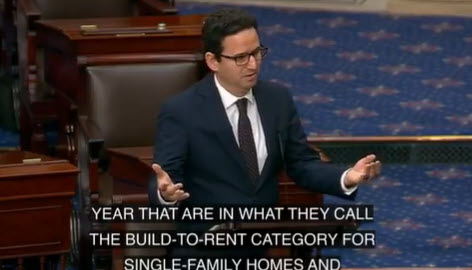
Sen. Brian Schatz (D-HI) criticized the investor language on the Senate floor, calling it a “drafting error” and warning it could undermine housing production. (Watch Schatz Speech, March 11)
“I will stipulate that there are a lot of good things in this bill that are kind of on the pro-housing supply side, but what we are about to do is essentially ban a specific kind of housing,” said Sen. Schatz. (Barrons, March 11 | NBC News, March 12)
Sen. Schatz also said the bill could interfere with LIHTC projects, including affordable single-family developments, if the language is not revised.
Rep. Mike Flood (R-NE) has also warned that the Senate bill’s BTR provision could “crush an industry” that produces roughly 50,000 homes a year. (PoliticoPro, March 11)
What the Research Shows
Analysis has reinforced the concern that restricting institutional capital may do little to improve affordability while creating new supply problems.
RER has consistently emphasized that expanding housing supply is the most effective path to improving affordability, as research shows affordability pressures are driven primarily by supply shortages, construction costs, and mortgage rates—not institutional ownership levels. (Roundtable Weekly, Jan. 9 | Jan. 16)
Recent analysis from AEI and Cato indicated that driving institutional capital out of housing is unlikely to improve affordability and may instead reduce investment, shrink supply, and leave Treasury with broad discretion over favored and disfavored forms of housing investment. (AEI, March 10 | CATO Institute, March 4)
According to analysis by The Pew Charitable Trusts, Section 901 could sharply curtail build-to-rent housing, which has recently added 70,000 to 130,000 homes annually, by undermining the financial viability of those projects, displacing renters, and reducing new single-family construction starts by 100,000 or more homes a year. (Pew, March 10)
RER & Industry Advocacy
RER and broad housing coalitions have been making the same supply-focused case for weeks. (Roundtable Weekly, Jan. 9 | Jan. 16 | Jan. 23 | Feb. 27| Mar. 6)
In March, RER joined a series of coalition letters urging senators to remove or revise Section 901, warning that the seven-year sale requirement would effectively eliminate the production of BTR housing. (PoliticoPro, March 10 | BisNow, March 12; Letter | Bisnow | Politico, March 5; Letter, March 9)
This week, RER President and CEO Jeffrey D. DeBoer sent senators an analysis warning that the bill’s forced-sale provision raises serious constitutional concerns and would likely trigger years of litigation. (RER Analysis, March 10)
In a letter sent today to House leadership, RER and other national organizations thanked the House for advancing landmark housing legislation while urging lawmakers to amend Section 901 before final passage. (Letter, March 13)
The letter warns that the Senate-passed language would effectively eliminate the production of BTR housing and take critically needed new housing units off the table at a time of severe affordability and supply pressures. (Letter, March 13)
The coalition also argued that BTR homes expand rental choices for families seeking more space and flexibility, and that forcing providers to sell those homes would displace renters, reduce supply, and undermine the bill’s broader pro-housing goals.
What’s Next
The House would need to pass the Senate’s version or convene with the upper chamber to combine the bills into one piece of legislation before it heads to the president’s desk. (Politico, March 12)
“If the White House wants the House to pick up the bill and pass it, they’ll probably have to make that argument to the House leadership,” Senate Majority Leader John Thune (R-SD) said Thursday. (Politico, March 12)
RER will continue urging lawmakers to preserve the bill’s pro-supply provisions while removing language that would reduce rental housing production and chill the capital formation needed to address the nation’s housing shortage.

Tax Policy
In the News: Roundtable TPAC Chair Urges Treasury to Modernize Foreign Investment Tax Rules, Preserve U.S. Access to Foreign Capital
A new Bloomberg op-ed by RER Tax Policy Advisory Committee Chair Joshua Parker (Founder, Chairman and Chief Executive Officer, Ancora) reinforces The Real Estate Roundtable’s (RER) push for Treasury to modernize Section 892 regulations without discouraging sovereign investment in U.S. real estate and other long-term assets. (Bloomberg Tax, March 11)
Section 892 of the tax code generally exempts investment income earned by foreign governments, including sovereign wealth funds, from U.S. income tax. The 892 exemption does not apply, however, if the foreign government effectively controls the U.S. business or is deemed to be engaged in a commercial activity.
Parker writes that Treasury’s regulatory effort is “constructive and necessary,” but cautions that the rules must distinguish between legitimate investor stewardship and effective control of a business. (Bloomberg Tax, March 11)
The op-ed argues that Section 892 needs to catch up with major changes in capital markets, including the growth of private credit, direct lending, and co-investment strategies that were not significant features of the market when the statute was enacted.
Parker emphasizes that policymakers should not “sweep fundamentally different forms of investor participation into the same regulatory framework.
Responsible investors “must exercise fiduciary oversight, manage risk, and ensure disciplined capital deployment,” Parker adds. Customary minority protections such as consent rights, veto rights, and approval of extraordinary actions are forms of stewardship, not day-to-day business control.
Why It Matters
Since 2011, foreign governmental investors have invested more than $100 billion in U.S. commercial real estate. (Roundtable Weekly, Feb. 13)
Foreign capital invested in the U.S. has supported housing supply, infrastructure development, research facilities, and place-based economic growth. (Bloomberg Tax, March 11| RER Letter, Feb. 12)
RER Advocacy
In February, RER submitted a comment letter to Treasury Secretary Scott Bessent on the Section 892 regulations and proposed rules, urging clear grandfathering rules and changes to prevent disruptions to sovereign investment in U.S. real estate. (Letter, Feb. 12 | Roundtable Weekly, Feb. 27)
RER will continue engaging Treasury to ensure the final rules provide clarity for investors while avoiding unintended disruptions to U.S. real estate capital formation.