RER White Paper Raises Constitutional Concerns With Senate Housing Bill’s Section 901
RER and Coalition Partners Call on Congress to Ensure Continued ENERGY STAR Funding
White House Economic Report Underscores Supply Gap as ROAD to Housing Act Stalls
Roundtable Weekly
April 17, 2026
RER White Paper Raises Constitutional Concerns With Senate Housing Bill’s Section 901

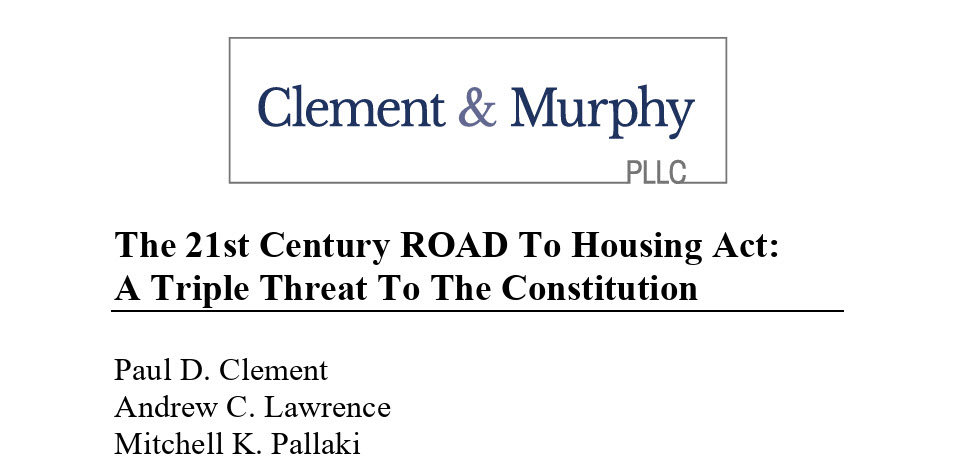
The Real Estate Roundtable (RER) this week released a white paper authored by Paul Clement of Clement & Murphy, PLLC, adding significant constitutional concerns to the growing case against Section 901 of Title IX of the Senate-passed 21st Century ROAD to Housing Act (H.R. 6644). While the broader legislation contains several constructive provisions to help boost housing supply, the Senate bill’s restrictions on certain institutional investors would undermine new development, disrupt the build-to-rent (BTR) market, and raise serious legal questions. (White Paper, April 14)

Why It Matters

  • The Senate provision would apply to corporate entities that own more than 350 single-family homes. It would largely prohibit those entities from purchasing additional single-family homes and require them to sell newly constructed single-family rentals (SFR) after seven years.
  • The investor “purchase ban” on single-family homes and the “forced sale” of new single-family rentals would amount to an unprecedented federal intervention in housing markets at a time when the country needs policies that encourage development—not deter it.

What the White Paper Says

  • The white paper released by RER argues that the forced-sale requirement for build-to-rent housing raises serious constitutional problems under the Fifth Amendment’s Takings Clause. (White Paper, April 14)
  • The paper concludes government cannot force one private owner to sell its homes to another without trampling on the Constitution’s “public-use” and “just-compensation” requirements. Furthermore, the Senate’s bill provides no mechanism for the government to pay just compensation to investors whose homes would be taken.
  • The paper also raises equal protection concerns by singling out a narrow category of corporate owners for special burdens.
  • While Congress has broad authority to regulate economic activity, the paper notes that it cannot arbitrarily target a specific class of property owners—particularly where the ownership and disposition of private property are at stake.
  • In addition, the paper argues that the proposal departs from the traditional state and local roles in land use and housing policy, raising broader federalism concerns.

Roundtable Advocacy

  • RER has consistently supported policies that expand housing availability, reduce barriers to development, and improve affordability.
  • At the same time, RER has warned that Section 901 would do the opposite by discouraging new investment in housing and weakening a growing source of supply.
  • RER shared the white paper with members of Congress in a letter urging lawmakers to preserve the bill’s pro-supply provisions while removing Title IX.
  • Since the Senate passed its version of the bill, progressive and conservative groups alike have cited numerous benefits that SFR owners and builders deliver for U.S. housing markets, in terms of increasing supply, maintenance, and upkeep of units, and providing opportunities for families to live in communities with strong education systems, where they can’t afford to buy. (Progressive Policy Institute, February 2026; Competitive Enterprise Institute, February 2026)

  •  As lawmakers work to address the housing shortage, the focus should remain on expanding supply and lowering barriers to development—not on punitive restrictions that threaten new investment, weaken build-to-rent housing, and make affordability challenges worse.

The constitutional concerns surrounding Section 901, and the broader policy debate over how best to expand housing supply, will be part of the discussion at RER’s Spring Roundtable Meeting (Roundtable-level members only) next week in Washington.

RER and Coalition Partners Call on Congress to Ensure Continued ENERGY STAR Funding

As focus on Capitol Hill shifted to appropriations talks this week, The Real Estate Roundtable (RER) and a broad coalition of organizations representing the real estate, consumer products, manufacturing, and retail sectors sent a letter urging congressional leaders to ensure that the ENERGY STAR program remains amply funded in the 2027 fiscal year (FY’27), starting Oct. 1.

Coalition Advocacy

  • On Tuesday, the multi-industry coalition requested that House and Senate appropriators include explicit funding for ENERGY STAR in the FY’27 spending bill, in line with FY’26 funding levels. (Letter, April 14)
  • The letter also encouraged lawmakers to include strong congressional oversight measures in the legislation, as lead agency responsibilities for the program shift from the Environmental Protection Agency (EPA) to the Department of Energy (DOE). (Letter, April 14)
  • In the letter, the coalition recommended that legislators consolidate past funding for ENERGY STAR expressly given to the EPA, plus amounts used by DOE historically to run its portion of the program. (Letter, April 14)
  • Congress provided approximately $33 million for ENERGY STAR to EPA in the FY’26 appropriations bill (H.R. 6938), signed into law on Jan. 23, preserving the program through Sept. 30 following earlier reports that it could be privatized or defunded. (Roundtable Weekly, April 3)
  • Though President Trump’s FY’27 budget request, released this month, does not specifically mention ENERGY STAR—as was the case last year—the White House has proposed cutting DOE and EPA’s overall budgets by 11 percent and 52 percent, respectively. (Budget of the U.S. Government, April 3)

DOE Budget Hearings

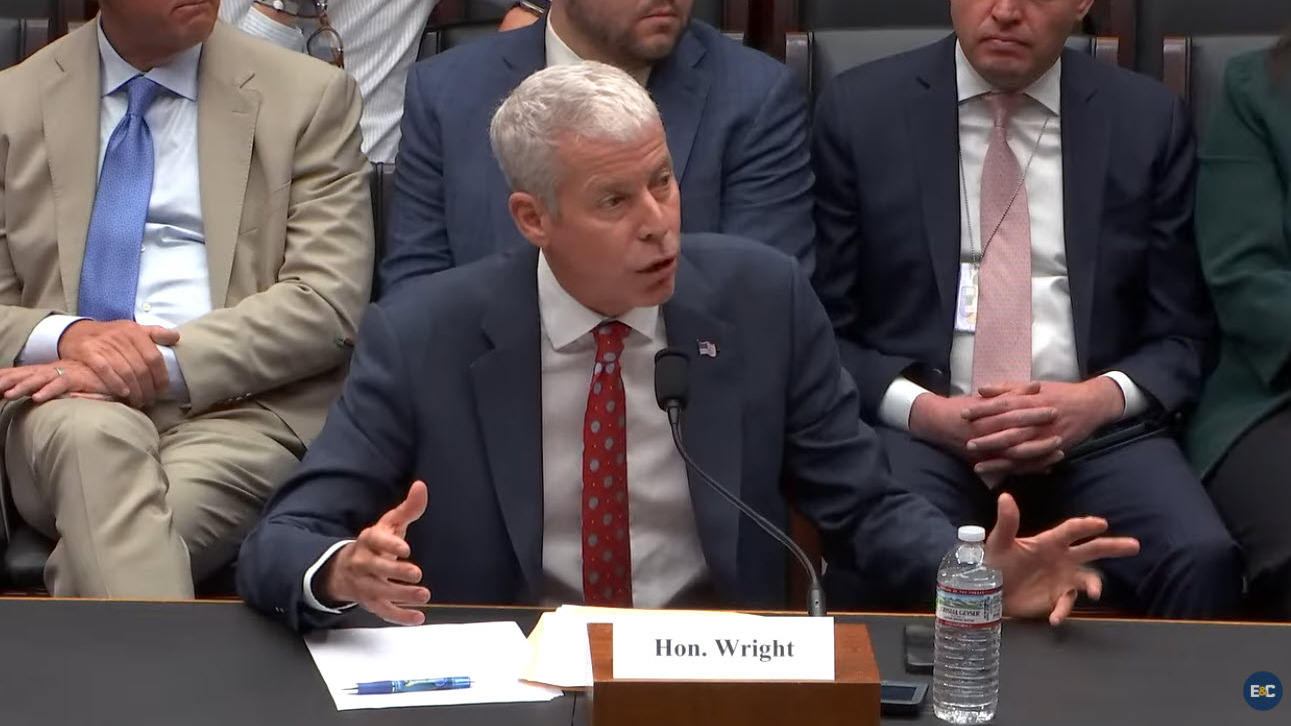
  • This week, DOE Secretary Chris Wright appeared before the House Committee on Energy and Commerce (E&C) and a subcommittee of the House Committee on Appropriations to discuss the agency’s FY’27 budget request. 
  • Though most of Sec. Wright’s testimony did not focus on ENERGY STAR, Rep. Paul Tonko (D-NY) raised the topic during Thursday’s E&C hearing. (Watch Hearing)
  • Rep. Tonko noted the importance of ENERGY STAR and pointed out that ENERGY STAR has historically required approximately $35 million in annual funding. (Watch Hearing)
  • When asked if DOE would be seeking that funding as part of its budget request, and if he could provide assurance that DOE is already working to put the people and resources in place to transition and manage the program, Sec. Wright said he would follow up on the details. (Watch Hearing)
  • Still, Sec. Wright added that he is “all for” voluntary energy efficiency ratings on appliances as well as data and transparency. (Watch Hearing)
  • The bulk of the two hearings this week focused on a range of other topics, including rising energy prices, permitting reform, and nuclear power. (Politico E&E News, April 16)

Roundtable View

  • In March, RER and coalition partners sent a letter expressing support for DOE assuming its new role as lead federal agency for ENERGY STAR. (Roundtable Weekly, April 3)
  • Additionally, the March letter underscored that DOE is well-positioned to lead a modernized program that continues to provide consumers and businesses with access to efficient products and buildings that uphold the performance they have come to expect from the ENERGY STAR brand. (Roundtable Weekly, April 3)
  • RER and coalition partners have long made the business case for ENERGY STAR and emphasized its status as a federal program required by law—meaning that it cannot be privatized or operated outside the U.S. government by agency decree. (Roundtable Weekly, April 3 | Roundtable Weekly, March 6) 
  • As Tuesday’s coalition letter highlighted, “Since 1992, ENERGY STAR and its partners have helped American families and businesses save more than $500 billion in energy costs.” (Letter, April 14)
  • By driving cost savings through energy efficiency, the program contributes to reducing energy waste and freeing up capacity on the electricity grid, in alignment with President Trump’s goal to “unleash America’s energy dominance.” (RER Policy Priorities Document)

Next week, Sec. Wright is scheduled to appear before Senate appropriators to discuss DOE’s budget request. RER will continue to track developments related to ENERGY STAR funding and support the continuation of the program and its smooth transition to DOE.

White House Economic Report Underscores Supply Gap as ROAD to Housing Act Stalls

Congress returned to Washington this week after a two-week recess with little visible movement on the 21st Century ROAD to Housing Act, even as House Financial Services Committee staff continued work on a bipartisan response to the Senate-passed bill.

State of Play

  • House and Senate lawmakers remain at odds over how to reconcile the competing housing packages, with the Senate bill’s treatment of institutional investment in single-family housing still one of the biggest sticking points. (Politico, April 14)
  • RER and other housing advocates continue to press lawmakers to preserve the bill’s pro-supply provisions while removing language that could reduce rental housing production and discourage new investment.

Why It Matters

  • The report says that if single-family homebuilding had continued at its historical pace after 2008, the U.S. would have “10 million or more additional single-family homes today”—a striking measure of the nation’s housing shortfall and the scale of lost supply. (CRE Daily, April 14)
  • White House economists reached that figure by asking how many homes would exist today if construction had continued at its pre-2008 pace, making the estimate as much about lost capacity as current demand. (Propmodo, April 13)
  • The findings reinforce that improving affordability will require more building, more investment, and fewer barriers to supply—and that policies constraining new housing production could worsen affordability rather than improve it.

New Research

  • Updated research continues to undercut the argument that institutional ownership is the main source of today’s affordability challenges.
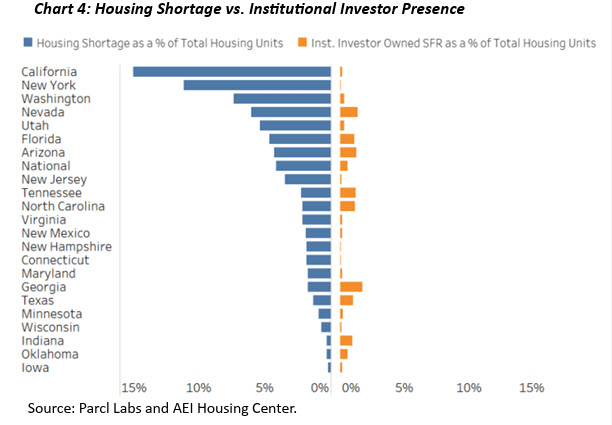
  • An AEI report released last week says large institutional investors own less than 1 percent of the nation’s single-family homes and concludes that Section 901 of the Senate’s bill would reduce the supply of newly constructed and rehabilitated homes while burdening low- and middle-income renters. (AEI, April 10)
  • Separate Realtor.com research published in March also found that the institutional investor footprint has been shrinking from its 2022 peak. (Politico, April 14 | Realtor, March 13)
  • Recent market data points in the same direction. If institutional investment were the main cause of the nation’s housing affordability problems, the markets with the heaviest investor activity would be consistently posting the strongest price growth. (Roundtable Weekly, April 10 | GAO Report, April 6 | GAO Report, 2024)
  • The latest Case-Shiller data show the opposite pattern: Chicago and New York led annual home-price gains in December 2025, while several Sun Belt metros where institutional investors have been more prominent—including Tampa, Phoenix, Dallas, and Miami—saw prices decline. That divergence reinforces the broader point that supply constraints, not institutional investment alone, are the bigger force shaping affordability. (S&P Global, December 2025 | Realtor, October 2025)

New Housing Legislation Introduced

  • Separate from the House-Senate standoff, Sen. Bill Hagerty (R-TN) this week introduced the Freedom to Build Act, a proposal backed by The Real Estate Roundtable (RER) that would create a HUD “Freedom to Build” certification for localities adopting pro-supply policies such as faster approvals, regulatory streamlining, and other measures to expand housing construction. (Sen. Hagerty Press Release, April 14)
  • The bill is intended to incentivize deregulation, expand housing supply, and make homes more affordable by aligning existing federal incentives with communities that reduce barriers to building.
  • Jeffrey D. DeBoer, President & CEO of RER said, “This legislation would be a meaningful step toward expanding housing supply and improving affordability for working families. The Freedom to Build Act would align federal incentives with local decision-making to help unlock private capital, enhance housing supply, and support long-term economic growth. The Real Estate Roundtable has long supported policies that promote housing affordability—for renters and homeowners—and strengthen the connection between housing, jobs, and transportation.”

Sen. Hagerty will also be a featured guest at RER’s upcoming Spring Roundtable Meeting next week (Roundtable-level members only), where housing supply, affordability, and related policy developments will be among the topics discussed.