CRE Leaders Gather in Washington to Discuss Post-Election Priorities, Tax Policy, Energy, Global Risks, and More
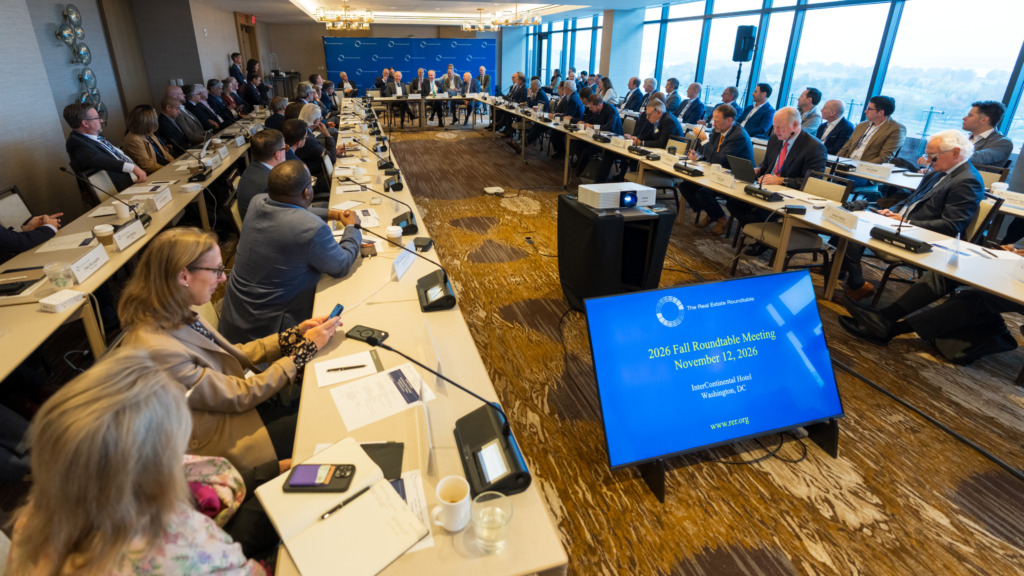
The Real Estate Roundtable’s (RER) Fall Roundtable Meeting convened members in Washington this week, on the heels of the historic midterms, to discuss prospects for year-end legislation and the new Democratic leadership’s expected 2027 agenda for tax, housing, banking, and energy policy.
The two-day program covered prospects for reauthorizing the Terrorism Risk Insurance Program, EB-5 legislation, and passing permitting reform before year-end, opportunities for bipartisan agreement on ways to expand housing supply in the next Congress, and what shifts in tax, trade, housing, and energy policy could mean for commercial real estate investment. (RER’s Fall 2026 Policy Priorities and Executive Summary)
Roundtable Leadership
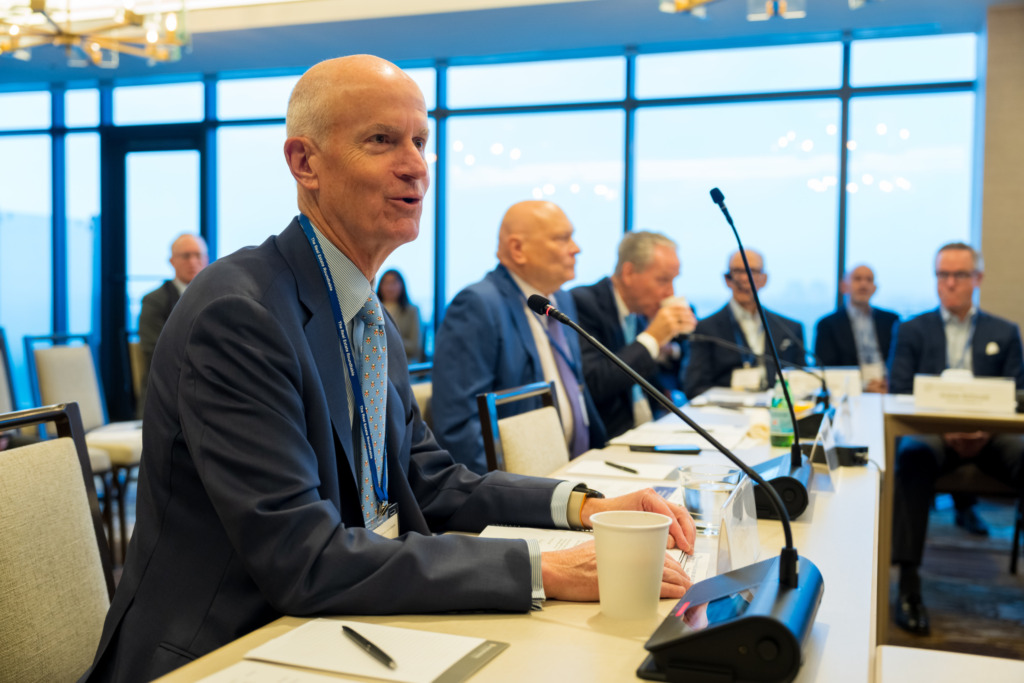
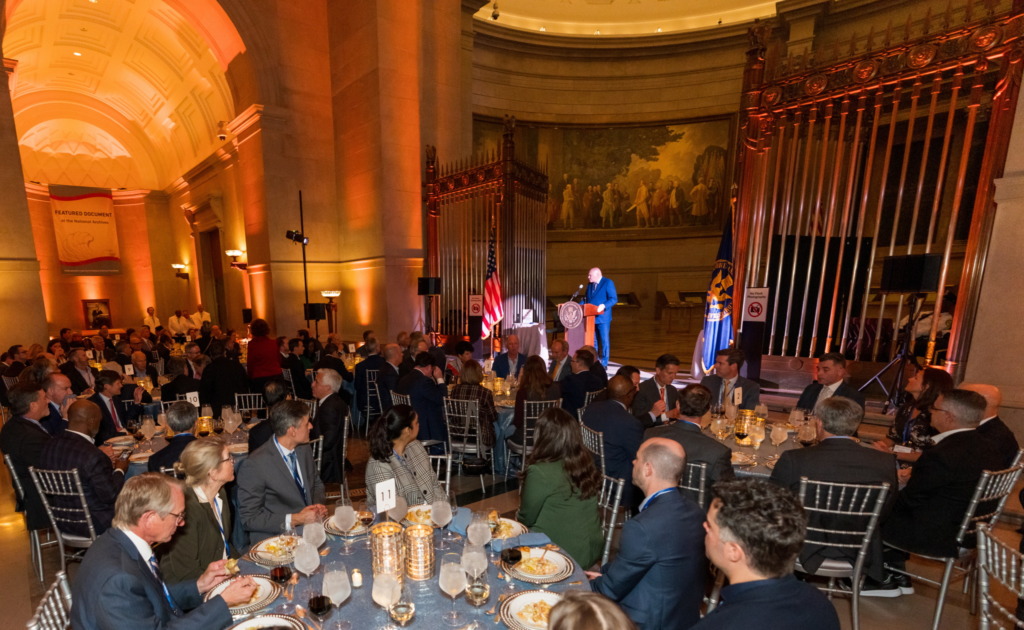
At his first Fall Roundtable Meeting as RER Board Chair, Owen D. Thomas (Chairman and CEO, BXP) welcomed members to the policymakers dinner at the National Archives and said he looks forward to leading The Roundtable’s advocacy in Washington and working with newly elected members of Congress to show how commercial real estate supports job creation and economic growth.
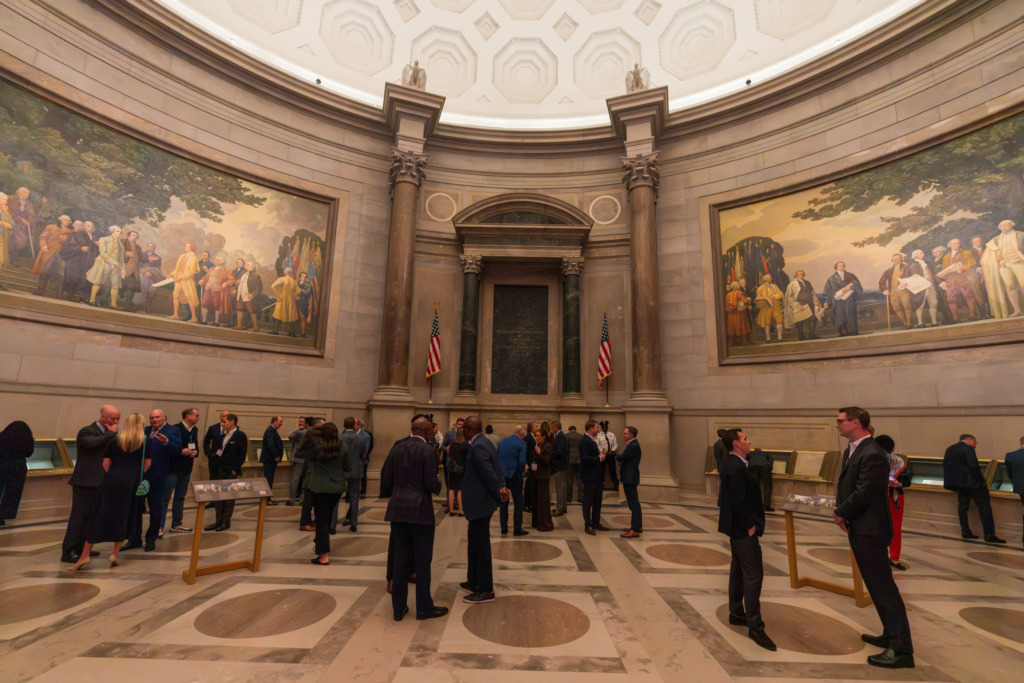
Speaking just steps from the U.S. Constitution at the National Archives, RER President and CEO Jeffrey D. DeBoer recalled how RER drew on the Fifth Amendment’s Takings Clause and a white paper it commissioned from former U.S. Solicitor General Paul Clement to challenge a provision in the ROAD to Housing Act that would have required companies that build single-family rental homes to sell them after seven years. “Ultimately, that forced-sale proposal … was removed by the language in that very document sitting right behind us,” DeBoer said.
DeBoer also spoke about RER’s challenge coin, which members received. “Traditionally, challenge coins represent camaraderie, trust, and a shared mission among leaders,” he said. “This Roundtable coin represents the strength of bringing top real estate owners, lenders, managers, and trade associations together to speak as one cohesive voice in Washington.”
Speakers & Policy Issues
Roundtable members engaged in policy discussions with the following guests:
(L-R): Marc Short (former Chief of Staff to Vice President Mike Pence and Founding Partner, Advance Strategies Consulting) and Terry McAuliffe (former Governor of Virginia and Democratic National Committee Chair) joined for a bipartisan post-election conversation on the state of American politics, the shifting balance of power in Congress, and the economic issues driving voters.
(L-R): Rep. Richard Neal (D-MA) (Ranking Member, House Ways and Means Committee), who is expected to return as committee chair in January, joined John Fish (Chairman and CEO, Suffolk; Past Chair, RER) to discuss economic policy priorities for the next Congress, Affordable Care Act tax credits, tariffs, the federal deficit, and how zoning and land-use decisions affect housing supply and affordability. (RER’s Tax Policy Priorities)
(L-R): Mike Sangaline (Deputy Assistant Secretary of Building Technologies and Development, U.S. Department of Energy (DOE)) and Anthony Malkin (Chairman and CEO, Empire State Realty Trust; Chair, RER’s Sustainability Policy Advisory Committee) discussed how energy production, grid access, ENERGY STAR’s transition to DOE, and rising electricity demand from data centers are shaping commercial real estate development. (RER’s Energy Policy Priorities)
Next on RER’s meeting calendar is the all-member State of the Industry Meeting (SOI) on Jan. 28-29, 2027, in Washington, D.C., which will include policy advisory committee meetings.
Energy
Senate Advances Bipartisan Permitting Reform Bill
On Nov. 9, the Senate voted 73–25 to begin consideration of the Bipartisan American Affordability and Jobs Act (S. 5653), clearing a key initial procedural hurdle but stopping short of approving the legislation. The bill would overhaul federal permitting for energy and infrastructure projects and modernize transmission planning. (U.S. Senate, Nov. 9)
State of Play
Bipartisan sponsors: The bill was introduced Sept. 30 by the leaders of the Senate Environment and Public Works Committee (Chair Shelley Moore Capito (R-WV) and Ranking Member Sheldon Whitehouse (D-RI)) and the Energy and Natural Resources Committee (Chair Mike Lee (R-UT) and Ranking Member Martin Heinrich (D-NM)). A revised version was released Nov. 7. (Bipartisan Policy Center, Oct. 2)
NEPA reforms: The bill would set deadlines for environmental reviews, narrow who can challenge projects in court, and limit the time to file challenges under the National Environmental Policy Act (NEPA) to 150 days, matching the House-passed SPEED Act. (Bipartisan Policy Center, Oct. 2)
Transmission and grid costs: The bill would give the Federal Energy Regulatory Commission (FERC) backstop authority to site certain interstate transmission lines. It would also require data centers to pay their full share of grid upgrade costs so other customers do not subsidize them. (White & Case, Nov. 11)
What's Next
Senators will consider amendments, addressing concerns including provisions that would relax federal reviews of a project’s impacts on historic properties. Some Democrats who voted to begin debate have indicated they may oppose the final bill depending on the amendments. (Heatmap, Nov. 9)
A final Senate vote could come as early as the week of Nov. 16. The House would then need to consider the legislation before the lame-duck session ends. (White & Case, Nov. 11)
President Trump said Nov. 9 that the bill "hasn't been fully negotiated." It remains unclear how his comments could affect the legislation's prospects. (Heatmap, Nov. 9)
The Real Estate Roundtable (RER) continues to support permitting reform to improve energy affordability and meet growing electricity demand. RER has urged Congress to provide certainty for approved projects and eliminate redundant federal reviews that delay affordable, reliable power. (Roundtable Weekly, Oct. 2, 2026)
Energy
Ninth Circuit Allows California Scope 1 and 2 Reporting to Proceed, Blocks Scope 3 and Climate Risk Disclosures
On Nov. 9, the U.S. Court of Appeals for the Ninth Circuit ruled that California can enforce certain corporate climate disclosure requirements while blocking others that likely violate the First Amendment. (Foley & Lardner, Nov. 9)
State of Play
Scope 1 and 2 reporting: The court allowed California to enforce Senate Bill (SB) 253's requirement that companies doing business in the state with more than $1 billion in annual revenue disclose emissions from their direct operations (“Scope 1”) and purchased energy (“Scope 2”). The Nov. 10 deadline for initial Scope 1 and 2 reports remained in effect, requiring covered companies to comply while litigation continues. (Foley & Lardner, Nov. 9)
Scope 3 reporting: The court found that SB 253's requirement to report indirect supply chain and value chain emissions (Scope 3), scheduled to begin in 2027, likely violates the First Amendment. The requirement remains on hold while litigation continues. (Ninth Circuit ruling, Nov. 9)
Climate-related financial risk reports: The court maintained its freeze on SB 261, which requires companies doing business in California with more than $500 million in annual revenue to report climate-related financial risks. Enforcement remains on hold while litigation continues. (National Law Review, Nov. 9)
What's Next
The case returns to the district court, which will determine, among other issues, whether the Scope 3 provisions can be separated from the rest of SB 253. Covered companies, including commercial real estate firms, remain subject to Scope 1 and 2 reporting requirements. (Cooley, Nov. 10)
The Real Estate Roundtable (RER) continues to advocate for practical, consistent climate disclosure requirements that limit compliance burdens for commercial real estate owners and operators. RER has raised concerns about mandatory Scope 3 reporting, particularly the challenges of obtaining reliable emissions data from tenants and other third parties, and has urged policymakers to avoid costly, overlapping reporting requirements. (Roundtable Weekly, Nov. 21, 2025)


 Menu
Close
 About Us