White House Economic Report Underscores Supply Gap as ROAD to Housing Act Stalls
April 17, 2026
Congress returned to Washington this week after a two-week recess with little visible movement on the 21st Century ROAD to Housing Act, even as House Financial Services Committee staff continued work on a bipartisan response to the Senate-passed bill.
State of Play
House and Senate lawmakers remain at odds over how to reconcile the competing housing packages, with the Senate bill’s treatment of institutional investment in single-family housing still one of the biggest sticking points. (Politico, April 14)
RER and other housing advocates continue to press lawmakers to preserve the bill’s pro-supply provisions while removing language that could reduce rental housing production and discourage new investment.
The report says that if single-family homebuilding had continued at its historical pace after 2008, the U.S. would have “10 million or more additional single-family homes today”—a striking measure of the nation’s housing shortfall and the scale of lost supply. (CRE Daily, April 14)
White House economists reached that figure by asking how many homes would exist today if construction had continued at its pre-2008 pace, making the estimate as much about lost capacity as current demand. (Propmodo, April 13)
The findings reinforce that improving affordability will require more building, more investment, and fewer barriers to supply—and that policies constraining new housing production could worsen affordability rather than improve it.
New Research
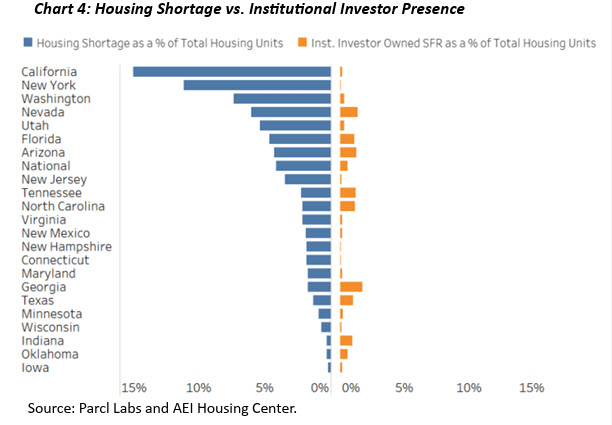
Updated research continues to undercut the argument that institutional ownership is the main source of today’s affordability challenges.
An AEI report released last week says large institutional investors own less than 1 percent of the nation’s single-family homes and concludes that Section 901 of the Senate’s bill would reduce the supply of newly constructed and rehabilitated homes while burdening low- and middle-income renters. (AEI, April 10)
Separate Realtor.com research published in March also found that the institutional investor footprint has been shrinking from its 2022 peak. (Politico, April 14 | Realtor, March 13)
Recent market data points in the same direction. If institutional investment were the main cause of the nation’s housing affordability problems, the markets with the heaviest investor activity would be consistently posting the strongest price growth. (Roundtable Weekly, April 10 | GAO Report, April 6 | GAO Report, 2024)
The latest Case-Shiller data show the opposite pattern: Chicago and New York led annual home-price gains in December 2025, while several Sun Belt metros where institutional investors have been more prominent—including Tampa, Phoenix, Dallas, and Miami—saw prices decline. That divergence reinforces the broader point that supply constraints, not institutional investment alone, are the bigger force shaping affordability. (S&P Global, December 2025 | Realtor, October 2025)
New Housing Legislation Introduced
Separate from the House-Senate standoff, Sen. Bill Hagerty (R-TN) this week introduced the Freedom to Build Act, a proposal backed by The Real Estate Roundtable (RER) that would create a HUD “Freedom to Build” certification for localities adopting pro-supply policies such as faster approvals, regulatory streamlining, and other measures to expand housing construction. (Sen. Hagerty Press Release, April 14)
The bill is intended to incentivize deregulation, expand housing supply, and make homes more affordable by aligning existing federal incentives with communities that reduce barriers to building.
Jeffrey D. DeBoer, President & CEO of RER said, “This legislation would be a meaningful step toward expanding housing supply and improving affordability for working families. The Freedom to Build Act would align federal incentives with local decision-making to help unlock private capital, enhance housing supply, and support long-term economic growth. The Real Estate Roundtable has long supported policies that promote housing affordability—for renters and homeowners—and strengthen the connection between housing, jobs, and transportation.”
Sen. Hagerty will also be a featured guest at RER’s upcoming Spring Roundtable Meeting next week (Roundtable-level members only), where housing supply, affordability, and related policy developments will be among the topics discussed.


 Menu
Close
Menu
Close
 About Us