Bipartisan “Physical” Infrastructure Agreement Announced; Separate Package on “Social Infrastructure” Tied to Reconciliation Path

Infrastructure Chicago interexchange

President Joe Biden and a bipartisan group of senators yesterday announced a tentative agreement to address the nation’s “physical” infrastructure – as Democrats indicated that its passage into law would depend on enactment of a separate, much larger “social” infrastructure bill structured to bypass Republican votes through a budget “reconciliation” process. 

Goals and Pay-Fors 

  • The total cost of the physical infrastructure deal, according to the White House, is $1.2 trillion over eight years, with $579 billion in new spending for investments in transit, roads, bridges, the electrical grid, and other systems. (White House Fact Sheet, June 24)
  • The 21-member bipartisan Senate group also released a document outlining how the agreement would be funded while avoiding new taxes. Among the pay-fors listed: 
    • Leverage private sector investment through incentivizing use of public private partnerships, expanding use of Private Activity Bonds, and encouraging asset recycling.
    • Create direct-pay municipal bonds to attract more investment in public infrastructure.
    • Repurpose unused COVID relief funds. 

Jeff DeBoer RER Meeting

  • Roundtable President and CEO Jeffrey DeBoer, above, said, “Americans depend on safe and efficient roads, bridges, and mass transit to commute all across the country. Our nation’s buildings and the people in them depend on reliable supplies of water, power, and broadband to function, and meet the evolving demands of business and individual tenants. In turn, infrastructure and real estate are synergistic, and have a two-way relationship.”
  • DeBoer added, “The package has potential to impact GDP, promote job growth, keep the U.S. competitive with other countries that are massively investing in their own infrastructure, and expand the overall economy.”

Next: Reconciliation

Capitol Hill trees clouds in the evening

  • President Biden said that signing the bipartisan physical infrastructure deal into law would be contingent on a separate bill addressing his administration’s “social infrastructure” agenda on matters such as education and child care. “If the [physical infrastructure bill] is the only one that comes to me, I’m not signing it.” Biden said (Wall Street Journal, June 24)
  • Democratic leaders are aiming to move the “social” infrastructure bill through the budget reconciliation process which would only require a simple, 51-vote majority in the Senate. (NPR, June 24)
  • House Speaker Nancy Pelosi (D-CA) said yesterday, “We will not take up a bill in the House until the Senate passes the bipartisan bill and a reconciliation bill. If there is no bipartisan bill, then we’ll just go when the Senate passes a reconciliation bill.” (The Hill, June 24)
  • Senate Majority Leader Schumer stated his timeline is to have both the bipartisan infrastructure bill and the budget reconciliation bill passed in July. (Politico, June 24) 

Housing — New FHFA Director 

FHFA logo

  • President Biden on June 23 removed Fannie Mae and Freddie Mac’s chief regulator, hours after the U.S. Supreme Court ruled that the Federal Housing Finance Agency’s (FHFA) loan director is insufficiently accountable to the president. (CNBC and BloombergLaw, June 23)
  • Mark Calabria, a Trump administration appointee, focused much of his efforts at FHFA trying to end Fannie and Freddie’s 12 years under government conservatorship. A Biden White House official said, “It is critical that the agency (FHFA) implement the Administration’s housing policies.” (CNBC, June 23)
  • Calabria was replaced on an acting basis with FHFA Deputy Director Sandra Thompson. Since 2013, Thompson has led FHFA’s housing and regulatory policy, capital policy, financial analysis, fair lending and all mission activities for Fannie Mae, Freddie Mac and the Federal Home Loan Banks. (FHFA statement, June 24) 

The Roundtable’s Real Estate Capital Policy Advisory Committee (RECPAC) works on issues related to Fannie Mae and Freddie Mac and their impact on commercial real estate.

#  #  #
Senate Efforts Pursue Two-Track Approach to Infrastructure Package

Senate members announced this week that they are pursuing a two-track approach in assembling an infrastructure package in response to President Biden’s original multitrillion dollar proposal – a pared-down bipartisan plan, and a much larger Democratic plan that could advance on a narrow, party-line vote path. 

Bipartisan Framework

  • In the wake of failed negotiations last week between the White House and Senate GOP leaders, a group of five Democrats and five Republicans began work on an alternative plan focused on “core, physical infrastructure.” The bipartisan Senate group expanded this week to 21 members, including 11 Republicans. At least 10 Republicans in the 50-50 Senate must approve a bill to reach the 60-vote threshold for passage. (Bloomberg and Washington Post, June 16)
  • A draft outline of the bipartisan group’s infrastructure proposal published on June 16 by Politico revealed a framework that would cost $974 billion over five years, including $579 billion in new spending.
  • President Biden originally proposed $2 trillion in new infrastructure spending, then signaled a compromise closer to $1 trillion. (Roundtable Weekly, June 11)
  • The Senate group’s framework also includes numerous funding sources, such as unspent coronavirus relief aid and public-private partnerships. Since the document’s release, Republicans have provided assurances that a final framework would not include indexing the national gasoline tax to inflation, a proposal opposed by President Biden and House Speaker Nancy Pelosi (D-CA). (Politico and The Hill, June 17)

The Reconciliation Path

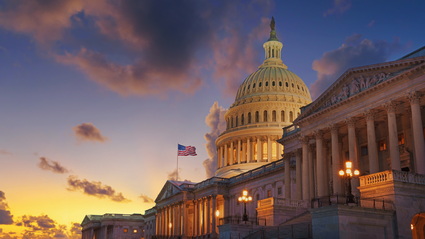
U.S. Capitol at sunset
US Capitol building at sunset, Washington DC, USA.
  • Meanwhile, Senate Majority Leader Chuck Schumer (D-NY) this week met with Democratic senators on the Budget Committee to trigger the budget reconciliation process, which would allow a party–line majority vote of an infrastructure package, eliminating the need for Republican votes. (Associated Press, June 17)
  • According to the AP, “Sen. Tim Kaine (D-VA) said the Budget Committee was unified in putting together a package that ‘gives us a latitude to do what we need to do — we can shrink it if there’s a bipartisan deal, we could do the broader deal if there isn’t.’”
  • Schumer said he would like to pass next month both a bipartisan infrastructure package and a larger budget blueprint, which would address a follow-up Democratic legislative. (BGov, June 17)
  • Additionally, Senate Budget Chairman Bernie Sanders (I-VT) said he is seeking a $6 trillion measure that would fund both Biden’s infrastructure proposals, including reforms targeting climate change and an expansion of Medicare. (Wall Street Journal and Washington Post, June 17
  • Sen. Mark Warner (D-VA), a member of the bipartisan group leading infrastructure negotiations, said, “I know there needs to be reconciliation. But that also doesn’t mean that I accept all of what the president proposed and all of what Sen. Sanders has proposed.” (BGov, June 17)
  • The Real Estate Roundtable, along with 16 other national real estate trade organizations submitted detailed comments in May to the Senate Finance Committee and House Ways and Means Committee as part of hearings on how to fund the administration’s infrastructure proposals. (Roundtable Weekly, May 21)

The Roundtable’s Annual Meeting this week also featured discussions with policymakers on the evolving infrastructure debate – and the organization plans to remain fully engaged with lawmakers on any eventual legislative proposal that could affect commercial real estate. 

#  #  #

Infrastructure Negotiations Shift to Bipartisan Congressional Groups; House, Senate Committees Advance Surface Transportation Bills

Capitol Hill trees clouds in the evening

Months of negotiations on bipartisan infrastructure legislation between President Biden and Republicans led by Sen. Shelley Moore Capito (R-WV) collapsed this week – and talks have shifted to alternative approaches from bipartisan groups of congressional policymakers. Meanwhile, House and Senate committees are moving forward on spending bills to meet the nation’s surface transportation needs before current funding expires on Sept. 30. (White House statement, June 8 and CQ, June 10) 

Alternative Paths 

  • President Biden recently reduced his original infrastructure package proposal from $2.3 trillion to $1.7 trillion – and requested at least $1 trillion in new spending from Republicans. The Senate GOP group counteroffered with nearly $1 trillion, which included only $330 billion in new spending and the rest from repurposed COVID-19 relief funding signed into law earlier this year. Biden cancelled the talks after the gap over the package’s scope and funding could not be bridged. (The Hill and AP, June 8)
  • Yesterday, a bipartisan group of 10 senators said they would propose a plan focused on “core, physical infrastructure” infrastructure that would cost $974 billion over five years, or $1.2 trillion over eight years, including about $579 billion in new spending. (CQ and New York Times and Washington Post, June 10)
  • According to Axios, “The group proposes paying for it through unspent coronavirus relief aid, public-private partnerships, indexing the gas tax to account for inflation and allowing states to borrow necessary money through a revolving loan fund.”
  • A joint statement released by the senators said, “[We] reached a bipartisan agreement on a realistic, compromise framework to modernize our nation’s infrastructure and energy technologies. This investment would be fully paid for and not include tax increases.” (Joint statement, June 10)

  • In the House, the Problem Solvers Caucus, which has 29 Democrats and 29 Republicans, on June 9 released a $1.25 trillion infrastructure spending framework, including $761.8 billion in new spending over eight years – yet did not include any details about how to pay for the proposal. (News release, Building Bridges Infrastructure  Framework and section-by-section summary)
  • The co-chairs of the House caucus – Reps. Josh Gottheimer (D-NJ) and Brian Fitzpatrick (R-PA) – are also in contact with a key group of bipartisan group of senators, including Bill Cassidy (R-LA), Kyrsten Sinema (D-AZ), Rob Portman (R-OH) and Joe Manchin, (D-WV) about developing a bipartisan, bicameral infrastructure package. (CQ, June 9)

  • White House Press Secretary Jen Psaki this week said, “[President Biden] feels it’s encouraging to see multiple proposals put out there, both from Republicans in the House and the Problem Solvers Caucus, as well as a bipartisan group that’s working on a proposal. Both will have increased numbers over what we’ve seen and been negotiating to date. Those are all positive steps.” (White House Press Gaggle, June 9)

Surface Transportation Legislation 

road construction and workers

  • Yesterday, the House Transportation and Infrastructure (T&I) Committee advanced a five-year, $547 billion surface transportation bill by a vote of 38-26 that included two supporting Republican votes. (Section-by-section summary of the INVEST in America Act)
  • Although the House Ways and Means Committee needs to address how to fund the bill’s costs, many of the provisions align with Biden administration transportation priorities – and could serve as a possible cornerstone for a larger infrastructure package. (CQ and BGov, June 10)
  • House Majority Leader Steny Hoyer (D-MD) said the chamber will take up the T&I committee bill the week of June 28.  A reauthorization bill for surface transportation is considered must-pass legislation as current funding expires Sept 30. (Washington Post, June 10)
  • In the Senate, several committees have jurisdiction over portions of that chamber’s surface transportation bill. The Environment and Public Works Committee unanimously voted on May 26 to advance a $303.5 billion bill over the next five years to fund the nation’s roads, bridges, tunnels, and mass transit projects. (Roundtable Weekly, June 4)
  • The Senate Commerce, Science and Transportation Committee is scheduled to consider rail and safety issues on June 16. Separately, a spokeswoman for Senate Banking, Housing and Urban Committee said Chairman Sherrod Brown (D-OH) said he continues to work with Ranking Member Patrick Toomey (R-PA) “in hopes of reaching a bipartisan agreement on a robust transit title for a surface transportation bill.” (CQ, June 10)

Reconciliation

Schumer fists podium

  • Democrats are also considering the use of the budget “reconciliation” process, which would allow them to bypass the Senate’s 60-vote requirement to pass legislation and push through an infrastructure package on a party line vote. (Roundtable Weekly, June 4)
  • Senate Majority Leader Charles Schumer (D-NY), above, said yesterday, “We continue to proceed on two tracks. A bipartisan track and a reconciliation track — and both are moving forward.” (Washington Post, June 10)
  • Schumer said last week that he wants to move forward on an infrastructure bill in July, whether it is bipartisan or not. (The Hill, May 25)
  • A National League of Cities’ 2021 State of Cities report released this week supported the need for infrastructure investment nationwide. Of the 600 mayors who provided information for the report, 91 percent said they did not have the funds to make needed infrastructure investments. (NLC news release, June 10)

The Roundtable will focus on the evolving infrastructure negotiations and their possible impact on CRE during its June 15-16 Annual Meeting and Policy Advisory Committee Meetings in Washington, DC.

#  #  #

President Biden and Congressional Leaders Discuss Path Forward for Infrastructure Legislation

President Biden met with congressional leaders this week to find a path forward on his $2.3 trillion infrastructure-focused American Jobs Plan. Republicans agreed to continue negotiations and develop a pared down counter-proposal that will limit the definition of infrastructure and include specific funding measures. (CNBC and Wall Street Journal, May 12 and The Hill, May 13) 

Negotiations on Scope 

  • Biden’s multitrillion-dollar proposal calls for funding infrastructure investments by raising the corporate tax rate to 28% from 21% and making other changes to tax laws passed during the 2017 overhaul.
  • “The proper price tag for what most of us think of as infrastructure is about $600 to $800 billion,” McConnell said on May 9. (CBS News, May 10 and Kentucky Educational Television, May 10)
  • Biden and Vice President Kamala Harris on May 12 met with the “Big 4” Congressional Leaders – Republican Senate Minority Leader Mitch McConnell of Kentucky, House Minority Leader Kevin McCarthy of California, Democratic Senate Majority Leader Chuck Schumer of New York and House Speaker Nancy Pelosi of California – to discuss infrastructure proposals. Although both sides remained deeply divided over the scope of an infrastructure package and exactly how to pay for it, some optimistic signs emerged from the meeting. (New York Times, May 12)
  • McConnell commented after the meeting, “We’re not interested in reopening the 2017 tax bill. We both made that clear with the president. That’s our red line.” (Business Insider, May 12)
  • However, McCarthy added, “there is a place where we can find bipartisanship” –  and Pelosi noted, “I feel very optimistic . . . about our ability to pass such a bill, more optimistic now about being able to do so in a bipartisan way. But we’ll see.” (Tax Notes, May 13) 

Republican Counter-Offer

  • Biden and Harris also met on May 13 to discuss infrastructure with a group of top Republican committee leaders, including Sen. Shelley Moore Capito of West Virginia, ranking member on the Senate Environment and Public Works Committee. (White House Readout of Oval Office Meeting, May 13)
  • During the meeting, Republicans suggested using public-private partnerships to partially cover the costs of funding an infrastructure bill, instead of reversing elements of the 2017 tax bill. (The Hill, May 13)


  • Capito commented after the meeting, “I think what he wants to see is ‘OK, I get it you don’t want me to touch the 2017 taxes … well then how are we going to pay for this.’ The [Paycheck Protection Program] was part of the discussion but there were other things discussed.”
  • Capito added, “He asked that we would come back with another offer, with more granularity to it and more details, and so we agreed to do that. Maybe some different numbers too.” (The Hill, May 13)


  • The president also met with key Democratic senators, including Joe Manchin of West Virginia and Kyrsten Sinema of Arizona, this week to discuss infrastructure measures proposals.
  • Congressional Republicans are expected to propose their counter-offer for a pared-down infrastructure program next week.

Roundtable Statement

  • Real Estate Roundtable President and CEO Jeffrey DeBoer on April 30 issued a statement on funding options for President Biden’s American Jobs Plan and American Families Plan.  
  • DeBoer noted, “As policymakers consider the options to raise this needed revenue, we strongly urge that the focus be on broad-based tax increases that do minimal damage to job creation, risk taking and entrepreneurial activity. Unfortunately, particularly when considered in total, many of the tax proposals accompanying the American Jobs Plan or American Families Plan would reduce economic activity, impede job growth, and diminish opportunities for startup businesses and those less advantaged. The current law in these areas may be in need of review and reform, but repealing these incentives is simply not wise.” (Full Roundtable statement)

The initial release of President Biden’s American Jobs Plan on March 31 listed several corporate tax revenue measures to offset infrastructure spending. Further details on the Administration’s proposed tax and revenue provisions are scheduled to be released on May 27 as part of the president’s FY 2022 budget proposal. (Reuters, May 13) 

#  #  # 

President Biden Announces $2.3 Trillion Infrastructure Plan Funded by Corporate Taxes

President Biden Offers Infrastructure Proposal

President Joe Biden on March 31 announced the first part of his sweeping economic growth proposal focused on infrastructure and clean energy – a $2.3 trillion, eight-year plan that White House officials said would be funded, over 15 years, by corporate and international tax increases. (Wall Street Journal and White House Fact Sheet: The American Jobs Plan, March 31)

Why It Matters

  • The enormous scale of the proposal seeks to use federal spending to address a wide-range of economic and social issues widely defined as infrastructure while strengthening America’s long-term competitiveness against challengers like China.
  • Biden stated, “It’s a once-in-a generation investment in America, unlike anything we’ve seen or done since we built the Interstate Highway System and the Space Race decades ago.” (Remarks by President Biden on the American Jobs Plan, March 31)
  • The White House proposal would direct federal spending to transportation, manufacturing, buildings, schools, water systems, broadband, health care, and energy infrastructure assets. (USA Today, April 1, “These 4 charts show where the money would go”)
  • A “Made in America Tax Plan” would pay for the proposal. It would increase the corporate tax rate from 21% to 28%; set the minimum tax for multinational corporations with U.S. operations at 21 percent; and eliminate certain incentives affecting the offshoring of jobs. (The Hill, March 31)

Impact on CRE

Transportation Infrastructure Seattle

  • The Biden proposal would spend $213 billion to produce, preserve, and retrofit two million homes and commercial buildings. In particular, it recommends:
    • Tax credits and grants with a goal of one million new and renovated, affordable and efficient, rental housing units;
    • Extend and expand energy efficiency tax incentives for homes and commercial buildings;
    • A new competitive grant program for cities and localities that eliminate exclusionary zoning policies – like minimum lot sizes, mandatory parking requirements, and density restrictions;
    • Mobilize private sector investment in distributed energy resources, and to de-carbonize the electric grid;
    • Drive clean energy deployment by requiring federal buildings to purchase 24/7 clean power; and
    • Support private development of idle Brownfields into hubs of economic growth.
  • The proposal does not affect the federal eviction moratorium, which was recently extended by the Centers for Disease Control and Prevention (CDC) until June 30. (CDC order and CNBC video, March 30)

Transportation Infrastructure

  • $115 billion in the White House proposal would focus on repairing Main Street roads, highways and bridges.

  • $80 billion would be devoted to inter-city high-speed rail to address Amtrak’s repair backlog and modernize the Northeast Corridor.  This is of significance to national and regional projects like “Gateway,” the rail tunnel project between New York City and New Jersey.

What’s Next

Build By the 4th Coalition

  • Senate Minority Leader Mitch McConnell (R-KY) said, “This proposal appears to use ‘infrastructure’ as a Trojan horse for the largest set of tax hikes in a generation,” and that Biden’s proposal “is not going to get support on our side.” (The Hill, March 31 and Bloomberg, April 1)
  • House Speaker Nancy Pelosi (D-CA) signaled she would like to see an infrastructure bill pass the House by July 4. She added that “hopefully” a final infrastructure package will include a repeal of the $10,000 cap on state and local tax deductions. (Associated Press, March 31 and BGov, April 1)
  • The Roundtable is part of the Build by the 4th coalition, led by the U.S. Chamber of Commerce, which encourages the Biden Administration and Congress to pass a comprehensive infrastructure deal by Independence Day 2021.
  • The Biden administration is planning a second legislative package for April that could seek an additional $1 trillion to expand family support such as the child tax credit and paid leave. (B-Gov, March 31)

President Biden’s infrastructure plan will be a focus of discussion during The Roundtable’s April 20 Spring Meeting (remote).

#   #   # 

Biden Administration Floats Tax Increases to Pay for Infrastructure as Policy Focus Shifts to Economic Growth

The White House
Biden Administration and The White House

The Biden administration is considering increasing the corporate tax rate and the individual rate for high earners as it deliberates how to structure its next major legislative initiative – a sprawling “Build Back Better” economic growth package that may cost far more than the $1.9 trillion coronavirus-relief bill enacted last week. (BGov, March 15 and Roundtable Weekly, March 12) 

Why It Matters: 

  • The first major tax increase since 1993 could be proposed as one method of funding Biden’s ambitious infrastructure plan. Heather Boushey, a member of the White House Council of Economic Advisers stated, “There is a long list of things that we need to invest in,” including “broadly defined” infrastructure, the power grid, and a plan to bolster child and elder care. (BGov and Bloomberg Television interview, March 15
  • Biden’s tax plan would aim to provide relief for middle-class households, including those in the $110,000-a-year income range, according to Bharat Ramamurti, deputy director of the White House National Economic Council. “The key here is that the president believes strongly that the biggest corporations and those folks who have done extremely well over the last several decades should pay a bit more,” Ramamurti said. (Bloomberg Television interview, March 16)
     
  • Senate Minority Leader Mitch McConnell (R-KY) this week rejected any potential tax increases to fund President’s Biden infrastructure plan. (The Hill, March 16)
     
  • Democrats are considering using the budget reconciliation process to pass an infrastructure bill, the same process used to pass the pandemic relief bill in the Senate by a simple majority in the 50-50 Senate. Under normal budget rules, the support of at least 10 GOP senators would be needed to defeat a 60-vote filibuster. Democrats will only be able to use reconciliation for one more bill this year. (The Hill, March 15)
  • The enormous scope of the administration’s legislative goals may lead to the possible separation of their economic growth package into as many as three bills. (Politico Playbook, March 18) 

Congressional Legislation:

  • Expanding allowable investment opportunities for REITs could increase private sector infrastructure and help revitalize distressed retail businesses. The Roundtable-supported, bipartisan Retail Revitalization Actof 2021 (H.R. 840) – introduced Feb. 4 by House Ways and Means Members Brad Schneider (D-IL) and Darin Lahood (R- IL) – would modernize real estate investment trust tax provisions to permit REITs to invest equity in struggling commercial tenants that have been harmed by the COVID-19 pandemic. (News release, Feb. 4)


  • H.R. 840 is the focus of a March 16 Tax Notes article entitled, Modifying REIT Rules Could Aid Recovery and Infrastructure Plans.”
  • House Energy and Commerce (E&C) Committee Chairman Frank Pallone, Jr. (D-NJ) has scheduled a March 22 hearing on the committee’s recently released Leading Infrastructure For Tomorrow’s (LIFT) America Act, which would provide more than $312 billion in funding for broad range of projects. (E&C news release, March 11 and Chairman’s Memorandum, March 18)
  • House E&C Committee Republicans released a clean energy and climate package this week in response to the E&C Democrats’ LIFT legislation. (E&C Republicans news release, March 15)
  • Sen. Elizabeth Warren (D-MA) and Rep. Alexandria Ocasio-Cortez (D-NY) on March 18 introduced the BUILD GREEN Infrastructure and Jobs Act, a $500 billion proposal to shift U.S. transportation away from fossil fuels by 2050. 

What’s Next:

  • More legislation is expected to be introduced that will focus on highways, mass transit and other surface transportation, as well as tax-related energy and infrastructure measures. House bills are expected from Transportation and Infrastructure Committee Chairman Peter DeFazio (D-OR) and Ways and Means Committee Chairman Richard Neal (D-MA).
     
  • A “by-the-mile” vehicle usage tax is also under consideration to fund transportation infrastructure projects. Transportation Secretary Pete Buttigieg is considering funding highway projects with a fee based on how many miles someone travels instead of how much gasoline they pump. Buttigieg has stated the administration will move swiftly to reauthorize the surface transportation highway bill, which is set to expire at the end of September. (BGov, March 15) 
  • The Roundtable is part of the Build by the 4th coalition, led by the U.S. Chamber of Commerce, which encourages the Biden Administration and the new Congress to pass a comprehensive infrastructure deal by Independence Day 2021. 

Infrastructure investment will be a focus of discussion between commercial real estate leaders and policymakers during The Spring Roundtable Meeting on April 20 in Washington, DC. 

#  #  #  

Biden Policy Eases Funding Constraints on Mass Transit Projects

NYC bridges

The Biden Administration released a policy letter on Feb. 16 enabling states to more readily access federal grant dollars to help finance mass transit and other large-scale transportation projects. (FTA “Dear Colleague” letter and CQ, Feb. 16).

  • The letter from Acting Federal Transit Administrator Nuria Fernandez reverses Trump-era policy from 2018. The earlier policy restricted the amount of transportation money states could receive from the U.S. Department of Transportation (DOT) through the Capital Investment Grants (CIG) program if the project also received a low-interest DOT loan.
  • The Feb. 16 letter clarifies that DOT loans extended under the Transportation Infrastructure Finance and Innovation Act (TIFIA) or the Railroad Rehabilitation & Improvement Financing (RRIF) program – when repaid with non-federal funds – can count toward the state’s cost-share requirement to also qualify for a “new starts” CIG grant.
  • The Roundtable has long supported the FTA’s recent step. “Loans repaid [by states] with interest are fundamentally different instruments than grants awarded with no repayment obligation,” The Roundtable noted in a 2019 letter to the House’s Transportation and Infrastructure Committee.  The letter added, “Credit-worthy state and local project sponsors who successfully navigate the TIFIA loan process should not be penalized for seeking a CIG grant as a separate, necessary layer in the capital stack to finance a massive transit project.” (Roundtable Weekly, May 3, 2019)   
  • The FTA’s policy change should help large-scale transportation projects of national and regional significance that may qualify for both CIG grants and TIFIA loans.  [See nationwide lists of CIG projects and TIFIA projects.] One prominent example is the New York-New Jersey Gateway Program, a $30 billion modernization of Amtrak’s Northeast Corridor.
  • Senator Bob Menendez (D-NJ) applauded the Biden Administration’s action, noting that the effect of the 2018 policy was to “stall the Gateway project” which includes replacing a 110-year-old bridge and construction of a “new Trans-Hudson rail tunnel.” (Menendez press release, Feb. 16)
  • The Real Estate Board of New York (REBNY) applauded the Biden FTA’s move.  “Restoring access to federal funding for Gateway is an initial but pivotal step toward advancing the project, which will improve mass transit service for millions of commuters, create thousands of good jobs and play a significant role in getting our regional and national economics back on track,” said REBNY President Jim Whelan. (REBNY news release, Feb. 18) 

Movement on Infrastructure

The Roundtable’s recommendations regarding infrastructure financing and permitting will again be featured in our forthcoming 2021 Policy Agenda. The Roundtable is also a member of the  “Build by the 4th”coalition, led by U.S. Chamber of Commerce, which urges Congress to pass a comprehensive infrastructure bill by Independence Day 2021. 

#  #  #

President Biden Focuses on Infrastructure Policy Plan With Key Senate Committee Leaders

Infrastructure Meeting at White House with Senate EPW members

The critical need for investing in modern and sustainable infrastructure was the focus of a Feb. 11 White House meeting between President Joe Biden, Vice President Kamala Harris, Transportation Secretary Pete Buttigieg, and a bipartisan group of senators from the Environment and Public Works (EPW) Committee.

  • The Senate EPW committee was represented by Chairman Thomas Carper (D-DE), Transportation Subcommittee Chairman Ben Cardin (D-MD), Ranking Member Shelley Moore Capito (R-WV), and former Chairman James Inhofe (R-OK).
  • Biden stated at the meeting that the EPW Committee “is central to everything that’s going to happen” on infrastructure. (White House Remarks and meeting video, Feb. 11). White House Press Secretary Jen Psaki remarked that the meeting “was a reflection of how important it is [for Biden] to meet with bipartisan leaders and have a discussion about what’s required in states and communities.” (White House press conference video, Feb. 11) 
  • The president noted the importance of investing in infrastructure to maintain Americas’s international competitiveness, referring to China’s advancements in high-speed rail and automobiles by stating, “if we don’t get moving, they’re going to eat our lunch.” (Washington Post, Feb. 11)
  • Sen. Cardin said after the meeting that “it’s going to be a challenge to… have adequate revenues to fund transportation moving forward.” Congressional focus on an infrastructure package is widely expected to take place after the legislature acts on the next round of COVID-19 relief. (Politico, Feb. 11). 
  • Sens. Cardin and Carper led a Feb. 9 letter from nearly 50 Democrats from both the House and Senate to Secretary Buttigieg, regarding the need for federal transportation policies to create jobs while also reducing carbon pollution, with an emphasis on reducing vehicle tailpipe emissions.
  • In a December 16, 2020 letter, The Roundtable and 12 national real estate organizations provided detailed recommendationsto then President-elect Biden and Vice President-elect Harris that included infrastructure funding and modernization as engines to drive recovery and job growth from the economic fallout of the COVID-19 pandemic. 
  • The December industry letter stated, “A strong national infrastructure is vital to the health of the nation’s real estate, and vice versa. Roads, bridges and mass transit enhance the values of nearby properties, which in turn generate greater tax revenues to fund even more infrastructure assets.”
  • The Roundtable is also part of Build by the 4th coalition led by U.S. Chamber of Commerce, which encourages the Biden Administration and the new Congress to pass a comprehensive infrastructure deal by Independence Day 2021.

The Biden Administration is expected to reveal its infrastructure package soon as part of its “Build Back Better” agenda to spur economic recovery from the repercussions of the pandemic.

#  #  # 

House Democrats Pass $1.5 Trillion Climate-Focused Infrastructure Package While GOP Prioritizes Surface Transportation Funding

Transportation Infrastructure Seattle

House Democrats on July 1 passed a sprawling $1.5 trillion infrastructure package (the Moving Forward Act, H.R. 2) largely along party lines (233-188). The bill would reauthorize spending for the nation’s roads, bridges and mass transit transportation – and also addresses housing, water, broadband, renewable energy, electric grid, and education infrastructure.  (Wall Street Journal and Washington Post, July 1) 

  • The broad Democratic package reflects the party’s blueprint for infrastructure priorities in the lead-up to the November elections. (Politico, July 1) H.R. 2 includes climate-related provisions that would require states to measure and reduce emissions from transportation systems, which account for the nation’s single largest source of greenhouse gases. (U.S. Energy Information Administration) 
  • H.R. 2 would also support mass transit and other low-emissions transportation modes with more money, and spur greater electrification of vehicle fleets.
  • H.R.. 2 faces steep GOP opposition. (E&E News, June 29) Senate Majority Leader Mitch McConnell (R-KY) said the measure is “not going anywhere in the Senate” due to its price tag and focus away from highways and more traditional surface transportation funding. (The Hill, July 1)
  • The White House threatened to veto H.R. 2 because it includes “‘Green New Deal’ initiatives” and “fails to tackle the issue of unnecessary permitting delays, which are one of the most significant impediments to improving our infrastructure.”  (Statement of Administrative Policy, June 29) The Trump administration is reportedly preparing its own $1 trillion infrastructure proposal. (Reuters, June 15)
  • A core component of the House-passed legislation is a $494 billion surface transportation bill – the INVEST in America Act – that would reauthorize funding for the Highway Trust Fund, which is scheduled to expire on September 30. Action on the Highway Trust Fund has been considered a “must-do” policy item before the November elections (Roundtable Weekly, June 19 and June 26)
  • A National League of Cities survey shows that coronavirus-related expenses have forced more than 700 U.S. cities to suspend or terminate plans to upgrade critical infrastructure. (Washington Post, June 23)

Job-creating infrastructure legislation could become a major focus for lawmakers in the second half of 2020 as high unemployment levels linger amid increasing uncertainty about business reopenings during the pandemic.

#  #  # 

House Democrats Release Infrastructure Package Details; Vote Expected Next Week

Capitol Dome close x475W

House Democrats on June 22 released details of a $1.5 trillion infrastructure package – the Moving Forward Act  (H.R. 2) – that they plan to bring to a vote before July 4, although the measure’s prospects in the GOP-controlled Senate are uncertain. (Bill Text | Section-by-Section | Fact Sheet)

  • The comprehensive Democratic infrastructure package, totaling about $1 trillion, has been combined with a $494 billion surface transportation bill – the INVEST in America Act – that would fund roads, bridges, and mass transit before current finding for the Highway Trust Fund expires on September 30.   (House Transportation and Infrastructure Committee news release, June 22)
  • The broad Moving Forward Act also addresses the nation’s housing, water, broadband, clean energy, and education systems.  More than 300 amendments to the package are expected to be considered on Monday by the House Rules Committee before it is advanced to the House floor.  (Miller & Chevalier, June 25)
  • About two-thirds of the infrastructure package does not appear to have specifics for funding, although some financing measures are listed for elements of the bill.  (CQ, June 22). 
  • The House Transportation and Infrastructure (T&I) Committee issued an excerpt of the 2,309-page bill containing the revenue provisions. 
  • Rep. Richard Neal, (D-MA), chair of the House Ways and Means Committee, floated the idea of reinstating “Build America” government bonds that could help spur private investment, as well as “a massive expansion of the Low Income Housing Tax Credit”. (Ways & Means news release, June 18) 
  • Rep. Sam Graves (R-Mo.), T&I’s Ranking Member, last week announced an alternative bill for surface transportation programs and on June 23 stated, “Now the bill has been completely swallowed up … and turned into a colossal $1.5 trillion wish list for the Majority.”
  • The Trump administration is reportedly preparing a nearly $1 trillion infrastructure package proposal focused on transportation projects. (Reuters, June 15)
  • The critical need for infrastructure improvements was supported this week by a National League of Cities survey, which showed that coronavirus-related expenses have forced more than 700 U.S. cities to suspend or terminate plans to upgrade critical infrastructure.  (Washington Post, June 23)

“The survey found that 65% of cities are being forced to delay or completely cancel capital expenditures and infrastructure projects, which will not only stifle job growth and slow local economic activity, but further jeopardize economic recovery efforts in communities across the nation,” said Clarence Anthony, CEO and Executive Director, National League of Cities. “Without congressional action now, the forced delay or cancellation of infrastructure projects will create an economic ripple effect throughout the nation not felt in decades.” (National League of Cities, June 23)

#  #  #