Trump Proposes Restricting Institutional Investment in Single-Family Housing
Congressional Spending Package Preserves ENERGY STAR Funding
OECD Carves Out U.S. Companies from Global Minimum Tax, Reducing Risk of Retaliatory Taxes on Foreign Real Estate Investors
Roundtable Weekly
January 9, 2026
Trump Proposes Restricting Institutional Investment in Single-Family Housing

President Donald Trump on Wednesday said he would move to ban “large institutional investors” from purchasing single-family homes, framing the proposal as part of a broader push to improve housing affordability. (Washington Post | CNBC, Jan. 7)

State of Play

  • “I am immediately taking steps to ban large institutional investors from buying more single-family homes, and I will be calling on Congress to codify it. People live in homes, not corporations,” Trump wrote in a post on Truth Social. (Bloomberg, Jan. 8)
  • He indicated plans to discuss the issue at the World Economic Forum in Davos, Switzerland, later this month. (WSJ, Jan. 7)
  • The White House did not specify what executive actions, if any, would be taken, nor how it would define “large institutional investors.”
  • As currently described, the proposal would apply only to future acquisitions and would not require existing owners to divest their single-family rental (SFR) portfolios. (GlobeSt., Jan. 8)
  • Codifying a ban would require clear statutory language passed by Congress and signed into law—raising complex questions around thresholds, exemptions, and enforcement.
  • Legal challenges would likely follow, including claims related to takings, equal protection, and interstate commerce. Absent congressional authorization, the executive branch lacks clear authority to impose such a restriction solely through regulation. (Propmodo, Jan. 8)
  • Former House Financial Services Committee Chair Patrick McHenry said on Bloomberg on Thursday that housing affordability challenges are driven largely by state and local land-use and regulatory barriers, noting that institutional investors account for only a small share of the housing market. (Bloomberg, Jan. 8)
  • Also this week, Trump wrote on Truth Social that he is directing Fannie Mae and Freddie Mac to purchase $200 billion in mortgage bonds to address the national housing affordability crisis. Federal Housing Finance Director Bill Pulte said in an interview that Fannie and Freddie Mac will carry out the president’s directive by purchasing $200 billion in mortgage-backed securities from the public market. (Politico | Bloomberg, Jan. 9)

What the Data Shows

GAO Report
  • Research consistently finds that housing affordability pressures stem primarily from chronic supply shortages, high construction costs, and elevated mortgage rates—not institutional ownership levels.
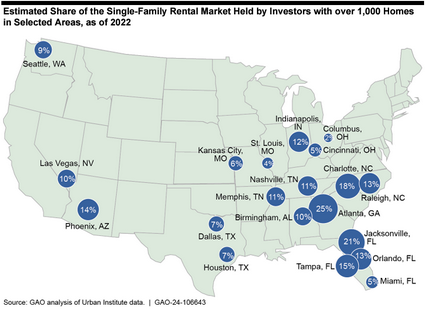
  • According to SFR Analytics, the top 24 SFR owners control just over 520,000 homes—about 3.5% of rental homes and less than 1% of the total single-family housing stock—underscoring the limited market impact of large investors. (Bloomberg, Jan. 7)
  • Single-family rentals expanded after the Great Financial Crisis in 2008-2009 as investors helped absorb foreclosures, stabilize neighborhoods, and provide rental housing for households unable to buy.  (Federal Reserve Bank of St. Louis, Oct. 2025)
  • A 2024 Government Accountability Office (GAO) report found that large institutional investment expanded rental-housing options, helped stabilize neighborhoods after the financial crisis, and improved access to quality communities for low- and middle-income households. (GAO Report Highlights | Full GAO Report) (Roundtable Weekly, June 2024)
  • The GAO study also found that large-scale SFR showed that many working families desire the space provided by single-family homes, but may have low credit scores and otherwise can’t afford to buy them. Renting is commonly their best option for moving into better neighborhoods and school districts.
  • Another study out of UNC Charlotte, released in May 2024, finds that children from low- and moderate-income households see improved achievements in school when they rent single-family homes in neighborhoods where they cannot afford to buy.  (UNC Study Highlights | Full UNC Report, 2024)
  • An August 2025 report from the American Enterprise Institute found that institutional investors are not a primary driver of housing unaffordability, noting that housing shortages stem largely from restrictive zoning, limited new construction, and inflationary pressures. (American Enterprise Institute Report, Aug. 2025)
  • Stephen Scherr, co-president of Pretium Partners, which owns Progress Residential (RER member) one of the nation’s largest SFR operators, said on CNBC today that institutional investors help expand housing supply by de-risking large developments through purchase commitments that enable projects to move forward. He added that many renters they serve are not mortgage-eligible and use renting as a pathway to eventual homeownership. (CNBC, Jan. 9)

Roundtable View

  • Expanding the supply of housing across the geographic and economic spectrum is essential for the nation’s economic vitality.
  • Large-scale SFR investments have helped revitalize distressed properties and communities, contributing to economic growth and stability.
  • The Real Estate Roundtable (RER) has consistently emphasized that restricting capital will not solve the affordability crisis, and that increasing housing supply is the most effective path forward.
  • RER President and CEO Jeffrey DeBoer said: “Access to affordable housing is central to the American Dream, a dream that for some families means renting a home and for others means owning a home. For more than a decade, our nation’s supply of both owner-occupied and rental housing has, for a variety of reasons, not kept up with demand. This gap between supply and demand is the true cause of today’s housing crisis. The supply of housing must be increased.”
  • “This will require, among other actions, common sense policy reforms to local permitting and zoning regulations, recognizing in both national and local policy actions the reality of escalating labor and material costs and, importantly, the need to maintain and improve incentives to encourage the capital needed to develop, redevelop, and modernize the nation’s housing stock,” DeBoer said. "We work with all policymakers to advance initiatives that remove barriers to housing development, incentivize capital investment in housing, and help people achieve the American Dream.” 
  • In March 2025, RER and Nareit submitted comments to the Federal Trade Commission (FTC) in response to the agency’s inquiry into the impact of large-scale SFR operators and institutional investors on home prices and rents. (Letter, March 2025)
  • The letter emphasized that institutional investors account for a small fraction of home purchases and play a limited, but constructive role in expanding supply, rather than driving affordability challenges. (Roundtable Weekly, March 2025)
  • This week, RER member Sean Dobson (Chairman, CEO & CIO, Amherst) said restricting investment would not improve affordability. “Banning investors from putting capital into the housing market is not going to make affordability any better,” Dobson said during an appearance on Wednesday on Bloomberg Markets. (Bloomberg, Jan. 7)

Without meaningful steps to expand housing supply, proposals to limit institutional participation are unlikely to address the root causes of affordability pressures facing renters and would-be homebuyers, reinforcing RER’s ongoing work with policymakers and the administration to promote policies that increase housing supply and improve affordability.

Congressional Spending Package Preserves ENERGY STAR Funding

A bipartisan, three-bill “minibus” appropriations package advanced by the House on Thursday preserves funding for ENERGY STAR, ensuring continued support through the end of the federal fiscal year for the voluntary public-private partnership focused on energy efficiency in buildings and appliances. (PoliticoPro, Jan. 8)

State of Play

  • The House passed the minibus on a bipartisan 397–28 vote. The package now heads to the Senate, which is expected to take up the measure as early as next week. (The Hill, Jan. 8)
  • The bill funds the Departments of Energy, Commerce, Interior, and Justice, along with water programs, the Environmental Protection Agency (EPA), and certain federal science initiatives through Sept. 30, the end of the current fiscal year.
  • The package reflects weeks of bicameral negotiations following last month’s deal on overall spending levels.
  • House Appropriations Chair Tom Cole (R- OK) defended the bills as the product of “bipartisan, bicameral consensus” and a member-driven process. (Politico, Jan. 9)
  • The final agreement largely rejected dramatic reductions sought by the White House last spring, opting instead for more targeted spending adjustments to energy and environmental programs. (PoliticoPro, Jan. 8)

Why It Matters

  • ENERGY STAR is a long-standing, market-based program that helps lower energy costs and supports “retrofit” investments for all commercial real estate asset classes.
  • The outcome builds on bipartisan actions last summer, when both House and Senate appropriators separately advanced bills supporting FY’26 ENERGY STAR funding. (Roundtable Weekly, July 25)
  • RER has long urged the “business case” to support the ENERGY STAR program. It is working with a coalition of multi-industry partners in the real estate, manufacturing, consumer tech, and retail sectors to explain to Congress and the administration why ENERGY STAR is critical to the national “energy dominance” agenda. (Roundtable Weekly, June 6; May 23).  

What’s Next

  • The minibus is expected to clear Congress before the current stopgap continuing resolution expires on Jan. 31.
  • Appropriators are preparing additional spending packages later this month, though several major funding bills—including Defense, Labor-HHS-Education, and Homeland Security have yet to be finalized.

These developments, alongside issues related to AI-driven power demand, grid reliability, and permitting reform, will be featured at RER’s upcoming Sustainability Policy Advisory Committee (SPAC) meeting on Jan. 21 in Washington, D.C.

OECD Carves Out U.S. Companies from Global Minimum Tax, Reducing Risk of Retaliatory Taxes on Foreign Real Estate Investors

After months of negotiations, global tax talks produced an agreement at the Organization for Economic Co-operation and Development (OECD) that exempts U.S.-headquartered companies from Pillar Two’s global minimum tax and reduces the risk of retaliatory taxes that could have affected foreign investment in commercial real estate. (ABCNews, Jan. 6)

State of Play

  • Nearly 150 jurisdictions agreed to new Pillar Two guidance, including a long-sought “side-by-side” safe harbor that shields U.S. multinationals from key global minimum tax rules. U.S. companies will remain subject only to existing U.S. global minimum taxes. (Reuters, Jan. 6)
  • The Trump administration renegotiated the framework in June after congressional Republicans removed a proposed retaliatory tax—Section 899—from the One Big Beautiful Bill Act (OB3 Act).
  • The agreement formally recognizes U.S. tax sovereignty over the worldwide operations of American companies, while preserving other countries’ authority to tax business activity within their borders. (OECD Press Release, Jan. 5)
  • Senate Finance Chairman Mike Crapo and House Ways and Means Chairman Jason Smith praised the outcome but warned that Congress remains prepared to revive retaliatory tax measures if countries delay or fail to implement the agreement. (Sen. Crapo and Rep. Smith Press Release, Jan. 5)
  • They emphasized that Republicans rolled back those measures earlier this year only after the G7 publicly committed to respecting U.S. tax sovereignty—and said that warning “remains today” as implementation begins.
  • Treasury Secretary Scott Bessent called the agreement “a historic victory” that protects American workers and businesses from extraterritorial taxation. (Press Release, Jan. 5)

Why It Matters

  • During negotiations for the OB3 Act, RER and other industry groups warned that Section 899 would deter foreign investment, weaken capital formation, increase borrowing costs, and dampen property values. (Roundtable Weekly, Sept. 12)
  • Section 899 would have generated significant uncertainty for foreign real estate investors, with applicable tax rates potentially shifting year to year or across administrations.
  • The provision would have extended to a wide range of passive investors—including sovereign wealth funds, pension funds, high-net-worth individuals, and insurance companies—with the economic burden often falling on U.S. borrowers under typical loan covenants that shift tax-law risk to domestic parties.

RER's Tax Policy Advisory Committee (TPAC) will review implications for U.S. real estate investment and global capital flows at the State of the Industry Meeting on Jan. 22, 2026, in Washington, D.C.