
Senate Takes Up House Housing Bill as White House Seeks Limits on Institutional Investors

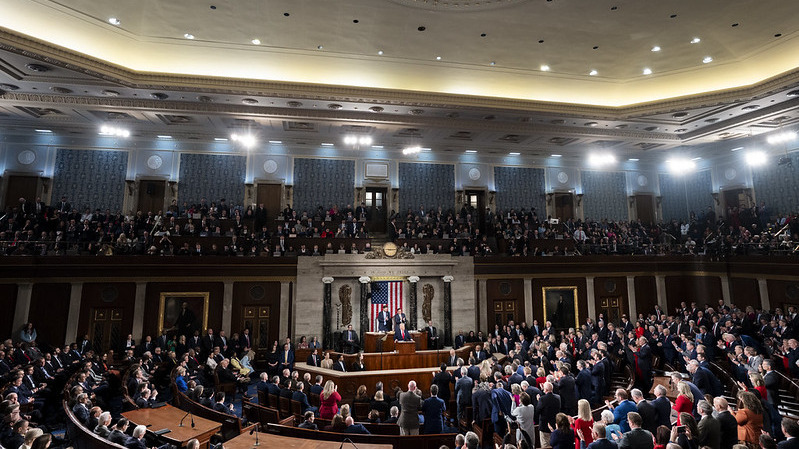
President Donald Trump used his State of the Union address on Tuesday to renew his call for Congress to codify limits on large institutional investors buying additional single-family homes, as lawmakers work to merge bipartisan House and Senate housing packages into a final deal set for a vote next week. (Axios | PoliticoPro, Feb. 25)

State of Play

  • “We want homes for people, not for corporations,” Trump said as he urged Congress to make the policy permanent. (PoliticoPro, Feb. 25)
  • House Republicans met this week with Treasury Secretary Scott Bessent as lawmakers explore legislative language tied to the housing package. Trump and Bessent have said that any final legislation must include language banning large investors from purchasing single-family. (Reuters, Feb. 19 | PoliticoPro, Feb. 26)
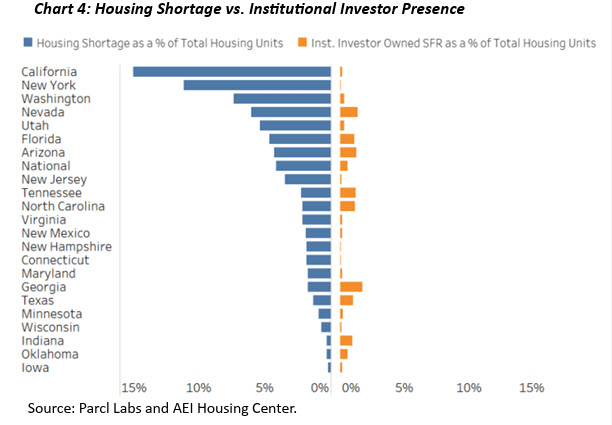
  • Some lawmakers and analysts have argued that investor bans do not address the core affordability driver—a persistent housing supply shortage. Goldman Sachs estimates the U.S. would need to build up to 4 million additional homes beyond the normal pace to reduce the deficit. (CBSNews, Feb. 25 |Washington Examiner, Feb. 26)

What’s Next: Bipartisan Housing Bill Vote

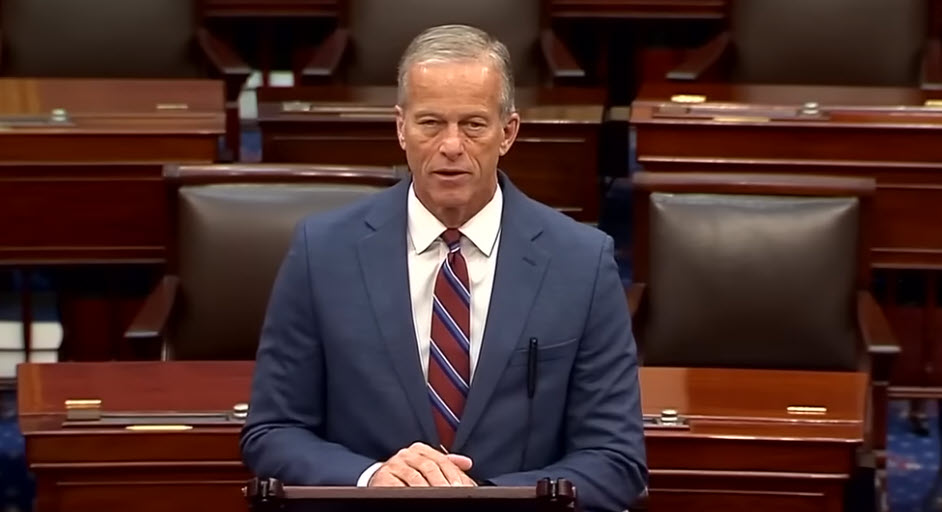
  • Senate Majority Leader John Thune (R-SD) filed cloture Thursday on the House-passed  Housing for the 21st Century Act (H.R. 6644), setting up a Monday vote on the motion to proceed as leadership uses the House bill as the vehicle for a version of the Senate Banking Committee’s ROAD to Housing Act. (PoliticoPro, Feb. 26 |Roundtable Weekly, Feb. 13)
  • The House passed the bipartisan bill earlier this month with broad support, and the Senate advanced its bill in October. The two sides are now negotiating a final package. (PoliticoPro, Feb. 26 | Roundtable Weekly, Oct. 17)
  • Senate aides said the Senate package could include some provisions from the House’s bill, including measures to expand manufactured and affordable housing and protect borrowers. The Senate measure wouldn’t include the House version’s community banking provisions. (PoliticoPro, Feb. 26)
  • House Financial Services Chair French Hill (R-AR) welcomed Majority Leader Thune’s move but urged a final product that reflects “shared priorities of the House, Senate, and White House,” as the administration continues to press for some form of large-investor purchase restriction to be included in any final bipartisan housing deal. (Press Release, Feb. 26)

White House Proposal

  • In a memo sent to lawmakers last week, the administration proposed banning institutional investors who own more than 100 single-family homes from buying any new ones. (CNBC, Feb. 24)
  • The proposal would continue to allow build-to-rent developments, where investors construct new single-family homes specifically for rental use. (WSJ, Feb. 26)
  • Government entities and community land trusts would be exempt altogether, and the Treasury Department would retain authority to approve other transactions deemed to expand homeownership opportunities, giving regulators flexibility to avoid unintended consequences for buyers and renters.
  • Treasury’s forthcoming definitions of “large institutional investor” and “single-family home” are expected to shape scope and compliance, including what property types are captured and how thresholds are applied. (GlobeSt., Feb 26)
  • The ban would apply only to future purchases—without forcing investors to sell existing holdings—and would take effect 180 days after enactment. (CoStar, Feb. 20)

By the Numbers

  • A recent American Action Forum analysis found that large institutional investors have expanded the much-needed supply of rental homes, improved housing quality, and added liquidity in under supplied markets. (AAF Study, Feb. 12)
  • A Chandan Economics review of Census Bureau data finds individual investors—not institutions—own the largest share of U.S. single-family rentals (SFRs). The analysis draws on the Census Bureau’s 2024 Rental Housing Finance Survey (data collected June-November 2024), a comprehensive snapshot of rental-property mortgage financing. (Chandan Economics, Feb. 19 |GlobeSt., Feb. 25)

RER Advocacy

  • The Real Estate Roundtable (RER) has consistently emphasized that expanding housing supply is the most effective path to improving affordability, as research shows affordability pressures are driven primarily by supply shortages, construction costs, and mortgage ratesnot institutional ownership levels. (Roundtable Weekly, Jan. 9 | Jan. 16)
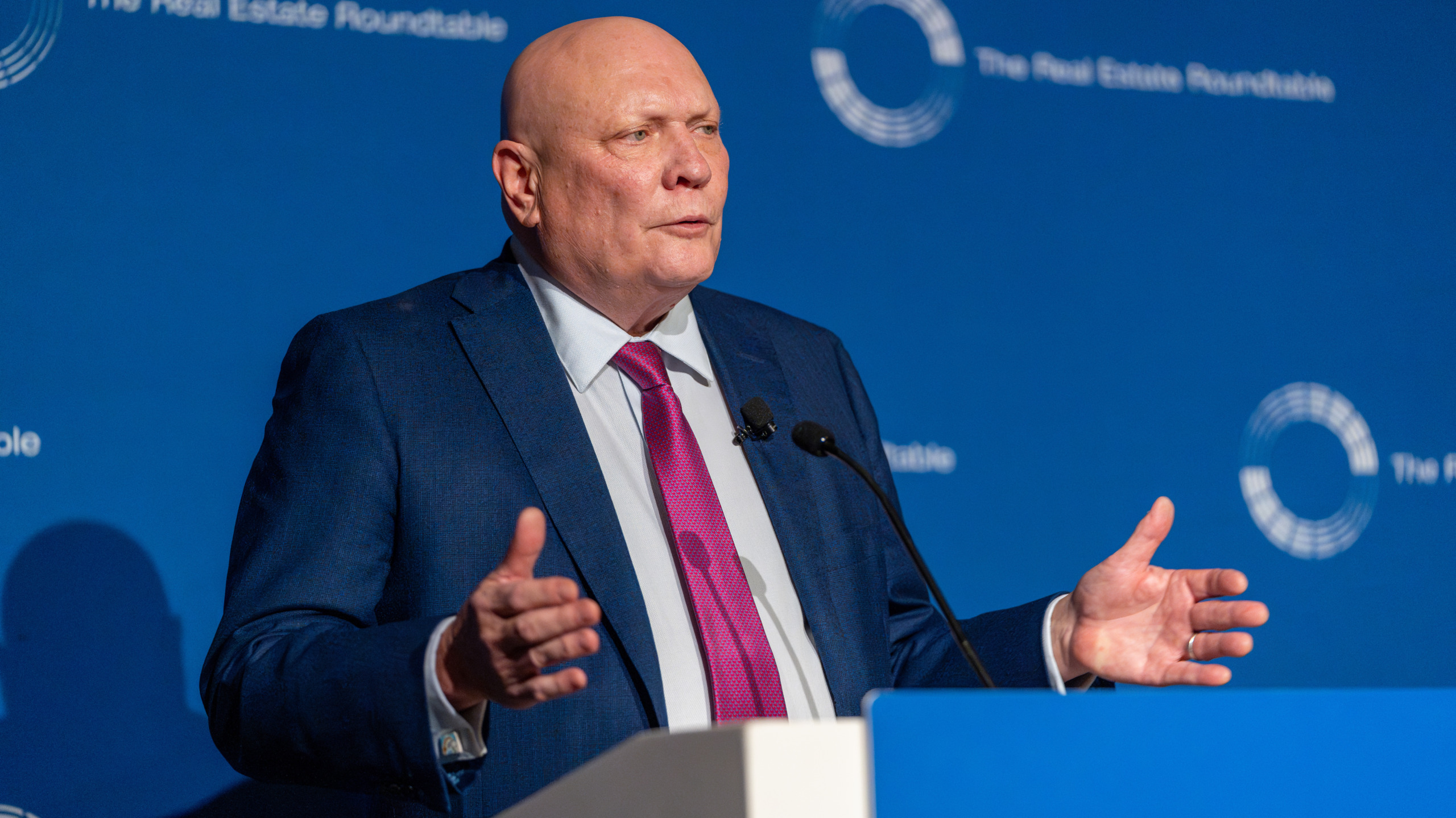
  • RER President & CEO Jeffrey DeBoer said, “Evidence shows that policy attacks on institutional investment in housing or other real estate are misguided.  Institutional investors actually expand the supply of rental homes, thus driving down rents. Their investments enable financially constrained families to move into neighborhoods that previously had few rental units, and these investments tend to improve the quality of the existing housing stock. While politically popular, restricting capital into housing will not address the housing problem.  Instead, policy should, as the bulk of the House and Senate bills do, intensely focus on expanding the supply of housing.”
  • In a Feb. 10 comment letter to House Financial Services Committee leadership, RER and national real estate trade groups cautioned against limiting institutional capital in the housing market, including SFR assets. (Comment Letter, Feb. 10 | Roundtable Weekly, Feb. 13)

New Senate Legislation Introduced

  • On Tuesday, Sens. Elizabeth Warren (D-MA), and Jeff Merkley (D-OR), and 16 other Senate Democrats introduced the American Homeownership Act. The bill would prevent companies with more than 50 single-family homes for rent from taking deductions for housing value depreciation and mortgage interest payments. Corporations would also be barred from getting federally backed mortgages. (Bill text | Bill fact sheet | Press Release, Feb. 24)
  • The bill would provide a temporary carve-out for companies building new multifamily housing or rehabilitating properties that would otherwise be uninhabitable. (CNBC, Feb. 24)
  • Edward Pinto, co-director of the AEI Housing Center at the American Enterprise Institute, said a more effective proposal would meet three specific criteria: reducing land costs, allowing homes to be built on smaller parcels, and lowering construction costs. (CBS News, Feb. 25)

RER will continue advocating for policies that expand housing supply and protect the capital formation needed to build and preserve housing—rather than measures that risk constraining investment without solving the underlying shortage.

Fed Holds Rates Steady as Housing Affordability Pressures Shape Policy Debate

The Federal Reserve building in Washington, DC

After the Federal Reserve’s Federal Open Market Committee (FOMC) concluded its January meeting on Wednesday by holding rates steady at 3.5 percent to 3.75 percent, President Donald Trump announced today he is nominating former Fed governor Kevin Warsh as the next Fed chair. (Axios, Jan. 30 | CBS News, Jan. 28)

Fed Chair

  • “I have known Kevin for a long period of time, and have no doubt that he will go down as one of the GREAT Fed Chairmen, maybe the best,” said Trump in a Truth Social post announcing the selection. (CNBC, Jan. 30)
  • Warsh still needs Senate confirmation and, if approved, would take over in May when Powell’s term expires.

Key Takeaways

  • The FOMC voted 10-2 to maintain rates, with Governors Stephen Miran and Christopher Waller dissenting in favor of an additional quarter-point cut. While most Fed officials still expect further reductions in 2026, Chair Powell emphasized that decisions will remain “data dependent.” (Fed statement, Jan. 28)
  • Fed Chair Jerome Powell said the economic outlook has “clearly improved” since the Committee’s December meeting.
  • Fed Chair Jerome Powell said the economic outlook has “clearly improved” since the Committee’s December meeting.
  • He cited growth and signs of stabilization in the labor market, while emphasizing that policymakers want greater confidence that inflation is moving toward the Fed’s 2 percent target before resuming rate cuts.
  • The U.S. economy grew at a 4.4 percent annual rate in the third quarter of 2025. Chair Powell noted that this performance suggests that interest rates are not currently restrictive enough to materially slow economic activity. (AP, Jan. 28)
  • Inflation remains above target, with the Fed’s preferred measure running near 2.8 percent late last year. Chair Powell acknowledged that recent tariff-related price pressures have lifted goods inflation but suggested those effects are likely temporary and could begin easing later this year. (AP, Jan. 28)
  • The Fed’s decision to hold rates steady reinforces expectations that borrowing costs will remain elevated through at least mid-year.
  • For commercial real estate, sustained higher-for-longer rates continue to place pressure on refinancing, valuations, and transaction activity.

Institutional Investor Legislation Introduced

  • Against this backdrop of a pause in rate cuts and broader concerns about housing affordability, lawmakers have renewed efforts to target institutional participation in the single-family housing market.
  • On Jan. 20, Reps. Summer Lee (D-PA), Ro Khanna (D-CA), Mark Takano (D-CA), and Jill Tokuda (D-HI) reintroduced the Stop Wall Street Landlords Act (H.R. 7138). (Press Release, Jan. 20)
  • The bill would deny mortgage interest, insurance, and depreciation deductions for large institutional investors that own single-family homes and impose a 100 percent federal real estate transfer tax on covered properties that are not sold within 18 months of enactment, with proceeds used to fund the federal Housing Trust Fund.
  • The proposal would also bar the Federal Housing Financial Agency, Fannie Mae, Freddie Mac, and Ginnie Mae from supporting single-family mortgages tied to large institutional investors. (CNBC, Jan. 18)
  • Other legislation aimed at restricting institutional investment in the single family rental market include:
  • Rep. Mary Miller (R-IL) introduced the American Family Housing Act (H.R. 7186), co-sponsored by Rep. Buddy Carter (R-GA), which would direct the SEC to enforce restrictions on large institutional investors (those with more than $100 billion in assets under management) from purchasing single-family homes. Rep. Miller serves on the House Agriculture Committee and Rep. Carter on the House Budget Committee.
  • The debate has taken on added political significance following President Trump’s recent statements and Executive Order on curtailing institutional ownership of single-family homes. (CNBC, Jan. 18 | Roundtable Weekly, Jan. 23)

Looking Ahead

  • Proposals such as the Stop Wall Street Landlords Act risk could further restrict housing supply and access to capital at a time when liquidity and investment are already under pressure.
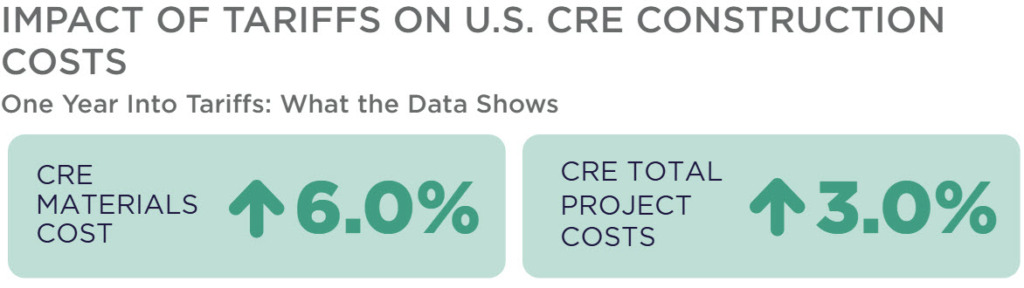
  • As The Real Estate Roundtable (RER) and partners have emphasized, targeting institutional investment does not address the core drivers of unaffordability: high mortgage rates, rising construction costs, labor shortages, and restrictive zoning that limits housing supply. (Roundtable Weekly, Jan. 9)

RER will continue to engage policymakers about the importance of expanding housing supply, preserving access to capital, and maintaining regulatory flexibility to support long-term stability for the commercial real estate industry and the overall economy.

Trump Proposes Restricting Institutional Investment in Single-Family Housing

President Donald Trump on Wednesday said he would move to ban “large institutional investors” from purchasing single-family homes, framing the proposal as part of a broader push to improve housing affordability. (Washington Post | CNBC, Jan. 7)

State of Play

  • “I am immediately taking steps to ban large institutional investors from buying more single-family homes, and I will be calling on Congress to codify it. People live in homes, not corporations,” Trump wrote in a post on Truth Social. (Bloomberg, Jan. 8)
  • He indicated plans to discuss the issue at the World Economic Forum in Davos, Switzerland, later this month. (WSJ, Jan. 7)
  • The White House did not specify what executive actions, if any, would be taken, nor how it would define “large institutional investors.”
  • As currently described, the proposal would apply only to future acquisitions and would not require existing owners to divest their single-family rental (SFR) portfolios. (GlobeSt., Jan. 8)
  • Codifying a ban would require clear statutory language passed by Congress and signed into law—raising complex questions around thresholds, exemptions, and enforcement.
  • Legal challenges would likely follow, including claims related to takings, equal protection, and interstate commerce. Absent congressional authorization, the executive branch lacks clear authority to impose such a restriction solely through regulation. (Propmodo, Jan. 8)
  • Former House Financial Services Committee Chair Patrick McHenry said on Bloomberg on Thursday that housing affordability challenges are driven largely by state and local land-use and regulatory barriers, noting that institutional investors account for only a small share of the housing market. (Bloomberg, Jan. 8)
  • Also this week, Trump wrote on Truth Social that he is directing Fannie Mae and Freddie Mac to purchase $200 billion in mortgage bonds to address the national housing affordability crisis. Federal Housing Finance Director Bill Pulte said in an interview that Fannie and Freddie Mac will carry out the president’s directive by purchasing $200 billion in mortgage-backed securities from the public market. (Politico | Bloomberg, Jan. 9)

What the Data Shows

GAO Report
  • Research consistently finds that housing affordability pressures stem primarily from chronic supply shortages, high construction costs, and elevated mortgage rates—not institutional ownership levels.
  • According to SFR Analytics, the top 24 SFR owners control just over 520,000 homes—about 3.5% of rental homes and less than 1% of the total single-family housing stock—underscoring the limited market impact of large investors. (Bloomberg, Jan. 7)
  • Single-family rentals expanded after the Great Financial Crisis in 2008-2009 as investors helped absorb foreclosures, stabilize neighborhoods, and provide rental housing for households unable to buy.  (Federal Reserve Bank of St. Louis, Oct. 2025)
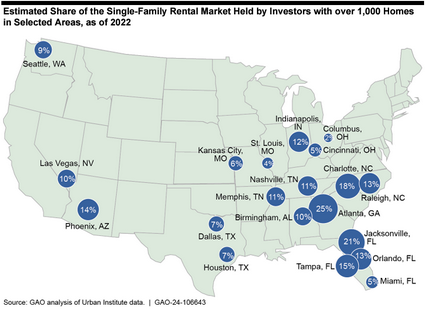
  • A 2024 Government Accountability Office (GAO) report found that large institutional investment expanded rental-housing options, helped stabilize neighborhoods after the financial crisis, and improved access to quality communities for low- and middle-income households. (GAO Report Highlights | Full GAO Report) (Roundtable Weekly, June 2024)
  • The GAO study also found that large-scale SFR showed that many working families desire the space provided by single-family homes, but may have low credit scores and otherwise can’t afford to buy them. Renting is commonly their best option for moving into better neighborhoods and school districts.
  • Another study out of UNC Charlotte, released in May 2024, finds that children from low- and moderate-income households see improved achievements in school when they rent single-family homes in neighborhoods where they cannot afford to buy.  (UNC Study Highlights | Full UNC Report, 2024)
  • An August 2025 report from the American Enterprise Institute found that institutional investors are not a primary driver of housing unaffordability, noting that housing shortages stem largely from restrictive zoning, limited new construction, and inflationary pressures. (American Enterprise Institute Report, Aug. 2025)
  • Stephen Scherr, co-president of Pretium Partners, which owns Progress Residential (RER member) one of the nation’s largest SFR operators, said on CNBC today that institutional investors help expand housing supply by de-risking large developments through purchase commitments that enable projects to move forward. He added that many renters they serve are not mortgage-eligible and use renting as a pathway to eventual homeownership. (CNBC, Jan. 9)

Roundtable View

  • Expanding the supply of housing across the geographic and economic spectrum is essential for the nation’s economic vitality.
  • Large-scale SFR investments have helped revitalize distressed properties and communities, contributing to economic growth and stability.
  • The Real Estate Roundtable (RER) has consistently emphasized that restricting capital will not solve the affordability crisis, and that increasing housing supply is the most effective path forward.
  • RER President and CEO Jeffrey DeBoer said: “Access to affordable housing is central to the American Dream, a dream that for some families means renting a home and for others means owning a home. For more than a decade, our nation’s supply of both owner-occupied and rental housing has, for a variety of reasons, not kept up with demand. This gap between supply and demand is the true cause of today’s housing crisis. The supply of housing must be increased.”
  • “This will require, among other actions, common sense policy reforms to local permitting and zoning regulations, recognizing in both national and local policy actions the reality of escalating labor and material costs and, importantly, the need to maintain and improve incentives to encourage the capital needed to develop, redevelop, and modernize the nation’s housing stock,” DeBoer said. “We work with all policymakers to advance initiatives that remove barriers to housing development, incentivize capital investment in housing, and help people achieve the American Dream.” 
  • In March 2025, RER and Nareit submitted comments to the Federal Trade Commission (FTC) in response to the agency’s inquiry into the impact of large-scale SFR operators and institutional investors on home prices and rents. (Letter, March 2025)
  • The letter emphasized that institutional investors account for a small fraction of home purchases and play a limited, but constructive role in expanding supply, rather than driving affordability challenges. (Roundtable Weekly, March 2025)
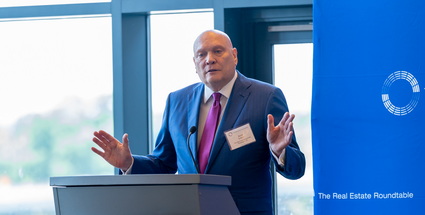
  • This week, RER member Sean Dobson (Chairman, CEO & CIO, Amherst) said restricting investment would not improve affordability. “Banning investors from putting capital into the housing market is not going to make affordability any better,” Dobson said during an appearance on Wednesday on Bloomberg Markets. (Bloomberg, Jan. 7)

Without meaningful steps to expand housing supply, proposals to limit institutional participation are unlikely to address the root causes of affordability pressures facing renters and would-be homebuyers, reinforcing RER’s ongoing work with policymakers and the administration to promote policies that increase housing supply and improve affordability.