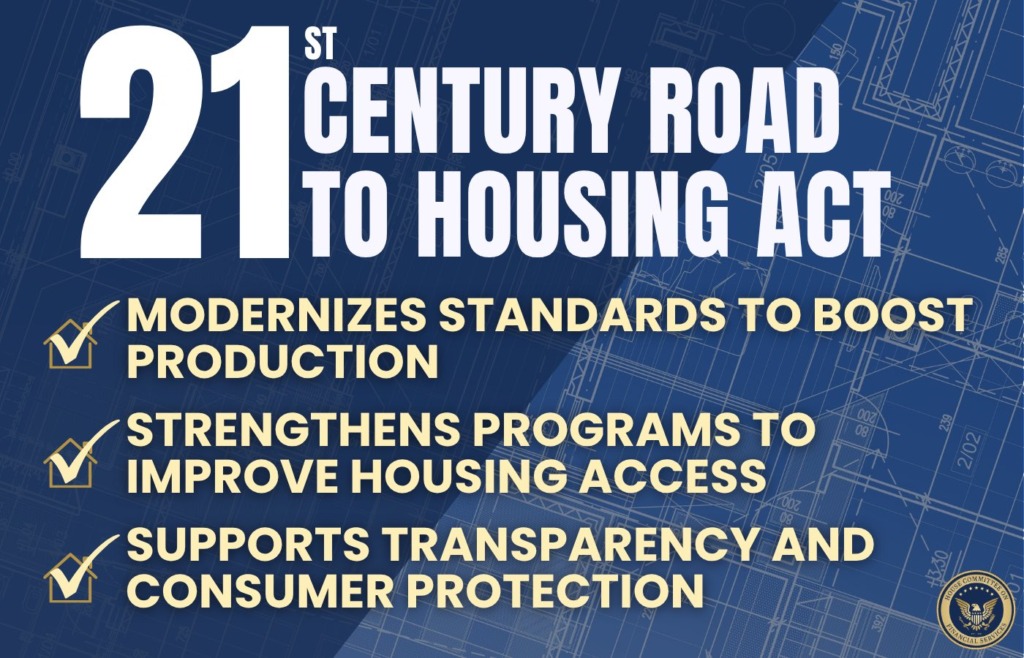
The landmark, bipartisan, bicameral 21st Century ROAD to Housing Act became law Saturday without President Trump’s signature, culminating months of congressional work and advocacy by The Real Estate Roundtable and its housing coalition partners. (NYT, July 11| Bill Text | One-pager | Section-by-Section, June 24)
State of Play
The Senate approved the final package 85–5 on June 22, followed by a 358–32 vote in the House on June 23. (Roundtable Weekly, June 26)
President Trump canceled a planned June 24 signing ceremony and later declined to sign the measure in protest over the Senate’s failure to pass the unrelated SAVE America Act. (Axios, July 10 | 11)
Because he neither signed nor vetoed the housing bill, it became law July 11 under the Constitution’s 10-day provision. (CBS News, July 11)
The bill was championed by House Financial Services Committee Chairman French Hill (R-AR), Ranking Member Maxine Waters (D-CA), Senate Banking Committee Chairman Tim Scott (R-SC), and Ranking Member Elizabeth Warren (D-MA).
“Homeownership should be within reach for more Americans, and this law moves us closer to that goal,” Chairman Hill said Saturday. (Rep. Hill Press Release, July 11)
Why It Matters
The bill is the most consequential housing package in a generation, with reforms aimed at increasing housing supply, boosting homeownership, and improving affordability. (One-pager | Section-by-Section, June 24)
The package advances major reforms to modernize federal housing programs, streamline environmental reviews, reduce barriers to construction, support manufactured housing, build more homes in Opportunity Zones, encourage transit-oriented development, and promote local zoning and land-use reforms. (Roundtable Weekly, May 22 | June 18)
For RER, a significant achievement is the removal of the Senate bill’s unconstitutional seven-year forced-sale mandate, which would have required certain owners to sell newly constructed build-to-rent homes to individual buyers. (RER Fact Sheet, July 17)
RER and other housing stakeholders warned that the mandate would be counterproductive—discouraging new construction and undermining efforts to increase housing supply.
RER Advocacy
Over the past several months, RER and its housing partners worked throughout the legislative process to preserve the package’s supply-focused reforms and remove the forced-sale mandate targeting build-to-rent housing through letters to Congress, coalition letters of support, and direct engagement with lawmakers.
RER also led efforts to raise constitutional concerns about the Senate’s forced-sale mandate, through a white paper by former U.S. Solicitor General Paul Clement, which characterized the provision as an unprecedented federal market intervention and outlined a “triple threat” to the U.S. Constitution. (RER’s One Pager, May 18 | RER Letter, May 12 | Roundtable Weekly, April 17)
“Enactment of the 21st Century ROAD to Housing Act is a historic bipartisan achievement that will help expand housing supply, reduce barriers to construction, and improve affordability nationwide,” said RER President and CEO Jeffrey DeBoer.
“This law protects private property rights and preserves the capital needed to build more homes, while advancing practical reforms to reduce regulatory barriers, modernize federal housing programs, and expand rental and homeownership opportunities. We commend Chairman Hill, Ranking Member Waters, Chairman Scott, Ranking Member Warren, and congressional leaders for their persistence in getting this comprehensive package across the finish line.” DeBoer said. (RER Fact Sheet, June 8)
DeBoer noted that the reforms will take time to reach the housing marketplace. “These reforms are significant, but they will take time to fully filter into the housing marketplace and begin correcting the supply imbalance caused by years of underbuilding and regulatory barriers,” DeBoer said. (RER Statement, June 18)
What’s Next
The institutional investor purchase restrictions are scheduled to take effect six months after enactment and expire after 15 years.
HUD, working with the Treasury, the Securities and Exchange Commission, and the Federal Housing Finance Agency, is directed to develop and implement regulations to avoid adverse effects on consumers and communities.
As federal agencies begin implementing the law’s numerous housing and banking provisions, RER will remain engaged throughout the process.


 Menu
Close
Menu
Close
 About Us