Category: News
Roundtable Comment Letter Recommends Additional Guidance from Treasury and IRS to Accelerate Capital Investment in Opportunity Zones
This week the Real Estate Roundtable provided formal comments regarding opportunity zones to the Treasury Department and the IRS. The letter encourages Treasury to clarify a number of tax issues that would remove uncertainty for potential investors and opportunity fund managers. This is the second Roundtable comment letter on opportunity zones, following Treasury’s publication of proposed regulations in October. ( Roundtable Weekly, Oct. 19)
![]() |
|
This week the Real Estate Roundtable provided formal comments regarding opportunity zones to the Treasury Department and the IRS. |
- The October proposed rules provided a strong foundation for opportunity fund formation and investment. Building on the rules, the Roundtable letter prioritizes five areas where additional guidance from Treasury would accelerate the pooling of capital and job creation in opportunity zones. The letter recommends that Treasury:
- Remove barriers to the formation of multi-asset opportunity funds through flexible exit rules;
- Clarify the circumstances in which land and previously vacant buildings constitute qualified opportunity zone business property;
- Allow appropriate refinancing of opportunity fund assets and avoid overly restrictive debt-distribution rules;
- Encourage continued investment in opportunity zones with flexible gain reinvestment, roll-over, and holding period rules at the investor, fund, and business level; and
- Provide additional protections in the working capital safe harbor and the substantial improvement rules for taxpayers making a good faith effort to comply with opportunity zone requirements.
- “Real estate development and redevelopment is a key component of any region’s economic strength and growth, wrote Roundtable President and CEO Jeffrey D. DeBoer. “The Roundtable foresees opportunity fund investors and fund managers actively partnering with local leaders and entrepreneurs on projects that both drive economic activity and respond to the needs of communities. Additional guidance along the lines described above will help ensure that the opportunity zone incentives fulfill their ambitious objectives.”
- The Treasury Department could issue a second set of proposed regulations on opportunity zones as soon as January, according to Treasury Assistant Secretary David Kautter (Roundtable Weekly, Dec. 14).
- The underlying legislation directs Treasury to report to Congress on opportunity zones’ effectiveness. The Roundtable letter encourages Treasury to consider, as part of its reporting, the aggregate impact of opportunity zone investments on the overall health and wellbeing of targeted communities, including the impact on the local tax base, surrounding infrastructure, and their ability to attract and retain employers.
The Roundtable comments are the product of an active Tax Policy Advisory Committee (TPAC) Opportunity Zone Working Group that includes leading real estate developers, owners, investors, lenders, industry organizations, and outside advisors. The TPAC working group will continue to work closely with government officials to help ensure the program fulfills its ambitious objective of stimulating economic development and job creation in low-income communities.
White House Executive Order Aims to Stimulate Opportunity Zone Investment by Channeling Federal Resources; Additional OZ Regulations Expected in January
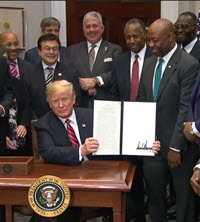
President Trump on Dec. 12 signed an Executive Order that seeks to facilitate long-term equity investment in new Opportunity Zones and other low-income communities. The order formally established the White House Opportunity and Revitalization Council. (White House statement and PBS Video, Dec. 12)
![]() |
|
President Trump on Dec. 12 signed an Executive Order that seeks to facilitate long-term equity investment in new Opportunity Zones and other low-income communities. (White House statement and PBS Video) |
- Congress created Opportunity Zones in the 2017 Tax Cuts and Jobs Act to encourage long-term, capital investment in economically struggling, low-income communities. Opportunity Funds that invest in tangible business property, such as real estate, located in a qualifying zone are eligible for tax benefits that are tied to the investment holding period. The capital gain on an Opportunity Fund investment is excluded from tax altogether if the asset is held for 10 years or more.
- In June 2018, the Treasury Department designated 8,761 communities in all 50 States, the District of Columbia, and five Territories as Opportunity Zones. (IRS Notice 2018-48 and Roundtable Weekly, June 22)
- The new Council will lead joint efforts across executive departments and agencies to implement reforms that streamline existing regulations, optimize the use of federal resources, and align the requirements for public and private investment programs in economically distressed communities. The Council will also present the President with a number of reports identifying and recommending ways to encourage investment in these areas. (White House statement, Dec. 12). The White House signing was live streamed and included comments from Sen. Tim Scott (R-SC), the original author and sponsor of Opportunity Zone legislation. (New York Times, Jan. 29, 2018)
- The Council-chaired by Secretary of Housing and Urban Development Ben Carson-will be comprised of officials from 13 Federal agencies and include Treasury Secretary Steven Mnuchin and Commerce Secretary Wilbur Ross.
Second Round of Opportunity Zone Regulations Expected in January
- The Treasury Department released its first round of Proposed Regulations governing the Opportunity Zone program in October. An Oct. 26 GlobeSt.com interview with Real Estate Roundtable President & CEO Jeffrey DeBoer and Roundtable SVP and Counsel Ryan McCormick focused on the initial regulatory guidance and its implications for the real estate industry.

The next round of Opportunity Zone regulations may be released in January, according to Treasury Assistant Secretary for Tax Policy David Kautter, above. (Tax Notes, Dec. 14).
- The next round of Opportunity Zone regulations may be released in January, according to Treasury Assistant Secretary for Tax Policy David Kautter. (Tax Notes, Dec. 14)
- The day after the White House Executive Order signing, Kautter told reporters that it would be “about January before we come out with additional guidance.” Kauter noted, “The first set of regulations was designed to provide rules for getting funds up and operating, and the second set of rules is more about the operational aspects of the funds themselves.”
- According to the New York Times, an anonymous administration official said Tuesday that the coming regulations would include reporting requirements for investments in Opportunity Zones to evaluate the program‘s impact. (New York Times, Dec. 12)
The Roundtable’s Tax Policy Advisory Committee (TPAC) recently convened a panel on Opportunity Zones that included the tax counsel for Senator Tim Scott (R-SC). TPAC’s Opportunity Zone Working Group is developing additional comments on how the industry can help the program fulfill its ambitious objective of stimulating economic development and job creation in low-income communities. (Roundtable Comment Letter, June 28 and Roundtable Weekly, July 20)
ECONOMIC GROWTH – TRAVEL & TOURISM
Roundtable Comments Support Proposed Implementation Rule for High Volatility Commercial Real Estate Loans
The Real Estate Roundtable’s support for a federal proposal that would implement modified capital rules for High Volatility Commercial Real Estate (HVCRE) loan exposures is detailed in a Nov. 26 comment letter to three banking agencies. The Agencies — tasked with developing a rule consistent with Section 214 of the Economic Growth, Regulatory Relief, and Consumer Protection Act (S. 2155) to clarify the capital treatment of HVCRE Acquisition, Development, or Construction (ADC) loans — invited comments on their Notice of Proposed Rulemaking. (Roundtable Weekly, May 25)
![]() |
|
The Real Estate Roundtable’s support for a federal proposal that would implement modified capital rules for High Volatility Commercial Real Estate (HVCRE) loan exposures is detailed in a Nov. 26 comment letter to three banking agencies.. |
- The Roundtable’s comment letter to the Office of the Comptroller of the Currency; the Board of Governors of the Federal Reserve System; and the Federal Deposit Insurance Corporation states the current implementation proposal “more realistically aligns the requirements for HVCRE loans on commercial real estate projects with the actual periods of development or construction risk.” The letter also notes that when the final proposal is implemented, it “will aid economic growth and job creation, while maintaining adequate capital levels to manage the risks associated with ADC lending.” (Roundtable Comment Letter, Nov. 26)
- The changes to the capital rules address key deficiencies in the agencies’ prior regulations governing the criteria for HVCRE or HVADC loans by providing the following modifications and clarifications:
- The 15% equity requirement would be revised to expressly include contributed land/property at the appreciated land value as determined by a FIRREA appraisal and bank review (versus the cost basis under the current rule).
- Clarifies that loans made to acquire existing property with rental income and/or do cosmetic upgrades and other improvements don’t trigger the capital penalty.
- A new exemption would be added to the HVCRE rule covering acquisition/refinancing loans for performing income producing properties.
- Allows borrowers to use internally generated capital in the project and, once the development/construction risk period has passed, outside the project, rather than forcing them to refinance the loan (possibly away from the original lender).
- All ADC loans made prior to January 2015 would be grandfathered and do not have to satisfy current HVCRE exemption criteria.
- Banks would able to withdraw HVCRE status prior to the end of an ADC loan’s term.
- Roundtable President and CEO Jeffrey DeBoer also suggests in the letter that periodic industry forums be held on the implementation of the capital rules. “This feedback would allow the Agencies to appropriately address any possible unintended economic consequences resulting from the regulation by supervisory personnel or by the institutions they supervise that might threaten the soundness of the banking system or the stability of the real estate lending market,” DeBoer added.
- The Roundtable’s letter is supported by The American College of Real Estate Lawyers (ACREL) and The American College of Mortgage Attorneys (ACMA). (Joint Letter of Support, Nov. 27)
The Agencies’ HVCRE proposal was one of the issues discussed at this week’s meeting of The Roundtable’s Real Estate Capital Advisory Committee (RECPAC). Since 2015, The Roundtable’s HVCRE Working Group and industry coalition partners have played a key role in advancing specific reforms to the HVCRE Rule. (Roundtable HVCRE Comment Letter, March 2).
President Trump Aims to Negotiate Infrastructure Plan With Democrats; Gateway Project Faces Federal-State Cost Share Issues
This week President Trump and key Democrats have spoken out about the possibility of a “grand bargain” infrastructure deal in the new Congress, if Democrats gain control of the House in the mid-term elections next month. (Politico, Oct. 22).
![]() |
|
In February, the Trump Administration released its long-awaited Legislative Outline for Rebuilding Infrastructure in America. |
- In February, the Trump Administration released its long-awaited Legislative Outline for Rebuilding Infrastructure in America, proposing at least $1.5 trillion in new investment across infrastructure asset classes; incentivizing greater state and local funding; and shortening the project permitting process to two years. (Roundtable Weekly, February 17, 2018).
- President Trump recently told Fox Business that his administration is aiming to slash the amount of time it takes to complete transportation projects and will focus on infrastructure legislation in the upcoming congressional Lame Duck session. “Infrastructure is going to be starting right after the midterms and we think that is going to be an easy one,” Trump said. (Fox Business, Oct. 17)
- Despite both parties acknowledging the importance of infrastructure legislation, the fundamental issue of how to pay for projects remains – with many Republicans expected to balk at massive deficit spending to fund the package. ( Politico, Oct. 22)
- Last week, New York Gov. Andrew Cuomo sent a video to President Trump, urging him to provide federal aid for the completion of the Gateway tunnel project that connects New York and New Jersey, and services a key rail link in the Northeast Corridor between Washington, D.C. and Boston. Both New York and New Jersey have already agreed to contribute half of the estimated $12.7 billion it will cost to repair and rebuild, and the states expect the federal government to contribute the remaining amount. (Curbed New York, Oct. 19) The Trump administration, however, has stated the federal commitment for Gateway should not exceed 20 percent. (POLITICO Magazine, July-August 2018).
- In September 2017, The Roundtable submitted comments to the Federal Transit Administration (FTA), in response for public input on a proposed rule that would make “greater use of public-private partnerships (P3s) and private investment in public transportation capital projects.” The comments emphasize how real estate and infrastructure have a synergistic, two-way relationship, where growth in one asset class benefits the other. (Roundtable Weekly, Sept. 29, 2017)
- Another influence on the need for innovative transit-oriented infrastructure projects are societal trends. As Millennials dominate the work force and Baby Boomers retire from it, more public transportation options will be critical as profound changes are anticipated in car use and ownership. Innovations in driverless vehicles and ride-hailing services are accelerating a “transportation revolution” as household vehicle ownership is forecast to drop, massive numbers of parking spaces may become obsolete, and billions of square feet of transit-oriented real estate could be unlocked for development.
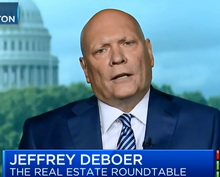
- Roundtable President and CEO Jeffrey D. DeBoer addressed the impact of these demographic trends, and their impact on real estate and the nation’s evolving infrastructure needs, in an interview on CNBC’s SquawkBox last June. ( CNBC Squawkbox interview and Roundtable Weekly, June 9, 2017).
- In January of this year to President Trump on infrastructure development, Roundtable President and CEO Jeffrey DeBoer commented on the positive economic benefits that infrastructure legislation would bring to the nation. “Modernizing our roads, tunnels, mass transit, drinking water, power grid, and telecommunications systems – in rural and urban areas alike – are vitally important to economic growth, productivity and America’s global competitiveness,” DeBoer said.
![]() |
|
Roundtable President and CEO Jeffrey D. DeBoer addressed the impact of these demographic trends, and their impact on real estate and the nation’s evolving infrastructure needs, in an interview on CNBC’s SquawkBox last June. (CNBC Squawkbox interview and Roundtable Weekly, June 9, 2017). |
He added, “Real Estate Roundtable members are experienced in addressing the financing, permitting and government partnership issues that frequently slow or stop infrastructure projects. We intend to provide positive feedback and ideas to all policymakers working to facilitate improvements in our nation’s infrastructure.” (Roundtable Letter on Infrastructure Funding, Jan. 11)
Real Estate Roundtable Perspective: Opportunity Zone Regulations Answer Critical Questions Regarding Real Estate Investment
Recent Proposed Treasury Regulations governing the new “Opportunity Zone” investment program – and its potential to spur productive real estate investment in struggling, low-income communities – is the focus of an Oct. 26 GlobeSt.com interview with Real Estate Roundtable President & CEO Jeffrey DeBoer and Roundtable SVP and Counsel Ryan McCormick.
- In the interview, DeBoer and McCormick provide answers to critical questions regarding the highly anticipated regulatory guidance and its implications for the real estate industry.
- DeBoer notes, “For real estate, the proposed regulations are unquestionably positive. They clarify key technical questions and open issues, and they should allow investments in funds and in underlying projects to go forward. While some important questions remain, we continue to believe that the Opportunity Zone program will be a powerful catalyst for transformational real estate investment in these designated low-income areas.”
- The Treasury in June designated more than 8,700 low-income census tracts in the United States, Puerto Rico, and territories as qualified Opportunity Zones. (IRS Notice 2018-48 and Roundtable Weekly, June 22 and Interactive Map, Economic Innovation Group)
- The Wall Street Journal reported this week that the highly-anticipated guidelines have offered investors greater certainty to begin the process of raising and investing billions of dollars into new real-estate funds targeting opportunity zones. (WSJ , Oct 23)
- The GlobeSt Q&A also clarifies who can defer gain by investing in an Opportunity Fund; the 180-day time period when investors are required to roll capital gain into a Fund; and how the proposed rules allow a Fund to mobilize capital over a period of nearly three years.
- McCormick explains in the article : “The proposed rule creates a ‘working capital safe harbor.’ Opportunity Funds have a minimum of 31 months to invest their working capital in qualified opportunity zone property. The longer runway aligns better with the practical realities of real estate investment.”
- DeBoer also offers clarifications about the “original use” and “substantial improvement” tests of an Opportunity Zone property, noting that they “… are critical elements of the Opportunity Zone program, and they are clarified in important ways in the proposed rules. Keep in mind, Congress wanted to stimulate new capital investment, not simply the transfer of income-producing assets from one owner to another. Therefore, property must either be put to its original use by the fund, or the fund must substantially improve the property. The Opportunity Zone law defines substantial improvement as the doubling of the adjusted tax basis of the property. The regulations provide that the original use and substantial improvement requirements only relate to the structure and not the underlying land.”
- Further clarification about the program is expected. According to DeBoer, “Some of the most important questions relate to Opportunity Fund transactions and the tax consequences when a fund buys, sells, and/or reinvests in Opportunity Zone property … Treasury and the White House have indicated that additional guidance is forthcoming before the end of the year. The Roundtable will be working with policymakers to ensure the next tranche of guidance and the final rules maximize productive, job-creating investment in Opportunity Zones.”
The Roundtable’s Tax Policy Advisory Committee (TPAC) recently convened a panel on Opportunity Zones that included the tax counsel for Senator Tim Scott (R-SC), the original author and sponsor of Opportunity Zone legislation. TPAC’s Opportunity Zone Working Group will continue to provide insight into how the industry can help the program fulfill its ambitious objective of stimulating economic development and job creation in low-income communities. (Roundtable Comment Letter, June 28 and Roundtable Weekly, July 20)
Treasury Releases Proposed Rules on Opportunity Zones Program
The Treasury Department today released Proposed Regulations giving investors added guidance regarding the new “Opportunity Zone” investment program. The Real Estate Roundtable’s Tax Policy Advisory Committee (TPAC) Opportunity Zone working group will analyze the much-anticipated regulatory proposal and their consequences for real estate-related jobs and investment. (IRS proposed rules, Oct. 19)
In late June, The Estate Roundtable provided formal comments to Treasury Department and IRS officials regarding implementation guidance that could maximize real estate investment, capital flows and jobs into newly designated Opportunity Zone communities. (Roundtable Weekly, June 29)
“Real estate development and redevelopment is a key component of any region’s economic strength and growth,” wrote Roundtable President and CEO Jeffrey DeBoer. “In our view, successful implementation of the Opportunity Zone program requires careful consideration of how the new rules will apply to real estate and real estate investment activities.”
Congress created Opportunity Zones in the 2017 Tax Cuts and Jobs Act to encourage long-term, capital investment in economically struggling, low-income communities. Opportunity Funds must invest in tangible business property located in a qualifying zone, which can include real estate, and the tax benefits are tied to the investment holding period. The capital gain on an Opportunity Fund investment is excluded from tax altogether if the asset is held for 10 years or more.
The Treasury in June designated more than 8,700 low-income census tracts in the United States, Puerto Rico, and territories as qualified Opportunity Zones. (IRS Notice 2018-48 and Roundtable Weekly, June 22)
Certain elements of the Proposed Regulations may be relied upon immediately, whereas others will take effect when final regulations are issued. Comments are due 60 days after the proposed guidelines are published in the Federal Register, and a hearing will be held on January 10, 2019.
Roundtable and Business Coalition Seek Administrative Relief, Shorter Cost Recovery Period for Nonresidential Real Estate Improvements
This week The Real Estate Roundtable, along with 239 businesses and trade groups, wrote to Secretary Mnuchinurging the Treasury Department to provide taxpayers with administrative relief from a drafting mistake in last year’s tax overhaul that increased the cost recovery period for qualified improvement property (QIP).
|
This week, The Real Estate Roundtable, along with 239 businesses and trade groups, wrote to Secretary Mnuchin urging the Treasury Department to provide taxpayers with administrative relief from a drafting mistake in last year’s tax overhaul that increased the cost recovery period for qualified improvement property (QIP). |
- The drafting error in the tax law has resulted in a significantly longer 39-year cost recovery period for new, qualified nonresidential interior improvements. The intent of Congress was to allow the immediate expensing of QIP – or provide a 20-year recovery period in the case of taxpayers electing out of new limitations on the deductibility of business interest.
- In the Oct. 9 letter to Secretary Mnuchin, the coalition addressed the need for a QIP correction, along with the unintended consequences if action is not taken. The letter raised concerns that the drafting error is resulting in “[d]elays in store and restaurant remodeling projects,” “[b]usinesses refraining from purchasing or leasing vacant stores or other leasehold spaces that require improvements,” and “[l]oss of construction jobs associated with commercial renovation projects.”
- The coalition letter was sent in response to the Administration’s request for comments on newly proposed regulationsimplementing the additional first year depreciation deduction (immediate expensing) benefit. The coalition submission also included two recent letters—one from 16 Democratic Senators to Treasury Secretary Steven Mnuchin and the other from 58 House Republicans to GOP leadership—reiterating the importance for policymakers to correct this unintentional drafting mistake in last year’s legislation, while recommending that Treasury should issue interim guidance and refrain from enforcing the drafting error. (House Letter, Oct 2 and Senate Letter, Sept 24)
- The Real Estate Roundtable and a broad-based business coalition urged Secretary Mnuchin in August to issue guidance clarifying certain provisions included in tax overhaul legislation enacted last year – including the cost recovery period for qualified improvement property. (Coalition letter, Aug. 22)
Congress could address the issue during the lame duck congressional session between the mid-term election and January. Senate Republican Conference Chairman John Thune (R-SD) said GOP lawmakers are motivated to address a number of tax issues that are outstanding, including tax reform technical corrections and expired tax provisions. (The Hill, Oct. 11)
Fed Chairman Testifies to Congress on Interest Rates; Banks Concerned About CRE Lending Risk
In testimony before Congress this week, Federal Reserve Chairman Jerome Powell testified about interest rates and monetary policy. “With a strong job market, inflation close to our objective, and the risks to the outlook roughly balanced, the FOMC believes that – for now – the best way forward is to keep gradually raising the federal funds rate,” Powell told the Senate Banking Committee on Tuesday.
![]() |
|
In testimony before Congress this week, Federal Reserve Chairman Jerome Powell testified about interest rates and monetary policy. |
- After the Fed raised short-term U.S. rates twice in the first half of 2018, it is expected to issue two more increases this year, starting in September. (MarketWatch, July 17 and Wall Street Journal, July 19)
- President Donald Trump criticized the Federal Reserve’s monetary policy again today after his initial critical remarks yesterday. In a statement to CNBC, the White House clarified, “Of course the President respects the independence of the Fed. As he said he considers the Federal Reserve Board Chair Jerome Powell a very good man and that he is not interfering with Fed policy decisions.” (CNBC, July 19)
- In Chairman Powell’s Senate testimony, he said the Fed expects, with appropriate monetary policy, that the job market will remain strong and inflation will stay near two percent over the next several years. He added that the Fed’s economic forecast faces the uncertain impact of trade policies and tax legislation. “It is difficult to predict the ultimate outcome of current discussions over trade policy as well as the size and timing of the economic effects of the recent changes in fiscal policy,” Powell testified.
- The Fed yesterday released its “Beige Book” of current economic conditions, which notes the effects of newly-imposed tariffs: “Manufacturers in all Districts expressed concern about tariffs and in many Districts reported higher prices and supply disruptions that they attributed to the new trade policies. Tariffs contributed to the increases for metals and lumber.” According to the report’s national summary commercial real estate markets show stable or improving growth. (Reuters, July 18 and GlobeSt, July 19)
- During the House Financial Services Committee on Wednesday, Powell also commented on CRE asset pricing. “Broadly speaking, commercial real estate prices are in the upper range, I think, generally elevated. I wouldn’t use the bubble word here, but I would say that many financial asset prices are elevated above their normal ranges.”
- According to a July 16 Financial Times article, U.S. banks are increasingly concerned about the effects of rising interest rates on CRE lending, with executives saying they are worried about an overheated market. “US bankers have warned about mounting risks in commercial real estate, with figures showing they are putting the brakes on loans to buyers of office buildings, hotels and shopping malls,” the Times reports.
The effects of monetary policy and tax legislation on commercial real estate will be a focus of The Roundtable’s September 26 Fall Meeting in Washington, DC.