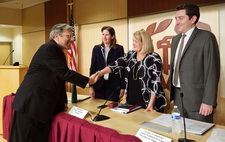
Top U.S. policymakers and industry leaders met this week for The Roundtable’s State of the Industry (SOI) Meeting in Washington, DC to discuss policy issues of compelling interest to CRE.
 |
|
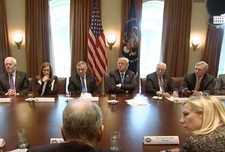
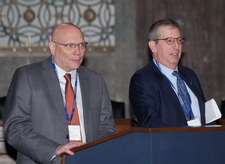
Launching the SOI meeting on Wednesday, Roundtable Chair William C. Rudin ( Rudin Management Company, Inc. ), right, and Roundtable President and CEO Jeffrey DeBoer, left, noted how Roundtable efforts are the result of research and analysis to find correct answers that benefit economic growth and job creation.
|
The Roundtable also issued its 2018 National Policy Agenda: Building For The Future. Specific issues included in the Policy Agenda were identified after a comprehensive, annual membership survey; frequent meetings held by The Roundtable’s policy advisory committees (see below); and participation by The Roundtable’s Board of Directors.
Launching the SOI meeting on Wednesday, Roundtable Chair William C. Rudin (Rudin Management Company, Inc.) noted how Roundtable efforts are the result of research and analysis to find correct answers that benefit economic growth and job creation. Rudin also said that the organization consistently communicates positions to policymakers that illustrate how healthy real estate markets are intertwined with the entire economy. This approach – “analysis first, followed by advocacy” – will continue to be the model for The Roundtable through 2018 and beyond, Rudin commented.
Illustrating how The Roundtable relies on member participation, he commented on the organization’s successful 2017 policy year regarding tax policy, sustainability and other efforts: “This past year we had great participation from Roundtable members who traveled to Washington when needed to personally meet with policymakers and discuss the obvious, and sometimes not so obvious, consequences of a policy decision.”
He added, “We testified, wrote comment letters, led industry coalitions, submitted economic analysis, organized targeted meetings, and continued to brand The Roundtable as a trusted voice on national policy issues.”
 |
|
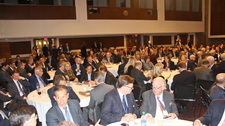
Illustrating how The Roundtable relies on member participation, Rudin spoke about the organization’s successful 2017 policy year regarding tax policy, sustainability and other efforts to the SOI audience.
|
Rudin also outlined various policy initiatives The Roundtable will focus on in the upcoming fiscal year with the Trump Administration and Congress, including implementation of the new tax law; financial regulatory issues; internet sales tax; infrastructure; attracting overseas tourists through the “Visit U.S.” coalition; and high performance buildings — all vital to spurring job creation and sustaining economic growth.
Roundtable President and CEO Jeffrey DeBoer then offered an overview of the recent changes in tax law, along with upcoming issues in play. He also noted the vital role of The Roundtable’s 17 national real estate trade association partners in presenting a unified voice on issues to policymakers in Washington.
Policy Issues and Meeting Speakers
Five U.S. Senators were among the featured SOI guests, which included:
 |
|
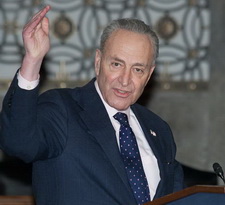
Senate Minority Leader Chuck Schumer (D-NY) engaged Roundtable members on the need for a massive plan to revamp the nation’s airports, bridges, roads, seaports, broadband and other critical infrastructure.
|
- Senate Minority Leader Chuck Schumer (D-NY) engaged Roundtable members on the need for a massive plan to revamp the nation’s airports, bridges, roads, seaports, broadband and other critical infrastructure. Sen. Schumer emphasized how critical infrastructure improvements are to commercial real estate, job creation and the national economy. He also spoke about the need to pass the Marketplace Fairness Act to bolster states’ collection of internet sales taxes, which could be used to assist state funding of infrastructure improvements.
- Sen. Mark Warner (D-VA) emphasized the need for bipartisanship in Congress in light of the recent tax legislation passed by Republicans. He noted that bipartisan efforts on issues such as GSE and housing finance reform could provide relief to the housing affordability crisis, while encouraging capital flows and competition. Sen. Warner said that regulatory relief on Dodd-Frank was also possible in upcoming months in Congress.
- Sen. Ron Wyden (D-OR), ranking member of the Senate Finance Committee, spoke about the need for a bipartisan effort to address low income housing needs. Sen. Wyden described the “Build America Bonds” program, which he helped create, as an example of successful legislation that could spur infrastructure investment through innovative tax financing. Temporarily authorized in 2009 and now expired, 181 billion dollars in Build America Bonds were issued in the years immediately following the financial crisis.
 |
|
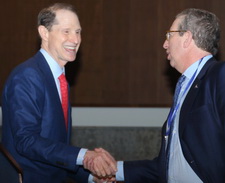
Sen. Ron Wyden (D-OR), left, ranking member of the Senate Finance Committee, spoke about the need for a bipartisan effort to address low income housing needs.
|
- Sen. Ron Johnson (R-WI) spoke with Roundtable members on the need for more deregulation and pro-growth policies. He also described his central role in ensuring that tax reform provided relief for all job-creating businesses, including pass-throughs. As the chairman of the Senate Homeland Security and Governmental Affairs Committee, Rep. Johnson also discussed the increasing need for cybersecurity in an age where future geopolitical conflicts will increasingly be conducted in cyberspace.
- Sen. Doug Jones (D-AL) commented about his recent election, appointment to the Senate Banking Committee and the need for broadband internet access in rural areas as part of an infrastructure program. Serving his first month in Congress, Sen. Jones noted he is receptive to all approaches to policy that encourage economic growth and looks forward to working with The Roundtable.
- Jim VandeHei — the co-founder of and CEO of Axios, gave a candid view of upcoming mid-term elections; prospects of the House flipping to Democrat majority; and the news dissemination role of large tech companies like FaceBook in past and future elections.
- Bob Schieffer — the former Face the Nation moderator participated in a discussion with incoming Roundtable Chair Deb Cafaro (Chairman & CEO, Ventas, Inc.) about the emerging era of “fake news” within a media landscape of fractured outlets and a deluge of partisan information.
Roundtable Policy Committees
In conjunction with the SOI Meeting, The Roundtable’s Policy Advisory Committees met on Jan. 24-25, discussing policy issues in detail with high-level congressional and agency staff.
 |
|
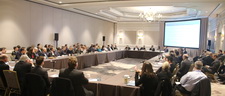
In the wake of the most significant tax measures passed in 31 years, TPAC attracted a large audience to address the details of what lay ahead in implementing the new tax law.
|
- Research and Real Estate Capital Policy Advisory Committee (RECPAC)
During this joint committee meeting, two panels of industry experts addressed the current real estate market cycle and provided an update on the state of real estate capital and debt markets. Participants also discussed High Volatility Commercial Real Estate (HVCRE) and the Roundtable’s response to the recently proposed High Volatility Acquisition, Development or Construction Loans (HVADC) rule, as well as potential GSE reform.
- Tax Policy Advisory Committee (TPAC)
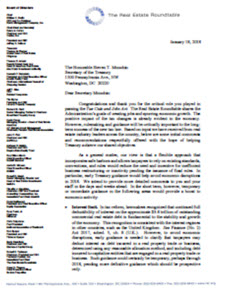
In the wake of the most significant tax measures passed in 31 years, TPAC attracted a large audience to address the details of what lay ahead in implementing the new tax law. A panel of experts from the congressional tax-writing committees described the evolution of the key partnership and real estate-related provisions. Following presentations by TPAC members, Dana Trier, Deputy Assistant Secretary of Treasury for Tax Policy, outlined the rulemaking process going forward and provided insight on how Treasury may resolve certain open questions important to real estate investment.
 |
|
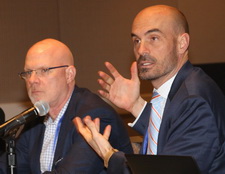
SPAC hosted Dr. Joseph Allen, Assistant Professor, Harvard T.H. Chan School of Public Health, right and John Mandyck, Chief Sustainability Officer, United Technologies Corporation, left, who presented new research on the health co-benefits of Green Buildings.
|
- Sustainability Policy Advisory Committee (SPAC)
In addition to other guests, SPAC heard updates from Environmental Protection Agency (EPA) staff on the ENERGY STAR building- and tenant-level recognition programs, which recognizes leased spaces for high-performance design, construction and energy efficiency in CRE assets.
- Homeland Security Task Force meeting (HSTF) and Risk Management Working Group (RMWG)
Representatives of the FBI briefed the Joint Meeting on the current threat picture and discussed psychological profiles of the recent homegrown violent extremists (HVEs). The Task Force was also briefed on current cyber threat picture and how businesses should be addressing this risk.
Next on The Roundtable’s FY2018 meeting calendar is the Spring Roundtable Meeting on April 25 at The Newseum in Washington, DC. This meeting will be restricted to Roundtable-level members only.



 About Us