

First Circuit Hears Denham Oral Argument as SECA Limited Partner Fight Continues

The legal dispute over the tax code’s limited partner exception from self-employment (SECA) taxes remains very much alive, with the issue now in various stages of litigation before three federal appellate courts. The IRS is asserting that a limited partner must be a passive investor.

Denham Oral Arguments

  • On Feb. 5, the First Circuit heard oral argument in Denham Capital Management LP, et al. v. Commissioner (No. 25-1349), while a related appeal in Soroban Capital Partners LP v. Commissioner is pending in the Second Circuit. The Fifth Circuit also recently issued a significant decision in Sirius Solutions, L.L.L.P. v. Commissioner (No. 24-60240). (Roundtable Weekly, Jan. 30)
  • The First Circuit heard oral arguments in Denham before Chief Judge David Barron, Judge Kermit Lipez, and Judge Lara Montecalvo Rikelman. Most of the argument focused on jurisdictional issues, which could allow the court to resolve the case without reaching the merits.
  • On the merits, the panel posed tough questions to Denham and the IRS. The discussion focused on the meaning of a limited partner in 1977 when the exception was enacted, prior case law, relevant dictionary definitions, the Revised Uniform Limited Partnership Act, and the provision’s legislative history.
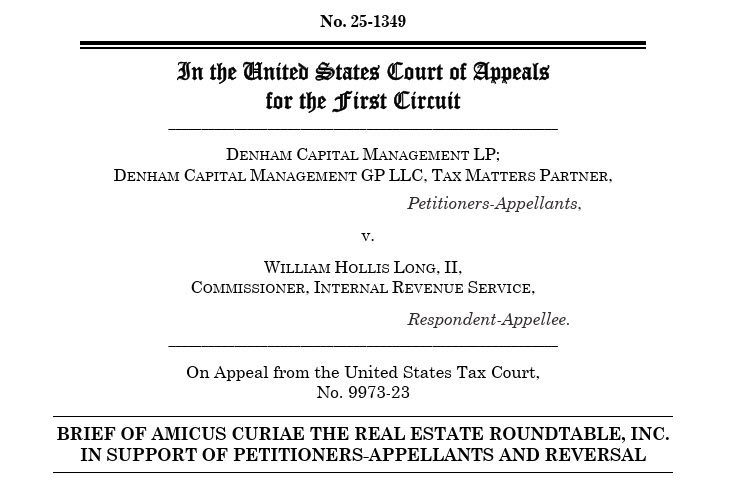
  • In the course of the argument, Denham emphasized state law developments leading up to the 1977 amendments and, notably, cited The Real Estate Roundtable’s (RER) amicus brief in support of its position. (RER Amicus Brief, Aug. 15; Roundtable Weekly, Sept. 12, 2025)

Why It Matters

  • Income-producing real estate is predominantly owned and operated through partnerships, and the IRS’s litigation campaign creates risk for long-standing structures relied on by real estate and other pass-through businesses.
  • A circuit split among the First, Second, and Fifth Circuits could accelerate Supreme Court review of the issue.

RER Advocacy
  • RER is actively engaged across the circuits to oppose the IRS’s restrictive “passive investor” approach:
  • First Circuit (Denham): RER filed an amicus brief in August 2025 supporting the taxpayer’s challenge to the Tax Court’s judge-made “passive investor” test and explaining the long-standing reliance of real estate partnerships on state-law limited partner status.
  • Second Circuit (Soroban): RER filed an amicus brief in December 2025 urging reversal of the Tax Court’s Soroban approach and warning that a new federal “passivity” overlay would inject uncertainty and increase tax burdens for partnership-based businesses. (Roundtable Weekly, Dec. 19, 2025)
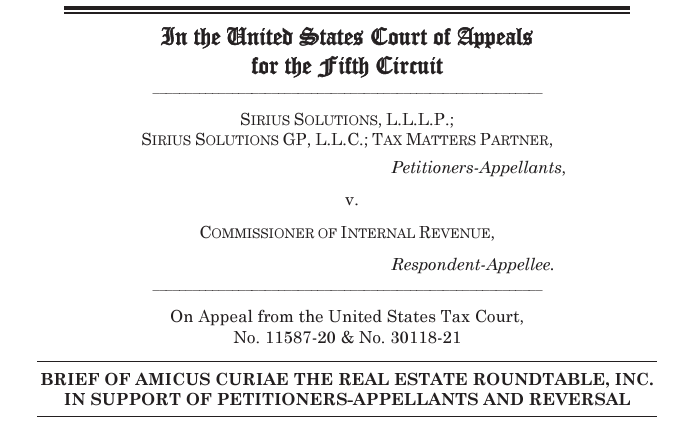
  • Fifth Circuit (Sirius): RER filed an amicus brief in 2024, and the Fifth Circuit’s Jan. 16, 2026 decision rejected the Tax Court’s passivity-focused framework in favor of a status-based analysis tied to limited liability.  (Roundtable Weekly, Jan. 30)

What’s Next

  • The First Circuit’s decision in Denham could turn on jurisdictional challenges, but the merits questions at argument underscored that the government’s “passive investor” theory remains contested and unstable across the courts.

RER will continue pressing its position through amicus advocacy to protect the flexibility inherent in partnership tax rules and preserve the long-standing tax exemption for limited partners.

Fifth Circuit Reverses Tax Court, Sides with Taxpayer and Roundtable in Limited Partnership Tax Dispute

The U.S. Court of Appeals for the Fifth Circuit issued a 2-1 decision in Sirius Solutions, L.L.L.P. v. Commissioner (No. 24-60240) on Jan. 16, restricting the federal government’s effort to extend self-employment taxes to a broad range of limited partners in limited partnerships. The Real Estate Roundtable (RER) submitted an amicus brief in the case, and the Court’s ruling closely aligns with the RER’s position.

Court Ruling

  • Since 1977, the tax code has exempted limited partners from self-employment taxes. In recent years, the IRS has asserted a new and more restrictive test to determine whether a limited partner qualifies for the exclusion.
  • The Fifth Circuit held that the Section 1402(a)(13) “limited partner” exception from self-employment (SECA) tax applies to a partner in a state-law limited partnership who has limited liability. (TaxNotes, Jan. 27)
  • The ruling vacates and remands the Tax Court decision that followed Soroban Capital Partners LP v. Commissioner (No. 25-2079), and applied a “functional analysis” of partner roles and activities to determine whether the SECA exclusion applies. (Sullivan Cromwell, Jan. 27)
  • The Fifth Circuit rejected that approach and held that “limited partner” in Section 1402(a)(13) is a status-based, state-law concept tied to limited liability, not an activity test.
  • The decision is the first appellate ruling to reach the issue and reverse the Tax Court’s restrictive interpretation. (Reuters, Jan. 21)
  • This ruling has set a precedent for future SECA tax cases, with significant consequences for real estate and other industries that use limited partnerships for business purposes.

Roundtable Advocacy

  • In August 2024, RER submitted an amicus brief to the Fifth Circuit. The brief argued that the IRS’s interpretation was flawed and inconsistent with decades of state law recognizing that limited partners can provide services while retaining limited partner status. (Roundtable Weekly, Sept. 6, 2024)
  • The brief emphasized that pre-1977 state court decisions and the IRS’s own 1994 proposed regulations contradict the government’s position that limited partners must be passive to avoid SECA taxes.
  • RER argued the Tax Court’s “passive investor” test is found nowhere in the statute and reflects a misunderstanding of partnership law that real estate and other businesses have relied on for decades.
  • RER has continued this advocacy across the circuits. In Dec. 2025, RER filed an amicus brief with the Second Circuit in Soroban, challenging the IRS’s restrictive interpretation of the “limited partner exception” under Section 1402(a)(13). (Roundtable Weekly, Dec. 19, 2025)
  • This successful outcome in the Sirius case supports RER’s position and could reduce momentum for formal tax guidance that would broaden the reach of SECA taxes.

What’s Next

  • Related appeals are pending in the First Circuit (Denham) and Second Circuit (Soroban). (TaxNotes, Jan. 27)
  • Divergent outcomes could create a circuit split and increase the odds of Supreme Court review. (Skadden Arps, Jan. 27)
  • The First Circuit is scheduled to hear oral arguments in Denham on Feb. 5. (TaxNotes, Jan. 27)

RER remains committed to protecting entrepreneurs’ ability to flexibly organize in partnerships and other pass-through entities that promote capital formation, risk-taking, and economic growth, and it will remain engaged as the SECA dispute moves forward.