It is a moral and economic imperative for The Real Estate Roundtable and CRE companies to take immediate and concrete actions that stand against racism and for inclusion, stated Roundtable Chair Debra Cafaro (Chairman and CEO, Ventas, Inc.) and Roundtable President and CEO Jeffrey DeBoer, in a statement issued on June 9. (DeBoer, above center, with Roundtable meeting attendees in 2019)
The entire statement – “The Real Estate Roundtable Stands in Solidarity Against Racism and Injustice” – also notes, “Systemic racism and injustice is a pandemic that has plagued our nation for far too long. The real estate industry must help to eliminate at its core this scourge in our society and economy.”
The statement preceded a discussion yesterday on “Real Estate’s Role in Addressing Racial Injustice” between Roundtable Immediate Past Chair William Rudin (Co-Chairman and CEO, Rudin Management Inc.), and Raymond McGuire (Vice Chairman, Citi and Chairman, Banking, Capital Markets and Advisory), during The Roundtable’s first Virtual Annual Meeting.
McGuire said that fortunate opportunities for an excellent education is what made the difference in his life experience and that providing similar opportunities to African American youths is of vital importance. “I do see this as a defining moment. It’s a challenge we have to answer for history,” McGuire said.
McGuire also discussed steps to combat systemic racism this week on CNBC’s Squawk Box. “We welcome the millions of dollars. We welcome the relatable messages, but we need to do more. Otherwise, it will have been another sad day in the neighborhood,” McGuire said.
The Roundtable’s Board yesterday approved the establishment of a standing committee to further equal opportunities and address racial disparities in the industry, with the goal of taking specific actions to bring more career opportunities to African American and other historically marginalized youth.
Ken McIntyre, Chief Executive Officer of the Real Estate Executive Council (REEC), will join The Roundtable’s Board of Directors, along with three other new members, effective July 1. REEC is a professional trade association composed of minority leaders in the commercial real estate industry – and is now officially one of 19 national real estate trade association partners that The Roundtable coordinates with on industry policy issues.
Cafaro and DeBoer’s statement concludes, “The moment for leadership is now. The Real Estate Roundtable commits to motivate meaningful and lasting change within our spheres of influence.”
Real estate industry leaders this week responded to protests against racial injustice throughout the nation sparked by the May 25 death of George Floyd in Minneapolis.
Real Estate Roundtable Chair Debra Cafaro (Chairman and CEO, Ventas, Inc.) on June 2 stated, “The buildup and expression of anger and frustration around racial injustice is real and it is justified. There are sadly far too many examples of systemic racism, bias and inequality in our society, and there are no fast or easy answers to dismantling hundreds of years of racism.”
She added, “We do not condone violence against people or property, which seems to be emanating principally from criminal and other elements, rather than from peaceful protesters who are demanding change. But We CAN stand together as allies, stand against racism when we see it, and take deliberate actions to encourage and promote diversity, equity and inclusion within and beyond our own homes, networks, and communities to ensure that everyone feels like they belong.” (Full Statement, Ventas, June 2)
Real Estate Roundtable President and CEO Jeffrey DeBoer on June 1 told BisNow, “Political, business and community leaders must come together and take concrete actions to significantly and measurably combat the long-standing abuse and unequal opportunities that continue to fall, particularly across race and gender.” (Bisnow article, June 1)
Roundtable Board Member and Related Companies CEO Jeff Blau also told Bisnow on Monday, “… this has been going on for a very, very long time, and I think [inequality] is probably one of the greatest risks to our country’s future that I can imagine. And I think it’s a topic that we all, as business leaders, need to focus on to try to make things better.”
Scott Rechler, chairman and CEO of RXR Realty and a Roundtable Member, tweeted a statement on May 31: “The rage currently being felt across our country reflects the widening inequality and systemic racism that has plagued our nation for far too long.” He urged demonstrators to channel their anger into change at the ballot box. (TRD, June 1, “Developers, brokerage heads express solidarity but urge non-violence”)
James Whelan, president of the Real Estate Board of New York, said Floyd’s killing underscores “systemic issues of race and class” that the city and country have failed to address. Whelan told The Real Deal that he condemned violence and pledged the industry would provide solutions, “not just lip service.” (TRD, June 2)
Economic Restart and Re-Entry Concerns
Working with its industry partners, The Roundtable is focused on identifying and addressing issues associated with building re-entry as people return to work in many regions.
The Real Estate Roundtable’s Building Re-Entry Working Group continues to meet weekly to address issues associated with the restarting of the economy. This week, the Working Group shared a report from fitwel on how to adapt building design projects to respond COVID 19.
A recent Littler survey of more than 1,000 employers show concerns centered on when to bring employees back and how to do so safely; how to accommodate increasing remote-work requests; and liability concerns stemming from the rise in COVID-19-related employment claims and lawsuits. (View the survey infographic and the May publication).
A multi-sector business coalition including real estate, tourism, technology, manufacturing, health care, and energy sector groups – led by the U.S. Chamber of Commerce – called upon Congress in a May 27 letter to enact temporary liability protections for businesses struggling to reopen and operate safely during the COVID-19 pandemic.
Among the more than 200 signatories to the letter are The Real Estate Roundtable, American Hotel & Lodging Association, International Council of Shopping Centers, National Apartment Association, National Association of REALTORS®, and the National Multifamily Housing Council.
The Post story notes when businesses stop paying rent, it sets off an alarming chain reaction that could threaten the broader economy and put landlords at risk of bankruptcy. The article also mentions how an aggressive proposal in California would force landlords to renegotiate leases with tenants affected by the pandemic, posing a risk to the basis of contract law. John Worth, executive vice president for research at Nareit, is quoted, “It’s not appropriate policy to have blanket rent forgiveness. It could really create some chaos.”
The New York Times on June 5 reports in “Tenants’ Troubles Put Stress on Commercial Real Estate” that landlords have begun to fall behind on the loans used to acquire or build properties, citing hotel and retail property data from Trepp.
The Times article notes, “As landlords face rent shortfalls and renegotiation because of the pandemic, lenders are also exposed.” It continues, “Beyond the immediate impact of business closings on tenants’ revenue are larger questions, including the already-dire trends for malls and shopping centers, how office and consumer behavior might change after the pandemic, and the effects of recent looting and vandalism on retail corridors.”
The Roundtable has emphasized the vital need to restore the “rent obligation chain” during this economic crisis, which would benefit all stakeholders – business and residential tenants, owners, lenders, municipal and state budgets and retirement investments. (Bisnow video interview with Jeffrey DeBoer, April 30)
Separately, Acting Comptroller of the Currency Brian P. Brooks on June 1 urged the nation’s mayors and governors to consider the adverse impacts of long-term regional economic shutdowns on the nation’s financial system and the commercial real estate sector. (Office of the Comptroller of the Currency news release, June 1)
In letters to the National League of Cities, the U.S. Conference of Mayors, and the National Association of Governors, Brooks warned that the lengthy duration and scope of continued lockdown orders “potentially threaten the stability and orderly functioning of the financial system the OCC is charged by law to protect.”
Brooks also warned about the negative potential consequences for CRE, stating, “Banks are a major source of commercial real estate finance in the United States. Cutting off utilities to commercial buildings can impair their condition, structural integrity, and value, thus impairing the collateral that secures real estate loans. Commercial real estate loan collateral is also put at risk by lengthy property vacancies that result from extended stay-at-home orders.”
“Apart from damage to the physical collateral, extended lockdown orders obviously impair the ability of businesses, particularly small businesses, to generate the revenue needed to pay their loan obligations,” Brooks stated. (OCC letter to U.S. Conference of Mayors)
The challenges of restarting the economy and re-entering commercial properties will be a central topic of The Roundtable’s June 11-12 Virtual Annual Meeting and concurrent policy advisory committees.
A multi-sector coalition including real estate, tourism, technology, manufacturing, health care, and energy sector groups – led by the U.S. Chamber of Commerce – called upon Congress in a May 27 letter to enact temporary liability protections for businesses struggling to reopen and operate safely during the COVID-19 pandemic.
The letter explains that American businesses face risks of frivolous litigation that will impede the nation’s path to economic recovery. “Absent a targeted safe harbor for [businesses] that work to follow applicable guidelines, the fear and uncertainty from boundless liability threatens to impede our country’s social and economic recovery,” the groups explain.
The Chamber-led coalition emphasized that “recourse for those harmed by truly bad actors who engage in egregious misconduct” must be preserved. Reasonable and temporary liability protections should also be offered for:
(1) businesses, nonprofit organizations, and educational institutions that work to follow applicable public health guidelines against COVID-19 exposure claims;
(2) healthcare workers and facilities providing critical COVID-19-related care and services;
(3) manufacturers, donors, distributors, and users of vaccines, therapeutics, medical devices, as well as PPE and other supplies (such as hand sanitizer and cleaning supplies) that are critical to the COVID-19 response; and
(4) public companies targeted by unfair and opportunistic COVID-19-related securities lawsuit
Among the more than 200 signatories to the letter are The Real Estate Roundtable, American Hotel & Lodging Association, International Council of Shopping Centers, National Apartment Association, National Association of REALTORS®, and the National Multifamily Housing Council.
Additionally, Building Owners and Managers Association (BOMA) International wrote to congressional leaders on May 27, urging them to consider business protections developed in response to prior emergencies like 9/11 as a guide for responding to Covid-19-related liability issues. (BOMA letter on business liability)
“A tailored, specific legal safe harbor program for those in the commercial real estate sector, who are following public health rules, directives, and guidelines, making plans, and implementing protective measures, will support ongoing recovery efforts,” BOMA’s letter explains.
Senate Majority Leader Mitch McConnell (R-KY) and House Minority Leader Kevin McCarthy (R-CA) said in a joint statement early this month that any future Covid-19 relief legislation must include liability protections for employers and businesses. (See Roundtable Weekly, May 1)
Senator John Cornyn (R-TX) emphasized the GOP’s position on May 18, stating on the Senate floor that “Leader McConnell and I … are working on a proposal that would put common sense reforms in place and protect those acting in good faith from being sued into oblivion.” (Cornyn statement). Potential employer immunity and anticipated litigation related to Covid-19were the focus of a May 12 Senate Judiciary Committee hearing. (Roundtable Weekly, May 15).
Several states have implemented or are considering pandemic-related liability protections that could provide a direction for federal legislation. Utah, for example, provides law suit immunity to businesses except in cases of reckless or intentional misconduct. (Salt Lake Tribune, May 4)
Roundtable Members Continue to Drive the “Re-Entry Discussion”
Roundtable Immediate Past Chair Bill Rudin (Co-Chairman & CEO, Rudin Management Company, Inc.) today joined CNBC for a conversation about the path forward for re-populating office spaces in New York and cities nationwide.
Citing recent industry surveys, Rudin said, “Over 75% of the employees want to come back to work. They want to be with their co-workers and interact and have that cohesiveness that is missing right now.” He added, “We’re optimistic that when we get through this the office building will still be a central hub for creativity and entrepreneurship.” (CNBC Squawkbox, Twitter, May 29)
Business liability and building re-entry are crucial issues affecting commercial real estate operations in the Covid-19 era. They will be discussed during The Roundtable’s virtual Annual Meeting on June 11-12, which will include remote events for both business and policy advisory committee meetings.
CDC’s “Activities and Initiatives” summary describes its measures to date to control the spread of the pandemic and enable contact tracing to slow transmission. CDC’s initiatives support the White House’s guidelines for “Opening Up America Again” through a phased approach that governors, mayors, and state/local public health officials may implement statewide or community-by-community.
Six “gating criteria” that consider a community’s “downward trajectory” of patients treated for the virus over a 2-week period, availability of Covid-19 testing, and public health capacity, provide the basis to guide officials’ decisions to “move between phases” toward gradual re-opening. (CDC’s “Activities and Initiatives,” p. 7)
Meanwhile, the U.S. Environmental Protection Agency (EPA) recently issued an information resource and checklist to address water quality in buildings as they ramp-up operations. EPA recommends that owners and managers take proactive steps to minimize water stagnation in plumbing systems during temporary shutdowns or reduced operations, prior to building re-population. See:
Additionally, Roundtable Board Member Owen Thomas (CEO, Boston Properties) was interviewed yesterday on CNBC’s Squawkbox (photo above) about the pandemic’s impact as employees return to office environments and how cities may compare to suburbs as major work hubs of the future. (CNBC interview, May 21)
“We have a pandemic underway; there will be a gradual return to the office. But I do think companies will be actively using their offices in the long-term,” Thomas said.
“I also hear from customers that remote work is not an acceptable replacement for the in-person interactions that happen in the office space. The ability to mentor younger employees. The spontaneous collaboration and creativity that occurs and also the culture that companies develop – it’s very difficult to do it when we’re all on Zoom and Webex.” (Thomas CNBC interview, May 21)
Roundtable members who have recently been interviewed about workplace return strategies and technologies include Immediate Past Chair Bill Rudin, Roundtable Member Scott Rechler and others. (Roundtable Weekly, May 15)
Two industry reports issued this month also address return-to-work guidelines and COVID-19 operational contingency plans:
A CBRE analysis of 203 companies’ operations across the globe – “ReEntering the World’s Workplaces” – shows many companies have implemented return-to-work guidelines stricter than local government requirements (CBRE news release, May 15) / (GlobeSt, May 18)
A Deloitte survey of 100 senior financial service institutions’ (FSI) executives with responsibility for crisis management and business continuity planning reveals that at least half of the respondents are developing COVID-19 operational contingency plans spanning at least the next three months. Part of the complexity around re-opening has to do with the scale and scope of FSI real estate. (Deloitte, May 15)
The Roundtable’s Building Re-Entry Working Group continues to meet weekly to address issues associated with the restarting of the economy.
An 11-member industry coalition, including The Real Estate Roundtable, urged Members of Congress on May 14 to consider Opportunity Zones (OZ) rule changes that could spur investment, promote capital formation and bolster job growth in economically disadvantaged communities impacted by the coronavirus pandemic. (Coalition letter, May 14)
Opportunity Zones seek to stimulate jobs and growth where they are most needed by encouraging taxpayers to make long-term, patient investments in targeted, low-income communities. On Thursday, Federal Reserve Chairman Powell reported that “among people who were working in February, almost 40 percent of those in households making less than $40,000 a year had lost a job in March.” (Chairman’s Prepared Remarks, May 13)
The coalition letter asks Congress to make three critical improvements to the Opportunity Zone incentives. The changes would:
Allow opportunity funds to raise capital from all sources, not just gain rolled over from a recently disposed investment.
Spur productive real estate investment in low-income communities by providing that a 50 percent increase in the basis of a building constitutes a substantial improvement of the property.
Strengthen the economic incentives by codifying the tax rate on deferred gain and extending for two years the recognition date for deferred gain, and consequently, the deadlines that must be met in order to qualify for the increase in basis for gain rolled into an opportunity fund.
The coalition’s legislative suggestions come not long after Sen. Tim Scott (R-SC) and eight other Senate Republicans made several regulatory Opportunity Zone recommendations on May 4 in a letter to Treasury Secretary Mnuchin and IRS Commissioner Rettig. (Roundtable Weekly, May 8)
The Senators encouraged 10 specific changes in their letter, which states, “Significant challenges arise from the inability to raise capital; decreased demand for space, products and services; a decline in the local economy; governmental delays; supply chain interruptions; and uncertainty regarding valuations and ability to secure loans and necessary funding apart from Opportunity Zone capital gain investments.”
The role of investment in Opportunity Zones may be addressed in eventual Covid-19 stimulus legislation in Congress. The Roundtable’s Tax Policy Advisory Committee (TPAC) will continue to collect and share information regarding with policymakers regarding the real estate industry’s experience with the Opportunity Zone tax incentives and the impact on low-income communities of real estate-focused opportunity funds.
Roundtable members addressed the challenges and techniques in reopening the workplace in a variety of media outlets this week.
On May 13, Roundtable Chair Debra Cafaro (Chairman & CEO, Ventas) discussed the steps being taken by the City of Chicago towards reopening with Mayor Lori Lightfoot as part of The Economic Club of Chicago’s virtual program series. The discussion also covers the city’s response to the COVID-19 pandemic and other aspects of Mayor Lightfoot’s first year in office. (Video: Mayor Lightfoot’s Prepared Remarks: 00:45 – 29:30, followed by Q&A with Debra Cafaro: 29:30 – 54:00)
Roundtable Immediate Past Chair Bill Rudin (Co-Chairman & CEO, Rudin Management Company, Inc.) today joined CNBC for a conversation about the path forward for reopening office space in New York City as employees work from home amid the coronavirus pandemic. Rudin, above, discussed his building operating system called Nantum, which tracks real time data on metrics like indoor air quality, energy usage, temperature and carbon dioxide. Rudin also commented on the need for state and local stimulus funding from Congress to support the basic functions of municipalities that will help economic recovery. (CNBC video, May 15)
Roundtable member Scott Rechler (Chairman and CEO, RXR Realty) yesterday participated in a webinar hosted by Axios’ Mike Allen on reopening the economy and the future of workplace safety. (Axios webinar, May 14). Rechler discusses a “Leap to Labor Day” project for his company that will rotate employees back to offices on a staggered time basis to avoid congestion. (Watch Axios webinar)
Roundtable Board Member and Sustainability Policy Advisory Committee Chair, Tony Malkin (Chairman and Chief Executive Officer, Empire State Realty Trust, Inc.), was quoted this week in a New York Times article on the challenges Manhattan owners and developers may face if the change in work environments evolves from buildings to homes. He added that New York City’s diverse and educated work force will drive an economic rebound and desire for office space that caters to large industries, including a fast-growing technology sector. (New York Times, “Manhattan Faces a Reckoning if Working From Home Becomes the Norm,” May 12)
Real Estate Roundtable President and CEO, Jeffrey DeBoer, discussed what building owners and managers should consider to safely manage the reentry of tenants, workers and visitors in an interview last week with Dr. Joseph Allen, Assistant Professor at Harvard’s T.H. Chan School of Public Health and Director of its Healthy Buildings Program. (Video, May 6)
The Roundtable’s Building Re-Entry Working Group continues to meet weekly to address issues associated with the restarting of the economy.
Operations and performance standards for healthy buildings will be a topic discussed during The Roundtable’s virtual Annual Meeting on June 11-12, which will include remote events for both business and policy advisory committee meetings.
Senate committee hearings on May 12 addressed Covid-19 issues including reopening businesses and schools, legal liability for businesses, and the role of financial regulations in combatting the economic repercussions of the pandemic.
A “new normal” for congressional hearings was on display as social distancing and remote testimony were put into effect, with lawmakers and witnesses meeting through video conferences to maintain social distancing protocols.
Workplace Re-Entry
The health risks associated with reopening places of work, education and recreation were explored during the Senate Health, Education, Labor and Pensions Committee hearing, “COVID-19: Safely Getting Back to Work and Back to School.”
Dr. Anthony Fauci, Director of the National Institute of Allergy and Infectious Diseases, testified that returning too quickly could “turn the clock back, rather than going forward” on the road to economic recovery. (Stat, May 12)
According to Politico, a dozen states will see their stay-at-home orders or business restrictions expire between today and Monday (May 15 to May 18) at the same time other states surpass the two-week point since reopening. Updated reports on reopening status are available from CNN and the New York Times.
The Centers for Disease Control and Prevention posted new one-page “decision tool” guidance documents on Thursday that advise businesses, restaurants and bars, mass transit systems, and other concerns on how to safely reopen during the pandemic.
Business Liability
Potential employer immunity and anticipated litigation related to Covid-19 were the focus of a Senate Judiciary Committee hearing on Tuesday, “Examining Liability During the COVID-19 Pandemic.”
Republicans and Democrats expressed that enforceable federal guidelines from the Occupational Safety and Health Administration (OSHA) or Centers for Disease Control and Prevention (CDC), outlining proper health, safety, cleaning and other procedures, would likely be necessary to set standards for business conduct. Senators also acknowledged that potential plaintiffs asserting liability claims would likely confront challenges in establishing that a business’s actions directly caused a Covid-related injury. (Brownstein Hyatt Farber Schreck, May 14)
“One primary goal out of this hearing is to get the standards in place for business, for universities, for schools, whether they come from the CDC [or] OSHA,” Chairman Lindsey Graham (R-SC) said at the hearing. Standards are needed so businesses “can understand what’s expected of them. And if they do what’s expected, they don’t need to worry about getting sued. The big hole in the puzzle right now is the standard,” (The Hill, May 12)
The Judiciary hearing followed prior statements on employer liability from Republican congressional leaders that “these protections will be absolutely essential to future discussions surrounding recovery legislation” and that any coronavirus stimulus package will not pass the Senate without addressing business liability. (Roundtable Weekly, May 1)
Financial Regulations
The Senate Banking Committee hearing on “Oversight of Financial Regulators” focused on the effectiveness of recent financial regulatory actions implemented to combat the economic impact of the pandemic.
Lawmakers shared the sentiment that more could be done by U.S. financial regulatory agencies to broaden the availability of various lending facilities put into effect to get more capital to businesses and communities in need.
During the hearing, Fed Vice Chairman for Supervision, Randy Quarles, responded to questions on the need for expanding the Fed’s Term Asset-Backed Securities Loan Facility (TALF) by saying there were no “specific changes to suggest” at this time, but that the Fed was “very sensitive to that.”
The Roundtable joined industry letters to the Fed on March 24 and April 14 on the need to broaden the range of the TALF to include both outstanding (legacy) CMBS, commercial mortgage loans and newly issued collateralized loan obligations. On April 9, the Fed confirmed that the TALF would be expanded to include triple-A rated legacy non-agency CMBS and loans.
The Fed on May 12 also broadened the range of leveraged loans that can be used as collateral for the TALF. The Fed will now accept new Triple-A rated collateralized loan obligations (CLOs) with leveraged loans, including refinanced loans and priced as far back as January 2019, as part of the TALF. (Fed news release and Wall Street Journal, May 12)
Today, a business coalition including The Real Estate Roundtable wrote to financial regulators requesting they clarify their April 7 guidance encouraging financial institutions to work constructively with borrowers impacted by COVID-19. Specifically, the coalition requests clarification that – in addition to traditional loan products – lending and financing arrangements, such as warehouse lines and repurchase agreements secured by multifamily and commercial real estate loans and commercial mortgage-related securities, are within the scope of the guidance in the Statement. (Coalition letter, May 15)
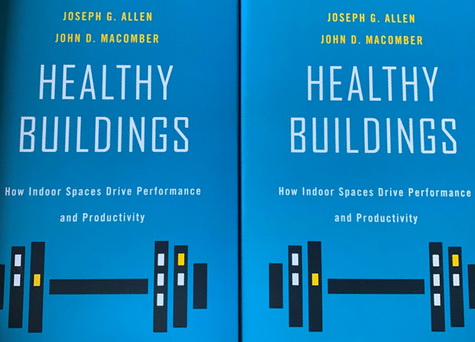
With states and cities beginning to re-open economic sectors, what should building owners and managers consider to safely manage the reentry of tenants, workers and visitors? This was the topic of an interview conducted this week by Real Estate Roundtable President and CEO, Jeffrey DeBoer, with Dr. Joseph Allen, Assistant Professor at Harvard’s T.H. Chan School of Public Health and Director of its Healthy Buildings Program. (Video, May 6)
He was inspired at a Roundtable Sustainability Policy Advisory Committee (SPAC) meeting to assemble a report that eventually became “The 9 Foundations of a Healthy Building.” The publication “takes 40 years of scientific evidence, distills it down to those key factors or features that we know relate to better employee health, improved productivity and help reduce infectious disease transmission.”
Building stakeholders could implement a health safety plan using “a five-step hierarchy of controls” detailed in his April 29 Harvard Business Review article, “What Makes an Office Building ‘Healthy’”
Healthy building metrics can contribute to building valuation. “Start measuring … health performance indicators. Capture all those gains.” He gives a specific marketplace example featured in an April 28 Harvard Business Review podcast case study, “A Tower for the People: 425 Park Avenue.”
There is increased market interest in healthy buildings, especially in light of the fallout from the global pandemic. “This healthy building movement, just like working from home and teleworking, have been slowly rising – and with COVID, it has forced a massive quickening of these movements.” (Watch interview, May 6)
Building Owners and Managers Association (BOMA) International: “Getting Back to Work: Preparing Buildings for Re-Entry Amid COVID-19” provides guidance for preparing commercial properties for the safe return of office tenants, building personnel, visitors, vendors and contractors. The guidance document provides a framework for developing individual property or portfolio plans.
Department of Homeland Security (DHS) State/Local COVID Requirements: “State and Local Executive Actions” chart provided by DHS is a compendium (to date) of state and local laws and ordinances related to COVID-19 (e.g., stay-at-home orders, social distancing, facial covering/PPE requirements).
The Roundtable’s Building Re-Entry Working Group continues to meet weekly to address issues associated with the restarting of the economy.
Operations and performance standards for healthy buildings will be a topic discussed during The Roundtable’s virtual Annual Meeting on June 11-12, which will include remote events for both business and policy advisory committee meetings.
Liability concerns in a post-coronavirus world are influencing congressional negotiations about the next pandemic relief package as states move forward on easing business restrictions and employers across the country consider plans to reopen. (AP, April 28 and The Hill, May 1)
With the Senate scheduled to return to Washington on May 4, policymakers are staking their priorities about stimulus and other measures that may be included in the next round of Covid-19 related legislation. The House announced this week they will delay their return until May 11 due to concerns about coronavirus in Washington, DC.
Senate Majority Leader Mitch McConnell (R-KY) and House Minority Leader Kevin McCarthy (R-CA.) said in a joint statement today that any future stimulus bill must include liability protections for employers. “Senate and House Republicans agree these protections will be absolutely essential to future discussions surrounding recovery legislation,” according to the statement.
McConnell on Tuesday referred to the protections as his “red line” during an interview with Fox News. “Let me make it perfectly clear, the Senate is not interested in passing a bill that does not have liability protection. … What I’m saying is we have a red line on liability. It won’t pass the Senate without it,” he added. (Fox interview, April 24)
House Speaker Nancy Pelosi (D-CA) on Wednesday said employees returning to work should have increased safety protections. “Especially now, we have every reason to protect our workers and our patients in all of this. So we would not be inclined to be supporting any immunity from liability,” Pelosi stated during a press briefing. (National Review, April 29)
Senate Minority Leader Chuck Schumer (D-NY) on Tuesday said employers pushing workers to return to unsafe conditions during the pandemic should not receive protections. He stated, “If an employer makes an employee do something that is untenable, shouldn’t an employee have some rights here?” (Bloomberg, April 28).
The Roundtable’s Building Re-Entry Working Group is working to address this issue and continues to meet weekly. The Working Group will hold its third virtual meeting on May 7 when it will discuss issues affecting building re-entry, including legal liability and developing best practices to support building health standards. (Reference: The Centers for Disease Control and Prevention publication, “Reopening Guidance for Cleaning and Disinfecting Public Spaces, Workplaces, Businesses, Schools, and Homes.”)
Negotiations on the next pandemic bill in Congress will intensify this month, as Democrats are expected to push for massive assistance to help state and local governments meet tax revenue shortfalls that pay for essential services.
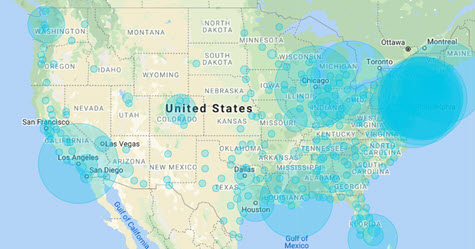
Moody’s Analytics on April 22 unveiled a new tool to help commercial real estate market participants assess how the coronavirus crisis is affecting CRE fundamentals across US markets. The COVID-19 CRE Impact Dashboard is a publicly available resource that provides access to economic, property, and construction data, analytics and insights for CRE property types.
Presented as a visual mapping tool, the dashboard brings together Moody’s Analytics CRE capabilities and supplements them with up-to-date information on COVID-19 from public sources. The dashboard also includes forecasts for market vacancies and rents under different economic scenarios for office, retail, industrial, and multi-family properties.
“The coronavirus pandemic is changing the landscape of commercial real estate, as businesses of all types adapt to new economic realities,” said Cristina Pieretti, Managing Director of Moody’s Analytics REIS. “We are offering our new tool to help the CRE community make the critical business decisions necessary to navigate this unprecedented event.”



 About Us