Treasury Issues Final Regulations Affecting National Security Concerns Over Foreign Investment, Including Real Estate Transactions

CFIUS-abbreviationx470

The Treasury Department on Jan. 13 issued two final regulations that increase the U.S. executive branch’s ability to address national security concerns arising from certain foreign investments, including real estate transactions.  (Treasury’s full text of the final regulations & related resources)

  • The new rules, which go into effect Feb. 13, will comprehensively implement the Foreign Investment Risk Review Modernization Act of 2018 (FIRRMA).  The Act authorizes the Committee on Foreign Investment in the United States (CFIUS) to review certain transactions involving foreign investment to determine potential effects on U.S. national security.
  • FIRRMA, enacted with bipartisan support in August 2018, established CFIUS’ jurisdiction over certain real estate transactions.  It also broadened CFIUS’ jurisdiction over certain non-controlling investments into certain U.S. businesses involved in critical technology, critical infrastructure, or sensitive personal data.
  • The new regulations were released in two parts: Provisions Pertaining to Certain Investments in the United States by Foreign Persons (31 C.F.R. part 800); and Provisions Pertaining to Certain Transactions by Foreign Persons Involving Real Estate in the United States (31 C.F.R. part 802).  (Skadden, Jan. 16 – “CFIUS’ Final Rules: Broader Reach, Narrow Exceptions and Foretelling Future Change“)
  • “These regulations strengthen our national security and modernize the investment review process,” said Treasury Secretary Steven T. Mnuchin. “They also maintain our nation’s open investment policy by encouraging investment in American businesses and workers, and by providing clarity and certainty regarding the types of transactions that are covered.”  (Treasury statement, Jan. 13)
  • The new rules create exemptions to CFIUS jurisdiction for so-called “excepted foreign states” that include nationals, entities, and governments of certain countries.  The current list of eligible foreign states includes Australia, Canada and the United Kingdom, but may expand to include other nations in the future.
  • The Real Estate Roundtable submitted comments to Treasury last year about the original, proposed CFIUS rules and requested clarifications about how investments in commercial real estate would be affected.  (Roundtable Weekly, Sept. 20, 2019 and Roundtable Letter, Oct. 17, 2019)
  • FIRRMA expands the list of covered transactions to include some foreign purchases and leases of real estate near military and other strategic facilities.  Responding to concerns raised by The Roundtable and other industry groups, language is included in the rules that exempts real estate located in an ‘urbanized area’ from the criteria of a covered transaction.  The Census defines an urbanized area as one comprising more than 50,000 people.
  • The new rules include other modifications to the proposed rules affecting real estate transactions.  The final rules lower the threshold for investors to qualify as “excepted investors.”  A foreign person who now qualifies as an excepted investor will not be subject to CFIUS’ jurisdiction for non-controlling investments regarding real estate transactions.  (Law 360, Jan. 15)
  • A Ropes & Gray Jan. 15 summary – “CFIUS Issues Final Rules Implementing FIRRMA: Key Changes and Developments” – reports that an entity may be deemed an “excepted investor” if, among other requirements:
    • 75 percent or more of the members and 75 percent or more of the observers of the board of directors (or comparable body) are citizens of either the United States or an excepted foreign state – instead of the 100 percent requirement articulated in the Proposed Rules, and
    • All investors that hold a 10 percent or greater equity interest are citizens of either the United States or an excepted foreign state – instead of the 5 percent or greater requirement set forth in the Proposed Rules.

According to a Jan. 16 JD Supra report — “Key Takeaways from CFIUS Final Rules Implementing FIRRMA  — the final rules also broaden the covered real estate exception for retail trade, accommodation, and food service stores.  The new rules apply the exception to leases and concessions of real estate that are “used only for the purpose of engaging in the retail sale of consumer goods or services to the public.”

CFIUS also intends to make a web-based tool available in the near term to assist the public with assessing what qualify as “covered real estate transactions” that are potentially subject to CFIUS review.

With these final rules, investors and companies now face a more complicated CFIUS framework that accounts for evolving national security risks involving foreign investments and real estate transactions.   

The Roundtable’s Real Estate Capital Policy Advisory Committee (RECPAC) and Homeland Security Task Force (HSTF) plan to study the 132-page rule (part 802) affecting foreign transactions in U.S. real estate for more insight into how the new rules may impact commercial real estate investment.

#  #  #


IRS Delays and Modifies Several New Partnership Tax Reporting Requirements

treasury-department-building_x475w

Responding to concerns raised by The Real Estate Roundtable and others, the Internal Revenue Service (IRS) on Dec. 9 issued Notice 2019-66 modifying and postponing several proposed changes to partnership tax reporting requirements.  (Bloomberg Tax, Dec. 9)

The Real Estate Roundtable on Nov. 18 sent a letter to Treasury and the IRS urging the government to postpone certain reporting requirements in the new partnership tax return forms for 2019.  The letter encouraged the IRS to seek formal input from stakeholders regarding specific items.  The Roundtable noted in the letter that the reporting requirements as originally proposed were generating significant taxpayer uncertainty; could lead taxpayers to adopt inconsistent approaches to computing information; and may result in more harm than good.  (Roundtable letter, Nov. 18)

Twelve other national real estate organizations sent a joint letter on Nov. 22 seeking a delay in the requirements and requesting a comprehensive comment process

This week’s IRS Notice makes the following changes:

  • The requirement to report partners’ shares of partnership capital on the tax basis method is delayed until 2020 (for 2019, capital accounts will be reported consistent with the reporting requirements in 2018);
  • The requirement for partnerships to report to partners information about separate “Section 465 at-risk activities” is delayed until 2020;
  • The Notice clarifies the requirement for partnerships and other persons to report a partner’s share of “net unrecognized Section 704(c) gain or loss” by defining this term for purposes of the reporting requirement.
  • It exempts publicly traded partnerships from the requirement to report their partners’ shares of net unrecognized Section 704(c) gain or loss; and
  • It also provides relief from certain reporting penalties imposed under the tax code for taxpayer who follow the Notice.  These penalties include the failure to furnish correct payee statements; the failure to file a partnership return that shows required information; and the failure to furnish information required on a Schedule K-1.

Significant changes were made to the partnership audit rules in 2015, in response to widespread government concerns related to the challenges of administering partnership tax rules. The Roundtable and members of its Tax Policy Advisory Committee (TPAC) have actively contributed to the development and modification of partnership audit reform legislation.  (Roundtable Weekly, Jan. 5, 2018 and October 11, 2019)

TPAC will continue to engage IRS and Treasury officials about timely stakeholder concerns with regulatory issues affecting real estate and the economy.

#  # #

The Roundtable Recognized as Leading Industry “Influencer” by Real Estate Forum Magazine

The Real Estate Roundtable is featured as one of the industry’s “Influencers in Marketing and Communications” in the November / December issue of Real Estate Forum magazine published this week.  

  • Managing Editor Erika Morphy offers her perspective on the 24 individuals, 10 marketing organizations, 7 company teams and 1 trade group (The Roundtable) profiled in the issue.  “We like to think these lists are special to the industry.  Why influencers at all? That is simple: because even though commercial real estate is all about physical buildings and the trends that govern their supply and demand, it also is very much a relationship-oriented space. Who you know, who you’ve heard about and who you would like to know is the name of the game.” Morphy writes. (Digital issue and GlobeSt. article, Dec. 3)
     
  • The Real Estate Forum article notes that “The Roundtable’s leaders seek to ensure a cohesive industry voice is heard by government officials and the public, concerning real estate’s important role in the global economy.”  The Forum report also mentions The Roundtable’s successes related to the Tax Cuts and Job Acts of 2017 and the 20% deduction for qualified pass-through businesses – in addition to its continued work on Opportunity Zones with the Treasury Department and IRS.
     
  • The report adds, “Under the leadership of Roundtable chair, Debra Cafaro, the organization is also committed to building an industry network that reflects the diversity of the membership.”
     
  • Roundtable President and CEO Jeffrey DeBoer commented on the recognition.  “We are proud to be named as a leading industry Influencer by Real Estate Forum.  The Roundtable continually strives to clearly communicate our views on policy issues affecting CRE to our membership, policymakers and throughout the industry.  Our communications approach reflects how we present the industry’s positions to lawmakers in person – in a balanced, nonpartisan way, supported by detailed analysis on legislative and regulatory proposals.” 

The Roundtable will debut its 2020 National Policy Agenda publication during its State of the Industry Meeting on Jan. 28-29 in Washington, DC. 

# # # 

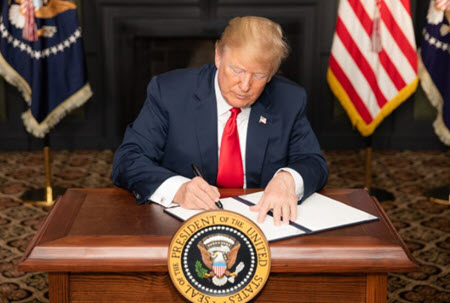
President Trump Signs Spending Bill to Fund Government Until Dec. 20

President Trump signing legislation

Congress this week passed a four-week spending bill that was by signed President Trump last night to fund the government beyond Nov. 21 and avoid a shutdown.

  • The Continuing Resolution (CR) locks in current funding levels for government operations until Dec. 20 – including the National Flood Insurance and EB-5 investment programs.
  • The measure, passed by the House on Tuesday and the Senate on Thursday, gives Congress three weeks after the Thanksgiving recess to agree on allocating $1.37 trillion for the 2020 fiscal year, which began Oct. 1.  (Roundtable Weekly, Sept. 27)
  • To avoid future stopgap measures for FY2020, policymakers will need to settle the contentious issue of funding for a wall along the U.S.-Mexico border.  Last Dec. 22, the government shutdown for 35 days when Congress and President Trump could not reach agreement on border-security funding for a wall.  (Wall Street Journal, Nov. 22)
  • Senate Appropriations Chairman Richard Shelby (R-AL) commented on recent efforts to reach an agreement for funding the Department of Homeland Security, which oversees border security. “We gotta deal with the wall, too,” Chairman Shelby said this week. “The wall is still there.”  (Politico, Nov. 21)
  • The CR’s extension for the EB-5 investment program until Dec. 20 does not include any legislative reforms.  However, long-anticipated regulatory changes to key elements of the EB-5 regional center program took effect Nov. 21.  (Roundtable Weekly, March 8, 2019).
  • Negotiations to modernize the investment visa program are expected after the Thanksgiving recess in light of a comprehensive EB- reform bill introduced earlier this month (Roundtable Weekly, November 8, 2019).  

The Real Estate Roundtable, U.S. Chamber of Commerce, EB-5 Investment Coalition, and other real estate organizations sent a letter on Nov. 15 in support of the bipartisan Immigrant Investor Program Reform Act (S. 2778) – sponsored by Senate Judiciary Chairman Lindsey Graham (R-SC), Democratic Leader Charles Schumer (D-NY), and Sens. Mike Rounds (R-SD) and John Cornyn (R-TX).

The Senate is scheduled to return on Dec. 2 and the House on Dec. 3.

#  #  # 

Building Success” Reports on The Roundtable’s FY2018 Policy Activities in Tax, Capital and Credit, Homeland Security, Energy and Infrastructure Issue Areas

The Real Estate Roundtable has released its FY2018 Annual Report “Building Success,” which reports on the organization’s policy activities from July 1, 2017 to June 30, 2018 and outlines its policy priorities for the coming year.

Roundtable President and CEO Jeffrey D. DeBoer showcasing The Roundtable’s 2018 Annual Report “Building Success.”

 –  enlarge photo –

  • “We are extremely proud of our success this past year and equally eager to build on its foundation as we move into our new fiscal year. As always, we will continue to inform lawmakers with consistent and credible policy analysis that encourages economic growth, job creation, and a healthy national real estate market,” said Roundtable President and CEO Jeffrey D. DeBoer.
  • Immediate Past Roundtable Chair (2015-2018) William C. Rudin (Co-Chairman and CEO, Rudin Management Company, Inc.) noted the continued efforts of promoting greater diversity throughout the organization and his efforts during his tenure as Chair. “We have made measurable progress at identifying and recruiting more highly qualified women and people of color to join, and participate at The Roundtable. With greater membership diversity, we ensure that our decisions are better informed and more sustainable.”

The Report includes summaries showing continued progress on the policy front, including:

  • In late 2017, the most comprehensive tax reform in over 30 years, the Tax Cuts and Jobs Act, was signed into law.  Due in large part to the Roundtable’s advocacy efforts, TCJA preserved interest deductibility; retained like-kind exchanges for real estate; and maintained depreciation and cost recovery rules. The Roundtable and its Tax Policy Advisory Committee is continuing its efforts with Treasury and the Administration to ensure appropriate implementation of the comprehensive law.

    The Real Estate Roundtable’s FY2018 Annual Report “Building Success” reports on the organization’s policy activities from July 1, 2017 to June 30, 2018 and outlines its policy priorities for the coming year.

  • Congress passed financial deregulation legislation – Economic Growth, Regulatory Relief, and Consumer Protection Act (S.2155) – that included important reforms to the Basel III High Volatility Commercial Real Estate (HVCRE), which promote sustainable development and lending, and lowers financial barriers for job-creating projects.
  • The Federal Reserve and four other federal agencies approved a proposal to simplify and ease the Volcker Rule.  The proposal, known as Volcker 2.0, seeks to simplify regulatory requirements by giving banks new quantitative “bright-line rules” to provide more clarity on what activities are prohibited and permitted.
  • As a long-time supporter of the ENERGY STAR Program, The Roundtable was a key player in the creation and ongoing development of the EPA’s new charter tenant program “ENERGY STAR for Tenants” labeling platform of high-performance leased office spaces.
  • Anticipating infrastructure as a policy issue for possible compromise after the upcoming midterm elections, The Roundtable offered comments to the Administration and Congressional committees on real estate’s role in creating public-private partnerships to help repair the roads, transit, broadband, power grid and other systems needed to make our communities safe, productive and competitive.

Newly elected Roundtable Chair Debra A. Cafaro (Chairman and Chief Executive Officer, Ventas, Inc.) emphasized that The Roundtable’s policy agenda remains full of key issues that require our engagement as a non-partisan industry voice. “Above all, we must uphold our independent and respected position on Capitol Hill, emphasizing our optimism about the economy and the positive contributions the real estate industry provides as a job creator and as a cornerstone for retirement savings. We are committed to proactively advancing policies that promote a healthy balance of capital and people flows to create sustainable economic growth that is good for our members, our industry and our national economy,” said Cafaro.

The publication includes a listing of all Roundtable members, as well as the FY2019 Board of Directors and Committee Leadership, and has been mailed to all Roundtable members, congressional offices on Capitol Hill, and is available online.

ULI Releases “Emerging Trends in Real Estate 2020”; Podcast Features Roundtable’s DeBoer on Industry Issues

The publication Emerging Trends in Real Estate 2020, released by the Urban Land Institute (ULI) and PwC, reports that U.S. real estate remains a favored asset class, as economic uncertainty and societal changes have resulted in successful industry adaptations to space design, development and business operations.   


  • “Throughout this period of extended economic growth, real estate development has been dominated by creative mixed-use projects that have revived many urban areas,” said ULI Global Chairman W. Edward Walter. “Going forward, those who continue to innovate with spaces that can be easily be repurposed as cities evolve will have a competitive edge.  Staying ahead of change means being flexible and adaptable.” (ULI news release, Sept. 19)
  • Trends highlighted in the report include: 
    • ESG – There is a growing commitment to the tenets of ESG (environmental, social and governance) principles among corporations in general and real estate in particular. Sustainability evaluation is becoming a checklist item for institutional investors domestically and worldwide. Strong interest by millennials in environmentally and socially conscious business practices is a major factor driving this trend.
    • Infrastructure – Real estate professionals waiting for a federal solution to America’s infrastructure needs are looking to states and localities that are committed to improved infrastructure as a foundation for economic growth.
    • Housing Affordability has reached a crucial point, even in markets that previously boasted of low-cost housing.  There is a rise in co-living arrangements, among older as well as younger generations.
    • Hipsturbia – The live-work-play districts that spurred 24-hour downtowns in the 1990s has spread to many suburban communities, which are seeking to become hip destinations, or “hipsturbs.”  The key to success: transit access, walkability, and abundant retail, restaurant and recreation options.
    • Technology – Property managers are turning to technology solutions for productivity enhancements and improved operational efficiency.  Demand is also increasing from occupants and capital sources for technological sophistication across all sectors.
  • The report also notes that the industrial/distribution sector continues to be ranked highest for investment and development prospects, reflecting the impact of e-commerce and rising demand for storage and delivery facilities.  Multifamily and single-family housing are also highly favored, as housing needs continue to change for millennials and baby boomers. 
  • Societal trends and public policy issues affecting commercial real estate are also featured in an Oct. 1 interview with Roundtable President and CEO Jeffrey DeBoer (left in photo above)  during an episode of the podcast, “Through The Noise.”  
  • In a wide-ranging, 50-minute interview, DeBoer explains The Roundtable’s role in industry efforts in Washington, including terrorism insurance, affordable housing needs, energy efficiency and opportunity zones. 
  • DeBoer states in the podcast, ““Whether rural or urban; multifamily or office … we’re working together as an industry and talking about how development projects contribute to jobs and local communities.  Commercial real estate provides 70% of local budgets to pay teachers and build roads. Healthy, strong real estate is good for everyone and helps every part of our society.”

Public policies affecting CRE will be discussed during The Roundtable’s Fall Meeting on Oct. 30 in Washington, where guests will include U.S. Housing and Urban Development (HUD) Secretary Ben Carson.

 #  #   # 


Test

2018 -Department-of-Treasury border

A bipartisan bill reintroduced July 17 by Sens. Rob Portman (R-OH) and Jeanne Shaheen (D-NH) includes provisions to advance energy efficiency standards for U.S. real estate by fostering market incentives, data-driven research, and open government procedures.  

  • Roundtable President and CEO Jeffrey D. DeBoer joined other industry and environmental group leaders at a press conference Wednesday in the Senate to support the Energy Savings and Industrial Competitiveness (ESIC) Act.  (Video of DeBoer’s statement and entire press event)
  • The ESIC Act is a revived version of comprehensive energy efficiency legislation introduced in prior sessions of Congress. (Bill summaryand  text.)  
  • The Real Estate Roundtable has long endorsed the ESIC Act.  The bill contains no mandatory federal building or climate-related regulations.  It aims to improve energy efficiency across U.S. buildings by:  
    • Importing new economic, cost, and small business impact considerations into the process by which the U.S. Department of Energy (“DOE”) proposes revisions to “model” building energy codes, that state and local bodies may ultimately adopt;  
    • Providing stakeholders with opportunities to comment on code revisions suggested by DOE – to correct the currently closed process by which federal code proposals are developed without industry input;  
    • Clarifying standards for real estate appraisers and banks to consider energy efficiency capital investments when determining an asset’s market value; and
    • Creating a voluntary program that can lead to lower interest rates and greater qualifications for buyers seeking mortgages on new energy efficient homes.


  • The Portman-Shaheen bill also includes new Section 103 , strongly supported by The Roundtable.  This provision would require coordination by federal agencies to gather and report higher quality data on energy consumed by U.S. buildings, through the nationwide Commercial Building Energy Consumption Survey (CBECS).   Data from CBECS provides the underpinning for EPA’s ENERGY STAR scores.  (See Roundtable Weekly  energy policy story above)
  • In a July 18 Senate news release , 15 business and energy efficiency sector leaders expressed support for the latest Portman-Shaheen bill – including DeBoer and Henry H. Chamberlain, President and CEO, Building Owners and Managers Association (BOMA) International.
  • DeBoer stated in the Senate news release, “The [ESIC Act] is exactly the kind of smart, forward-looking policy that will help building owners respond to our modern, evolving economy.  The needs of business tenants have changed dramatically since the turn of the century to power the data centers, IT, and communications systems upon which our workforce depends.  Building owners are meeting their tenants’ 24/7 energy demands while constructing and managing their assets more efficiently – and reducing their carbon footprints.”
  • During the July 17 news conference, Sen. Portman added that the bill would save consumers $13 billion a year – the equivalent in emissions savings of taking 11 million cars off the road within 15 years. (Video of press event, July 17)

In a positive sign, a swath of energy efficiency bills are moving through both the Senate and House, indicating that energy policy could pass in a divided Congress.  ( The Washington Examiner , July 18) 


Senate Committee Advances Legislation to Reauthorize “Brand USA” Tourism Marketing Program

The Senate Committee on Commerce, Science and Transportation on July 24 overwhelmingly passed  S. 2203 , the Brand USA Extension Act  to reauthorize the organization that promotes the U.S. globally as a travel destination. 

Brand USA - RW

Brand USA is a public-private partnership  that attracts international travelers to the U.S. to encourage tourism spending at America’s hospitality, retail, attraction and other properties.  The Brand USA marketing organization operates at no expense to taxpayers.  Private sector contributions fund the program, matched by U.S. government fees collected from foreign visitors who enjoy visa-free entry to the U.S.

  • Brand USA is a public-private partnership  that attracts international travelers to the U.S. to encourage tourism spending at America’s hospitality, retail, attraction and other properties.  The Brand USA marketing organization operates at no expense to taxpayers.  Private sector contributions fund the program, matched by U.S. government fees collected from foreign visitors who enjoy visa-free entry to the U.S. 
  • The federal portion of Brand USA funding runs out next year.  S. 2203 would extend the federal cost-share until 2027, and increase the foreign traveler fees that pay for the federal portion. 
  • The bill’s bipartisan co-sponsors are Sens. Roy Blunt (R-MO), Amy Klobuchar (D-MN), Cory Gardner (R-CO), Catherine Cortez Masto (D-NV), Dan Sullivan (R-AK), Lindsey Grahan (R-SC), and Jacky Rosen (D-NV).  Nearly 50 senators signed-onto a bipartisan May 2019 “Dear Colleague” letter to support reauthorizing and extending Brand USA
  • The Real Estate Roundtable is part of the Visit U.S. Coalition which advocates for Brand USA reauthorization.  The coalition, led by the U.S. Travel Association (USTA) and the American Hotel and Lodging Association, also includes the American Resort Development Association and the U.S. Chamber of Commerce.  The importance of international travel to the domestic economy, job growth, and CRE was the focus of a panel discussion during The Roundtable’s 2018 Annual Meeting. (Roundtable Weekly, June 15, 2018). 
  • study released last year shows that Brand USA’s marketing efforts brought in 6.6 million incremental international visitors to the U.S. between 2013 and 2018, at a return-on-investment of $28 in visitor spending for every $1 the agency spent on marketing. 
  • S. 2203 is introduced at a crucial time, as recent travel trend figures forecast steady declines in the U.S.’s share of the international travel market through at least 2022.   The decline in market share represents estimated losses to the domestic economy of 14 million international visitors, $59 billion in international traveler spending and 120,000 U.S. jobs. (USTA news release, Aug. 1) 
  • Other travel policy legislation is pending in the House.  Reps. Mike Quigley (D-IL) and Tom Rice (R-SC) on April 9 reintroduced the bipartisan Jobs Originating through Launching Travel (JOLT) Act of 2019 (H.R. 2187) to improve national security, increase international tourism, and reform visa laws.  (Roundtable Weekly, April 26, 2019) 

When Congress returns from its summer recess on Sept. 9, policymakers will face the task of setting FY’20 federal appropriations for individual agencies and departments – before current funding runs out on September 30.  It is uncertain which individual programs such as Brand USA could be addressed within these funding bills, or whether Congress will need to pass an extension of current funding levels via a “Continuing Resolution.”  (Roundtable Weekly, Aug. 2)

# # #

President Trump Signs Debt Limit, Budget Caps Deal After Senate Passage; Congress In Recess Until Sept. 9

President Trump signed major bipartisan legislation today that allocates more than $2.7 trillion in discretionary federal spending over two years; suspends the debt ceiling until July 2021; and permanently eliminates the prospect of strict “sequestration”
spending caps imposed under the Budget Control Act of 2011. ( The Hill , Aug. 2) 

After passing the budget deal yesterday, the Senate left for summer recess, following the House’s exit last week.  Congress will reconvene on September 9.

  • The legislation – a result of weeks of negotiations between Democratic congressional leaders and the White House – passed the Senate yesterday by a vote of 67-28 after the House last week approved it 284-149.  (Roundtable Weekly, July 26).  President Trump tweeted yesterday
    in support of the bill. 
  • Senate Majority Leader Mitch McConnell (R-KY) yesterday commented on the bill: “In recent weeks, key officials on President Trump’s team engaged in extensive negotiations with Speaker Pelosi and the Democratic House.  Given the exigencies of
    divided government, we knew that any bipartisan agreement on funding levels would not appear perfect to either side. But the administration negotiated a strong deal.” (CNN,
    August 1) 
  • Notably, the budget deal puts an end to the threat of sequestration, which would have imposed a mandatory 10 percent cut on all programs if budget targets were not met.  Senate Minority Leader Chuck Schumer (D-NY), said yesterday, “For too long,
    the arbitrary, draconian limits of sequester have hampered our ability to invest in working Americans and in our military readiness. This deal ends the threat of sequester permanently. That is huge.” (Schumer Floor Remarks, August
    1) 
  • President Trump has indicated he wanted to eliminate budget brinkmanship in Washington that last year resulted in the longest partial government shutdown in U.S. history – while obtaining a two-year budget allocation until after the 2020
    presidential election.  (Wall Street Journal, August 1) 
  • After passing the budget deal yesterday, the Senate left for summer recess, following the House’s exit last week.  Congress will reconvene on September 9. 
  • Policymakers will face a tight deadline upon their return as they will need to set federal appropriations for individual agencies and departments for FY’20.  Current FY’19 funding runs out on September 30, as does legislative authority for the
    National Flood Insurance and EB-5 investment programs.  

If Congress and President Trump cannot agree on how to allocate the $1.37 trillion in discretionary money allotted for the new fiscal year beginning October 1, a stopgap funding measure (or “Continuing Resolution”) may be required.

ENERGY POLICY – LEGISLATION

A bipartisan bill reintroduced July 17 by Sens. Rob Portman (R-OH) and Jeanne Shaheen (D-NH) includes provisions to advance energy efficiency standards for U.S. real estate by fostering market incentives, data-driven research, and open government procedures.  

Roundtable President and CEO Jeffrey D. DeBoer, left, with Sens. Rob Portman (R-OH) and Susan Collins (R-ME) at a press conference to support the Energy Savings and Industrial Competitiveness (ESIC) Act.
  (  Video of DeBoer’s statement and  the entire press event)

– enlarge photo above  –  

  • Roundtable President and CEO Jeffrey D. DeBoer joined other industry and environmental group leaders at a press conference Wednesday in the Senate to support the Energy Savings and Industrial Competitiveness (ESIC) Act.  (Video of DeBoer’s statement and entire press event)
  • The ESIC Act is a revived version of comprehensive energy efficiency legislation introduced in prior sessions of Congress. (Bill summaryand  text.)  
  • The Real Estate Roundtable has long endorsed the ESIC Act.  The bill contains no mandatory federal building or climate-related regulations.  It aims to improve energy efficiency across U.S. buildings by:  
    • Importing new economic, cost, and small business impact considerations into the process by which the U.S. Department of Energy (“DOE”) proposes revisions to “model” building energy codes, that state and local bodies may ultimately adopt;  
    • Providing stakeholders with opportunities to comment on code revisions suggested by DOE – to correct the currently closed process by which federal code proposals are developed without industry input;  
    • Clarifying standards for real estate appraisers and banks to consider energy efficiency capital investments when determining an asset’s market value; and
    • Creating a voluntary program that can lead to lower interest rates and greater qualifications for buyers seeking mortgages on new energy efficient homes.

      The Portman-Shaheen bill also includes new Section 103,  strongly supported by The Roundtable.  


  • The Portman-Shaheen bill also includes new Section 103 , strongly supported by The Roundtable.  This provision would require coordination by federal agencies to gather and report higher quality data on energy consumed by U.S. buildings, through the nationwide Commercial Building Energy Consumption Survey (CBECS).   Data from CBECS provides the underpinning for EPA’s ENERGY STAR scores.  (See Roundtable Weekly  energy policy story above)
  • In a July 18 Senate news release , 15 business and energy efficiency sector leaders expressed support for the latest Portman-Shaheen bill – including DeBoer and Henry H. Chamberlain, President and CEO, Building Owners and Managers Association (BOMA) International.
  • DeBoer stated in the Senate news release, “The [ESIC Act] is exactly the kind of smart, forward-looking policy that will help building owners respond to our modern, evolving economy.  The needs of business tenants have changed dramatically since the turn of the century to power the data centers, IT, and communications systems upon which our workforce depends.  Building owners are meeting their tenants’ 24/7 energy demands while constructing and managing their assets more efficiently – and reducing their carbon footprints.”
  • During the July 17 news conference, Sen. Portman added that the bill would save consumers $13 billion a year – the equivalent in emissions savings of taking 11 million cars off the road within 15 years. (Video of press event, July 17)

In a positive sign, a swath of energy efficiency bills are moving through both the Senate and House, indicating that energy policy could pass in a divided Congress.  ( The Washington Examiner , July 18)