

 Menu
Close
Menu
Close
 About Us Issues News Resources Members
 Menu
Close
About Us Issues News Resources Members
Menu
Close
About Us Issues News Resources Members
Summary
Today, the risk of terrorism remains as strong as ever. According to the 2025 Annual Threat Assessment from the Office of the Director of National Intelligence (ODNI), “A diverse set of foreign actors are targeting U.S. health and safety, critical infrastructure, industries, wealth, and government. State adversaries and their proxies are also trying to weaken and displace U.S. economic and military power in their regions and across the globe.”
For more than two decades, the national terrorism insurance program established by the Terrorism Risk Insurance Act (TRIA) has made it possible for businesses to purchase the terrorism risk coverage that the private market alone cannot provide. RER supports a long-term reauthorization of TRIA and urges prompt congressional action to renew this critical program in advance of its expiration on Dec. 31, 2027.
Key Takeaways
Terrorism risk is a national security challenge that requires a federal solution.
TRIA has successfully maintained market stability for over 20 years at minimal taxpayer cost.
Without TRIA, terrorism risk coverage would become scarce or unaffordable, threatening economic
resilience and recovery.
Should a terrorist attack occur without adequate coverage in place, underinsured businesses will face the risk of ruin, with potentially catastrophic local economic effects, and the federal government will face significant pressure to hastily assemble financial assistance to underinsured victims.
Early reauthorization will ensure continued business confidence and prevent market disruption as the
program approaches its 2027 expiration.
To that end, the TRIA Program Reauthorization Act of 2026 (H.R. 7128) is currently moving through the U.S. House of Representatives. The bill aims to extend the Terrorism Risk Insurance Program for an additional seven years, moving the expiration date from Dec. 31, 2027, to Dec. 31, 2034.
See the full fact sheet.
Reauthorize and Strengthen TRIA: TRIA has been a tremendous success. It is a comprehensive plan to provide for economic continuity and recovery in the wake of a major terrorist attack, while simultaneously protecting taxpayers via a mandatory recoupment mechanism. We urge Congress to promptly enact a long-term reauthorization of this important program.
Terrorism Risk Requires a Federal Insurance Backstop
Summary
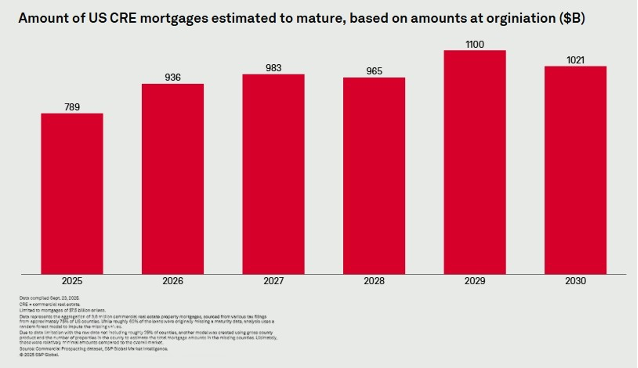
Nearly $983 billion of U.S. commercial real estate mortgages are estimated to mature in 2027. To help rebalance the wave of maturing loans, it is important to advance measures that will encourage additional capital formation and loan restructuring.
As urged by RER, a policy statement—Policy Statement on Prudent Commercial Real Estate Loan Accommodations and Workouts—issued by regulatory agencies encouraging financial institutions to work constructively with creditworthy borrowers on CRE loan workouts is helping to see loans through the current environment. Many of these loans require additional equity, and borrowers still need time to restructure this debt. Capital formation is vital to help restructure maturing debt and fill the equity gap. It is also important to avoid pro-cyclical regulatory actions.
Key Takeaways
Providing banks with the flexibility to work constructively with their borrowers during times of economic
stress has led to billions of dollars of loan restructurings and reduced undue stress in bank loan
portfolios.
The largest U.S. banks’ capital and liquidity levels have grown dramatically since the original Basel III
standards were implemented in 2013 in response to the 2008 Global Financial Crisis. Since 2009, Tier 1
capital has increased by 56 percent and Common Equity Tier 1 capital has tripled. Today, as the Federal Reserve recently observed, the U.S. “banking system is sound and resilient, with strong capital and liquidity.”
See the full fact sheet.

