

Solar Credit “Safe Harbor” Restored; Court Cites RER Comments

A Washington, D.C. federal court this week fully restored the long-standing “5% Safe Harbor” as a valid method for solar projects to establish the key “beginning of construction” date—before certain energy tax credits start phasing out under the GOP’s tax law passed last summer. (Reuters, June 8 | Holland & Knight, June 8)

Why It Matters

  • The June 6 court decision restores a key tax credit pathway that real estate owners, developers, and investors have relied on for more than a decade to plan rooftop solar and other clean energy investments.
  • The court’s opinion cited comments submitted by The Real Estate Roundtable (RER) and coalition partners urging the IRS to preserve the long-standing, clear-cut rule to establish “beginning-of-construction” based on expenditure of 5% of project costs. (Letter, Aug. 8 | Roundtable Weekly, Sept. 5, 2025)
  • Under the ruling, projects that spend 5% of project costs by July 4, 2026, have a longer time period to preserve tax credit eligibility under the beginning-of-construction deadline set by the One Big Beautiful Bill (OB3) Act. (McGuire Woods, June 8)

RER Advocacy
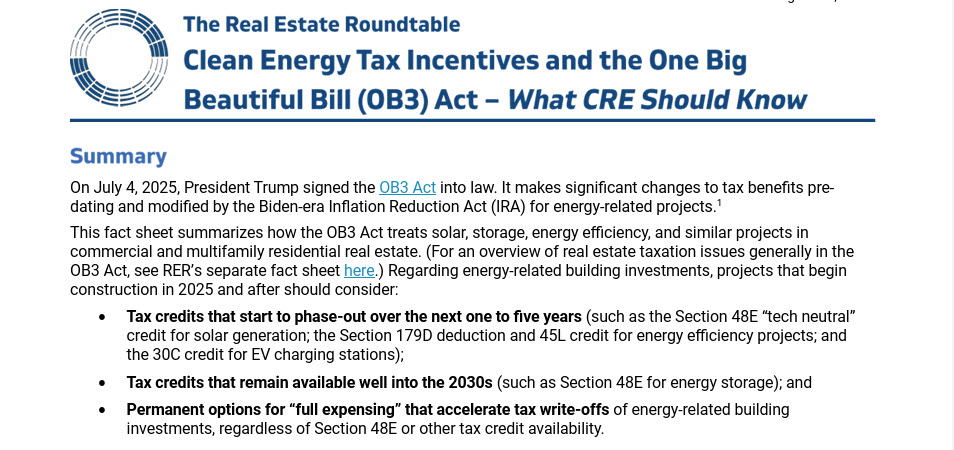
  • RER, Nareit, NAIOP, and ICSC submitted a joint letter to Treasury in August 2025, urging the IRS to continue allowing taxpayers to rely on both the 5% Safe Harbor and the Physical Work Test to show “beginning of construction.” (Letter, Aug. 8 | RW, Sept. 5, 2025)
  • The court cited the RER coalition letter, explaining that businesses have relied on the 5% cost test as a valid method for tax credit eligibility  â€śfor more than twelve years.” (Memorandum Opinion, June 6)
  • The court also cited the letter in recognizing the coalition’s concerns to avoid “stranding capital already invested” in rooftop solar and similar projects that relied upon the well-established safe harbor. (Memorandum Opinion, June 6)

The Ruling

  • The U.S. District Court for the District of Columbia found that the IRS acted arbitrarily and capriciously under the Administrative Procedure Act when it eliminated the 5% Safe Harbor for most wind and solar facilities. (Memorandum Opinion, June 6)
  • Most commercial building rooftop projects met the small-scale threshold—but this week’s court decision reinstates the cost-based safe harbor for large-scale installations as well. (JD Supra, June 9 | Nixon Peabody, June 10)
  • The ruling does not change the OB3 Act’s underlying “beginning of construction” deadlines. Projects that start construction by this coming July 4 must be “placed in service” by the end of 2030. Projects that start construction after this coming July 4 must be “placed in service” by the end of 2027. (RER Fact Sheet, Aug. 27)

The IRS could issue revised guidance or appeal the court’s ruling. In the meantime, the decision restores the 5% Safe Harbor as a planning tool for clean energy projects seeking to meet the July 4 “beginning-of-construction” deadline.

What the Government’s Reopening Means for CRE Policy Priorities

The new stopgap extends government funding only through Jan. 30, leaving appropriators less than two months to complete the remaining FY2026 bills. With the government reopened, housing, permitting, tax, and energy policy issues are again at the forefront of congressional debates. (PoliticoPro, Nov. 13)

Housing

  • HOME Program: House Financial Services Housing and Insurance Subcommittee Chair Rep. Mike Flood (R-NE) plans to restart bipartisan work on legislation updating HUD’s HOME Investment Partnerships Program, which supports affordable housing development for low-income households. Rep. Flood hopes to hold a hearing with HUD Secretary Scott Turner, though the compressed calendar may limit year-end action. (PoliticoPro, Nov. 13) (Roundtable Weekly, July 18, Sept. 5)
  • Housing Supply: The Housing Supply Expansion Act of 2025 (S.2414) is a proposed set of provisions, not a standalone bill, that aims to increase housing supply by modernizing regulations and streamlining development processes. Key components include eliminating the permanent chassis requirement for manufactured homes to lower costs, simplifying environmental review processes, and providing incentives for local governments to adopt more pro-growth housing policies. It is part of broader legislative packages like the ROAD to Housing Act of 2025 (S. 2651) and the Strengthening Housing Supply Act of 2025 (H.R.5077).
  • The ROAD to Housing Act of 2025 (S. 2651), included in the Senate-passed National Defense Authorization Act (NDAA), is on track for a House vote in December, according to House Armed Services Chair Mike Rogers (R-AL). (PoliticoPro, Nov. 14) (Roundtable Weekly, Oct. 17)
  • Portable Mortgages: Federal Housing Finance Agency (FHFA) Director Bill Pulte said Wednesday the administration is actively evaluating portable mortgages, which would allow homeowners to transfer an existing mortgage rate when buying a new home, an attempt to break the current “lock-in effect.” (Bloomberg, Nov. 12)
  • RER President and CEO Jeffrey DeBoer raised a similar supply-focused idea during the National Summit on the Housing Affordability Crisis in September. He noted that affordability challenges stem from constrained supply, limited mobility in the for-sale market, and high development costs—and that portable mortgage–style tools could be part of the solution. (Roundtable Weekly, Sept. 5)

Permitting & Energy

  • Permitting remains one of the most consequential issues for real estate investment, energy transmission, construction timelines, and infrastructure reliability. House Republicans are preparing a major overhaul aimed at accelerating approvals of energy and infrastructure projects. (Roundtable Weekly, Oct. 10)
  • House Outlook: House Natural Resources Chair Bruce Westerman (R-AR) plans to mark up the SPEED Act, co-led by Rep. Jared Golden (D-ME), which would streamline NEPA reviews and limit legal challenges. Democrats secured “permit certainty” language to prevent agencies from indefinitely stalling approvals. (PoliticoPro, Nov. 12)
  • “To keep energy prices from escalating, we have to build more energy and more energy infrastructure, or the supply and demand is going to overpower any policy you can do in Washington D.C.,” Westerman said. “We’ve got to get electricity prices stabilized.” (PoliticoPro, Nov. 12)
  • Senate Outlook: Broader Senate negotiations may include updates to Clean Water Act reviews and reforms to transmission siting, both critical for meeting surging electricity demand from AI data centers and maintaining grid reliability.

Tax and Tariff Policy

  • Section 899: The U.S. continues to push for Organization for Economic Cooperation and Development (OECD) ratification of its carveout from the global minimum tax agreement (Pillar Two). Without an agreement, Republicans could revive legislation to enact “retaliatory tax measures” against foreign companies and taxpayers, including real estate investors, that reside in countries deemed to impose discriminatory taxes. (PoliticoPro, Nov. 13)
  • Over the weekend, President Trump floated the idea of issuing tariff rebate checks to American taxpayers, a “dividend” he suggested could total at least $2,000 per person, excluding high-income households. (ABC News | Bloomberg, Nov. 10)
  • These proposals have renewed speculation that Congress may pursue a tax package next year. A tax bill, pursued through budget reconciliation rules, could be a vehicle for other tax proposals related to health care, housing, and affordability issues.

Roundtable on the Road

  • This week, Jeffrey DeBoer participated in the Stanford Professionals in Real Estate (SPIRE) 2025 SREC Fall Conference in California with RER board member Michael Lowe (Co-CEO, Lowe), where he discussed the reopening of the government, the path ahead on appropriations, and RER’s policy priorities.
  • He also highlighted how recent election results have intensified focus on housing affordability, permitting reform, and practical policy solutions that support real estate investment and community growth.

RER will continue working with lawmakers to provide insights and advance practical solutions as Congress moves into a compressed legislative window.