RER and Coalition Partners Call on Congress to Ensure Continued ENERGY STAR Funding

As focus on Capitol Hill shifted to appropriations talks this week, The Real Estate Roundtable (RER) and a broad coalition of organizations representing the real estate, consumer products, manufacturing, and retail sectors sent a letter urging congressional leaders to ensure that the ENERGY STAR program remains amply funded in the 2027 fiscal year (FY’27), starting Oct. 1.

Coalition Advocacy

  • On Tuesday, the multi-industry coalition requested that House and Senate appropriators include explicit funding for ENERGY STAR in the FY’27 spending bill, in line with FY’26 funding levels. (Letter, April 14)
  • The letter also encouraged lawmakers to include strong congressional oversight measures in the legislation, as lead agency responsibilities for the program shift from the Environmental Protection Agency (EPA) to the Department of Energy (DOE). (Letter, April 14)
  • In the letter, the coalition recommended that legislators consolidate past funding for ENERGY STAR expressly given to the EPA, plus amounts used by DOE historically to run its portion of the program. (Letter, April 14)
  • Congress provided approximately $33 million for ENERGY STAR to EPA in the FY’26 appropriations bill (H.R. 6938), signed into law on Jan. 23, preserving the program through Sept. 30 following earlier reports that it could be privatized or defunded. (Roundtable Weekly, April 3)
  • Though President Trump’s FY’27 budget request, released this month, does not specifically mention ENERGY STAR—as was the case last year—the White House has proposed cutting DOE and EPA’s overall budgets by 11 percent and 52 percent, respectively. (Budget of the U.S. Government, April 3)

DOE Budget Hearings

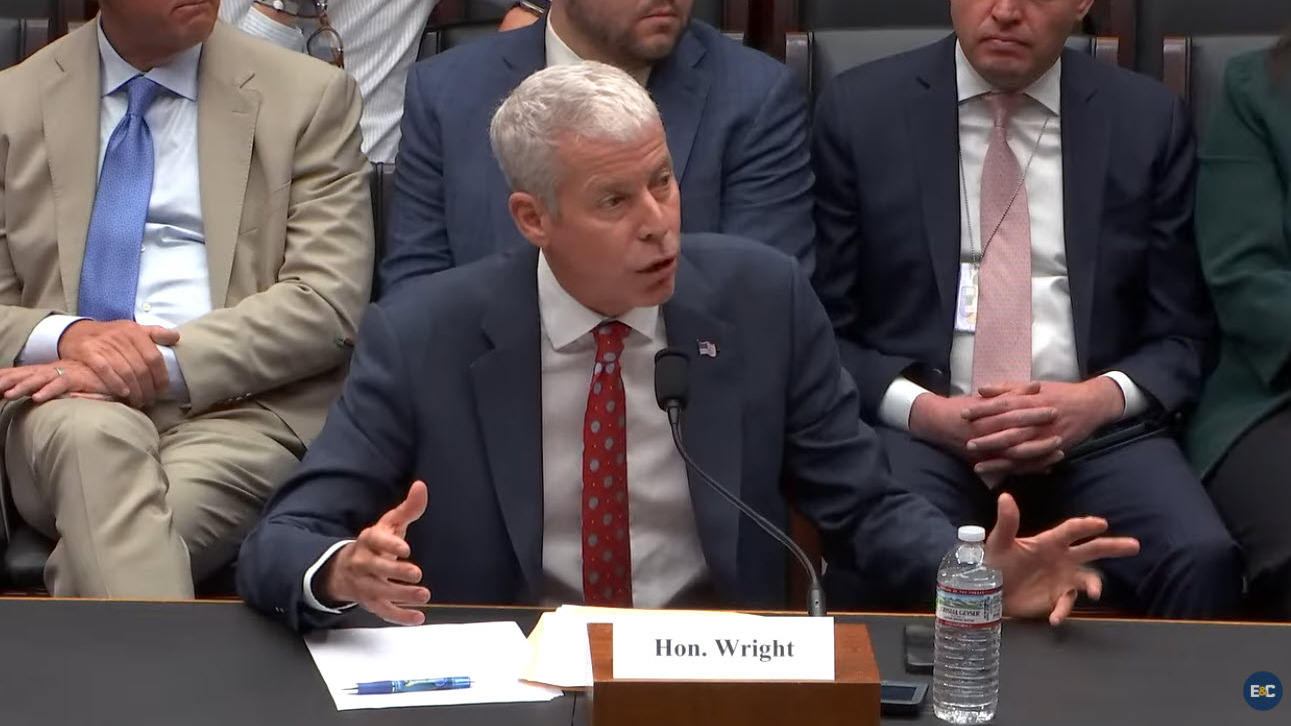
  • This week, DOE Secretary Chris Wright appeared before the House Committee on Energy and Commerce (E&C) and a subcommittee of the House Committee on Appropriations to discuss the agency’s FY’27 budget request. 
  • Though most of Sec. Wright’s testimony did not focus on ENERGY STAR, Rep. Paul Tonko (D-NY) raised the topic during Thursday’s E&C hearing. (Watch Hearing)
  • Rep. Tonko noted the importance of ENERGY STAR and pointed out that ENERGY STAR has historically required approximately $35 million in annual funding. (Watch Hearing)
  • When asked if DOE would be seeking that funding as part of its budget request, and if he could provide assurance that DOE is already working to put the people and resources in place to transition and manage the program, Sec. Wright said he would follow up on the details. (Watch Hearing)
  • Still, Sec. Wright added that he is “all for” voluntary energy efficiency ratings on appliances as well as data and transparency. (Watch Hearing)
  • The bulk of the two hearings this week focused on a range of other topics, including rising energy prices, permitting reform, and nuclear power. (Politico E&E News, April 16)

Roundtable View

  • In March, RER and coalition partners sent a letter expressing support for DOE assuming its new role as lead federal agency for ENERGY STAR. (Roundtable Weekly, April 3)
  • Additionally, the March letter underscored that DOE is well-positioned to lead a modernized program that continues to provide consumers and businesses with access to efficient products and buildings that uphold the performance they have come to expect from the ENERGY STAR brand. (Roundtable Weekly, April 3)
  • RER and coalition partners have long made the business case for ENERGY STAR and emphasized its status as a federal program required by law—meaning that it cannot be privatized or operated outside the U.S. government by agency decree. (Roundtable Weekly, April 3 | Roundtable Weekly, March 6) 
  • As Tuesday’s coalition letter highlighted, “Since 1992, ENERGY STAR and its partners have helped American families and businesses save more than $500 billion in energy costs.” (Letter, April 14)
  • By driving cost savings through energy efficiency, the program contributes to reducing energy waste and freeing up capacity on the electricity grid, in alignment with President Trump’s goal to “unleash America’s energy dominance.” (RER Policy Priorities Document)

Next week, Sec. Wright is scheduled to appear before Senate appropriators to discuss DOE’s budget request. RER will continue to track developments related to ENERGY STAR funding and support the continuation of the program and its smooth transition to DOE.

Roundtable and Coalition Support ENERGY STAR Transition to the Department of Energy

The Real Estate Roundtable (RER) joined a broad coalition of organizations representing the consumer products, manufacturing, real estate, and retail sectors this week to support the Department of Energy’s (DOE) new role as lead federal agency for ENERGY STAR, following the recent Memorandum of Agreement with the Environmental Protection Agency (EPA). (RER News Release, March 31 | Memorandum of Agreement, March 3)

ENERGY STAR Coalition Letter

  • In a coalition letter sent this week to DOE, the groups said they look forward to collaborating with the agency to ensure an effective transition that maintains and evolves the voluntary ENERGY STAR public-private partnership. (Letter, March 30 | PoliticoPro, March 31)
  • The coalition emphasized that DOE is well-positioned to lead a modernized ENERGY STAR program that continues to provide consumers and businesses with access to efficient products and buildings with the performance they have come to expect from the ENERGY STAR brand.
  • The letter also reaffirmed strong support for keeping ENERGY STAR within the federal government. (Letter, March 30)
  • “Our longstanding partnership with the federal government’s ENERGY STAR program remains a top priority as DOE assumes the lead implementation role,” said RER’s President & CEO Jeffrey D. DeBoer. “DOE has the data, talent, lab research, and other resources to run all facets of ENERGY STAR efficiently and effectively. Down the years, ENERGY STAR for buildings has saved families and businesses hundreds of billions of dollars in energy costs, and helps create greater capacity on the grid to boost economic growth. We will continue to partner in the evolution of ENERGY STAR to support the economic growth in our buildings, plants, and consumer products.” (RER News Release, March 31)
  • Congress provided approximately $33 million for ENERGY STAR to EPA in the FY’26 appropriations bill (H.R. 6938), signed into law on Jan. 23, preserving the program through Sept. 30 following earlier reports that it could be privatized or defunded. (Roundtable Weekly, Jan. 9 | Utility Dive, March 10) 
  • Additionally, the letter noted that the program has helped save families and businesses more than $500 billion in energy costs since 1992. (Letter, March 30)

Roundtable View

Tony Malkin (Chairman and CEO, Empire State Realty Trust, Inc.), chair of The Roundtable’s Sustainability Policy Advisory (SPAC) Committee.
RER’s Sustainability Policy Advisory Committee (SPAC) Chair Anthony E. Malkin (Chairman and CEO, Empire State Realty Trust, Inc.)
  • RER has long made the business case for ENERGY STAR and, with coalition partners, emphasized that it is a federal program required by law—not one that can be privatized or operated outside the U.S. government by agency decree. (Roundtable Weekly, Mar. 6)
  • Last year, RER joined dozens of industry groups in a letter to Congress to support the ENERGY STAR. The multi-industry letter cited federal statutes that compel ENERGY STAR to be a program run by federal agencies, with DOE and EPA authorized to assign program responsibilities between themselves. (Roundtable Weekly, Jun. 6, 2025)
  • “DOE has always been a key part of the ENERGY STAR ecosystem and is ideally suited to assume the role as the program’s primary steward and ensure its vitality and progress forward,” said RER’s Sustainability Policy Advisory Committee (SPAC) Chair Anthony E. Malkin (Chairman and CEO, Empire State Realty Trust, Inc.).
  • “ENERGY STAR has long enhanced the profitability of buildings and established a voluntary reporting structure for real estate assets. It helps our industry attract investors from all over the world to the United States. ENERGY STAR works better than any other building energy ‘label’ on the market because it is grounded in quantifiable metrics and deploys standard software geared to save money on utility bills and avoid wasted energy,” added Malkin.
  • Malkin continued, “Our industry coalition with leading organizations in the real estate, manufacturing, consumer tech, and retail sectors will continue to advocate to Congress and the Executive branch the critical role ENERGY STAR plays to advance America’s energy dominance and global competitiveness.”

RER will continue working with policymakers and aligned stakeholders to help ensure a smooth and productive transition for ENERGY STAR.

DOE Assumes Lead Responsibilities for ENERGY STAR

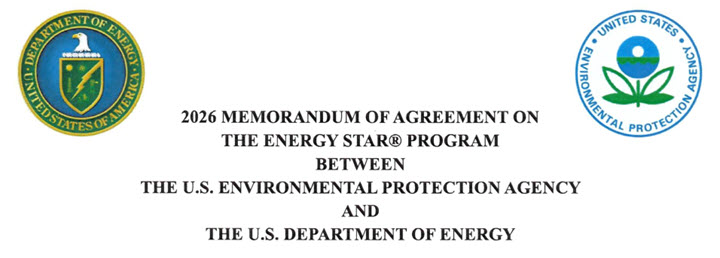
A federal agency Memorandum of Agreement (MOA) signed this week provides that the U.S. Department of Energy (DOE) will assume lead responsibilities to implement the ENERGY STAR program as oversight of the effective, popular, and voluntary public-private partnership shifts from the U.S. Environmental Protection Agency (EPA). (E&E News, March 5)

ENERGY STAR Transition

  • DOE and EPA signed the MOA for an “orderly” transition of ENERGY STAR activities including oversight of partnership agreements, trademarks, and related IT systems and databases. (Memorandum, March 2)
  • The MOA explains that a 90-day plan will provide details regarding the agencies’ transition.
  • The MOA further explains that transition activities will be initially funded by each agency using their own funds appropriated by Congress. Federal law authorizes DOE and EPA to transfer funds “as the transition progresses.”
  • Congress provided approximately $33 million for ENERGY STAR to EPA in the FY’26 appropriations bill (H.R. 6938), signed into law on Jan. 23. This law maintains funding through Sept. 30 and preserves ENERGY STAR following prior Trump administration reports to privatize the program – or de-fund it altogether. (Roundtable Weekly, Jan. 9) 

Why It Matters

  • The Real Estate Roundtable’s (RER) advocacy, in collaboration with coalition partners in the real estate, manufacturing, and consumer products sectors, has long emphasized that ENERGY STAR is a federal program required by federal law. It cannot be privatized or run outside of the U.S. government by agency decree. (Roundtable Weekly, May 9, 2025)
  • For example, RER joined dozens of industry groups last year in a letter to Congress to “strongly support continuation of the non-regulatory and non-partisan ENERGY STAR program within the federal government.” (Roundtable Weekly, June 6). The multi-industry letter cites federal statutes that compel ENERGY STAR to be a program run by federal agencies—with DOE and EPA authorized to assign program responsibilities between themselves, as indicated by this week’s Memorandum of Agreement.

RER View

Tony Malkin (Chairman and CEO, Empire State Realty Trust, Inc.), chair of The Roundtable’s Sustainability Policy Advisory (SPAC) Committee.
Tony Malkin (Chairman and CEO, Empire State Realty Trust, Inc.)
  • RER has long urged the “business case” to support the ENERGY STAR program.
  • “We look forward to continuing our longstanding partnership with the federal government’s ENERGY STAR program as DOE assumes the lead implementation role,” said RER’s President & CEO Jeffrey D. DeBoer. “DOE has the data, talent, lab research, and other resources to run all facets of ENERGY STAR efficiently and effectively. Down the years, ENERGY STAR for buildings has saved families and businesses hundreds of billions of dollars in energy costs, and helps create greater capacity on the grid to boost economic growth. We are ready to roll-up-our-sleeves to evolve ENERGY STAR to support a new generation of cutting-edge buildings, plants, and consumer products.”
  • “DOE has long been a key part of the ENERGY STAR ecosystem and is ideally suited to assume the role as the program’s primary steward,” said RER’s Sustainability Policy Advisory Committee (SPAC) Chair, Anthony E. Malkin (Chairman and CEO, Empire State Realty Trust, Inc.). “ENERGY STAR enhances profitability of buildings and establishes a voluntary reporting structure for real estate assets. It helps our industry attract investors from all over the world to the United States. ENERGY STAR works better than any other building energy ‘label’ on the market because it is grounded in quantifiable metrics and deploys standard software geared to save money on utility bills and avoid wasted energy.”
  • Malkin continued, “Real estate’s coalition with the manufacturing sector will continue to impress upon Congress and the Trump administration the critical role ENERGY STAR plays to advance America’s energy dominance and global competitiveness.”

In the coming months, RER will partner with DOE, EPA, and aligned stakeholders to accomplish a seamless and productive transition of the ENERGY STAR program.

Energy Policy Update: Permitting Push, ENERGY STAR Preserved, Grid Stressed

In Washington this week, President Donald Trump signed a bipartisan FY 2026 appropriations bill preserving ENERGY STAR funding, lawmakers refocused on permitting reform, and Winter Storm Fern exposed challenges to electric grid reliability driven by extreme weather.

ENERGY STAR

  • President Trump signed the bipartisan FY 2026 appropriations bill (H.R. 6938) into law on Jan. 23, securing approximately $33 million in funding for EPA’s ENERGY STAR program through Sept. 30. (E&E News, Jan. 29)
  • The agreement preserves the voluntary efficiency labeling initiative after earlier proposals to eliminate it and sets, for the first time, a specific mandatory annual funding level.
  • ENERGY STAR is a long-standing, market-based program that helps lower energy costs and supports “retrofit” investments for all commercial real estate asset classes. (Roundtable Weekly, Jan. 9)
  • The Real Estate Roundtable (RER) has long urged the “business case” to support the ENERGY STAR program. RER is working with a coalition of multi-industry partners in the real estate, manufacturing, consumer tech, and retail sectors to explain to Congress and the administration why ENERGY STAR is critical to the national “energy dominance” agenda. (Roundtable Weekly, June 6May 23).

Permitting Reform

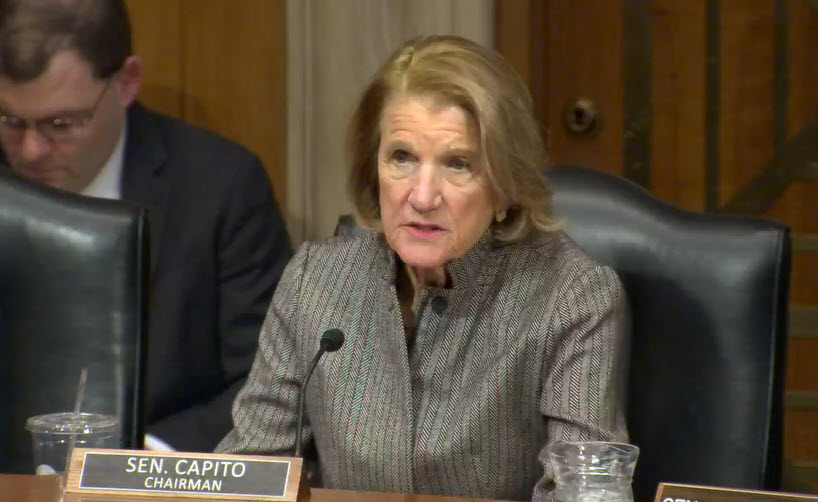
  • Senate EPW Committee Chair Shelley Moore Capito (R-WV) said permitting reform must be bipartisan, “project neutral,” and provide developers “predictability, consistency and finality” in securing permits in order to be effective. (E&E News, Jan. 29)
  • Abigail Ross Hopper (President and CEO of the Solar Energy Industries Association), testified that permitting reform should rest on three core principles: project certainty for approved projects, reduced timelines through streamlined and coordinated reviews, and a faster transmission buildout supported by stronger planning, permitting authority, and grid modernization. (UtilityDive, Jan. 29)
  • Faster permitting remains central to accelerating the buildout of the generation and transmission needed to meet rising electricity demand and improve reliability.

Winter Storm & Electric Grid

  • Ahead of Winter Storm Fern, the Department of Energy directed grid operators to be prepared to tap backup generation from large facilities—including data centers—to prevent outages and limit price spikes.
  • Energy Secretary Chris Wright framed the directive as part of a response to a “national energy emergency,” reflecting heightened reliability concerns as extreme weather collides with rapidly rising electricity demand from AI and other large loads. (WSJ, Jan. 22)
  • In the wake of this week’s winter storm, the North American Electric Reliability Corp. (NERC) warned that power generation and transmission are not growing fast enough to meet accelerating demand. NERC cautioned that several regions may lack sufficient energy supplies during extreme winter conditions, raising the stakes for grid expansion and resilience planning. (PoliticoPro, Jan. 29 | PoliticoPro, Jan 25)

RER will continue advocating for policies that remove permitting bottlenecks and support cost-effective grid modernization to ensure a robust supply of affordable power and a safe, reliable electric grid.

Roundtable Urges Congress to Pass Bipartisan SPEED Act to Advance Energy Permitting Reform and Support Grid Demand

The Real Estate Roundtable (RER) wrote to congressional leadership this week, urging passage of the bipartisan SPEED Act (H.R.4776), calling the bill essential to strengthening grid reliability, lowering energy costs, and keeping pace with surging electricity demand. (Letter, Dec. 8)

Roundtable Advocacy

  • The House is expected to vote next week on the SPEED Act, the centerpiece of a broader GOP push to overhaul NEPA reviews and ease longstanding permitting bottlenecks.  (Letter, Dec. 8)
  • In the letter, RER emphasized that the bill is critical to improving energy affordability, meeting surging electricity demand, and ensuring the grid can support U.S. families, job creators, and long-term economic competitiveness. The current patchwork of federal reviews delays the delivery of affordable, reliable power to homes and commercial buildings.
  • RER noted the U.S. needs “as much electricity as possible, from as many sources as possible, delivered as quickly and cheaply as possible” to lead in artificial intelligence, re-shore manufacturing, and maintain global competitiveness.
  • Duane Desiderio, RER Senior Vice President & Counsel, stated, “Reliable, affordable power is essential to the buildings that support our communities and economy. Modernizing permitting is critical to improving energy affordability, strengthening the grid, and reducing costly project delays. RER supports policies like the SPEED Act to build the infrastructure our country needs for long-term economic growth.”
  • Excessive and redundant reviews under NEPA delay energy and housing projects, drive up costs, and stall critical grid upgrades. The bill would reduce duplicative reviews and frivolous lawsuits, harmonize categorical exclusions, and provide certainty for approved projects.
  • Edison Electric Institute (EEI) and a coalition of energy and utility groups also urged Congress to advance the comprehensive permitting reform bill to accelerate infrastructure deployment and strengthen U.S. energy dominance. (Roundtable Weekly, Dec. 5)

State of Play

  • House and Senate leaders were active this week, advancing and negotiating several permitting reform measures as momentum builds around the SPEED Act. (Axios, Dec. 11)
  • This week, Majority Whip Tom Emmer (R-MN) convened industry leaders to discuss how streamlined permitting can support affordability, data center buildout, and rising power demand, as House leaders move a series of related bills forward.
  • On Thursday, the House passed three GOP-led permitting bills to bolster grid reliability and accelerate energy project reviews, underscoring bipartisan interest in reducing regulatory delays amid rising power demand and affordability pressures. (PoliticoPro, Dec. 11)
  • Natural Resources Chair Bruce Westerman (R-AR) is aiming for a strong bipartisan vote to build momentum for Senate action. (UtilityDive, Dec. 10)
  • Senators Mike Lee (R-UT) and Martin Heinrich (D-NM) expressed optimism about ongoing bipartisan Senate negotiations with Environment and Public Works Chair Shelley Moore Capito (R-WV) and Ranking Member Sheldon Whitehouse (D-RI), noting that any deal should make it easier to permit transmission and other major energy infrastructure. (PoliticoPro. Dec. 10)
  • The Trump administration has expressed support for congressional action on permitting reform, but has not taken a position on the SPEED ACT. (PoliticoPro, Dec. 8)

Permitting reform will be a featured topic at RER’s next all-member State of the Industry Meeting on Jan. 21–22, 2026, in Washington, D.C., as policymakers consider strategies to bolster energy infrastructure and support long-term economic growth.

EPA’s Reorganization Plan Includes ENERGY STAR

The U.S. Environmental Protection Agency (EPA) released its long-awaited reorganization of various program offices on Monday. It lists ENERGY STAR–the voluntary federal public-private partnership promoting efficiency in buildings and appliances–as falling under the newly structured Office of Radiation and Indoor Air (“ORIA”). (EPA website | E&E News, Nov. 3)

Agency Restructuring

  • The new ORIA office, which includes ENERGY STAR, is part of EPA’s ongoing “comprehensive restructuring efforts” and staff reduction plans announced this summer. (EPA press release, July 18)
  • For example, EPA reorganized its research office in October–carrying through on Administrator Lee Zeldin’s May testimony to Congress. (E&E News, Oct. 20)
  • EPA’s new structure acts on a Feb. 26 memo of the White House Office of Management and Budget (“OMB”) directing all agencies to implement plans to reorganize, streamline, and reduce federal staff. The OMB memo itself stems from the DOGE Executive Order signed by President Donald Trump on Jan. 20.

Industry Advocacy

  • In May, Zeldin stated to Congress that EPA was considering whether it might be appropriate to privatize ENERGY STAR. This followed a proposed White House budget to eliminate a now-defunct EPA office that previously housed ENERGY STAR. (Roundtable Weekly, May 9)
  • RER and leading real estate organizations responded with letters to EPA (April 4) and the Department of Energy (May 14), highlighting ENERGY STAR’s importance for U.S. buildings and explaining why ENERGY STAR should remain a federal program. (Roundtable Weekly, May 23)
  • A multi-industry coalition followed suit. Trade associations representing real estate, product manufacturers, consumer technology, and retailers took the issue to Congress. Their June 6 letter emphasizes that ENERGY STAR is a statutorily required federal program that cannot be privatized. (Roundtable Weekly, June 6)
  • These efforts resulted in ENERGY STAR funding approved by House and Senate Appropriations Committees. Both chambers have clearly signaled that ample funds for EPA’s buildings and appliance partnership program are available once the government reopens. (Roundtable Weekly July 25; Sept. 5)

ENERGY STAR Continues During Shutdown

  • While EPA’s funding bill for FY ’26 (that started Oct. 1) has yet to pass the full Congress and reach President Trump’s desk, ENERGY STAR has continued to function amid the ongoing shutdown. For example:
  • The open-access federal contracting database shows that the consultant contract to support ENERGY STAR for commercial buildings is paid through at least July 13, 2026.
  • While ENERGY STAR finds a place in EPA’s new indoor air office–with Congress prepared to fund it, and the program continuing during the shutdown–EPA’s overall reorganization continues. An agency spokesperson reportedly stated, “No final decision has been made at this time” regarding ENERGY STAR’s long-term status. (New York Times, Nov. 1)

RER and our industry partners will continue to track these events closely. The coalition will advocate for EPA to operate the bipartisan, highly successful ENERGY STAR program robustly and efficiently once the government reopens.

Record-Level Investments Aim to Enhance Grid Reliability

Unprecedented demand for electricity is prompting major private sector investments to shore up the grid’s security and reliability, amid the Trump Administration’s cancellation of Biden era clean energy funds.

Billions in Private Investments

  • Investor-owned electric companies plan to invest an unprecedented record-high $208 billion in capital projects this yeara $30 billion increase from 2024 — to modernize transmission systems, expand capacity, and manage consumer costs, according to new Edison Electric Institute (EEI) data. (Axios, Oct. 7)
  • “Our new data shows how our industry is strengthening the energy grid with real investments—in jobs, critical infrastructure, and communities across the nation,” Edison Electric Institute President and CEO Drew Maloney said in a statement. (Axios, Oct. 7)

Major Energy Policy Shift

  • Meanwhile, the Trump administration is cutting federal support “to get low-cost renewable projects on the grid”—cancelling billions in Biden administration project funding—and “pinning many of its promises of energy affordability on a nuclear moon shot.” (PoliticoPro, Oct. 6).
  • The Department of Energy (DOE) announced millions to “reinvigorate America’s coal industry” (Release, Sept. 25), while the Department of the Interior (DOI) has opened up more federal lands to coal leasing. (Release, Sept. 29)
  • The Environmental Protection Agency (EPA) is pushing for a natural gas pipeline “vital to New England’s grid stability.” (Release, Aug. 6)
  • The sharp policy swing has some members of Congress calling for a fuel-agnostic, all-of-the-above national energy strategy. “We need every electron we can get if we want to be energy dominant. To do that, we should take every electron,” said Sen. John Curtis (R-UT). (PoliticoPro, Oct. 6)

The Drivers

  • Electricity demand is spiking from a “perfect storm” of multiple forces:
  • AI and Data Centers: Expected to account for nearly half of global demand growth through 2030. (IEA 2025)
  • EV Charging: Electric vehicles are expected to raise global power demand 6–8% by 2035 (IEA 2024)
  • Manufacturing Reshoring: New U.S. facilities for semiconductors, batteries, and critical minerals production will significantly increase industrial load (CSIS 2024)
  • Crypto Mining: U.S. Bitcoin mining consumes electricity equal to powering 6 million homes (EIA 2024)
  • Building Electrification: 40% of U.S. buildings now use electric heating, driven by codes, tenant preferences, and investor sustainability demands (BOMA 2023)

Permitting Reform

  • Permitting reform continues to be a top bipartisan priority on Capitol Hill, as lawmakers debate how best to reform the federal approval process for energy infrastructure projects. (Utility Dive, Sept. 18 | Roundtable Weekly, Oct. 2024)
  • Last month, the bipartisan House Problem Solvers Caucus released a framework to speed construction of transmission lines, pipelines, and power projects to meet surging energy demand. (PoliticoPro, Sept. 18)
  • In September, the House Natural Resources Committee held a legislative hearing on a trio of bipartisan permitting reform bills—including Chair Bruce Westerman’s (R-AR) SPEED Act, aimed at streamlining the permitting process. “My goal is to have a big permitting bill sitting over at the Senate for them to consider with some bipartisan support.” (PoliticoPro, Sept. 18)
  • At an event last month, White House National Energy Dominance Council Executive Director Jarrod Agen said, “Probably the top priority for us from an energy perspective” is permitting reform to build transmission lines and pipelines. (E&E News, Sept. 8)
  • RER believes permitting reform is essential for advancing our economy’s energy transition. The current fragmented system of administrative reviews and approvals hinders the delivery of quick, low-cost, reliable electricity to our nation’s homes and commercial buildings. (Roundtable Weekly, March 7)

Energy supply, grid reliability, and infrastructure investment will be a central topic at RER’s Fall Meeting (Roundtable-level members only) on Oct. 27–28 in Washington, D.C.

Update: What CRE Needs to Know About Energy Policy

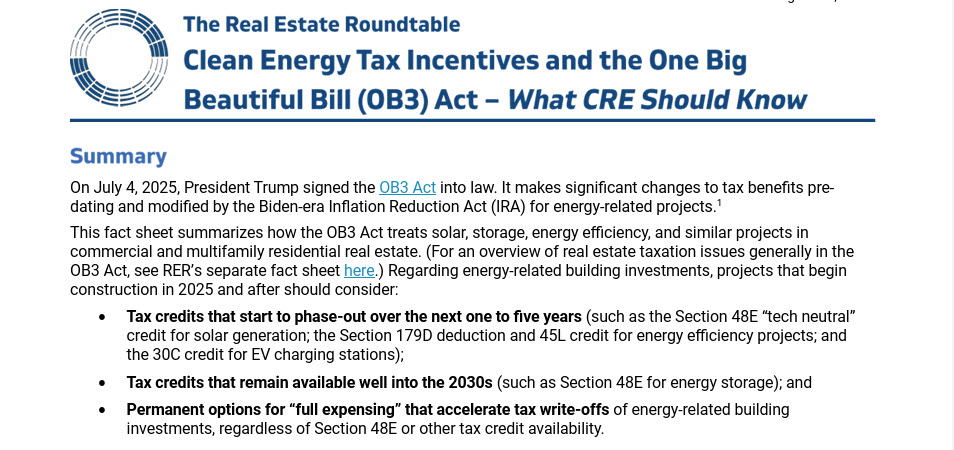
Major changes to the federal tax code’s clean energy incentives, signed into law on July 4 by the One Big Beautiful Bill (OB3) Act, continue to reshape the future of building-related solar, storage, and energy efficiency investments.

Energy Tax Incentives

  • The OB3 Act accelerates the phase-down of certain tax credits, shortens eligibility timelines, and adds stricter foreign content and control rules. Projects beginning construction in 2025 and beyond should consider:
  • Tax credits that phase out over the next few years (such as the Section 48E “tech neutral” credit for solar, the Section 179D deduction and 45L credit for energy efficiency projects, and the Section 30C credit for EV charging stations);
  • Tax credits that remain available well into the 2030s (such as Section 48E for energy storage); and
  • Permanent options for “full expensing” that can accelerate tax write-offs of energy-related and other building investments, regardless of Section 48E or other tax credit availability

Solar “Beginning of Construction”

Workers on sustainable energy project on rooftop of building
  • The timing of when rooftop solar projects are deemed to “begin construction” is crucial for determining tax credit eligibility under the OB3 Act’s accelerated phase-down of the Section 48E credit.
  • RER, Nareit, NAIOP, and ICSC submitted a joint letter to Treasury on Aug. 8 urging continued reliance on both the Safe Harbor and Physical Work Tests. (Letter, Aug. 8)
  • On Aug. 15, the IRS issued Notice 2025‑42, preserving the Safe Harbor for rooftop solar projects of 1.5 MW or less, which includes most CRE rooftop solar projects and maintains their eligibility for Section 48E credits (for as long as they remain available). (Clean Energy Council, Aug. 18)

EPA ENERGY STAR

  • The status of the ENERGY STAR program should become clearer as part of the “phase 2” reorganization plan of the Environmental Protection Agency (EPA), expected to be implemented by the end of September, as per a White House budget office memo. (EPA press release, July 18) (Politico, July 17).
  • RER and multi-industry coalition partners advocated strongly for Senate and House Appropriations Committee actions this summer, which would provide ample federal spending for ENERGY STAR in FY’2026 starting on Oct. 1. (Roundtable Weekly, July 25).
  • Meanwhile, ENERGY STAR recently certified 131 buildings nationwide under its voluntary new NextGen program, available for highly energy efficient buildings that also opt to reduce emissions and use renewable energy.

California Guidance on Climate Reporting

  • The California Air Resources Board (CARB) released draft guidance this week for companies required to publicly report on climate-related financial risks under state law SB 261.
  • Quantifying and reporting Scope 1, 2, and 3 emissions will not be mandatory in the initial reporting period under California’s law, which applies to companies with annual worldwide revenue greater than $500 million. (PoliticoPro, Sept. 2 | RER’s fact sheet on SB 261 and SB 253, Sept. 2023)
  • The new reporting requirements are expected to start in 2026. Final rules from CARB are expected by December. (ESGToday, Sept. 4)

Housing Affordability and Energy Codes

  • Next Tuesday, Sept. 9, the House subcommittee focused on energy policy will hold a hearing examining the impact of residential building energy codes on housing affordability. (Energy Subcomm. Press release, Sept. 2)
  • According to the memo prepared for the hearing, construction that aligns with the 2021 version of model residential energy codes can add $31,000 to the price of a new home, “and take up to 90 years for a home buyer to recoup the payback value.”
  • Witnesses at the hearing include representatives from the National Association of Home Builders (NAHB) and the natural gas utility serving the Washington, D.C. metro area.

RER will continue advocating to the Trump administration and Congress for clear, workable policies that support long-term real estate energy investments.

Energy Tax Incentives in the OB3 Act: What They Mean for CRE

Major changes to the federal tax code’s clean energy incentives, signed into law on July 4 by the One Big Beautiful Bill Act (OB3 Act), continue to generate questions regarding the future of building-related solar, storage, and similar projects.

Why It Matters

  • The new law accelerates the phase-down of tax credits, shortens eligibility timelines, and adds new foreign content and control rules, creating an urgent planning window for energy-related building investments.
  • Regarding energy-related building investments, projects that begin construction in 2025 and after should consider:
    • Tax credits that phase-out over the next few years (such as the Section 48E “tech-neutral” credit for solar, the Section 179D deduction and 45L credit for energy efficiency projects, and the Section 30C credit for EV charging stations);
    • Tax credits that remain available well into the 2030s (such as Section 48E for energy storage); and
    • Permanent options for “full expensing” that can accelerate tax write-offs of energy-related and other building investments, regardless of Section 48E or other tax credit availability.

Executive Order Tightens Rules    

  • A July 7 White House executive order directs the U.S. Treasury Department to consider revising the IRS’s longstanding “5% safe harbor test to determine a project’s “beginning of construction” date, which could further tighten tax credit eligibility for investments such as rooftop solar. (Roundtable Weekly, July 11)
  • The EO also directs Treasury to strictly enforce the OB3 Act’s scheduled termination of clean energy production and investment tax credits under Sections 45Y and 48E of the Internal Revenue Code. Updated guidance is anticipated in August. (Bloomberg, July 7) (Utility Dive, July 9)
  • In a similar move, on Tuesday, Interior Secretary Doug Burgum issued a final order requiring high-level departmental scrutiny of solar projects on public lands, and on private property that requires Interior’s approval (such as solar panels on historic buildings, or installed as part of projects impacting federally-listed endangered species habitat). (Politico, July 18).   

Market Impact

  • A new POLITICO analysis estimates that more than 662,000 jobs and $565 billion in investment tied to clean energy projects announced since 2017 could be at risk under the OB3 Act. (PoliticoPro July 30)
  • Many of these projects depended on long-term planning horizons and Biden-era tax incentives, now constrained by tighter deadlines and new eligibility rules.

EPA Endangerment Finding

  • In related news, the Trump administration this week proposed eliminating the 2009 “Endangerment Finding.” This Obama-era decision underpins federal regulations to address climate change and limit greenhouse gas emissions from power plants, vehicles, and other sources. (EPA Press Release, July 30) (Politico, July 29)
  • The EPA’s proposal only impacts federal-level rules. Governors and officials in California, Colorado, New York, and elsewhere pledged to continue their own climate regulatory efforts, citing the need for science-based action. (BBC News, July 29; The Hill, July 29; Colorado Governor statement; NYS-DEC statement.)
  • In this regard, efforts by EPA Administrator Lee Zeldin to rescind the Endangerment Finding will likely have minimal impact on state and local Building Performance Standards (BPS) that aim to reduce energy use and emissions from commercial and multifamily properties. (See RER’s 20-Point BPS Guide (Oct. 2024)).
  • The EPA’s proposal is not yet final and will undergo a 45-day public comment period once published in the Federal Register. (PoliticoPro, July 29)

As regulatory guidance evolves, RER will continue advocating for clear, workable policies that support long-term real estate energy investments.

Multi-Industry Coalition Urges ENERGY STAR Support

Today, The Real Estate Roundtable (RER) joined a broad coalition of manufacturing, consumer technology, retail, and real estate allies in a letter to Congress urging continued federal support for the overwhelmingly bipartisan ENERGY STAR program. (Letter, June 6)

Cross-Sector Advocacy Push

  • The coalition letter emphasized that ENERGY STAR has delivered hundreds of billions of dollars in energy savings since its inception—approximately $40 billion in annual savings alone for American consumers, families, and businesses. 
  • More than 30 leading organizations signed today’s letter including RER, many real estate partners, and manufacturing, consumer products, and retail groups. They include the Air-Conditioning, Heating and Refrigeration Institute (AHRI); American Chemistry Council (ACC); Consumer Technology Association (CTA); National Association of Manufacturers (NAM); National Retail Federation (NRF); National Electrical Manufacturers Association (NEMA); and the Retail Industry Leaders Association (RILA).
  • The multi-industry letter also highlights ENERGY STAR’s brand as a highly successful, non-regulatory, and bipartisan public-private partnership that promotes energy efficiency and consumer trust across industries that drive the U.S. economy.
  • The industry letter stated that ENERGY STAR is fundamental to an “all of the above” energy strategy, crucial for accommodating growing electricity demands from artificial intelligence, crypto assets, and advanced manufacturing. (Letter, June 6)

Real Estate Sector Support

  • The real estate industry previously sent letters to Congress, the Department of Energy (DOE), and the Environmental Protection Agency (EPA) explaining the importance of ENERGY STAR focusing on U.S. commercial and residential buildings. (Roundtable Weekly, May 23) (Letters: May 23, May 14, and April 4)

  • In response to indications that the Trump Administration might eliminate ENERGY STAR as federally managed, RER President and CEO Jeffrey DeBoer commented the program “is integral to the U.S. real estate industry. Its software is embedded in the fabric of how profitable, energy efficient buildings are run and managed in all markets across the nation.”
  • “ENERGY STAR provides the key tools for families and business to save money on their utility bills,” DeBoer continued. “Owners and developers rely on ENERGY STAR to attract investment capital so U.S. building infrastructure can compete with the best real estate assets in the world.” (Roundtable Weekly, May 9)

Press Coverage

  • A recent op-ed in The Hill made the economic case for ENERGY STAR, arguing that its elimination would raise operational costs, disrupt performance standards, and weaken a public-private partnership that delivers measurable benefits to businesses, consumers, and the environment. (The Hill, May 31)
  • A former Republican EPA Administrator who helped create ENERGY STAR in the 1990s commented that the energy efficiency and waste avoidance goals of the program “should make a DOGE bro swoon.” (Washington Post, May 14). 

RER will continue to advocate with aligned groups in the real estate sector and across industry lines to preserve ENERGY STAR as a voluntary, federal public-private partnership.