About Us



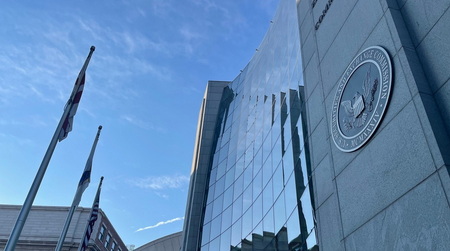
The Real Estate Roundtable submitted comments today to the U.S. Securities and Exchange Commission (SEC) on a proposed rule that would require all registered companies to disclose material financial risks related to climate change. The comments were developed with The Roundtable’s Sustainability Policy Advisory Committee (SPAC), chaired by Tony Malkin (Chairman, President and CEO of Empire State Realty Trust). (GlobeSt, March 22)
Extensive Climate Risk Disclosures
- The SEC’s proposal, “Enhancement and Standardization of Climate-Related Disclosures for Investors,” is a key component of the Biden Administration’s efforts to cut U.S. greenhouse gas emissions. (CBS-AP | Bloomberg | Axios, March 21)
- If the rule is finalized, compliance would phase-in over the next several years. All SEC registrants would be required to quantify their greenhouse gas (GHG) emissions, assess the economic impact of rising sea levels related to their assets, and report in SEC filings (for the benefit of investors) on these and other climate-related risks through annual 10-Ks and additional filings. (SEC News Release | Proposed Rule | Fact Sheet, March 22)
- The SEC’s extensive draft rule has raised significant concerns throughout the U.S. business community. (ClimateWire, June 2). The proposal includes new disclosure requirements for “Scope 3” GHG emissions, which are generated outside a business’ direct control by partners, suppliers, and consumers that make up the “value chain” of that business. (EPA Scope 3 Inventory Guidance and Fourkites).
Roundtable Response

- The Roundtable’s comment letter is summarized as follows:
- Registered Companies Should Not be Required to Report on Emissions From Sources They Do Not Own or Control.
When applied to the CRE context, this means that a building owner should not be under a mandate to report on emissions attributable to the operations of tenants in leased spaces. For example, emissions from metered electricity in a tenant-leased space should not be the CRE owner’s responsibility to report to the SEC. - Create a “Safe Harbor” for Emissions Calculated with U.S. Government Data and Tools.
Reporting companies should be protected by a “safe harbor” that insulates emissions disclosures from liability—in both SEC enforcement as well as private litigation—when calculations are based on the best, available, and most recent data and tools released by the federal government. - There Should be No Scope 3 Reporting “Mandate.”
Scope 3 disclosures typically depend on GHG data possessed by suppliers and other businesses in a reporting company’s value chain. Registrants should not be under any Scope 3 disclosure mandate because they frequently cannot get the basic data to quantify those “indirect” estimates. - Wait Until a Registrant has a Full Year of “Actual” Data Before Requiring Emissions Disclosures.
The proposal as written effectively requires two separate emissions disclosures each fiscal year. The SEC should only require emissions filings once a year—after a company has all of the “actual” data it needs to support and verify its calculations. - Financial Risks from Severe Weather Events Should be Subject to “Principles-Based” Reporting—As Opposed to One-Size-Fits-All “Prescriptive” Rules.
Risks from floods, droughts, and similar events should be subject to narrative, “principles-based” reporting. The SEC should drop its proposed “prescriptive” rule that registrants should precisely quantify impacts from climate-related events if they have a one-percent or greater impact on any line item in a financial statement.
- Registered Companies Should Not be Required to Report on Emissions From Sources They Do Not Own or Control.
Policymaker Concerns
- The Biden administration is expected to push forward with a final rule that could be issued later this year.
- Senator Joe Manchin (D-WV), chairman of the Senate Committee on Energy and Natural Resources, sent a letter to the SEC on April 4 outlining his concerns with the proposal.
- Senate Republicans also expressed their opposition to the SEC proposal in an April 5 letter.
- House Republicans have called for a hearing on the SEC’s proposal—signaling heightened oversight should they win the majority in this November’s mid-term elections. (E&E News, May 10)
The Roundtable’s comments to the SEC will be a focus of the SPAC meeting on June 17, held in conjunction with The Roundtable’s Annual Meeting.
# # #