
RER Statement on the 21st Century ROAD to Housing Act

Statement by Real Estate Roundtable (RER) President and CEO Jeffrey D. DeBoer

(WASHINGTON, D.C.) — “The Real Estate Roundtable supports many provisions in the ROAD to Housing Act and the Housing for the 21st Century Act, both of which take important steps toward expanding housing supply.  Expanding housing supply requires significant capital investment.  However, the institutional investor provisions under consideration in the Senate bill would be counterproductive. These provisions would discourage the capital investments that are needed to develop, redevelop, and modernize the nation’s owner-occupied and rental housing stock.  In particular, the provision to force institutional owners of rental housing to sell the homes that they build within a specified 7-year timeframe would discourage investment in home construction, could actually result in rent increases in many markets, and would no doubt face substantial constitutional challenges.  

Addressing housing affordability challenges facing families across the country requires a greater supply of housing.  While much of the housing bill now before the Senate is properly focused, the institutional investor provisions should be dropped.”

Coalition Statement on Making Housing More Affordable for Americans

(WASHINGTON, D.C.) — The United States is facing a housing affordability crisis driven by demand exceeding supply, causing a shortage of all types of housing—homes for sale, homes for rent, apartments, duplexes and others—that has been decades in the making. For too long, families and communities throughout the country have struggled with the high cost of housing.

The undersigned organizations appreciate the Trump Administration’s ongoing commitment to reducing housing costs and broadening housing opportunity by exploring solutions that will expand the number of homes available—the only real solution to housing affordability. While there is no single policy solution, we know it will require public and private partnerships collaborating with communities nationwide to build the housing America needs.

The cost of housing is one of the most critical issues facing many Americans. The only way to lower the cost of mortgages and rent is by encouraging, not hindering, investment and constructing the housing that individuals and families can build lives upon.

President Trump has made increasing housing supply and addressing today’s shortage a top priority, and rental housing providers are the very organizations to partner with to solve our housing affordability challenges.

As a coalition, we urge policymakers of both parties and at all levels of government to embrace solutions that will have the greatest positive impact on housing supply and make a meaningful difference in Americans’ lives by building the housing our nation needs.

We look forward to learning more about the Administration’s housing proposals and partnering with the Administration in developing a national housing policy that will ensure that generations of Americans have the freedom to choose from a wide range of affordable housing options.

Download Statement

Council for Affordable and Rural Housing

Institute of Real Estate Management

Manufactured Housing Institute

NAIOP, Commercial Real Estate Development Association

Nareit

National Association of Housing Cooperatives

National Affordable Housing Management Association

National Apartment Association

National Association of Home Builders

National Leased Housing Association

National Multifamily Housing Council

National Rental Home Council

The Real Estate Roundtable 

RER Statement on Restricting Institutional Investment in Single-Family Housing

Statement by Real Estate Roundtable (RER) President and CEO Jeffrey D. DeBoer

(WASHINGTON, D.C.) — “Access to affordable housing is central to the American Dream, a dream that for some families means renting a home and for others means owning a home.

For more than a decade, our nation’s supply of both owner-occupied and rental housing has, for a variety of reasons, not kept up with demand.

This gap between supply and demand is the true cause of today’s housing crisis.

The supply of housing must be increased.

This will require, among other actions, common sense policy reforms to local permitting and zoning regulations, recognizing in both national and local policy actions the reality of escalating labor and material costs and, importantly, the need to maintain and improve incentives to encourage the capital needed to develop, redevelop, and modernize the nation’s housing stock.

We work with all policymakers to advance initiatives that remove barriers to housing development, incentivize capital investment in housing, and help people achieve the American Dream.”

NEWS: Commercial Real Estate Confidence Holds Steady as Market Stabilizes, Q4 Sentiment Index Shows

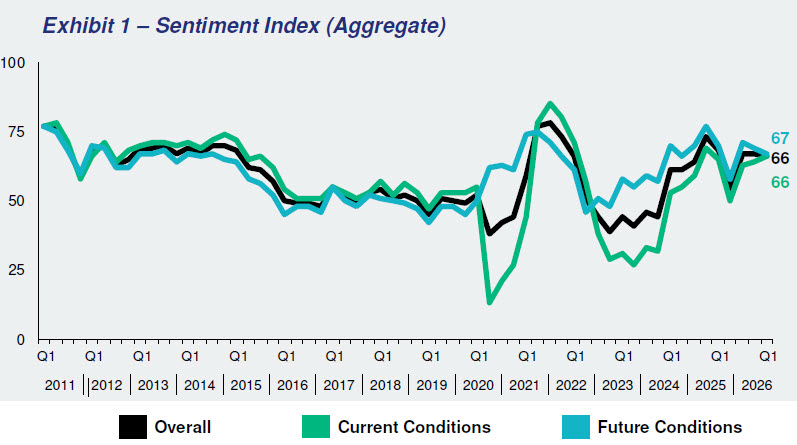
(WASHINGTON, D.C.) — The Real Estate Roundtable’s (RER) Q4 2025 Sentiment Index registered an overall score of 67, equivalent to the prior quarter, reflecting that commercial real estate executives’ sentiment has shifted from caution toward guarded optimism as markets stabilize, transaction activity resumes, and expectations build for easing interest rates in 2026.

The Current Index rose one point to 64, while the Future Index dipped slightly to 69, together indicating confidence that the worst disruptions of recent years have passed—even as policy uncertainty and uneven capital access continue to shape near-term decision-making.

Industry leaders credited easing rate pressures and increased market activity for boosting optimism, despite tariffs and shifting policy signals posing persistent challenges.

“Real estate executives see encouraging momentum,” said Jeffrey DeBoer, RER President and CEO. “Roundtable members are reporting steady improvement and renewed confidence across sectors. Despite improvements, tariffs continue to drive up development costs and complicate business planning. Moreover, the record-long government shutdown is disrupting infrastructure and construction permitting, and access to current economic data that companies rely on to plan. Clear, consistent, and coordinated policies from Washington are essential to unlock capital and support long-term economic growth in communities nationwide.”

The Q4 Sentiment Index topline findings include:

  • The Q4 2025 Real Estate Roundtable Sentiment Index registered an overall score of 67, equivalent to the previous quarter. The Current Index registered a score of 64, a 1-point increase over Q3 2025. The Future Index posted a score of 69 points, a decrease of 2 points from the previous quarter, reflecting sentiment that the market has largely stabilized and is now transitioning from caution to guarded optimism. Many participants anticipate stronger transaction activity in 2026 as interest rates ease and confidence builds, yet acknowledge that political and policy uncertainty continue to temper near-term enthusiasm.
  • Although perspectives vary by asset class, overall market sentiment remains positive. Only 13% of respondents believe that general market conditions are worse than this time last year, while 63% believe that general market conditions are better than this time last year. More than two-thirds (70%) of Q4 survey participants expect general market conditions to show improvement one year from now. Leaders reported continued strength in residential sectors, alongside steady improvement in retail and hospitality. Office remains the most challenged asset class, though signs of stabilization are emerging in top-tier markets.
  • Forty-three percent (43%) of respondents believe asset values are roughly unchanged compared to a year ago. A large minority of participants see green shoots, with 42% believing asset prices have increased and only 15% believing they have declined. Looking ahead, the outlook is optimistic: 72% expect asset prices to rise over the next year, 24% believe asset values will remain stable, and only 4% anticipate a slight decline.
  • Perceptions on the availability of equity capital relative to last quarter are muted, although nearly half (48%) of respondents still believe equity availability is better compared to a year ago. On the other hand, sentiment around debt capital has risen significantly, as 78% said the availability of debt capital has improved from last year. Looking forward, 64% of respondents believe that equity capital availability will be better in one year and 56% believe debt capital availability will be better.

Sample responses from participants in the Sentiment Index’s Q4 survey include:

“Market conditions have strengthened, and real estate has benefited from overall market optimism, driven by expectations of continued rate cuts on the short end of the curve and confidence that the economy will avoid a recession.”

“Equity is coming in, but real estate has lots of competition among infrastructure, private markets, etc.”

“Tariffs have been a disaster for our industry, not only because the cost of materials is higher, but also because of the uncertainty they create which significantly hampers the ability to make decisions.”

Data for the Q4 survey was gathered by Chicago-based Ferguson Partners on RER’s behalf in October. See the full Q4 report.

The Real Estate Roundtable (RER) brings together leaders of the nation’s top publicly-held and privately-owned real estate ownership, development, lending and management firms with the leaders of major national real estate trade associations to jointly address key national policy issues relating to real estate and the overall economy.

#     #     #
Stabilizing Market Conditions Drive Optimism in Q3 Sentiment Index

(WASHINGTON, D.C.) — The Real Estate Roundtable’s Q3 2025 Sentiment Index reflects increased confidence among commercial real estate executives as market conditions stabilize and sector-led growth emerges. The Q3 Index posted an overall score of 67, a 13-point increase from the previous quarter, with notable increases in both the Current (63) and Future (71) indices.

RER President and CEO Jeffrey DeBoer said, “Our Q3 Sentiment Index results show that market conditions have continued to stabilize in a meaningful way, supported by improved supply and demand. Commercial real estate executives are increasingly optimistic that the next 12 months will bring continued improvement. That said, certain property types continue to face headwinds, and capital access remains uneven across markets and sectors. Even so, the prevailing sentiment is that stability is returning and opportunities are emerging.”

While challenges remain, industry leaders see meaningful opportunities ahead, particularly in multifamily, data centers, and select office markets.

He added, “The provisions in the One Big Beautiful Bill Act should help accelerate this momentum— expanding housing supply, revitalizing communities, spurring job-creating investment nationwide, and strengthening the broader economy. Coupled with improving debt capital availability and stabilizing asset values, these policies set the stage for renewed growth. Moving forward, industry leaders and policymakers must continue to work together to promote investment, ensure credit access, and address persistent supply-demand imbalances in housing and other high-need property sectors.”

The Q3 Sentiment Index topline findings include:

  • The Q3 2025 Real Estate Roundtable Sentiment Index registered an overall score of 67, an increase of 13 points over the previous quarter. The Current Index registered 63, a 13-point increase over Q2 2025. The Future Index posted a score of 71 points, an increase of 13 points over the previous quarter, reflecting sentiment that operating conditions have largely stabilized: occupancy and demand are holding, and values appear to have bottomed. Participants expect modest, sector-led growth, yet acknowledge lingering headwinds for weaker property types.
  • Sentiment around general market conditions has markedly increased since last quarter (Q2). Only 10% of respondents believe that general market conditions are worse than this time last year, and 56% of respondents believe that general market conditions are better than this time last year. Almost three- quarters (73%) of Q3 survey participants expect general market conditions to show improvement one year from now. Multifamily, data centers, and NYC office shine while industrial supply is overbuilt.
  • Half of respondents believe asset values are roughly unchanged compared to a year ago. The remaining respondents are divided, with 32% believing asset prices have increased and 18% believing they have declined. Looking ahead, the outlook is optimistic: 59% expect asset prices to rise over the next year, 32% believe asset values will remain stable, and only 9% anticipate a slight decline.
  • Perceptions on the availability of equity capital relative to last year are muted, with 50% of respondents believing equity availability is unchanged compared to a year ago. On the other hand, sentiment around debt capital has risen significantly, as 65% said the availability of debt capital has improved from last year. Looking forward, 55% of respondents believe that equity capital availability will be better in one year and 48% believe debt capital availability will be better.

Survey participants noted that the market is increasingly sector-specific, with performance tied closely to location, asset quality, and loan maturity schedules. Comments highlighted stabilizing fundamentals, renewed deal competition, and a narrowing bid-ask spread in transactions.

Some sample responses from participants in the Sentiment Index’s Q3 survey include:

“The market feels largely stable. There is still uncertainty about what lies ahead, yet conditions are far steadier than we have seen in recent years.”

“Real estate is a local business, and this cycle underlines how unique every market and product type really is. There is no ‘one-size-fits-all’ answer; it all depends on where you are, how favorable your product is, and the date of your loan maturity.”

“Debt is liquid with tight spreads; on the equity side it’s a ‘haves and have-nots’ market. Quality product will still get funded.”

Data for the Q3 survey was gathered by Chicago-based Ferguson Partners on RER’s behalf in July. See the full Q3 report.

The Real Estate Roundtable (RER) brings together leaders of the nation’s top publicly-held and privately-owned real estate ownership, development, lending and management firms with the leaders of major national real estate trade associations to jointly address key national policy issues relating to real estate and the overall economy.

Roundtable Statement on Tragic New York City Shooting

Statement by Real Estate Roundtable (RER) President and CEO Jeffrey D. DeBoer

(WASHINGTON, D.C.) — “The Real Estate Roundtable (RER) is deeply saddened by the tragic shooting that occurred Monday in New York City.

On behalf of our membership, I extend our heartfelt condolences to the families and loved ones of the victims, including those from Rudin Management and Blackstone — and to all those impacted by this senseless act of violence.

RER will continue to work closely with the FBI and other federal, state and local agencies to share critical intelligence, strengthen building security, support first responders and advance national policies that promote public safety while protecting individual rights.”

Roundtable Statement on Senate Passage of the One Big Beautiful Bill Act

Statement by Real Estate Roundtable President and CEO Jeffrey D. DeBoer

(WASHINGTON, D.C.) —“The Real Estate Roundtable supports the Senate Amendment to H.R. 1, the One Big Beautiful Bill Act. We urge its final passage and speedy enactment. This legislation will spur needed investment in our nation’s housing supply, strengthen urban and rural communities, and grow the broader economy to the benefit of all Americans.”

# # #

Commercial Real Estate Executives Signal Increased Caution in Q2 Sentiment Survey

(WASHINGTON, D.C.) — The Real Estate Roundtable (RER) today released its Q2 2025 Sentiment Index, reporting a decrease in confidence in the commercial real estate market environment among industry executives due to policy uncertainty, rising costs, and cautious investor sentiment. The quarterly Sentiment Index, measuring executive perceptions on market conditions, asset values, and capital availability, declined to an overall score of 54, down 14 points from last quarter. The Current Conditions Index dropped to 50, reflecting a 15-point decline, while the Future Conditions Index decreased by 12 points, settling at 58. The Overall Index is scored on a scale of 1 to 100 by averaging Current and Future Indices; any score over 50 is viewed as positive.

RER President and CEO Jeffrey DeBoer said, “While respondents note early signs of market stabilization and improved transactional discipline, lingering concerns over U.S. trade policies and other economic headwinds are tempering optimism for the remainder of 2025. The office sector remains under pressure, but is experiencing a gradual rebound as return-to-office trends continue to shift closer to pre-pandemic patterns.”

He added, “Uncertain tariff policies are driving up construction costs and weighing on long-term investment decisions. At the same time, the Federal Reserve’s decision to hold interest rates steady is slowing capital formation and delaying needed transactions. We need pro-growth economic policies that encourage productive investment, strengthen communities, and promote long-term stability. Extending and making the2017 Tax Cuts and Jobs Act (TCJA) provisions permanent, along with advancing incentives to address our nation’s housing supply shortage, are crucial to help achieve these goals.”

The Q2 Sentiment Index topline findings include:

  • The Q2 2025 Real Estate Roundtable Sentiment Index registered an overall score of 54, a decrease of 14 points from the previous quarter. The Current Index registered at 50, a 15-point decrease compared to Q1 2025. The Future Index posted a score of 58 points, a decrease of 12 points from the previous quarter, reflecting uncertainty around policy direction, rising costs, and execution risk. While market sentiment remains cautious, respondents are seeing early signs of stabilization and improved transactional discipline. Nevertheless, expectations for improvement have softened compared to last year, and many investors remain hesitant to re-engage.
  • Market conditions remain mixed, with general uncertainty, along with sector and geographic bifurcation, driving sentiment. 37% of respondents believe that general market conditions are worse than this time last year, and 37% of respondents believe that general market conditions are better than this time last year. Close to half (47%) of Q2 survey participants expect general market conditions to show improvement one year from now, while 20% of Q2 participants expect general market conditions to be somewhat worse in a year. Logistics and high-quality multifamily remain bright spots, while hospitality and office—particularly commodity space—continue to face significant challenges. From a geographic standpoint, the Midwest is showing relative resilience, whereas sentiment around the Sunbelt reflects concern over elevated supply and near-term softened demand.
  • 42% of respondents believe asset values are roughly unchanged compared to a year ago. The remaining respondents are divided, with 22% believing asset prices have increased and 36% believing they have declined. Looking ahead, the outlook is cautious: 38% expect asset prices to remain stable over the next year, while another 38% anticipate a slight decline.
  • Perceptions of equity capital are widely varied, though 34% of respondents believe the availability of equity capital is better than it was a year ago. Sentiment around debt capital has brightened, as 43% said the availability of debt capital has improved from last year. Looking forward, 45% of respondents believe that equity capital availability will be better in one year and 39% believe debt capital availability will be better in one year.

Some sample responses from participants in the Sentiment Index’s Q2 survey include:

“The one thing that every investor – domestic and foreign – wants is stability. The environment in the United States is incredibly unstable, so some of our investors are sitting on the sidelines.”

“Foreign capital flows into the U.S. will shrink in the near term. That said, the U.S. is typically the first market to readjust in terms of pricing, and that will create opportunity.”

“We’re starting to see slightly more trades, which opens up the door to better visibility into valuations, and as a result, may improve the comfort and volume of future trades.”

Data for the Q2 survey was gathered by Chicago-based Ferguson Partners on RER’s behalf in April. See the full Q2 report.

The Real Estate Roundtable brings together leaders of the nation’s top publicly-held and privately-owned real estate ownership, development, lending and management firms with the leaders of major national real estate trade associations to jointly address key national policy issues relating to real estate and the overall economy.

#     #     #
Roundtable Statement on the House Ways and Means Committee Reconciliation Mark-Up

Statement by Real Estate Roundtable President and CEO Jeffrey D. DeBoer

(WASHINGTON, D.C.) — “The Real Estate Roundtable supports Chairman Smith’s budget reconciliation substitute amendment. Taken as a whole, the tax proposals in the Chairman’s amendment will spur needed investment in our nation’s housing supply, strengthen urban and rural communities, and grow the broader economy to the benefit of all Americans.

Importantly, the amendment preserves the deductibility of business-related state and local property tax payments. It ensures that the long-term capital gains rate continues to reward entrepreneurial risk-taking by recognizing the value of sweat equity, business acumen, and other non-cash risks that taxpayers assume in order to build businesses and create jobs, and the amendment expands tax incentives for badly needed new housing construction. The amendment also recognizes the vital role that non-corporate businesses play in the nation’s economy.

When combined with spending reductions expected in the overall reconciliation bill, the pro-growth tax measures in the amendment can be expected to lessen the immediate impact on our nation’s budget deficit and begin to address our country’s long term structural, fiscal challenges.”

#     #     #

Roundtable Statement on the Reorganization of the ENERGY STAR Program

Statement by Real Estate Roundtable President and CEO Jeffrey D. DeBoer

(WASHINGTON, D.C.) — In response to reports regarding the federal government’s budget and reorganization of the ENERGY STAR program, Jeffrey D. DeBoer, President and CEO of The Real Estate Roundtable, stated:

“The highly successful ENERGY STAR program is an integral, voluntary participation program critical to residential and commercial, private and public sector U.S. buildings. The program drives efficiency, helps create greater capacity on energy grids to boost economic growth, and enhances profitability for owners and investors in U.S. real estate.

“ENERGY STAR software is embedded in the fabric of how profitable, energy efficient buildings are run and managed in all markets across the nation. ENERGY STAR provides the key tools for families, businesses, and owners of schools, hospitals, government, and many other types of buildings to save money on their utility bills with no heavy-handed federal mandates. Owners and developers rely on ENERGY STAR to attract equity and debt capital so U.S. building infrastructure can compete with the best real estate assets in the world. ENERGY STAR also provides the best measure to reduce energy use so buildings put less strain on the grid—to free up the electricity we need to lead the world in artificial intelligence, support innovations in the crypto asset industry, and bring back manufacturing to America.

“Only the federal government has the data, talent, lab research, and other expertise necessary to run all facets of ENERGY STAR efficiently and impartially,” DeBoer continued. “Over the course of 35 years, Congress has authorized ENERGY STAR through bipartisan legislation on multiple occasions. The Real Estate Roundtable looks forward to collaborating with the Trump Administration, Congress, the Environmental Protection Agency, the Department of Energy, and our allies in the product manufacturing sector to transition the landmark ENERGY STAR public-private partnership as it evolves to support a new generation of cutting edge buildings, plants, and consumer products.”

About The Real Estate Roundtable

The Real Estate Roundtable brings together leaders of the nation’s top publicly-held and privately-owned real estate ownership, development, lending, and management firms with leaders of major national real estate trade organizations to jointly address key national policy issues relating to real estate and its important role in the global economy.

The collective value of assets held by Roundtable members exceeds $4 trillion. The Roundtable’s membership represents more than 3 million people working in real estate; 12 billion square feet of office, retail, and industrial space; over 4 million apartments; and more than 5 million hotel rooms. It also includes the owners, managers, developers, and financiers of senior, student, and manufactured housing—as well as medical offices, life science campuses, data centers, cell towers, and self-storage properties.

The Roundtable’s policy news and more are available on The Roundtable website.

#     #     #