Senate Efforts Pursue Two-Track Approach to Infrastructure Package

Senate members announced this week that they are pursuing a two-track approach in assembling an infrastructure package in response to President Biden’s original multitrillion dollar proposal – a pared-down bipartisan plan, and a much larger Democratic plan that could advance on a narrow, party-line vote path. 

Bipartisan Framework

  • In the wake of failed negotiations last week between the White House and Senate GOP leaders, a group of five Democrats and five Republicans began work on an alternative plan focused on “core, physical infrastructure.” The bipartisan Senate group expanded this week to 21 members, including 11 Republicans. At least 10 Republicans in the 50-50 Senate must approve a bill to reach the 60-vote threshold for passage. (Bloomberg and Washington Post, June 16)
  • A draft outline of the bipartisan group’s infrastructure proposal published on June 16 by Politico revealed a framework that would cost $974 billion over five years, including $579 billion in new spending.
  • President Biden originally proposed $2 trillion in new infrastructure spending, then signaled a compromise closer to $1 trillion. (Roundtable Weekly, June 11)
  • The Senate group’s framework also includes numerous funding sources, such as unspent coronavirus relief aid and public-private partnerships. Since the document’s release, Republicans have provided assurances that a final framework would not include indexing the national gasoline tax to inflation, a proposal opposed by President Biden and House Speaker Nancy Pelosi (D-CA). (Politico and The Hill, June 17)

The Reconciliation Path

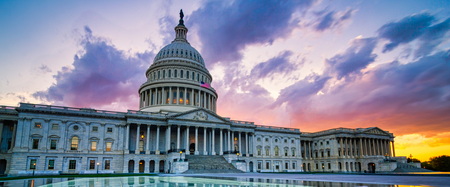
U.S. Capitol at sunset
US Capitol building at sunset, Washington DC, USA.
  • Meanwhile, Senate Majority Leader Chuck Schumer (D-NY) this week met with Democratic senators on the Budget Committee to trigger the budget reconciliation process, which would allow a party–line majority vote of an infrastructure package, eliminating the need for Republican votes. (Associated Press, June 17)
  • According to the AP, “Sen. Tim Kaine (D-VA) said the Budget Committee was unified in putting together a package that ‘gives us a latitude to do what we need to do — we can shrink it if there’s a bipartisan deal, we could do the broader deal if there isn’t.’”
  • Schumer said he would like to pass next month both a bipartisan infrastructure package and a larger budget blueprint, which would address a follow-up Democratic legislative. (BGov, June 17)
  • Additionally, Senate Budget Chairman Bernie Sanders (I-VT) said he is seeking a $6 trillion measure that would fund both Biden’s infrastructure proposals, including reforms targeting climate change and an expansion of Medicare. (Wall Street Journal and Washington Post, June 17
  • Sen. Mark Warner (D-VA), a member of the bipartisan group leading infrastructure negotiations, said, “I know there needs to be reconciliation. But that also doesn’t mean that I accept all of what the president proposed and all of what Sen. Sanders has proposed.” (BGov, June 17)
  • The Real Estate Roundtable, along with 16 other national real estate trade organizations submitted detailed comments in May to the Senate Finance Committee and House Ways and Means Committee as part of hearings on how to fund the administration’s infrastructure proposals. (Roundtable Weekly, May 21)

The Roundtable’s Annual Meeting this week also featured discussions with policymakers on the evolving infrastructure debate – and the organization plans to remain fully engaged with lawmakers on any eventual legislative proposal that could affect commercial real estate. 

#  #  #

Infrastructure Negotiations Shift to Bipartisan Congressional Groups; House, Senate Committees Advance Surface Transportation Bills

Capitol Hill trees clouds in the evening

Months of negotiations on bipartisan infrastructure legislation between President Biden and Republicans led by Sen. Shelley Moore Capito (R-WV) collapsed this week – and talks have shifted to alternative approaches from bipartisan groups of congressional policymakers. Meanwhile, House and Senate committees are moving forward on spending bills to meet the nation’s surface transportation needs before current funding expires on Sept. 30. (White House statement, June 8 and CQ, June 10) 

Alternative Paths 

  • President Biden recently reduced his original infrastructure package proposal from $2.3 trillion to $1.7 trillion – and requested at least $1 trillion in new spending from Republicans. The Senate GOP group counteroffered with nearly $1 trillion, which included only $330 billion in new spending and the rest from repurposed COVID-19 relief funding signed into law earlier this year. Biden cancelled the talks after the gap over the package’s scope and funding could not be bridged. (The Hill and AP, June 8)
  • Yesterday, a bipartisan group of 10 senators said they would propose a plan focused on “core, physical infrastructure” infrastructure that would cost $974 billion over five years, or $1.2 trillion over eight years, including about $579 billion in new spending. (CQ and New York Times and Washington Post, June 10)
  • According to Axios, “The group proposes paying for it through unspent coronavirus relief aid, public-private partnerships, indexing the gas tax to account for inflation and allowing states to borrow necessary money through a revolving loan fund.”
  • A joint statement released by the senators said, “[We] reached a bipartisan agreement on a realistic, compromise framework to modernize our nation’s infrastructure and energy technologies. This investment would be fully paid for and not include tax increases.” (Joint statement, June 10)

  • In the House, the Problem Solvers Caucus, which has 29 Democrats and 29 Republicans, on June 9 released a $1.25 trillion infrastructure spending framework, including $761.8 billion in new spending over eight years – yet did not include any details about how to pay for the proposal. (News release, Building Bridges Infrastructure  Framework and section-by-section summary)
  • The co-chairs of the House caucus – Reps. Josh Gottheimer (D-NJ) and Brian Fitzpatrick (R-PA) – are also in contact with a key group of bipartisan group of senators, including Bill Cassidy (R-LA), Kyrsten Sinema (D-AZ), Rob Portman (R-OH) and Joe Manchin, (D-WV) about developing a bipartisan, bicameral infrastructure package. (CQ, June 9)

  • White House Press Secretary Jen Psaki this week said, “[President Biden] feels it’s encouraging to see multiple proposals put out there, both from Republicans in the House and the Problem Solvers Caucus, as well as a bipartisan group that’s working on a proposal. Both will have increased numbers over what we’ve seen and been negotiating to date. Those are all positive steps.” (White House Press Gaggle, June 9)

Surface Transportation Legislation 

road construction and workers

  • Yesterday, the House Transportation and Infrastructure (T&I) Committee advanced a five-year, $547 billion surface transportation bill by a vote of 38-26 that included two supporting Republican votes. (Section-by-section summary of the INVEST in America Act)
  • Although the House Ways and Means Committee needs to address how to fund the bill’s costs, many of the provisions align with Biden administration transportation priorities – and could serve as a possible cornerstone for a larger infrastructure package. (CQ and BGov, June 10)
  • House Majority Leader Steny Hoyer (D-MD) said the chamber will take up the T&I committee bill the week of June 28.  A reauthorization bill for surface transportation is considered must-pass legislation as current funding expires Sept 30. (Washington Post, June 10)
  • In the Senate, several committees have jurisdiction over portions of that chamber’s surface transportation bill. The Environment and Public Works Committee unanimously voted on May 26 to advance a $303.5 billion bill over the next five years to fund the nation’s roads, bridges, tunnels, and mass transit projects. (Roundtable Weekly, June 4)
  • The Senate Commerce, Science and Transportation Committee is scheduled to consider rail and safety issues on June 16. Separately, a spokeswoman for Senate Banking, Housing and Urban Committee said Chairman Sherrod Brown (D-OH) said he continues to work with Ranking Member Patrick Toomey (R-PA) “in hopes of reaching a bipartisan agreement on a robust transit title for a surface transportation bill.” (CQ, June 10)

Reconciliation

Schumer fists podium

  • Democrats are also considering the use of the budget “reconciliation” process, which would allow them to bypass the Senate’s 60-vote requirement to pass legislation and push through an infrastructure package on a party line vote. (Roundtable Weekly, June 4)
  • Senate Majority Leader Charles Schumer (D-NY), above, said yesterday, “We continue to proceed on two tracks. A bipartisan track and a reconciliation track — and both are moving forward.” (Washington Post, June 10)
  • Schumer said last week that he wants to move forward on an infrastructure bill in July, whether it is bipartisan or not. (The Hill, May 25)
  • A National League of Cities’ 2021 State of Cities report released this week supported the need for infrastructure investment nationwide. Of the 600 mayors who provided information for the report, 91 percent said they did not have the funds to make needed infrastructure investments. (NLC news release, June 10)

The Roundtable will focus on the evolving infrastructure negotiations and their possible impact on CRE during its June 15-16 Annual Meeting and Policy Advisory Committee Meetings in Washington, DC.

#  #  #

Senate Committee Unanimously Reauthorizes Highway Trust Fund; “Gateway” Hudson Tunnel Project Reaches Major Milestone

Senate Environment & Public Works Comittee

The Senate Environment and Public Works (EPW) Committee’s unanimous vote last week to advance $303.5 billion over the next five years to fund the nation’s largest source for roads, bridges, tunnels, and mass transit may help advance negotiations over President Biden’s infrastructure proposal. (BGov, May 26)

A Bipartisan Signal

  • Senate EPW Ranking Member Shelly Moore Capito (R-WV) is the lead GOP negotiator on the White House’s infrastructure proposal, which includes $115 billion for repairing Main Street roads, highways and bridges. (White House Fact Sheet: The American Jobs Plan, March 31)
     
  • Sen. Capito said the 20-vote committee vote to advance the Surface Transportation Reauthorization Act “… is further proof that a bipartisan infrastructure deal is possible. I’m hopeful this bipartisan product can be the anchor of a larger infrastructure package moving forward.” (Senate EPW Markup and news release, May 26)
     
  • The Senate committee’s measure would set a new baseline funding level for the Department of Transportation’s Highway Trust Fund – an increase of more than 34 percent from the last reauthorization to pass Congress in 2015.  (Full text of the EPW bill and one-page summary)

Time Considerations

Road Construction ramp

  • The Senate EPW Committee only has jurisdiction over the surface transportation bill’s highway section. The Senate Commerce Committee is next, with a markup expected the week of June 14. The Senate Finance Committee will eventually address how to pay for the measure and the Senate Banking Committee will consider sections dealing with mass transit programs.
     
  • In the House, Democrats on the Transportation and Infrastructure Committee  introduced the INVEST in American Act today and plan to mark up their surface reauthorization bill on June 9. (Bill Text | Fact Sheet | Section-by-Section and Washington Post, June 4)
  • The Biden administration was encouraged by the Senate EPW vote. White House Press Secretary Jen Psaki said during a May 25 briefing that the$303 billion dollar bill “is a great down payment” for a broader infrastructure package. (BGov, May 26)
     
  • However, the administration has expressed it is on a tighter deadline to advance a comprehensive infrastructure proposal. Transportation Secretary Pete Buttigieg recently said, “I think we are getting pretty close to a fish-or-cut-bait moment.” (CNN, May 30) 

Gateway Progress

Gateway Hudson Tunnel Project

  • The Biden Administration on May 28 approved a key step allowing the multi-billion dollar “Gateway” rail tunnel project between New York City and New Jersey to move forward, ending years of delay and clearing the way for state officials to apply for federal funding.  (New York Times, May 28)
     
  • The administration’s approval of a long-awaited environmental impact statement clears the way for pre-construction activities to begin on the crucial infrastructure project, which aims to repair tunnels damaged by Superstorm Sandy. (Politico, May 28)
     
  • Transportation Secretary Buttigieg commented on the approval – clearing the way for the project to advance to the next steps such as engineering, final design development, and property acquisition, as well as construction. “This is a big step for the Northeast, and for the entire country, as these tunnels connect so many people, jobs, and businesses,” he said. (DOT statement, May 28)

Senate Majority Leader Chuck Schumer (D-NY) said, “It’s probably the most important public works project in America. If those tunnels fail and can’t be used, 25 percent of our economy would be at risk from Boston to Washington.” (Politico, May 28) 

#  #  # 

Policymakers Remain Far Apart on Bipartisan Infrastructure Package; Senate Ruling Limits Reconciliation as Fast-Track Option

President Biden and Sen. Capito

Policymakers this week remained far apart on the scope and cost of a possible bipartisan infrastructure package, as President Biden floated a 15% minimum corporate tax to partially fund his pared-down proposal. Meanwhile, a recent Senate Parliamentarian ruling would limit the use of a fast-track budget process called “reconciliation” that could allow Democrats to bypass Republicans and pass legislation on a party-line vote. (Washington Post, June 3, The Hill and New York magazine, June 2)  

[Photo above: President Biden discusses infrastructure with Sen. Shelley Moore Capito (R-WV)]

Seeking New Spending

  • President Biden recently reduced his original infrastructure package cost from $2.3 trillion to $1.7 trillion – and is now looking for at least $1 trillion in new spending from Republicans on infrastructure. Biden this week proposed raising these funds partially through a new 15% minimum corporate tax, which would replace his initial proposal to raise the corporate income rate to 28% from 21%. (BGov and New York Times, June 3)
  • Sen. Shelley Moore Capito (R-WV), who is leading GOP lawmakers in negotiations with the White House, last week counteroffered with $928 billion – although it limits new spending to $257 billion for traditional “hard” infrastructure such as roads, bridges and other public works. Republicans proposed the remaining $671 billion come from repurposed funding previously passed as part of the American Rescue Plan Act’s Covid-19 relief effort. Democrats have rejected repurposing of funds. (Roundtable Weekly, May 28 and AP, May 27)
  • The U.S. Conference of Mayors, National League of Cities and National Association of Counties recently expressed their “adamant opposition to any proposal that would detrimentally recoup and repurpose funds allocated to local governments” from coronavirus relief funds. (NLC news release, June 1 and joint letter, May 27)
  • The coalition’s joint letter to congressional leadership, stated, “Local governments are using these critical recovery funds to invest in public safety, vaccine distribution, housing and rental assistance, local economic support, economic and workforce development, broadband expansion, social safety-net services, hospitality and tourism development, and hazard pay for public employees.”

Time is Short

The White House with Washington Monument

  • White House Press Secretary Jen Psaki this week said, “Patience is not unending, and [President Biden’s] wants to make progress. His only line in the sand is inaction. He wants to sign a bill into law this summer.” (White House Press Briefing, June 2)
  • The No. 3-ranked House Democrat, Rep. Jim Clyburn of South Carolina, yesterday said time is short to complete negotiations on a bipartisan package. “I don’t think we should run the risk of not getting something done because the other side is not cooperating.” (Bloomberg’s Balance of Tower, June 3)
  • Sen. Ben Cardin (D-Md.) on Thursday added that Democrats would soon take actions to use the budget reconciliation process to bypass the Senate’s 60-vote requirement to pass legislation and push through a bill on a party line vote.  Cardin said that Democrats are “going as far as we can with Republicans and not delay[ing] it beyond this work period without seeing some action.” (Politico, June 3)
  • Senate Majority Leader Charles Schumer (D-NY) said last week that he wants to move forward on an infrastructure bill in July, whether it is bipartisan or not. (The Hill, May 25)

Limits on Reconciliation

Senate side - Capitol Building

  • The Democrats’ alternative plan to use reconciliation to bypass Republican opposition on infrastructure legislation may be slowed by a recent Senate Parlimentarian ruling. Congressional Democrats used reconciliation in March to pass the administration’s $1.9 trillion pandemic relief package. (Roundtable Weekly, March 12)
  • Senate Parliamentarian Elizabeth MacDonough’s four-page opinion, issued to Senate staff on May 28, stated, “overuse and over-reliance on a hyper-fast track procedure in the ordinarily deliberative Senate … will change the culture of the institution to the detriment of the committee and amendment processes and the rights of all Senators.” (CQ, June 2)
  • The new guidance adds that lawmakers intended the reconciliation provision to be used only “in extraordinary circumstances and not for things that should have been or could have been foreseen and handled” in a regular budget resolution. 

The ruling suggests that Democrats will be restricted to one additional opportunity this year to use reconciliation to pass a filibuster-proof legislative package.  (Roll Call, June 2 and The Hill, June 4)

#  #  #

Biden Administration Issues FY22 Budget with Tax Policy Details; Policymakers Face Deadline on Bipartisan Infrastructure Negotiations

The Biden Administration today issued its FY22 budget proposal, which serves as a benchmark of its tax policy priorities, accompanied by the Treasury Department’s “General Explanations of the Administration’s Revenue Proposals.” Meanwhile, negotiations continued this week between Senate Republicans and the White House on the scope and cost of President Biden’s multitrillion infrastructure investment proposal.

Budget Pay-fors 

  • The administration’s $6 trillion 2022 budget beginning Oct. 1 represents some of the highest levels of federal spending of the postwar era. The revenue portion of the proposal would sharply raise taxes on corporations and high-income households to fund President Biden’s infrastructure, climate change and social safety net goals. (BGov, White House Fact Sheet and budget appendix, May 28)
  • Although Congress will eventually determine final legislation that controls the federal government’s annual spending, today’s White House budget influences the debate on how to pay for its proposed programs with a variety of taxes, including:
    • An increase in the corporate tax rate to 28% from 21%;
    • Nearly doubling the tax rate on long-term capital gains to 40.8% from 23.8%;
    • Limiting capital gains treatment to invested cash and disregarding other forms of risk taken by partners;
    • Limiting taxpayers’ ability to defer gain that is reinvested in property of a like-kind; and
    • Making death a taxable event at far lower levels of income and potentially taxing the unrealized gain on appreciated assets not once but twice when an individual dies.

GOP Infrastructure Counteroffer 

  • Senate Republicans yesterday outlined a $928 billion infrastructure proposal over eight years as a counteroffer to Biden’s $1.7 trillion infrastructure initiative. The GOP proposal would repurpose funds from the $1.9 trillion pandemic relief law enacted in March, an approach rejected by Democrats. The Republican proposal also includes $257 billion in new spending for traditional “hard” infrastructure such as roads, bridges and other public works. (NPR / New York Times / AP, May 27)
  • Democrats are weighing whether to advance the Biden infrastructure plan under the same “reconciliation” budget process that was used to pass the March pandemic relief package by a simple majority vote – thereby bypassing the 60-vote requirement typically needed to advance most legislation in the 50-50 Senate.
     
  • President Biden yesterday referred to the infrastructure talks, stating, “We’re going to have to close this down soon.” He added that he plans to meet next week with Sen. Shelley Moore Capito (R-WV), above at podium, who has led Republican policymakers in infrastructure negotiations. (Bloomberg, May 27) 
  • Senate Majority Leader Chuck Schumer (D-NY) on May 25 said, “The bottom line is very simple, that it has always been our plan regardless of the vehicle to work on an infrastructure bill in July. And that’s our plan, to move forward in July.” (The Hill, May 28) 
  • Senate Minority Leader Mitch McConnell (R-KT) stated during a May 27 CNBC interview, “We’re open to spending some more … we’re going to keep talking.”  
  • White House Press Secretary Jen Psaki issued a May 27 statement on the Republican infrastructure proposal. “We are concerned that the proposal on how to pay for the plan remains unclear: we are worried that major cuts in COVID relief funds could imperil pending aid to small businesses, restaurants and rural hospitals using this money to get back on their feet after the crush of the pandemic.” The statement added, “As for the path forward … we will work actively with members of the House and Senate next week, so that there is a clear direction on how to advance much needed jobs legislation when Congress resumes legislative business during the week of June 7.” 

According to Axios, Senate Democrats intend to continue working on bipartisan infrastructure negotiations through the week after Memorial Day congressional recess “… then forge ahead on their own if there’s no deal.” (Axios, May 24) 

#  #  # 

Real Estate Coalition Weighs In on Infrastructure Funding Options; Roundtable Addresses Tax Proposals and Like-Kind Exchanges

The Real Estate Roundtable, along with 16 other national real estate trade organizations, submitted detailed comments to the Senate Finance Committee and House Ways and Means Committee, which held hearings this week on how to fund recent Biden Administration  infrastructure investment proposals.

Congressional Consideration

  • The coalition letter states, “As Congress considers options to pay for these investments, we urge policymakers not to erode longstanding tax rules that support job creation, capital formation and productive risk taking. Several of the tax proposals in the Administration’s infrastructure and human capital initiatives, unfortunately, would reduce real estate investment and diminish opportunities for startup businesses and those less advantaged.”
  • The comments focus on recent Biden Administration tax proposals, including:
    • Limiting taxpayers’ ability to defer gain that is reinvested in property of a like-kind;
    • Nearly doubling the tax rate on long-term capital gains;
    • Limiting capital gains treatment to invested cash and disregarding other forms of risk taken by partners; and
    • Making death a taxable event at far lower levels of income and potentially taxing the unrealized gain on appreciated assets not once but twice when an individual dies. 

Economic Impact 

Dramatic sunset over the US capitol in Washington DC
  • The letter states, “(President Biden’s) American Jobs Plan and American Families Plan offer credible initiatives to address many of our Nation’s most pressing needs, such as a modernized infrastructure, a more comprehensive approach to climate-related matters, and increased investments in housing, education, and childcare. We support aggressive steps to finance infrastructure needs, increase the supply of affordable housing, expand the economy, and promote job growth. Regrettably, some of the tax proposals accompanying the plans would reduce economic activity and opportunities and be completely counterproductive to the goals of the President’s initiatives.
  • The coalition comments detail how the Biden tax proposals would undercut the tax base in localities throughout the country that rely on real estate taxes to finance schools, police, and other first responders. It also notes how the proposed taxes would diminish the incentive for private investment of capital in riskier real estate projects, such as affordable housing and redevelopment in struggling communities.
  • The letter also cites an April 2021 EY study commissioned by the Family Business Estate Tax Coalition, which includes The Real Estate Roundtable, that shows the impact of a specific proposal that would impose tax on transferred assets at death. The study found that repealing stepped-up basis and taxing unrealized gains at death would result in reduced job growth, lower wages, and a reduction in GDP of roughly $10 billion per-year. 

Tax Issues & LKEs 

  • Among the other industry leaders scheduled to participate in the May 25 event are the following Real Estate Roundtable Members:
  • A list of all participants is on the event website.
  • DeBoer was also quoted in Commercial Observer on May 18 on President Biden’s proposal to limit the use of Section 1031 like-kind exchanges. “Exchanges reduce the need for outside financing, leading to less leverage and debt on U.S. real estate. As a result, exchanges allow cash-strapped minority-, women- and veteran-owned businesses to grow their business by temporarily deferring tax on the reinvested proceeds,” DeBoer stated. 

President Biden’s proposals, congressional action and the industry response will be a focus of discussion at The Roundtable’s June 15 Annual Meeting and its Tax Policy Advisory Committee (TPAC) Meeting on June 16.

#  #  # 

President Biden and Congressional Leaders Discuss Path Forward for Infrastructure Legislation

President Biden met with congressional leaders this week to find a path forward on his $2.3 trillion infrastructure-focused American Jobs Plan. Republicans agreed to continue negotiations and develop a pared down counter-proposal that will limit the definition of infrastructure and include specific funding measures. (CNBC and Wall Street Journal, May 12 and The Hill, May 13) 

Negotiations on Scope 

  • Biden’s multitrillion-dollar proposal calls for funding infrastructure investments by raising the corporate tax rate to 28% from 21% and making other changes to tax laws passed during the 2017 overhaul.
  • “The proper price tag for what most of us think of as infrastructure is about $600 to $800 billion,” McConnell said on May 9. (CBS News, May 10 and Kentucky Educational Television, May 10)
  • Biden and Vice President Kamala Harris on May 12 met with the “Big 4” Congressional Leaders – Republican Senate Minority Leader Mitch McConnell of Kentucky, House Minority Leader Kevin McCarthy of California, Democratic Senate Majority Leader Chuck Schumer of New York and House Speaker Nancy Pelosi of California – to discuss infrastructure proposals. Although both sides remained deeply divided over the scope of an infrastructure package and exactly how to pay for it, some optimistic signs emerged from the meeting. (New York Times, May 12)
  • McConnell commented after the meeting, “We’re not interested in reopening the 2017 tax bill. We both made that clear with the president. That’s our red line.” (Business Insider, May 12)
  • However, McCarthy added, “there is a place where we can find bipartisanship” –  and Pelosi noted, “I feel very optimistic . . . about our ability to pass such a bill, more optimistic now about being able to do so in a bipartisan way. But we’ll see.” (Tax Notes, May 13) 

Republican Counter-Offer

  • Biden and Harris also met on May 13 to discuss infrastructure with a group of top Republican committee leaders, including Sen. Shelley Moore Capito of West Virginia, ranking member on the Senate Environment and Public Works Committee. (White House Readout of Oval Office Meeting, May 13)
  • During the meeting, Republicans suggested using public-private partnerships to partially cover the costs of funding an infrastructure bill, instead of reversing elements of the 2017 tax bill. (The Hill, May 13)


  • Capito commented after the meeting, “I think what he wants to see is ‘OK, I get it you don’t want me to touch the 2017 taxes … well then how are we going to pay for this.’ The [Paycheck Protection Program] was part of the discussion but there were other things discussed.”
  • Capito added, “He asked that we would come back with another offer, with more granularity to it and more details, and so we agreed to do that. Maybe some different numbers too.” (The Hill, May 13)


  • The president also met with key Democratic senators, including Joe Manchin of West Virginia and Kyrsten Sinema of Arizona, this week to discuss infrastructure measures proposals.
  • Congressional Republicans are expected to propose their counter-offer for a pared-down infrastructure program next week.

Roundtable Statement

  • Real Estate Roundtable President and CEO Jeffrey DeBoer on April 30 issued a statement on funding options for President Biden’s American Jobs Plan and American Families Plan.  
  • DeBoer noted, “As policymakers consider the options to raise this needed revenue, we strongly urge that the focus be on broad-based tax increases that do minimal damage to job creation, risk taking and entrepreneurial activity. Unfortunately, particularly when considered in total, many of the tax proposals accompanying the American Jobs Plan or American Families Plan would reduce economic activity, impede job growth, and diminish opportunities for startup businesses and those less advantaged. The current law in these areas may be in need of review and reform, but repealing these incentives is simply not wise.” (Full Roundtable statement)

The initial release of President Biden’s American Jobs Plan on March 31 listed several corporate tax revenue measures to offset infrastructure spending. Further details on the Administration’s proposed tax and revenue provisions are scheduled to be released on May 27 as part of the president’s FY 2022 budget proposal. (Reuters, May 13) 

#  #  # 

Congress Reviews Biden’s Multitrillion Infrastructure Proposals

President Biden Speaks at Amtrak Anniversary

Capitol Hill continued to assess President Biden’s “physical” and “social” infrastructure plans this week as Democrats considered how to advance the Administration’s proposals in a narrowly divided Congress. (BGov, May 4)  Photo: President Biden on April 30th discussed his infrastructure proposals during Amtrak’s 50th anniversary.

Infrastructure Negotiations 

  • Biden’s infrastructure proposals include last week’s $1.8 trillion American Families Plan, composed mainly of social spending and tax hikes on wealthy individuals – and his $2.3 trillion American Jobs Plan unveiled in March. (Roundtable Weekly, April 30 and Wall Street Journal, April 29).  
  • Senate Minority Leader Mitch McConnell (R-KY) on Monday said Republicans are open to funding projects that fit into a much narrower definition of infrastructure, for a much smaller cost, and funded by unspecified fees rather than tax increases. (AP, May 3)
  • “We’re open to doing a roughly $600 billion package, which deals with what all of us agree is infrastructure and to talk about how to pay for that in any way other than reopening the 2017 tax reform bill,” McConnell said.
  • White House Press Secretary Jen Psaki on May 5 said Biden plans to meet with key policymakers on his proposals next week, including Sen. Shelley Moore Capito (R-WV), ranking member on the Environment and Public Works Committee. “The president believes Congress can and should move forward with multiple policies at the same time. And, certainly, that is what is happening on Capitol Hill.” Psaki said. (White House press briefing, May 5 and Transport Topics, May 6)
  • CNBC reported on May 6 how residential and commercial real estate could be affected by Biden’s tax proposals, which would raise capital gains taxes, tax unrealized gains at death with an exception for family-owned businesses, and restrict the use of Section 1031 like-kind exchanges.
  • The Wall Street Journal on May 6 also reported how Biden’s proposal to restrict 1031 exchanges would add another burden on farmers, who have used the provision to relocate operations, diversify crops, and consolidate land holdings. 

Congressional Legislation

Capitol Building with sun

  • This week, Congress considered legislation that would impact issues of interest to commercial real estate, including:
  • The House Energy Committee addressed the CLEAN Future Act (H.R.1512) during a hearing focused on decarbonizing the transportation sector.  H.R. 1512 is a sprawling bill aimed at achieving net-zero greenhouse gas emissions by 2050 that contains provisions affecting building construction, operations, and ESG reporting. (Politico, March 3 and CQ NewsReuters, March 2)
  • A May 4 House Financial Services Subcommittee hearing addressed the National Flood Insurance Program (NFIP). A discussion draft released before the hearing would reauthorize the NFIP for five years, enact reforms to place the program on sound financial footing, institute a cap on premium increases of 9% per year, and forgive over $20 billion in NFIP debt. (Committee background memorandum)
  • In the Senate, legislation is expected to be reintroduced in the next few weeks that would encourage the construction of more energy-efficient new homes and commercial buildings through voluntary “model” building codes. Sens. Jeanne Shaheen (D-NH) and Rob Portman (R-OH) issued a May 3 news release on their plans to reintroduce their energy efficiency legislation. 

House Appropriations Chair Rosa DeLauro (D-CT) on May 6 said she plans to mark up fiscal 2022 spending bills in June, before expected floor votes in July.  Lawmakers would have to finish their spending bills by Sept. 30, when the government’s fiscal year ends, or pass a stopgap measure to avert a shutdown of government agencies. (BGov, May 6)

 #  #  #

GOP Senators Outline Infrastructure Plan; Biden Announces U.S. Emissions Goal at Global Summit

Capito GOP Infra Package podium x475edit2

Senate Republicans on April 22 unveiled a five-year, $568 billion infrastructure proposal as a counteroffer to President Joe Biden’s eight-year, $2.2 trillion plan. (Republican infrastructure framework and press conference)

Contrasting Infrastructure Plans

  • The GOP plan, crafted by a group led by Senate Environment and Public Works Committee Ranking Member Shelley Moore Capito (R-WV), at podium in photoadheres to a more narrow definition of infrastructure than the Democrats’ proposal. (CQ and CNBC, April 22)
  • The Republican proposal is focused on transportation, but also targets broadband and water projects. Details about how to fund the plan are vague, referencing unspecified user fees and spending unused money from prior COVID-19 relief bills. (Republican infrastructure framework and Politico Pro, April 22)
  • Funding for Biden’s multitrillion dollar “hard infrastructure” plan, by contrast, would rely on an increase in corporate taxes and further address electrical vehicles and “clean energy” assets.  The Administration is expected to unveil its “American Families Plan” next week – an extensive framework supporting “human infrastructure” investments that would be paid for, at least partially, through tax increases on wealthy individuals. (Roundtable Weekly, April 2)
  • Meanwhile, a group of 58 bipartisan lawmakers called the Problem Solvers Caucus on April 23 released a report that proposes several possible fee increases to pay for infrastructure spending.  The caucus report includes options to impose a vehicle-miles traveled tax from electric vehicles – and proposes indexing gas and diesel taxes to inflation, highway construction costs, fuel-economy standards, or some combination.  (Caucus report and Wall Street Journal, April 23)

Climate Goals

President Biden's Closing Remarks at Climate Change Virtual Summit

  • President Biden held a historic “virtual” climate summit yesterday and today with 40 world leaders to build global commitments to slash greenhouse gas emissions and ramp-up renewable energy development. (New York Times, April 22 and White House Fact Sheet, April 23)
  • Biden committed the U.S. to cut its emissions in half by 2030 (relative to a 2005 baseline) – a pledge that would “dramatically reshap[e] key sectors of the economy.” (Wall Street Journal, April 23). The Biden Administration considers its climate commitments a “core part of [its] $2.2 trillion infrastructure plan,” essential to embrace new technologies, and necessary for the U.S. to out-compete China. (POLITICO, April 22)
  •  An open letter signed by 400+ businesses and investors support Biden’s 2030 target, calling it “ambitious and attainable.” The CEOs for Bank of America and Citibank appeared at the summit, as the financial sector faces increasing pressure to “play its biggest role yet in greening the global economy.” (Axios, April 22)

Energy Tax Bill

Senator Roy Wyden (D-OR) comments on floor

  • Senate Finance Committee Chairman Ron Wyden (D-OR) on April 21 reintroduced legislation that would consolidate and refocus a range of existing energy tax incentives directed at buildings, clean electricity, transportation and conservation.
  • The Clean Energy for America Act would provide performance-based tax incentives for energy efficient homes and commercial buildings – with the value of the tax incentives increasing as more energy is conserved. (Text of the legislation, one-page summary of the bill and a section-by-section summary.)
  • Similar to the previous version of the legislation, the bill would also address Section 179D – the enhanced deduction for energy-efficient commercial buildings – by creating a sliding scale based on the percent of energy efficiency achieved above the most recent ASHRAE 90.1 standard.
  • A business coalition led by The Roundtable supports the E-QUIP Act (H.R. 2346), which proposes “accelerated depreciation” for high-performance equipment installed in commercial and multifamily building.  The coalition is urging policymakers to include this measure as part of any “green tax” package that may be folded into larger infrastructure spending legislation. (Roundtable Weekly, April 2)

The Senate Finance Committee will discuss energy tax policy and climate change at an April 27 hearing entitled “Climate Challenges: The Tax Code’s Role in Creating American Jobs, Achieving Energy Independence, and Providing Consumers with Affordable, Clean Energy.”

#  #  # 

Bipartisan Legislation to Build More Housing Near Transit Reintroduced

San Diego

The bipartisan Build More Housing Near Transit Act of 2021 (H.R. 2483) – reintroduced on April 14 by Reps. Scott Peters (D-CA) and McMorris Rodgers (R-WA) – would encourage the construction of low and middle-income housing in transit-served, walkable locations. 

  • The United States is in the middle of a severe affordable housing shortage exacerbated by the economic toll of the COVID-19 pandemic. The National Low Income Housing Coalition estimates there is a shortage of 7 million affordable homes, and 10.4 million Americans spend more than half of their income on housing. 

Benefits of the Bill 

  • The Build More Housing Near Transit Act of 2021 would provide incentives for building housing developments that use less land, allow people to live closer to job opportunities and effectively reduce green house gas emissions by eliminating the need for cars.
  • The Roundtable-supported bill was initially introduced in the previous Congress, which passed the House as part of last year’s Moving Forward Act. (One-page summary, Up for Growth Action)
  • This year’s bill (H.R. 2483) would ensure the Federal Transit Administration (FTA) takes a holistic and quantitative approach to evaluating applicants seeking to build affordable housing projects near transit station areas. Specifically, the bill would make some minor, but essential, enhancements to the evaluation criteria for the FTA’s Fixed Guideway Capital Investment Grants Program, or Section 5309 grants, which fund projects like commuter rail, light rail, and bus rapid transit. 

Broad Support 

Housing Near Transit

  • The Real Estate Roundtable joined a broad coalition of housing, transportation and other organizations in an April 14 letter to the bill’s sponsors to express strong support for the legislation.
     
  • The coalition letter states, “ From encouraging more thoughtful planning, to supporting more inclusive housing policies, to enabling more efficient use of federal dollars, the Build More Housing Near Transit Act is a sound policy and the product of a collaborative process.”
  • One of the organizations includes Up for Growth Action, whose Executive Director Mike Kingsella said, “The Build More Housing Near Transit Act encourages localities to align land-use policies and affordable housing resources with federal transit investment, ensuring that transit-rich communities are accessible to more Americans.” (Rep. Peters news release, April 24) 

Original cosponsors of the legislation include Reps. Marilyn Strickland (D-WA), Derek Kilmer (D-WA), Lisa Blunt Rochester (D-DE), David Scott (D-GA), Ami Bera (D-CA), Alan Lowenthal (D-CA), and Tom Suozzi (D-NY). 

#  #  #