Bipartisan Legislation to Build More Housing Near Transit Reintroduced

San Diego

The bipartisan Build More Housing Near Transit Act of 2021 (H.R. 2483) – reintroduced on April 14 by Reps. Scott Peters (D-CA) and McMorris Rodgers (R-WA) – would encourage the construction of low and middle-income housing in transit-served, walkable locations. 

  • The United States is in the middle of a severe affordable housing shortage exacerbated by the economic toll of the COVID-19 pandemic. The National Low Income Housing Coalition estimates there is a shortage of 7 million affordable homes, and 10.4 million Americans spend more than half of their income on housing. 

Benefits of the Bill 

  • The Build More Housing Near Transit Act of 2021 would provide incentives for building housing developments that use less land, allow people to live closer to job opportunities and effectively reduce green house gas emissions by eliminating the need for cars.
  • The Roundtable-supported bill was initially introduced in the previous Congress, which passed the House as part of last year’s Moving Forward Act. (One-page summary, Up for Growth Action)
  • This year’s bill (H.R. 2483) would ensure the Federal Transit Administration (FTA) takes a holistic and quantitative approach to evaluating applicants seeking to build affordable housing projects near transit station areas. Specifically, the bill would make some minor, but essential, enhancements to the evaluation criteria for the FTA’s Fixed Guideway Capital Investment Grants Program, or Section 5309 grants, which fund projects like commuter rail, light rail, and bus rapid transit. 

Broad Support 

Housing Near Transit

  • The Real Estate Roundtable joined a broad coalition of housing, transportation and other organizations in an April 14 letter to the bill’s sponsors to express strong support for the legislation.
     
  • The coalition letter states, “ From encouraging more thoughtful planning, to supporting more inclusive housing policies, to enabling more efficient use of federal dollars, the Build More Housing Near Transit Act is a sound policy and the product of a collaborative process.”
  • One of the organizations includes Up for Growth Action, whose Executive Director Mike Kingsella said, “The Build More Housing Near Transit Act encourages localities to align land-use policies and affordable housing resources with federal transit investment, ensuring that transit-rich communities are accessible to more Americans.” (Rep. Peters news release, April 24) 

Original cosponsors of the legislation include Reps. Marilyn Strickland (D-WA), Derek Kilmer (D-WA), Lisa Blunt Rochester (D-DE), David Scott (D-GA), Ami Bera (D-CA), Alan Lowenthal (D-CA), and Tom Suozzi (D-NY). 

#  #  # 

President Biden Signals Flexibility on Infrastructure Plan as GOP Senators Craft Alternative Approach; SALT Repeal May Influence Negotiations

Biden White House Meeting

President Joe Biden this week met with a bipartisan group of policymakers about the details of his multitrillion infrastructure proposal as a bloc of moderate GOP senators stated they are developing a far less expensive counterproposal that would pare back the definition of what comprises “infrastructure” and fund it with unspecified user fees. (Washington Post, April 14)

  • Sen. Mitt Romney (R-UT), who is involved in talks about an alternative infrastructure plan, said, “The pay-for ought to come from the people who are using it,” suggesting that a transportation mileage charge could be applied to electric vehicle drivers. “Clearly by bringing in additional revenue from actual miles driven is going to create some additional revenue,” Romney said.  (Politico Pro, April 14)
  • Rep. Donald  Payne, Jr., chairman of the House Transportation Subcommittee on Railroads, attended the White House meeting where President Biden said he was “prepared to negotiate” on his new infrastructure-focused economic plan – and expressed support for the Gateway project, a major rail tunnel project between New York and New Jersey. (BGov, April 12)

SALT Caucus

SALT Caucus

  • An effort by members of Congress to repeal the cap on state and local tax deductions (SALT) is adding to the complexity of negotiations over the White House infrastructure proposal. Yesterday, a bipartisan congressional “SALT caucus” was launched to push for the full repeal of the $10,000 limit on state and local deductions, which was enacted as part of the 2017 Republican tax overhaul. (Bloomberg, April 15)
  • It is unclear how many members of the bipartisan caucus would link their support for Biden’s infrastructure proposal, and its increased corporate taxes, to action on the SALT cap.  Reps. Josh Gottheimer (D-NJ) and Tom Suozzi (D-NY), who co-chair the SALT caucus, said they “will not accept any changes to the tax code that do not restore the SALT deduction.” (CNBC, April 15)
  • Additionally, several New York Democrats sent a letter to House leadership on April 13 urging for a full repeal. “We will not hesitate to oppose any tax legislation that does not fully restore the SALT deduction,” according to the letter. (BGov and Wall Street Journal, April 13)

Energy-Efficient Buildings

  • The White House’s infrastructure plan and the importance of energy efficient buildings was noted in a recent New York Times interview with White House National Economic Council Director Brian Deese.
  • Deese stated during the April 9 Ezra Klein Show (podcast), “… it’s been true for multiple years that energy efficiency upgrades in commercial buildings should just happen, and they’re not.  The built environment and industry get less attention but are extraordinary opportunities. And this [infrastructure] plan has a very significant investment in upgrading buildings and making them more energy efficient.”
  • He added, “The jobs doing that happen all around the country. They’re construction jobs, building trades. A lot of it is actually high-value investment, where providing an incentive could actually unlock a bunch of private capital to invest, particularly in the commercial building space.
  • Deese is scheduled to participate in next week’s Roundtable Spring Meeting, along with U.S. Department of Transportation Secretary Pete Buttigieg. The remote discussions will be available on The Roundtable’s YouTube channel by April 21.

The Roundtable is part of the Build by the 4th coalition, led by the U.S. Chamber of Commerce, which encourages the Biden Administration and Congress to pass a comprehensive infrastructure deal by Independence Day 2021.

#  #  #

Biden Administration Details Tax Proposals to Fund Infrastructure Package

The White House - roses

The Biden administration this week released additional details on its proposals to raise corporate taxes to pay for its massive $2.3 trillion economic growth and infrastructure proposal.

Infrastructure & Taxes

  • President Biden, anticipating Congress’ return next week to begin deliberations on his proposal, stated, “Debate is welcome. Compromise is inevitable. Changes are certain. Inaction simply is not an option.” (White House remarks, April 7)
  • The administration aims to raise $2.5 trillion to pay for its sprawling “American Jobs Plan” by increasing the corporate tax rate to 28 percent from 21 percent, imposing a strict new minimum tax on global profits, and eliminating incentives to shift profits overseas. (New York Times, April 7)
  • The proposed taxes to fund the infrastructure investments were detailed this week in a Wall Street Journal op-ed by Treasury Secretary Janet Yellen – “A Better Corporate Tax for America” – and in Treasury’s report, “The Made in American Tax Plan.”
  • According to an April 8 Wall Street Journal report, the infrastructure proposal includes at least $5 billion for an affordable-housing grant program that would encourage local jurisdictions to relax zoning rules and restrictions on new construction.  The new competitive grants for cities and localities would seek to eliminate exclusionary zoning policies such as minimum lot sizes, mandatory parking requirements and density restrictions.
  • The Journal article quotes a recent Urban Institute brief: “There are so many decisions made at the local level that can impede the development of affordable housing that federal policy makers should push communities to reorganize their approach to development from the ground up.”
  • The Roundtable has long encouraged federal agencies to leverage economic development and infrastructure funds to discourage exclusionary zoning tactics. Bills such as the Yes in My Backyard Act  and the Build More Housing Near Mass Transit Act would require state and local governments to plan for and encourage high-density and multifamily development when they seek grants from US-HUD and US-DOT. (Roundtable Weekly, March 6, 2020 and February 28, 2020)

What’s Next:

U.S. Capitol with flag

  • Democrats are weighing whether to advance the Biden infrastructure plan under the same “reconciliation” budget process that was used to pass the March $1.9 trillion pandemic relief package by a simple majority vote – thereby bypassing the 60-vote requirement typically needed to advance most legislation in the 50-50 Senate.
  • Senate Parliamentarian Elizabeth MacDonough this week issued an opinion that may allow Democrats to pass additional, large-scale bills with no Republican support before the midterm elections. The sparse April 5 ruling, according to a Democratic spokesperson, has “some parameters [that] still need to be worked out.” The ruling does not specify the types of reconciliation bills that could be considered or how many times the maneuver would be allowed. (Politico, April 7 and CQ News, April 8)
  • House Speaker Nancy Pelosi (D-CA) yesterday said, “If [Democrats] have to go to reconciliation, that’s a lever, but I hope it’s not something that we need to do.” (Roll Call, April 8)
  • Pelosi added that the House could pass the infrastructure package by the July 4 recess, followed by the Senate before the August recess. (Bloomberg, April 8)

Pelosi also said she expects the White House in the coming months to introduce a separate, multi-trillion “American Families Plan” focused on expanded family support benefits, including child care and health measures. That plan could be pared with significant changes to individual taxes, including capital gains.

#  #  # 

President Biden Announces $2.3 Trillion Infrastructure Plan Funded by Corporate Taxes

President Biden Offers Infrastructure Proposal

President Joe Biden on March 31 announced the first part of his sweeping economic growth proposal focused on infrastructure and clean energy – a $2.3 trillion, eight-year plan that White House officials said would be funded, over 15 years, by corporate and international tax increases. (Wall Street Journal and White House Fact Sheet: The American Jobs Plan, March 31)

Why It Matters

  • The enormous scale of the proposal seeks to use federal spending to address a wide-range of economic and social issues widely defined as infrastructure while strengthening America’s long-term competitiveness against challengers like China.
  • Biden stated, “It’s a once-in-a generation investment in America, unlike anything we’ve seen or done since we built the Interstate Highway System and the Space Race decades ago.” (Remarks by President Biden on the American Jobs Plan, March 31)
  • The White House proposal would direct federal spending to transportation, manufacturing, buildings, schools, water systems, broadband, health care, and energy infrastructure assets. (USA Today, April 1, “These 4 charts show where the money would go”)
  • A “Made in America Tax Plan” would pay for the proposal. It would increase the corporate tax rate from 21% to 28%; set the minimum tax for multinational corporations with U.S. operations at 21 percent; and eliminate certain incentives affecting the offshoring of jobs. (The Hill, March 31)

Impact on CRE

Transportation Infrastructure Seattle

  • The Biden proposal would spend $213 billion to produce, preserve, and retrofit two million homes and commercial buildings. In particular, it recommends:
    • Tax credits and grants with a goal of one million new and renovated, affordable and efficient, rental housing units;
    • Extend and expand energy efficiency tax incentives for homes and commercial buildings;
    • A new competitive grant program for cities and localities that eliminate exclusionary zoning policies – like minimum lot sizes, mandatory parking requirements, and density restrictions;
    • Mobilize private sector investment in distributed energy resources, and to de-carbonize the electric grid;
    • Drive clean energy deployment by requiring federal buildings to purchase 24/7 clean power; and
    • Support private development of idle Brownfields into hubs of economic growth.
  • The proposal does not affect the federal eviction moratorium, which was recently extended by the Centers for Disease Control and Prevention (CDC) until June 30. (CDC order and CNBC video, March 30)

Transportation Infrastructure

  • $115 billion in the White House proposal would focus on repairing Main Street roads, highways and bridges.

  • $80 billion would be devoted to inter-city high-speed rail to address Amtrak’s repair backlog and modernize the Northeast Corridor.  This is of significance to national and regional projects like “Gateway,” the rail tunnel project between New York City and New Jersey.

What’s Next

Build By the 4th Coalition

  • Senate Minority Leader Mitch McConnell (R-KY) said, “This proposal appears to use ‘infrastructure’ as a Trojan horse for the largest set of tax hikes in a generation,” and that Biden’s proposal “is not going to get support on our side.” (The Hill, March 31 and Bloomberg, April 1)
  • House Speaker Nancy Pelosi (D-CA) signaled she would like to see an infrastructure bill pass the House by July 4. She added that “hopefully” a final infrastructure package will include a repeal of the $10,000 cap on state and local tax deductions. (Associated Press, March 31 and BGov, April 1)
  • The Roundtable is part of the Build by the 4th coalition, led by the U.S. Chamber of Commerce, which encourages the Biden Administration and Congress to pass a comprehensive infrastructure deal by Independence Day 2021.
  • The Biden administration is planning a second legislative package for April that could seek an additional $1 trillion to expand family support such as the child tax credit and paid leave. (B-Gov, March 31)

President Biden’s infrastructure plan will be a focus of discussion during The Roundtable’s April 20 Spring Meeting (remote).

#   #   # 

Biden Administration Preparing Multitrillion Economic Growth Proposal; Transportation Secretary Buttigieg Testifies Gateway Project Has “Sense of Urgency”

Oval Office Infrastructure meeting Biden Buttigieg others

President Biden will unveil an ambitious economic growth plan on March 31 that may cost up to $4 trillion to fund his administration’s wide-ranging goals on infrastructure, climate and domestic policies. (Reuters, March 24 and Bloomberg News, March 25) 

  • The administration’s legislative effort may be split into two parts – an initial package that funds transportation projects with a focus on climate change, and a second that addresses domestic priorities such as universal prekindergarten, national childcare and free community college tuition.  (Wall Street Journal and Washington Post, March 22, New York Times March 25)
  • Congressional Democrats are working on a filibuster-proof fiscal 2022 reconciliation bill to advance President Biden’s economic recovery plan, along with a five-year surface transportation reauthorization. Funding for the current surface transportation bill expires Sept. 30. (Law360, March 22)
  • Axios reported on March 23, the White House is considering using the budget reconciliation process two more times this year, after using it to pass the recent $1.9 trillion pandemic relief package without any Republican support. Enacting three separate reconciliation packages would be unprecedented, and require a ruling from the Senate parliamentarian that proposed legislation is eligible for reconciliation under the Congressional Budget Act of 1974. 

Focus on Gateway Project: 

Gateway Project map

  • The “Gateway” rail tunnel project between New York City and New Jersey is a high priority for the Biden administration that is being treated with a “sense of urgency,” according to Transportation Secretary Pete Buttigieg, who testified March 25 before the House Transportation and Infrastructure Committee. (BGov, March 25)
  • “This is a regional issue, but one of national significance because if there were a failure in one of those tunnels, the entire U.S. economy would feel it,” Buttigieg said. He added that federal and state officials are working “to develop the next administrative draft of the environmental impact statement, which is a big part of what needs to be completed in order to get there.”
  • Buttigieg also acknowledged that funding the administration’s infrastructure transportation goals must look to other revenue sources than borrowing. “There is a simple set of places we can look: user fees, general fund or other tax sources as Congress has done to fill gaps in Highway Trust Fund in recent years or borrowing,” Buttigieg testified.

 How to Pay: 

Yellen and Powell remote testimony

  • Treasury Secretary Janet Yellen and Federal Reserve Chairman Jerome Powell testified jointly this week before House and Senate committees on economic conditions and pandemic relief. (Wall Street Journal, March 23)
  • Yellen testified before the House Financial Services Committee on March 23 that future taxes are needed to fund infrastructure programs. “A package that consists of investments in people, investments in infrastructure, will help to create good jobs in the American economy, and changes to the tax structure will help to pay for those programs.” She added, “We do need to raise revenues in a fair way to support the spending that this economy needs to be competitive and productive.” (Financial Times, March 23)
  • Chairman Powell responded to a concern from House Committee Member Blaine Luetkemeyer (R-MO) that Fed data indicates 51 percent of current commercial real estate debt is held by banks and that community banks have a higher concentration of these loans. Powell stated, “We’re monitoring CRE very carefully. Its concentrations arise principally in smaller banks, and we’ll have to monitor it carefully as we allow moratoriums to elapse. We’re well aware of the issue and we’ll be sure to move very, very carefully when we do address that.”
  • The two regulators also testified before the Senate Banking Committee on March 24. Treasury Secretary Yellen stated that the federal government can afford to invest trillions, despite the national debt. “My views on the amount of fiscal space that the United States, I would say, have changed somewhat since 2017. Interest payments on that debt relative to GDP have not gone up at all, and so I think that’s a more meaningful metric of the burden of the debt on society and on the federal finances,” Yellen said. (The Hill, March 24)

 Taxes & CRE: 

Taxes and CRE Ryan McCormick

  • A March 25 BisNow webinar on Tax Policy and the Impact on CRE featured Roundtable Senior Vice President and Tax Counsel Ryan McCormick, bottom left in photo. The webinar focused on the outlook for real estate tax policy in 2021, with an emphasis on like-kind exchanges and opportunity zones.
  • Other participants included Ja’Ron Smith, former Deputy Assistant to President Trump; Capital Square Founder and CEO Louis Rogers; and David Franasiak, Principal at Williams & Jensen. (Watch Video)

Congress leaves Washington today for a two-week recess. “When the Senate returns to session, our agenda will be no less ambitious than it was over the past few months,” Senate Majority Leader Chuck Schumer (D-NY) said yesterday. (The Hill, March 25 and New York Times, March 26) 

#  #  #

Biden Administration Floats Tax Increases to Pay for Infrastructure as Policy Focus Shifts to Economic Growth

The White House
Biden Administration and The White House

The Biden administration is considering increasing the corporate tax rate and the individual rate for high earners as it deliberates how to structure its next major legislative initiative – a sprawling “Build Back Better” economic growth package that may cost far more than the $1.9 trillion coronavirus-relief bill enacted last week. (BGov, March 15 and Roundtable Weekly, March 12) 

Why It Matters: 

  • The first major tax increase since 1993 could be proposed as one method of funding Biden’s ambitious infrastructure plan. Heather Boushey, a member of the White House Council of Economic Advisers stated, “There is a long list of things that we need to invest in,” including “broadly defined” infrastructure, the power grid, and a plan to bolster child and elder care. (BGov and Bloomberg Television interview, March 15
  • Biden’s tax plan would aim to provide relief for middle-class households, including those in the $110,000-a-year income range, according to Bharat Ramamurti, deputy director of the White House National Economic Council. “The key here is that the president believes strongly that the biggest corporations and those folks who have done extremely well over the last several decades should pay a bit more,” Ramamurti said. (Bloomberg Television interview, March 16)
     
  • Senate Minority Leader Mitch McConnell (R-KY) this week rejected any potential tax increases to fund President’s Biden infrastructure plan. (The Hill, March 16)
     
  • Democrats are considering using the budget reconciliation process to pass an infrastructure bill, the same process used to pass the pandemic relief bill in the Senate by a simple majority in the 50-50 Senate. Under normal budget rules, the support of at least 10 GOP senators would be needed to defeat a 60-vote filibuster. Democrats will only be able to use reconciliation for one more bill this year. (The Hill, March 15)
  • The enormous scope of the administration’s legislative goals may lead to the possible separation of their economic growth package into as many as three bills. (Politico Playbook, March 18) 

Congressional Legislation:

  • Expanding allowable investment opportunities for REITs could increase private sector infrastructure and help revitalize distressed retail businesses. The Roundtable-supported, bipartisan Retail Revitalization Actof 2021 (H.R. 840) – introduced Feb. 4 by House Ways and Means Members Brad Schneider (D-IL) and Darin Lahood (R- IL) – would modernize real estate investment trust tax provisions to permit REITs to invest equity in struggling commercial tenants that have been harmed by the COVID-19 pandemic. (News release, Feb. 4)


  • H.R. 840 is the focus of a March 16 Tax Notes article entitled, Modifying REIT Rules Could Aid Recovery and Infrastructure Plans.”
  • House Energy and Commerce (E&C) Committee Chairman Frank Pallone, Jr. (D-NJ) has scheduled a March 22 hearing on the committee’s recently released Leading Infrastructure For Tomorrow’s (LIFT) America Act, which would provide more than $312 billion in funding for broad range of projects. (E&C news release, March 11 and Chairman’s Memorandum, March 18)
  • House E&C Committee Republicans released a clean energy and climate package this week in response to the E&C Democrats’ LIFT legislation. (E&C Republicans news release, March 15)
  • Sen. Elizabeth Warren (D-MA) and Rep. Alexandria Ocasio-Cortez (D-NY) on March 18 introduced the BUILD GREEN Infrastructure and Jobs Act, a $500 billion proposal to shift U.S. transportation away from fossil fuels by 2050. 

What’s Next:

  • More legislation is expected to be introduced that will focus on highways, mass transit and other surface transportation, as well as tax-related energy and infrastructure measures. House bills are expected from Transportation and Infrastructure Committee Chairman Peter DeFazio (D-OR) and Ways and Means Committee Chairman Richard Neal (D-MA).
     
  • A “by-the-mile” vehicle usage tax is also under consideration to fund transportation infrastructure projects. Transportation Secretary Pete Buttigieg is considering funding highway projects with a fee based on how many miles someone travels instead of how much gasoline they pump. Buttigieg has stated the administration will move swiftly to reauthorize the surface transportation highway bill, which is set to expire at the end of September. (BGov, March 15) 
  • The Roundtable is part of the Build by the 4th coalition, led by the U.S. Chamber of Commerce, which encourages the Biden Administration and the new Congress to pass a comprehensive infrastructure deal by Independence Day 2021. 

Infrastructure investment will be a focus of discussion between commercial real estate leaders and policymakers during The Spring Roundtable Meeting on April 20 in Washington, DC. 

#  #  #  

Infrastructure Legislation Next on Biden Agenda; Michael Regan Confirmed as EPA Administrator

Infrastructure Dallas

The Biden Administration plans to move forward on its “Build Back Better” infrastructure initiative as the next legislative push to spur the economy after he signed the COVID-19 relief package yesterday. (CNBC, March 10 and New York Times, March 3)

Why It Matters

  • A $312 billion bill was introduced yesterday by House Democrats on the Energy & Commerce (E&C) Committee that would invest in clean energy, drinking water, broadband, and health care infrastructure. LIFT America Act (text, section-by-section analysis, press release).
  • House E&C Democrats last week introduced a sprawling climate change bill, the CLEAN Future Act, which includes provisions on building energy codes, energy benchmarking, and SEC public company reporting on climate risks. (Roundtable Weekly, March 5)
  • More bills are forthcoming on matters addressing highways, mass transit and other surface transportation, as well as energy and infrastructure tax-related matters. In the House, these bills are expected from Peter DeFazio (D-OR) and Richard Neal (D-MA), chairs of the Transportation and Infrastructure Committee and the Ways and Means Committee, respectively.
  • How to pay for the price tag of these measures remains an overriding issue. Possible revenue sources for infrastructure investments were discussed by the White House with a bipartisan group of Senate leaders on Feb. 11, and House leaders on March 4.  (Roundtable Weekly, Feb. 12 and Feb. 19, and Reuters, March 4)

Congressional Committees’ Influence

Senate Energy Committee Chairman Joe Manchin (R-WV)

  • Capitol Hill hearings this week focused on various aspects of low-carbon energy, climate-resilient infrastructure and transportation issues. (Axios, March 8, “Energy and climate move closer to center stage on Capitol Hill”)  The House Energy Committee will start hearings next week on its CLEAN Future Act (E&C press release, March 11)
  • Senate Energy Committee Chairman Joe Manchin (R-WV), above, told “Axios on HBO” that he will seek tax increases to pay for Biden’s upcoming proposal, and will use his leadership position to pursue bipartisan solutions to climate realities.
  • Manchin said the budget process called reconciliation should not be pursued to pass the climate and infrastructure package. Reconciliation was used to advance the pandemic relief bill without Republican support in the 50-50 Senate. (Axios, “Manchin’s Next Power Play,” March 8).
  • Senate Environment and Public Works Chairman Tom Carper (D-DE) told Bloomberg this week that a transportation infrastructure package could move through his committee by the end of May and signed into law as part of a broader economic recovery plan by the end of September. (Bloomberg, March 10)

Michael Regan Confirmed as EPA Administrator

EPA Administrator Michael Regan

  • Michael Regan was confirmed this week as Administrator of the Environmental Protection Agency (EPA).  He will apply his experience as North Carolina’s environmental chief to broad federal policies addressing climate change and energy efficiency. (E&E News and Reuters, March 10)

What’s Next

The Real Estate Roundtable, as part of the Build by the 4th coalition, is encouraging Congress to pass a comprehensive infrastructure package by Independence Day 2021. The Roundtable’s Sustainability Policy Advisory Committee (SPAC) is also focused on climate and energy regulations on buildings emerging at the state and local level. 

#  #  # 

Senate Advances Pandemic Relief Package as President Biden Pushes Infrastructure Plan

White House with Washington monument in background

Senate Democrats this week advanced an amended, $1.9 trillion pandemic relief package that is expected to pass on a party-line vote – then sent back to the House for final passage before current unemployment benefits expire March 14. (Politico, March 4 and Congress.gov, actions on H.R. 1319 

  • President Biden, who has championed the COVID-19 legislation, agreed to changes in the package such as restrictions on the use of $350 billion in state and local funding to solidify Democratic support in the 50-50 Senate. (BGov, March 4 and text of the amended Senate bill)
  • CQ reported that financial allocations changes for states and local governments require federal assistance be used for specific purposes, including: 
    • Aid to households, small businesses or nonprofits, or aid to “impacted” industries like tourism, hospitality and travel;
    • Funding government services that reduced due to the pandemic-related hit to tax revenue;
    • “Necessary investments” in water, sewer, or broadband infrastructure. 
  • Senate Majority Leader Chuck Schumer (D-NY) said yesterday, “No matter how long it takes, the Senate is going to stay in session to finish the bill, this week.” (Politico, March 4).
  • Meanwhile, the White House push for a massive infrastructure bill was discussed on March 4 in a meeting with President Biden, Transportation Secretary Pete Buttigieg and a bipartisan group of House members led by Rep. Peter A. DeFazio (D-OR), chairman of the House Transportation Committee.  (Bloomberg, March 4)
  • Biden remarked at the start of the meeting, “We’re going to talk about infrastructure and American competitiveness and what we’re going to do to make sure that we once again lead the world across the board on infrastructure. It not only creates jobs but it makes us a helluva lot more competitive around the world.”  (White House, March 4)
  • The White House infrastructure plan is expected to emphasize climate change, but legislation has not been unveiled nor has its cost or methods to pay for the initiative. (Wall Street Journal, March 4)
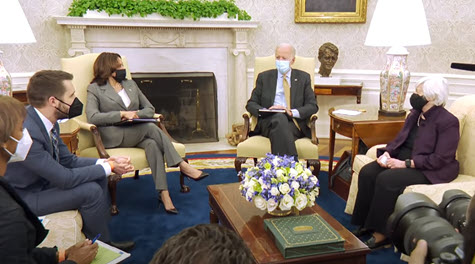
  • The critical need for investing in modern and sustainable infrastructure was also the focus of a Feb. 11 White House meeting between Biden, Vice President Kamala Harris, Buttigieg and a bipartisan group of senators from the Environment and Public Works Committee. (Roundtable Weekly, Feb. 12)
  • In a December 16, 2020 letter, The Roundtable and 12 national real estate organizations provided detailed recommendationsto then President-elect Biden and Vice President-elect Harris that included infrastructure funding and modernization as engines to drive recovery and job growth from the economic fallout of the COVID-19 pandemic.

The Roundtable is part of Build by the 4th coalition led by U.S. Chamber of Commerce, which encourages the Biden Administration and the new Congress to pass a comprehensive infrastructure deal by Independence Day 2021. 

 #  #  # 

Biden Plans Infrastructure Push as Congress, Agencies Prepare to Investigate the Texas Electric Grid Crisis

The Biden Administration plans to push for a large-scale infrastructure initiative that takes into account the effects of climate change after Congress finishes consideration of the pandemic relief package. Meanwhile, federal regulators and Congress are preparing to examine the threat that climate change poses to the nation’s electric infrastructure in the wake of last week’s deadly freeze in Texas that stranded millions without power. (Wall Street Journal and ReutersFeb. 22)   

  • The Biden Administration is expected to reveal details of its infrastructure package soon, as part of its “Build Back Better” agenda to spur economic recovery. (Roundtable Weekly, Feb. 19)
  • The rolling power outages across Texas and the Midwest due to severe winter storms prompted the Federal Energy Regulatory Commission (FERC) this week to open a proceeding to examine how electric grid operators prepare for and respond to extreme weather events. (FERC news release and FERC Insight, Feb. 2021)
  • FERC Chairman Richard Glick said, “The effects of climate change are already apparent and we must do everything we can within our statutory authority to ensure that the electric grid is capable of keeping the lights on in the face of extreme weather.” 
  • The Texas power outages have increased scrutiny in Congress on the need for investments in the nation’s electric grid. House Speaker Nancy Pelosi (D-CA) referred to the blackouts when she announced that the House Energy Committee will be investigating the matter. (Axios, Feb. 19)
  • In the Senate, Energy Committee Chairman Joe Manchin (R-WV) told Politico Pro that he is planning his own review of the power grid issue. (Politico, Feb. 19) 
  • The question of how to fund a national infrastructure effort remains the major challenge for Washington policymakers. ( Roundtable Weekly, Feb. 12)  Senate Environment and Public Works Committee Chairman Tom Carper (D-DE) suggested at a hearing yesterday that a national pilot program should explore a “vehicle miles travelled” tax, while Manchin separately stated that the gas tax paid by consumers at the pump “is not going to do what we need” to build and modernize roads, bridges, and mass transit. (NATSO, Feb. 25)   
  • The Roundtable and the Build by the 4th coalition is encouraging Congress to pass a comprehensive infrastructure package by Independence Day 2021. Last December it also provided recommendations to the new Administration that included infrastructure funding and modernization as engines to drive recovery and job growth from the economic fallout of the COVID-19 pandemic. 

Construction Industry’s Role

  • The leadership role that the construction industry could take in sustainable development was the focus of a Feb. 7 op-ed in Crain’s New York Business by Suffolk’s Executive President of Business Development, Ann Klee. (Suffolk’s Chairman and Executive Officer John Fish is the Chair-Elect of The Real Estate Roundtable)
  • “The construction industry can be part of the solution by working with developers and owners to reimagine the entire building lifecycle and ensure sustainability is incorporated at every stage of the process, from planning, design and material selection to building operation and energy efficiency after construction completion,” the op-ed states.
  • Other recommendations include more efficient management of the consumer supply chain; just-in-time delivery of materials to project sites; and minimizing construction waste.

Ms. Klee concludes that sustainable development will require “smart planning, flawless execution and education across the spectrum of stakeholders to ensure these best practices pay significant dividends, both socially and financially, in the long term.”

#  #  #

Biden Policy Eases Funding Constraints on Mass Transit Projects

NYC bridges

The Biden Administration released a policy letter on Feb. 16 enabling states to more readily access federal grant dollars to help finance mass transit and other large-scale transportation projects. (FTA “Dear Colleague” letter and CQ, Feb. 16).

  • The letter from Acting Federal Transit Administrator Nuria Fernandez reverses Trump-era policy from 2018. The earlier policy restricted the amount of transportation money states could receive from the U.S. Department of Transportation (DOT) through the Capital Investment Grants (CIG) program if the project also received a low-interest DOT loan.
  • The Feb. 16 letter clarifies that DOT loans extended under the Transportation Infrastructure Finance and Innovation Act (TIFIA) or the Railroad Rehabilitation & Improvement Financing (RRIF) program – when repaid with non-federal funds – can count toward the state’s cost-share requirement to also qualify for a “new starts” CIG grant.
  • The Roundtable has long supported the FTA’s recent step. “Loans repaid [by states] with interest are fundamentally different instruments than grants awarded with no repayment obligation,” The Roundtable noted in a 2019 letter to the House’s Transportation and Infrastructure Committee.  The letter added, “Credit-worthy state and local project sponsors who successfully navigate the TIFIA loan process should not be penalized for seeking a CIG grant as a separate, necessary layer in the capital stack to finance a massive transit project.” (Roundtable Weekly, May 3, 2019)   
  • The FTA’s policy change should help large-scale transportation projects of national and regional significance that may qualify for both CIG grants and TIFIA loans.  [See nationwide lists of CIG projects and TIFIA projects.] One prominent example is the New York-New Jersey Gateway Program, a $30 billion modernization of Amtrak’s Northeast Corridor.
  • Senator Bob Menendez (D-NJ) applauded the Biden Administration’s action, noting that the effect of the 2018 policy was to “stall the Gateway project” which includes replacing a 110-year-old bridge and construction of a “new Trans-Hudson rail tunnel.” (Menendez press release, Feb. 16)
  • The Real Estate Board of New York (REBNY) applauded the Biden FTA’s move.  “Restoring access to federal funding for Gateway is an initial but pivotal step toward advancing the project, which will improve mass transit service for millions of commuters, create thousands of good jobs and play a significant role in getting our regional and national economics back on track,” said REBNY President Jim Whelan. (REBNY news release, Feb. 18) 

Movement on Infrastructure

The Roundtable’s recommendations regarding infrastructure financing and permitting will again be featured in our forthcoming 2021 Policy Agenda. The Roundtable is also a member of the  “Build by the 4th”coalition, led by U.S. Chamber of Commerce, which urges Congress to pass a comprehensive infrastructure bill by Independence Day 2021. 

#  #  #