Roundtable Urges Second Circuit Court of Appeals to Preserve Employment Tax Exemption for Limited Partners

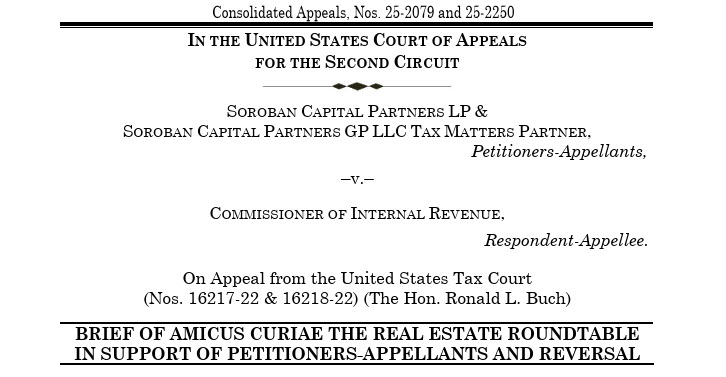
The Real Estate Roundtable (RER) filed an amicus brief this week with the Second Circuit Court of Appeals in Soroban Capital Partners LP v. Commissioner, a case that challenges the IRS’s restrictive interpretation of the “limited partner exception” from self-employment (SECA) taxes under section 1402(a)(13) of the tax code. (Amicus Brief, Dec. 15)

Why It Matters

  • Income-producing real estate—rental housing, neighborhood shopping centers, office buildings, etc.—is predominantly owned and operated in partnership form. In 2022, there were over 2.2 million real estate partnerships in the United States, with nearly 9.6 million partners.
  • The Self-Employment Contributions Act (SECA) imposes Social Security and Medicare taxes on net earnings from self-employment. The SECA tax rate on earnings above $250,000 is 3.8%. While the tax applies to a broad range of trade or business income, Congress expressly exempted limited partners from SECA in the Social Security Amendments of 1977.
  • Legislative proposals and proposed regulations have unsuccessfully attempted to extend the 3.8% SECA tax or the 3.8% net investment income tax to limited partners.
  • The IRS has undertaken an aggressive effort to redefine what it means to be a limited partner by challenging taxpayers and litigating the issue in several cases before the Tax Court.

Roundtable View

  • Real estate partnerships have relied for decades on longstanding tax law as it relates to limited partners and the SECA exception.
  • In Soroban and related cases, the Tax Court has imposed a judge-made test and concluded contrary to decades of established state law that a limited partner must be a ‘passive investor,’ notes the RER amicus brief.
  • The Tax Court’s 2023 Soroban ruling wrongly introduced a federal “passivity” requirement that is unmoored from statute, legislative history, and Treasury’s own prior interpretations. However, limited partners have routinely provided business services to their partnerships without losing their limited liability status. (Roundtable Weekly, Sept. 12)
  • “A shift in the federal tax definition of a limited partner could alter underlying partnership economics, increase tax burdens, and create significant uncertainty for real estate and other pass-through businesses,” said RER President and CEO Jeffrey DeBoer. “Such changes need to go through Congress and withstand legislative scrutiny.”

Background

  • RER’s amicus brief was drafted by litigation counsel at Sullivan & Cromwell LLP, in consultation with RER’s Tax Policy Advisory Committee (TPAC). RER also filed an amicus brief in August
    with the First Circuit Court of Appeals in a related case, Denham Capital Management LP v. Commissioner. (Roundtable Weekly, Sept. 12)

Next Steps

The decision in any of the pending cases could have nationwide implications for how partnerships are treated under SECA. A ruling against the Tax Court’s passive investor test would reinforce state law’s central role in defining “limited partner” status.


Building Emissions Policies Picking Up Steam in 2024

A confluence of mandatory rules and voluntary guidelines pertaining to real estate’s climate impacts—including a first-ever U.S. definition for the term Zero Emissions Building (“ZEB”) and an imminent Securities and Exchange Commission (SEC) greenhouse gas disclosure rule—will be a key focus of policy makers in 2024.

ZEB Definition

  • On Jan. 9, GlobeSt reported that The Roundtable supports the direction of the Biden administration’s recently released voluntary ZEB draft definition pertinent to private sector existing buildings and new construction. (Roundtable Weekly, Jan. 5)
  • The ZEB definition proposes voluntary criteria for buildings to be highly energy efficient and powered solely by clean energy sources to attain zero emissions status.

  • The Roundtable’s Sustainability Policy Advisory Committee (SPAC) is working on comments (due Feb. 5) in response to the Energy Department’s draft.

SEC & Scope 3

  • The SEC is expected to release its long-anticipated climate risk disclosure rule this spring. (Roundtable Weekly, March 10, 2023) On Jan. 11, Bisnow quoted Roundtable Senior Vice President and Counsel Duane Desiderio about the SEC’s impending rule and its impact on CRE and other industries. 
  • Desiderio explained to Bisnow, “Let’s hope the SEC delivers some workable rules and brings rationality to this space, especially regarding Scope 3 indirect emissions” that cover sources in a company’s supply chain beyond its immediate control. Desiderio added, “The market is certainly moving in the direction of the SEC rule.” (RER Fact Sheets: SEC’s Proposed Rule and California’s Climate Disclosure bills)

179D & BPS

  • Another federal rule expected in the coming weeks concerns the section 179D tax deduction for energy efficient buildings, substantially revamped by the Inflation Reduction Act (IRA). (Roundtable Weekly, Dec. 1).The Internal Revenue Service will propose a regulation for comment that addresses how existing building retrofits may qualify for this incentive.
  • Axios (Jan. 9) reported this week about trends at the local level to enact building performance standards (BPS) such as LL 97 in New York City. While Congress has not granted authority for a national emissions mandate on buildings, more cities and states are expected to run with these efforts in 2024. (Roundtable Weekly, Sept. 15).
  • A report from the Rhodium Group this week shows U.S. GHG emissions decreased nearly 2 percent year-on-year in 2023. The report also notes that emissions from commercial and residential buildings dropped by 4 percent, which the researchers attributed primarily to a mild winter. (PoliticoPro and The Hill, Jan. 10)  

SCOTUS to Consider Federal Agency “Deference”

The Supreme Court
  • A wild card in the effectiveness and durability of federal regulations—not just in the climate arena, but from any U.S. agency—will be at the fore this spring when SCOTUS renders a decision in Loper Bright Enterprises v. Raimondo.
  • Loper will consider whether an administrative law doctrine from 1984 known as Chevron deference,” which grants wide latitude to federal agencies when crafting rules to implement laws passed by Congress, should be overruled. (SCOTUS Blog, May 1, 2023)
  • The Department of Commerce stated in their brief that overruling Chevron “would be a convulsive shock to the legal system.” Oral argument will take place next Wednesday, with a decision expected by early summer. (SCOTUS Blog, Jan. 8, 2024)

Officials from the White House, the Environmental Protection Agency, the Energy Department and leading non-governmental organizations will address issues at the nexus of buildings and climate policy on January 24 at the Roundtable’s all-member 2024 State of the Industry Meeting.

#  #  #

Taxation of Unrealized Gains is Focus of Senate Democratic Bill and Supreme Court Case

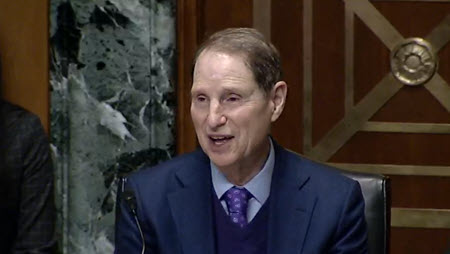
Senate Finance Committee Chairman Ron Wyden (D-OR), above, and 15 of his Senate colleagues recently introduced the Billionaires Income Tax Act (S.3367), which would tax the appreciation of wealthy individuals’ assets. On Tuesday, the Supreme Court heard oral arguments in Moore v. United States, a case challenging the federal government’s authority to tax unrealized gains under the 16th Amendment.

Billionaires Income Tax Act (BITA)

  • Under BITA, tradable, liquid assets would be marked-to-market and taxed annually on their appreciation, while illiquid assets would be subject to a “deferral recapture” tax when sold—or if certain other currently nontaxable events occur, such as death, a transfer to a trust, or a like-kind exchange. (One-page summary; section-by-section summary). (CQ, Nov. 30)
  • As drafted, the bill would apply to taxpayers with more than $100 million in annual income or more than $1 billion in assets for at least three consecutive years. (Tax Notes, Nov. 30).
  • The legislation is not limited to future appreciation of assets. It would reach back in time and apply the tax to accumulated, unrealized gains at the time of enactment.  The tax on built-in gains could be paid over a five-year period. Mark-to-market losses could be carried back for three years and applied against taxable market-to-market gains.
  • The appreciation of partnership assets (including built-in gains) and gains or losses from partnership transactions would flow through and taken into account at the partner level.
  • Related legislation was introduced in the House by Reps. Steve Cohen (D-TN) and Don Beyer (D-VA). 

Roundtable Position and Outlook

  • Real Estate Roundtable President and CEO Jeffrey DeBoer said, “Taxes rarely remain targeted, and like the income tax, this targeted proposal could be revised and expanded over time to apply to everyone. Moreover, taxing unrealized gains would upend over 100 years of federal taxation, require an unprecedented IRS intrusion into household finances, and create unknown and potentially unintended consequences at a time of economic uncertainty. Deferring the taxation of gains until an asset is sold supports entrepreneurs while encouraging the type of patient, long-term investing and productive risk-taking that drives our economy forward.”
  • In the last Congress, efforts to enact a mark-to-market regime were unsuccessful when they ran into resistance from moderate Democrats. Sen. Wyden (D-OR) acknowledged that his bill, which lacks bipartisan support, would not be part of any year-end tax legislation. (CQ, Nov. 30)

Moore v. United States

  • On Tuesday, the Supreme Court heard oral arguments in Moore v. United States, which challenges the federal government’s constitutional authority to tax unrealized income.
  • The petitioners in Moore argue that the mandatory repatriation tax in the Tax Cuts and Jobs Act exceeds Congress’s authority under the 16th Amendment to lay and collect taxes on incomes. They argue that because the tax is based on the accumulated, undistributed earnings of a foreign corporation, there is no income realization event for the Moores, who are a non-controlling minority shareholder of the corporation. (Roundtable Weekly, Oct.13)
  • Depending on the outcome and the scope of the decision, the Moore case could have implications for other forms of taxing unrealized gains, such as the appreciated value of real estate and other assets directly owned by a taxpayer.

A majority of the justices signaled they are hesitant to weigh into the broader debate of how to define income for tax purposes. A decision in Moore is not expected until June 2024. (USA Today and PoliticoPro, Dec. 5 | Tax Foundation, Aug. 30)

#   #   #

Supreme Court Case Challenges Federal Taxation of Unrealized Income

This week, the Supreme Court announced it will hear oral arguments on Dec. 5 in a case—Moore v. United States—challenging the federal government’s right to tax unrealized gains. (PoliticoPro, Oct. 12)

Moore Consequences

  • The question raised by the petitioners in Moore, and granted certiorari by the Supreme Court in June, is whether the 16th Amendment authorizes Congress to tax unrealized sums without apportionment among the states.

  • Specifically, the case involves a Washington state couple with an interest in an India-based corporation who are challenging a 2017 mandatory repatriation tax on foreign earnings as an unconstitutional levy on unrealized gains.

  • Outside legal and tax commentary and analysis have suggested the case could have far-reaching consequences for both the existing tax code and pending legislative proposals, depending on how the decision is drafted. 

  • A recent report from the Urban-Brookings Tax Policy Center report estimates that a ruling in favor of the petitioners could result in tax revenue losses exceeding $100 billion annually. Estimates of revenue losses from the Tax Foundation range as low as $3.5 billion and as high as $5.7 trillion in the unlikely event the Supreme Court were to strike down taxes on all undistributed business earnings, whether earned domestically or from foreign sources.

Policy Ramifications

  • A Supreme Court decision in favor of the petitioners could also undercut President Biden’s proposal to tax the unrealized real estate and other gains of wealthy taxpayers. The President and influential lawmakers such as Senate Finance Chairman Ron Wyden (D-OR) have proposed new mark-to-market taxes on assets based on annual changes in asset values rather than specific realization events. (Roundtable Weekly, Sept. 19, 2019)

  • The Real Estate Roundtable has consistently opposed the proposals to tax unrealized gains since they first emerged in 2019 (Sen. Wyden, Treat Wealth Like Wages, 2019).

JCT Memo

Joint Committee on Taxation logo
  • On Oct. 3, in a letter to House Ways and Means Ranking Democrat Richie Neal (D-MA), the Joint Committee on Taxation (JCT) provided an analysis of how a ruling for the petitioners in Moore could impact the tax code.

  • JCT informed Rep. Neal that partnership taxes, taxation of shareholders of S corporations, and taxes on mark-to-market valuations also could be implicated in the outcome. The income of real estate mortgage investment conduits, or REMICs, also may be affected, according to JCT’s memo.

Alternatively, notes JCT, the Court could rule that the mandatory repatriation tax is a tax on realized income, in which case it could “leave unanswered the question of whether the Constitution imposes a realization requirement.” (JCT memo, p. 2)