Democrats’ Revised Tax Plan Includes Changes and Improvements Important to Real Estate and Other Pass-through Businesses

DC landscape

This week’s frenzy of infrastructure negotiations in Washington was capped off by the White House’s release yesterday of a pared down, $1.75 trillion framework agreement on “human” infrastructure legislation, which trimmed back potential tax increases on commercial real estate and other pass-through businesses. (CQ, Oct. 30 and Tax Notes, Oct. 29) 

Dynamic Negotiations 

  • By introducing revised legislation – the Build Back Better Act (H.R. 5376) – Democratic leaders hoped to create momentum for a vote on the separate, bipartisan “physical” infrastructure bill. Their effort was unable to secure the necessary support for an immediate vote from House progressives. (Section-by-section bill summary and Washington Post, Oct. 29)
  • Policymakers did pass a short-term extension of surface transportation programs until Dec. 3 – the same day that funding for the government will run out and within the time frame for addressing the current debt ceiling. (Punchbowl News, and BGov, Oct. 30)
  • Roundtable President and CEO Jeffrey DeBoer commented on the evolving infrastructure legislative developments in an interview this week with American City Business Journals. DeBoer noted that as the bill’s cost has come down, policymakers have eliminated many proposed tax increases.
  • “We very much want to see the physical bipartisan infrastructure bill pass. It has been tied in the House to the larger human infrastructure bill, and that legislation is slowly winding its way to the finish line. As the larger bill was put forward, we were concerned about some provisions that we felt might target real estate activities and real estate investment. We tracked all of these various proposals such as mark-to-market and wealth taxes. We’re continuing to monitor developments and ensure that nothing comes up without proper vetting or full understanding of how it would impact CRE,” DeBoer said. 

What It Means for CRE 

Marcus and Millichap Oct 21 2021 tax webinar

  • The revised reconciliation bill reflects continued progress on a number of tax issues important to real estate and prioritized by The Real Estate Roundtable. Critically, the current bill includes:     
     
    • No limitations on like-kind exchanges (sec. 1031),
    • No increase in the capital gains tax rate,
    • No restrictions on the 20% pass-through business income deduction (sec. 199A),
    • No taxation of unrealized gains at death or repeal of the step-up in basis of assets,
    • No changes in the tax treatment of carried interest, and
    • No restrictions on estate tax valuation discounts. 
  • Additionally, the revised legislation excludes a complex mark-to-market regime to tax the unrealized gains of billionaires, new tax burdens on grantor trusts, and a provision that would have prohibited IRA investment in many non-listed REITS. 

Key Tax Revenue Provisions 

Tax issues grid choice image

  • In addition to provisions aimed at corporate and international business activities, tax provisions in the framework agreement include:
     
    • Expansion of the 3.8% net investment income tax to cover a much broader range of income – such as capital gains and rents – earned by both active business owners (such as real estate professionals), S corp. shareholders, and limited partners.

    • A new proposal to impose a 5% surtax on a taxpayer’s modified adjusted gross income (AGI) over $10M and an additional 3% surtax tax on modified AGI over $25 million.

    • Restrictions on taxpayers’ ability to deduct more than $250K (individual) or $500K (married couple) of losses incurred in an active trade or business from their portfolio income or wages.

    • Modifications to the portfolio interest exception that exempts interest earned on certain U.S. debt obligations from a withholding tax on outbound interest payments. The exception is sometimes used by foreign institutions when investing in US real estate.

    • Clarification that limitation on interest deductibility (sec. 163(j)) applies at the partner or shareholder level, not the entity level.

    • Clean Energy tax provisions affecting real estate are covered in the Roundtable Weekly story below. 

Dropped Tax Incentives 

  • As the cost of the bill came down, certain tax incentives were eliminated from the package: expansion of the low-income housing tax credit and the credit for rehabilitating historic structures, creation of a new tax credit for home construction in low-income communities for low-income buyers, and new infrastructure tax credit bonds and related infrastructure financing provisions. 

Legislative changes to the bill could occur next week on crucial issues such as the SALT deduction, but the timing of action on a final agreement remains uncertain. (Bloomberg, Oct. 29) 

#  #  #

Democrats Struggle to Reach Agreement on “Social Infrastructure” Package as Roundtable’s DeBoer Addresses Real Estate Tax Issues in Play

image - U.S. Capitol blue sky

Democrats this week struggled to reach agreement on cutting the cost of President Biden’s multitrillion “social infrastructure” proposal as Senator Kyrsten Sinema (D-AZ) opposed any increase in marginal rates for businesses, high-income individuals or capital gains to pay for the package. Democrats aim to pass both the “human” and “physical’ infrastructure packages under a budget reconciliation process that requires approval of all 50 Democrats in the evenly divided Senate. (Wall Street Journal, Oct. 20) 

CRE Impact 

Jeffrey DeBoer, Real Estate Roundtable President and CEP

  • Real Estate Roundtable President and CEO Jeffrey DeBoer (above) yesterday addressed the fluid nature of the reconciliation bill negotiations during a Marcus and Millichap tax policy webinar. The webcast is available here, but you must be registered to access the discussion.
  • DeBoer noted that the narrow voting margins in both the Senate and House have created an environment where it is difficult for various factions in Congress to reach consensus. “What we have here is a clash between expectations and reality,” DeBoer said.
  • He added that the current policy disputes among lawmakers adds uncertainty to the potential outcome. “Could negative tax provisions affecting real estate be put back on the table? Absolutely. What also worries me is that other proposals that we don’t know about yet may suddenly be considered.” (Registration required to view the Marcus & Millichap webcast)
  • The House Ways and Means Committee voted in September to advance legislation that would finance Biden’s social infrastructure initiatives with a $2.1 trillion tax increase focused on high-income individuals and corporations. The House legislation excluded several tax proposals put forward by the Biden administration and Senate lawmakers that would increase the tax burden on real estate. (Roundtable Weekly, Sept. 17)
  • The Washington Post today reported that a new “Billionaire Income Tax” proposal from Senate Finance Chair Ron Wyden (D-OR) would “aim to raise hundreds of billions of dollars from the fortunes of America’s roughly 700 billionaires” by applying a tax to those individuals earning over $100 million in income three years in a row. Taxes would be imposed on the increased value of assets such as stocks on an annual basis, regardless of whether those assets are sold. Billionaires would also be able to take deductions for the annual loss in value of those assets. (Washington Post, Oct 22)
  • Additional tax issues affecting CRE are profiled in The Roundtable’s summary on Real Estate Tax Issues and Budget Reconciliation Legislation.   

Tax Uncertainty 

Kyrsten Sinema

  • The Senate has not acted on any revenue-raising proposals to support President Biden’s original $3.5 trillion infrastructure package. Policymakers are now aiming to pare down the overall reconciliation bill cost to approximately $2 trillion before finalizing measures to pay for the package.
  • Sen. Sinema (above) yesterday spoke with House Ways and Means Committee Chairman Richard Neal (D-MA) in an effort to break the impasse on how to fund certain infrastructure spending priorities in a scaled-down package. Neal said he is optimistic a deal will be reached. “I did point out that it’s the ninth inning. I mean, when are you going to vet these issues?” Neal said. (The Hill, Oct. 21)
  • The current reconciliation bill in the House would raise the top marginal income tax rate on many pass-through business owners from 29.6% today to 46.4% (a 57% increase). The Roundtable believes this level of increase on pass-through businesses was unintended by Members of Congress and could undercut the bill’s own objectives. 

As negotiations continue among policymakers on a reduced topline number for the social infrastructure package – and the specific programs it would support within a multi-trillion reconciliation bill – The Roundtable continues to urge lawmakers to ensure that any tax changes within a final agreement treats pass-through businesses fairly and equitably. (Roundtable Weekly, Oct. 1 and Oct. 15

#  #  # 

Debt Ceiling Increase Enacted as House Democrats Consider Cuts to $3.5 Trillion Reconciliation Bill

Capitol with flag close

President Joe Biden yesterday signed a $480 billion increase in the federal government’s debt limit to $28.9 trillion, narrowly avoiding an Oct. 18 national default deadline. The debt increase – passed by the Senate last week and the House on Tuesday – sets the stage for another fiscal cliff negotiation in less than two months, when both the debt limit and funding for the government run out on Dec. 3. (Associated Press, Oct. 14 and Reuters, Oct. 13) 

Infrastructure Funding 

  • Democrats this week continued to struggle on how to cut the scope and cost of the $3.5 trillion “human” infrastructure bill, after an intraparty split between moderates and progressives postponed a vote on a scaled-down bill in the House. (Wall Street Journal, Oct. 1)
  • House Speaker Nancy Pelosi (D-CA) set an Oct. 31 target date to pass revised legislation under the budget reconciliation process, which requires a simple majority in the 50-50 Senate to bypass Republican opposition. (Bloomberg, Oct. 2) 

Cuts and Scale 

Schumer and Pelosi

  • Pelosi sent an Oct. 11 letter to her caucus members as they work to cut Biden’s reconciliation proposal from $3.5 trillion to approximately $2 trillion. “Overwhelmingly, the guidance I am receiving from Members is to do fewer things well,” Pelosi wrote. (PoliticoPro, Oct 13)
  • On Oct. 12, Pelosi also commented on possible cuts to the length of certain spending programs, stating, “What would be the first to go? … the timing would be reduced in many cases to make the cost lower.” (News conference transcript)
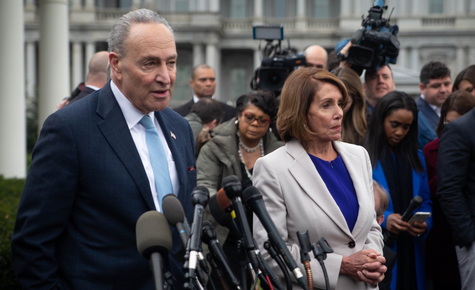
  • In the Senate, Majority Leader Chuck Schumer (D-NY) yesterday sent a letter to his fellow Democrats urging unity as they consider a scaled-back infrastructure bill. “To pass meaningful legislation, we must put aside our differences and find the common ground within our party. As with any bill of such historic proportions, not every member will get everything he or she wants,” Schumer wrote. (Associated Press, Oct. 14) 

Roundtable Concerns 

Marcus and Millichap Oct 21 2021 tax webinar

  • Real Estate Roundtable President and CEO Jeffrey DeBoer will participate in an Oct. 21 Marcus & Millichap webinar on the state of play in infrastructure proposals, the industry’s tax policy concerns and the possible impact on commercial real estate. (Register here)
  • The tax bill passed by the House Ways and Means Committee does not include restrictions on like-kind exchanges, taxation of gains at death, ordinary income treatment for carried interest, and tax parity between capital gains and ordinary income.  The Roundtable argued that these Biden administration tax proposals could harm job growth, local tax revenue, and the economic recovery. 
  • As negotiations continue on a multi-trillion reconciliation proposal, The Roundtable is urging lawmakers to ensure that any final agreement on tax changes to fund a bill would treat pass-through businesses fairly and equitably. The current reconciliation bill in the House would raise the top marginal income tax rate on many pass-through business owners from 29.6% today to 46.4% (a 57% increase). 
  • The Roundtable believes this level of increase on pass-through businesses was unintended by Members of Congress and could undercut the bill’s own objectives of stimulating job growth, improving housing availability, and promoting investment in economically struggling communities, among other priorities.

Additional tax issues affecting CRE are summarized in The Roundtable’s summary on Real Estate Tax Issues and Budget Reconciliation Legislation.  

#  #  # 

Senate Passes Short-Term Debt Limit Increase as Democrats Aim to Reduce Cost of Human Infrastructure Package

Capitol building bright

The Senate last night passed legislation (S.1301) on a 50-48 vote that would increase the debt limit by $480 billion and avoid an Oct. 18 national default. (Axios and Wall Street Journal, Oct. 7)

New Fiscal Cliff 

  • The bill would also effectively set Dec. 3 as the new fiscal cliff – when the new debt limit and the current short-term government-spending authorization both expire. (Roundtable Weekly, Oct. 1 and CQ, Oct. 7)
  • The agreement struck by Senate Majority Leader Charles Schumer (D-NY) and Minority Leader Mitch McConnell (R-KY) this week raises the current national debt to approximately $28.8 trillion to cover spending previously authorized by the federal government. (NPR and CNBC, Oct. 7) 
  • House Speaker Nancy Pelosi (D-CA) wrote to members of her caucus last night that she would call the House back from recess early to vote if necessary. President Biden said this week said he also would support an increase in the debt ceiling. (Wall Street Journal, Oct. 7 and White House remarks, Oct. 6)

Infrastructure Reset 

DC landscape sunset

  • Meanwhile, disagreements among moderate and progressive Democrats on the scope and cost of a $3.5 trillion “human” infrastructure package delayed a vote last week in the House, prompting Speaker Nancy Pelosi (D-CA) to reset the deadline for lawmakers to reach agreement to Oct. 31. (Forbes, Oct 2) 
  • Congressional leaders and President Biden continued negotiations this week with centrist Senate Democrats Joe Manchin (WV) and Kyrsten Sinema (AZ) aimed at reaching a deal that would allow a human infrastructure bill to pass the Senate with 50 votes. Manchin this week added that he is open to a reduction in the reconciliation bill’s cost to between $1.9 trillion and $2.2 trillion. (CNN, Oct 5)
  • Democrats are now engaged in an intense debate about how to cut the total cost of their human infrastructure bill. Legislation that would raise an estimated $2.1 trillion in taxes from corporations and the wealthy was approved by the House Ways and Means Committee on Sept. 15 to help finance the original $3.5 trillion reconciliation package. (Roundtable Weekly, Sept. 17) 
  • Real Estate Roundtable President Jeffrey DeBoer commented Sept. 17 on the bill’s advancement. “We encourage Congress to review the suggested tax hikes, particularly those on pass-through businesses, and work to ensure that unnecessary and unintended damage is not done to the economy. Substantial commercial real estate activities are conducted by pass-through entities and these activities create jobs, support retirement savings, and boost tax revenue for critical public services provided by local governments.”  DeBoer added, “The Roundtable is encouraged, yet cautious, at this still relatively early stage of the legislative process.” (Roundtable WeeklySept. 17 | Sept. 24 | Oct. 1)
  • Roundtable members and others are encouraged to reach out to their Representatives and contact their Senators to urge them to preserve the 20% deduction for pass-through business income (section 199A), which is directly tied to hiring workers and investing in capital equipment and property. Modest adjustments in the legislation would ensure that pass-through businesses could continue contributing to economic growth, innovation, and job creation. Background information and talking points on the pass-through issue can be found here. 
  • Tax issues affecting CRE are summarized in The Roundtable’s summary on Real Estate Tax Issues and Budget Reconciliation Legislation
  • DeBoer will participate in an Oct. 21 Marcus & Millichap webinar on the latest tax policy developments in Washington and what they mean for CRE. (Register here

Legislation on human and physical infrastructure, the debt ceiling, government funding and many other policy issues affecting CRE were the focus of discussions between Roundtable members and national policymakers during The Roundtable’s Oct. 5 Fall Business Meeting. (See story above).  

#  #  # 

Infrastructure Negotiations Continue as Congress Extends Government Funding to Dec. 3; Debt Ceiling Deadline Looms

U.S. Capitol

Intense negotiations among moderate and progressive Democrats on the scope and cost of the $3.5 trillion “human” infrastructure package continued this week, delaying a vote yesterday on the $1 trillion bipartisan “physical” infrastructure bill. House progressives have insisted they will not vote for the bipartisan bill until Senate centrists commit to support a multitrillion-dollar social benefits package. 

Moderates in the Balance 

  • President Joe Biden, House Speaker Nancy Pelosi (D-CA) and Senate Majority Leader Chuck Schumer (D-NY) this week engaged moderate Sens. Joe Manchin (D-WV) and Kyrsten Sinema (D-AZ) in hopes of sealing the support of all 50 Senate Democrats on the “human” infrastructure package. That bill’s passage depends on the budget reconciliation process to bypass Republican opposition. (Reuters, Sept. 28)
  • Sen. Manchin this week released a document indicating the terms for his potential support of the reconciliation package. Manchin’s conditions, provided to Schumer on July 28, cite a topline cost of $1.5 billion for spending on social programs and climate change – $2 trillion less than the package that Democratic progressives have agreed to support.  (Politico, Sept. 30)
  • The Manchin document included proposals to raise the corporate tax rate to 25% and increase the top tax rate on ordinary income to 39.6%. It also lists as an offset condition to “end carried interest,” raise the capital gains tax rate to 28 percent, and notes that “any revenue exceeding $1.5 trillion” should be used to reduce the national deficit. 
  • Tax issues affecting CRE in the “human” infrastructure package are summarized in The Roundtable’s “Pass-Through Businesses and the Reconciliation Bill” document. 
  • White House Press Secretary Jen Psaki yesterday said, “A great deal of progress has been made this week, and we are closer to an agreement than ever. But we are not there yet, and so, we will need some additional time to finish the work.”  (White House Statement, Sept. 30) 

CR and Debt Ceiling 

Treasury Department

  • Meanwhile, Congress passed a Continuing Resolution (CR) yesterday to fund the government through Dec. 3. President Biden signed the bill hours before a partial federal shutdown was scheduled to take effect. (BGov and CQ, Oct 1)
  • The flurry of activity in Washington this week also included action on the debt ceiling. Legislation that would suspend the nation’s debt limit until December 2022 passed the House on Sept. 29 but is expected to fail in the Senate, where 60 votes are needed to advance the bill in the 50-50 upper chamber. Republicans oppose the measure, insisting that Democrats should suspend the debt ceiling through the budget reconciliation process, which requires 50 votes. (CNBC, Sept. 29)

Treasury Secretary Janel Yellen testifying before Congress

  • The debt ceiling must be suspended by Oct. 18 to avoid the government from defaulting on its financial obligations, according to Treasury Secretary Janet Yellen’s Sept. 28 testimony before the Senate Banking Committee.
  • Unless Congress increases the government’s authority to borrow more, “It would be disastrous for the American economy, for global financial markets, and for millions of families and workers,” Yellen said. Federal Reserve Chairman Jerome Powell also testified, supporting Yellen’s view about the catastrophic economic consequences if the government were to default. (AP, Sept. 28)

The potential impact of infrastructure policy proposals on commercial real estate markets, employment and investment in communities Washington will be the focus of discussion during The Roundtable’s Fall Meeting on Oct 5.

#  #   # 

Real Estate Industry Weighs in Against Potential Partnership Tax Changes as House Lawmakers Prepare Next Steps for Infrastructure, Tax Bills

The Real Estate Roundtable and 22 other national real estate organizations wrote today to Senate Finance Committee Chairman Ron Wyden expressing significant concerns regarding his draft legislation to overhaul partnership tax rules. The letter was sent after congressional leaders and Treasury Secretary Janet Yellen yesterday announced they had agreed on a framework for moving forward with human infrastructure legislation, which includes a list of tax issues for discussion and potential inclusion in a final reconciliation bill. Additionally, the House Budget Committee announced it would “mark up” the combined $3.5 trillion reconciliation bill tomorrow. (Coalition letter, Sept. 24 and BGov, Sept. 23)

Why It Matters

  • On September 10, Chairman Wyden proposed a far-reaching restructuring of partnership taxation that would raise at least $172 billion over 10 years. Chairman Wyden or others could put forward the partnership proposals as revenue provisions for the reconciliation bill.
  • Real Estate Roundtable President and CEO Jeffrey DeBoer stated, “Partnerships are used to bring parties together to create and grow businesses that propel job creation, new investment, and productive economic activity. Partnerships contribute immensely to the culture of dynamic entrepreneurship and risk-taking that is missing in many parts of the world where business activity is dominated by large, public corporations. In this current environment, Congress should be working on ways to encourage and strengthen partnerships, not cut their knees out from under them.” (Roundtable Weekly, Sept. 10)
  • Nearly half of the four million partnerships in the United States are real estate partnerships. These pass-through businesses are a key driver of jobs, investment, and local tax revenue.
  • Provisions in the draft bill would alter the tax rules that apply when a partnership is formed and property is contributed, creating new barriers to business formation. Other provisions would changes the rules when a partnership borrows to finance its growth and expansion, as well as when a partnership distributes profits and gains to the owners.
  • Many of the provisions in Wyden’s draft would apply retroactively to economic arrangements entered into years, and sometimes decades, earlier. A proposal requiring that partners share all debt in accordance with partnership profits could overturn decades of tax law with respect to nonrecourse borrowing by a partnership.
  • The coalition of 24 real estate organizations stated, “With millions of Americans still unemployed and others who have yet to return to the labor force, we encourage you to focus instead on reforms that will strengthen and expand partnerships’ ability to create jobs and economic opportunities.” (Coalition letter, Sept. 24)

Infrastructure / Reconciliation Developments

  • A vote on the bipartisan infrastructure legislation is expected on Monday, Sept. 27 or Tuesday, Sept. 28, but that could change depending on Democratic leaders’ ability to ensure sufficient votes for passage.
  • The House Budget Committee’s scheduled mark-up the $3.5 trillion reconciliation bill on Saturday afternoon, Sept. 25 will proceed as Democrats race to reach consensus with moderates who object to the bill’s overall price. (PoliticoPro, Sept. 23)
  • The framework deal between House and Senate Leaders reportedly includes an understanding between Senate Finance Committee Chairman Ron Wyden (D-OR) and House Ways and Means Committee Chairman Richard Neal (D-MA) about revenue-raising proposals that could be used to pay for the massive proposal. (The Hill, Sept. 23)
  • Senate Majority Leader Chuck Schumer (D-NY) described the agreement as a “menu of options that will pay for any final negotiated agreement” as Pelosi called it “an agreement on how we can consider, go forward in a way to pay for this.”

Roundtable Resources

Infrastructure bills and tax policy issues in play that may impact commercial real estate will be the focus of discussions during The Roundtable’s Fall Meeting on Oct. 5 in Washington, DC (Roundtable-level members only).

#  #  #

Positive Transit Measures Included in Reconciliation Package

Infrastructure Virginia highway

The House Transportation and Infrastructure (T&I) Committee this week marked-up its $57.3 billion piece of the reconciliation package with a focus on mass transit and high-speed rail.

  • Many of the T&I measures are now in line with the Biden administration’s original transit priorities, which were pared down in the Senate’s final physical infrastructure bill. (Washington Post, Sept. 10)
  • Roundtable-supported measures in the T&I Committee’s bill include:

    • A competitive federal grant program to support transit access for affordable housing projects and improve mobility for low-income riders; 
    • Grants administered by the Federal Highway Administration to support transportation equity and reconnect communities divided by “existing infrastructure barriers;”
    • Funds to improve high-speed rail corridors;
    • Credit risk assistance to develop rail infrastructure under the Railroad Rehabilitation and Improvement financing (RRIF) program; and
    • Funds to convert federal buildings owned or managed by the General Services Administration to “high-performance green buildings.”    
  • Separately, the Ways and Means Committee’s package also proposed favorable tax-exempt bond financing improvements to attract greater public-private partnership investments in transportation projects.

Timing for a House vote on the sprawling reconciliation bill is uncertain. Modifications to the tax, energy or transportation sections of the bill could be introduced when it is sent to the House Rules Committee, which determines floor action – or through an amendment on the floor. House Speaker Nancy Pelosi (D-CA) can afford to lose only three votes when the final legislation comes to a vote. (Bloomberg, Sept. 15)

#  #  # 

House Ways and Means Committee Advances Historic Legislation with Safety Net Expansion and $2.1 Trillion in Tax Increases

House Ways and Means Committee graphic

The House Ways and Means Committee voted to advance legislation that would expand benefits for low-income families, invest in affordable housing and other Democratic priorities, and finance the initiatives with a $2.1 trillion tax increase that primarily falls on high-income individuals, pass-through businesses, and corporations. The legislation excludes several tax proposals put forward by the Biden administration and Senate lawmakers that would increase the tax burden on real estate. (Ways and Means news release and markup resources

  • Real Estate Roundtable President Jeffrey DeBoer stated, “The House Ways and Means Committee’s proposals include significant tax increases on corporations and income received by upper income taxpayers, and not on business activities like real estate.  Even so, the combined tax hikes on income received from pass-through entities could threaten job creation and business expansion. As the bill moves forward, we encourage Congress to review the suggested tax hikes, particularly those on pass-through businesses, and work to ensure that unnecessary and unintended damage is not done to the economy. Substantial commercial real estate activities are conducted by pass-through entities and these activities create jobs, support retirement savings, and boost tax revenue for critical public services provided by local governments. The Roundtable is encouraged, yet cautious, at this still relatively early stage of the legislative process. Further changes may be on the horizon, both positive and negative.” 
  • Tax issues affecting CRE are summarized in The Roundtable’s summary on Real Estate Tax Issues and Budget Reconciliation Legislation. The real estate tax issues addressed by the W&M Committee include: 

Ways and Means markup


Real Property Like-Kind Exchanges (Section 1031)
 

  • The bill wisely preserves taxpayers’ ability to defer capital gain when exchanging real property for another property of like kind. 

Step-Up in Basis and Taxation of Gains at Death 

  • The bill preserves the step-up in basis that applies to appreciated gain when real estate is transferred from a decedent to an heir. The bill does not impose capital gains tax on appreciated real estate when transferred by a decedent or donor.

Capital Gains 

  • The bill increases the maximum capital gains rate from 20% to 25%. The 3.8% investment tax is maintained and extended to all taxpayers, thus making the effective capital gain tax rate 28.8%. The President’s budget proposed increasing the capital gains rate to 39.6% to create parity between the tax rate on ordinary income and capital gains.

Real Estate Carried Interest 

  • The bill generally extends from 3 years to 5 years the holding period for partnership gains attributable to a profits interest to qualify for the long-term capital gains rate. However, the bill preserves the shorter 3-year holding period for capital gain related to a real property trade or business.  The President’s budget proposed converting all carried interest income derived from a profits interest in a real estate partnership to ordinary income.

Pass-Through Business Income Deduction (Section 199A) 

  • The bill limits the maximum deduction available for pass-through business income under section 199A to no more than $400,000 for an individual and $500,000 in the case of a joint return ($2.5 million).

Net Investment Income Tax 

  • The bill would apply the 3.8% net investment income tax to income derived from a trade or business, capital gain, dividends, interest, and rental income regardless of whether the taxpayer is active or passive in the activity.

Other Tax Issues 

  • Other tax issues addressed by the committee included affordable housing, infrastructure financing, grantor trusts, deductibility of active losses and REIT constructive ownership rules. These issues are also summarized in The Roundtable’s summary on Real Estate Tax Issues and Budget Reconciliation Legislation.
  • House Speaker Nancy Pelosi (D-CA) is expected to address a provision affecting the $10,000 limit on state and local deductions (SALT) before a final bill is assembled for a floor vote. (CNBC, Sept. 15)
  • The committee’s proposals on clean energy incentives are detailed in the Roundtable Weekly story below on energy policy. 

The House is expected to try to resolve major differences between their final bill and the Senate’s version before voting on the package. Senate Majority Leader Chuck. Schumer (D-NY) has not set a formal deadline for the Senate to complete its work but he said Tuesday “there’s going to be a lot of intense discussions and negotiations over the next few weeks.” (RollCall, Sept. 14) 

#  #  # 

Democrats Advance Human Infrastructure Package While Facing Tight Deadlines on Physical Infrastructure Bill, Budget Funding and Debt Ceiling

Capitol Building in Washington, DC side view
House Democrats this week advanced 13 committee bills – including positive measures affecting commercial real estate – that will be assembled into a massive $3.5 trillion “human” infrastructure package for policymakers to consider as soon as this month. (See Roundtable Weekly stories below for details on tax, energy and transportation legislation). 

Human and Physical Infrastructure 

  • Democrats aim to pass President Joe Biden’s massive social spending and tax package in the House and Senate without Republican support using the budget reconciliation process – despite signals of resistance from some caucus members in a narrowly divided Congress. (BGov, Sept. 15)  
  • Additionally, House Speaker Nancy Pelosi (D-CA) has set a Sept. 27 deadline for the House to vote on a separate, bipartisan “physical” infrastructure bill passed by the Senate on Aug. 10. (Roundtable Weekly, Sept. 10 and Aug. 20
  • Congress also needs to act on FY22 government funding by October 1 to avoid a partial shutdown – and reach agreement on raising the federal debt ceiling in October to avoid a national credit downgrade or default. (Politico, Sept. 12) 

Roundtable Response

Real Estate Roundtable Town Hall on Reconciliation bill

[Photo, right to left: Roundtable Chair John Fish (Chairman and CEO, Suffolk); Roundtable President and CEO Jeffrey DeBoer and Senior Vice President & Counsel Ryan McCormick during today’s Town Hall discussion on the House reconciliation package.]

  • The physical infrastructure bill’s impact on CRE was the focus of a discussion published Sept. 15 in The Real Deal, featuring Roundtable Chair John Fish (Chairman and CEO, Suffolk) and Roundtable President and CEO Jeffrey DeBoer. 
  • Fish stated in the article, “At the end of the day, these are investments that the government is going to be sponsoring, that creates economic activity, job creation, and a sense of equality across our communities of America.”
  • DeBoer commented, “We think it’s very important and very much needed, long overdue. I think everyone agrees that what is needed immediately is to work on our infrastructure, repairing roads, bridges, inter-city rail, broadband, water systems, and all of these things are definitely needed.” (The Real Deal, Sept. 15)
  • The Real Estate Roundtable also held an all-member Town Hall discussion this afternoon to address specific measures in the House’s human infrastructure bill, including its tax policy aspects. The event featured The Roundtable’s John Fish, Jeffrey DeBoer and Senior Vice President & Counsel Ryan McCormick. 
  • A coalition of 13 real estate trade organizations, including The Roundtable, yesterday urged congressional leaders to raise the statutory debt limit as soon as possible. The letter stated, “Given the more than $8.6 trillion in mortgage debt backed by the federal government through Fannie Mae, Freddie Mac, Ginnie Mae and other federal agencies, the housing and real estate markets are particularly susceptible to any instability stemming from concern about the U.S. meeting its financial obligations.” (Coalition letter, Sept. 16) 

The many policy issues now in play for CRE will be the focus of discussions during The Roundtable’s Fall Meeting on Oct. 5 in Washington, DC (Roundtable-level members only). 

#  #  # 

Congress Faces Daunting Fall Agenda of Infrastructure Bills, Budget Funding and Debt Limit Deadlines

red lines to Capitol

Several significant issues affecting commercial real estate converge this month as Congress faces deadlines on a $550 billion “physical” infrastructure bill, a separate $3.5 trillion “social” infrastructure package, government funding for FY2022, and the national debt ceiling.  

The full Senate will return on Sept. 13 and the House on Sept. 20. Deadlines to watch as policymakers face a daunting agenda: 

Sept. 15 — Reconciliation Bills Expected 

  • House committees this week began work on completing various portions of the massive social infrastructure package – including tax revenue raisers impacting CRE – by a Sept. 15 deadline set by House Speaker Nancy Pelosi (D-CA). The $3.5 trillion package will be considered under “reconciliation” budget rules that would only require Democratic votes to pass. (The Hill, Sept. 9 and Roundtable Weekly tax story below)
     
  • Senate Majority Leader Chuck Schumer (D-NY) has instructed his committees to finalize their parts of the upper chamber’s reconciliation bill by Sept. 15 – although this deadline is non-binding and expected to slip. (CNBC, Aug. 11)
     
  • Sen. Joe Manchin (D-WV) wrote in a Sept. 2 Wall Street Journal op-ed that Congress should take a “strategic pause” on the reconciliation package. In a 50-50 Senate, the votes of moderate Democrats such as Manchin and Krysten Sinema (D-AZ) are crucial for passage. 

Sept. 27 — House infrastructure Vote 

House of Reps vote

  • The Senate on Aug. 10 passed a bipartisan bill addressing physical infrastructure with $550 billion in new spending. (Roundtable Weekly, Aug. 13) 
  • Pelosi has set a Sept. 27 deadline for the House to vote on the Senate-passed bill. Pelosi’s move accommodated a group of 10 moderates in her caucus who insisted on de-coupling House votes on physical and human infrastructure legislation. (Roundtable Weekly, Aug. 20)
     
  • Pelosi can afford to lose only three Democratic votes in the narrowly divided House if all Republicans oppose a bill. (New York Times, Sept 5)
     
  • The Real Estate Roundtable held an all-member Infrastructure Town Hall on Aug. 12 to discuss the Senate infrastructure bill, what lay ahead in the House, and the potential impact on commercial real estate. (Roundtable Weekly, Aug. 13)   

October – Federal Government Funding and Debt Ceiling 

Treasury logo on flag background


  • Funding for the federal government expires Oct. 1 unless an FY22 appropriations bill is enacted. Congress is expected to pass a stopgap spending bill – known as a Continuing Resolution (CR) – that would fund agencies at current levels to avoid a partial government shutdown. 
  • The CR could also include a measure to suspend or raise the national debt ceiling, which would require at least 10 Senate Republican votes to pass under regular order. 
  • Democratic leaders plan to pursue a bipartisan vote to waive the debt limit. (Reuters and PoliticoPro, Sept. 8) However, 46 Senate Republicans pledged in an August 10 letter that they “will not vote to increase the debt ceiling, whether that increase comes through a stand-alone bill, a continuing resolution, or any other vehicle.” (Bloomberg and The Wall Street Journal, Aug. 10) 
  • Congress must address the national debt ceiling by October, according to a Sept. 8 letter from Treasury Secretary Janet Yellen to congressional leaders. 

The Roundtable will discuss how all these issues impact CRE and the national economy during its Fall Meeting on Oct. 5 in Washington, DC (Roundtable-level members only). 

#  #  #