Roundtable Members Support NYC Coalition to Reduce Crime and Increase Public Safety

NYC street scene

A coalition of more than 230 business, civic, and labor leaders – including 16 Real Estate Roundtable members – on Jan. 31 expressed broad support for New York City Mayor Eric Adams’s efforts to increase public safety in the wake of a series of violent crimes across the city. New York is one of several cities across the nation facing a spike in crime since the start of the pandemic. (Partnership for New York City letter, Jan. 31 | Reuters and CQ, Feb. 3) 

Private Sector Support

Rob Speyer

  • Roundtable Board Member Rob Speyer (President and CEO, Tishman Speyer), above, and Steven Swartz (President and CEO, Hearst) – Co-Chairs of the Partnership for New York City – stated, “We support Mayor Adams’ comprehensive approach to reducing crime and gun violence. The return of the pre-pandemic vibrancy of our city depends on his success.” (New York City’s website)
  • The coalition letter also noted, “New York cannot recover from the devastating impacts of the pandemic without first restoring the sense of personal security that every resident, worker, visitor, and community in our city has the right to expect.”
  • “[I]t is equally necessary to invest in mental health care and alleviate conditions that contribute to violent behavior” such as homelessness, the letter explains.

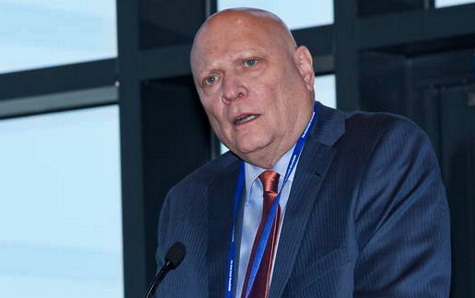
Real Estate Roundtable President and CEO Jeffrey DeBoer

  • Roundtable President and CEO Jeffrey DeBoer, above, stated, “The Real Estate Roundtable is highly supportive of governmental efforts nationally and locally to address violent behavior, substance abuse, homelessness, and joblessness. We join with our New York-based leaders in supporting efforts to address these troubling realities in New York City and we applaud President Biden for his announcement this week on community safety.”
  • The coalition letter comes a week after Adams proposed a comprehensive Blueprint to End Gun Violence. President Biden and Attorney General Merrick Garland yesterday traveled to New York to offer federal support to the plan of Adams and New York Gov. Kathy Hochul to crack down on illegal guns coming into the state. (New York Daily News and Reuters, Feb. 3) 

The White House yesterday announced President Biden’s plan to urge Congress to allocate $500 million more to combat gun violence into a fiscal 2022 spending package. (White House Announcement, Feb. 3) 

#  #  #

Roundtable Members Engage Policymakers on Economic, Energy, ESG and Other National Issues

Capitol from upper Pennsylvania Avenue

The Real Estate Roundtable’s Virtual 2022 State of the Industry (SOI) Meeting this week included discussions with national policymakers and industry leaders on the future of the Build Back Better (BBB) Act, the Fed and monetary policy, energy policy, regulatory oversight of ESG reporting, along with equity, diversity and inclusion issues in CRE. The Roundtable’s policy advisory committees also met, drilling down on timely issues with policy and industry experts in the areas of tax, sustainability, capital and credit, and homeland security.

Speakers & Policy Issues

Virtual SOI 2022 DeBoer and Fish

Roundtable Chair John Fish (Chairman and CEO, Suffolk), right, and Roundtable President and CEO Jeffrey DeBoer, left, launched the meeting and led discussions with three U.S. Senators and other prominent policymakers, including:

  • Sen. John Thune (R-SD)
    Senate Republican Whip
    Committees: Senate Commerce, Finance, Agriculture
    … joined Roundtable Board Member Ross Perot. Jr. (Chairman, Hillwood) to discuss upcoming Senate legislation and the political outlook.
  • Sen. Amy Klobuchar (D-MN)
    Committees: Joint Economic, Senate Commerce, Judiciary, and Rules
    …  expressed her support for the recently-enacted bipartisan infrastructure bill and additional pandemic aid for the hard-hit tourism industry and hospitality sectors.
  • Sen. Catherine Cortez Mastro (D-NV)
    Committees: Senate Finance, Banking, and Energy
    … noted her support for expanding the low-income housing tax credit to build affordable homes for working families, along with business incentives to invest in energy efficiency projects.
  • John Kerry
    President Biden’s Special Envoy for Climate and former Secretary of State
    … discussed the significant role of the real estate industry in efforts to combat the impact of climate change and emphasized the need for nations to adopt new green energy technologies.
  • Larry Summers
    Former Treasury Secretary under President Clinton and Former White House National Economic Council Director under President Obama

    … discussed a wide range of policy topics, including his views on the Fed’s reaction to market volatility, inflation, and the tight labor market. (Watch Summers video)

Equity, Diversity & Inclusion

Roundtable SOI 2022 Virtual E,D&I discussion

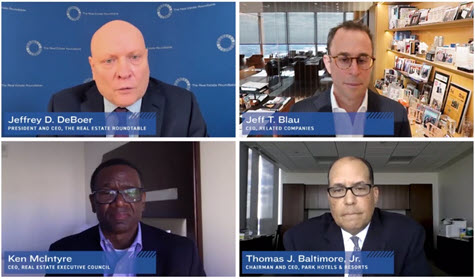
  • The SOI meeting also included a discussion about exploring a potential industry initiative that would aim to accelerate opportunities for minority and women business enterprises (MWBEs) in the commercial real estate industry.
  • The goals of the initiative were discussed by The Roundtable’s Equity, Diversity and Inclusion (E,D&I) Committee Chairman, and Roundtable Board Member, Jeff Blau (CEO, Related Companies); Ken McIntyre, CEO of The Real Estate Executive Council; and Thomas Baltimore, Jr., Chairman, President and CEO of Park Hotels & Resorts.

Roundtable Policy Advisory Committees

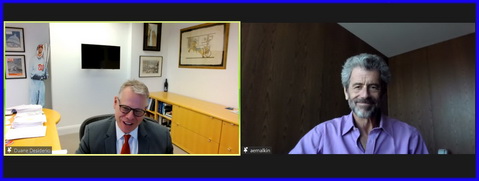
RER's Duane Desiderio and SPAC Chair Tony Malkin

(Above: Sustainability Policy Advisory Committee (SPAC) Chair Tony Malkin (Chairman, President and CEO, Empire Realty Trust), right, and Roundtable SPAC Liaison, Senior Vice President and Counsel Duane Desiderio, left.)

The Roundtable’s policy advisory committee meetings on Jan. 25-26 analyzed national issues impacting CRE, including:

  • Research and Real Estate Capital Policy Advisory Committees (RECPAC)

    Rep. French Hill (R-AR) provided his insights on the congressional legislative agenda from his perspective as a member of the House Financial Services Committee and Ranking Member of its Subcommittee on Housing, Community Development and Insurance. Research Committee co-chairs Spencer Levy (CBRE’s Global Chief Client Officer) and Paula Campbell Roberts (KKR Managing Director) provided their perspectives on real estate capital markets. RECPAC co-chair Kathleen Farrell, Head of Commercial Real Estate for Truist, moderated a joint committee meeting capital market discussion, along with co-chairs Gregg Gerken, Head of Commercial Real Estate with TD Bank, and Mike Lowe, Co-CEO with Lowe.

  • Tax Policy Advisory Committee (TPAC)

    Potential tax revenue policies that may be considered by Congress were a focus of a discussion moderated by Russ Sullivan (Brownstein Hyatt Farber Schreck) with Bethany Bell, staff director for the House Ways and Means Subcommittee on Select Revenue Measures. Additionally, Derek Theurer, chief tax counsel for Ways and Means’ Republicans, discussed tax legislative priorities prior to the upcoming mid-term elections.

  • Homeland Security Task Force (HSTF)

    HSTF members were briefed on the escalation of organized “smash and grab” looting incidents affecting the retail sector by Dan Kennedy, Senior Vice President of US Security Operations for Unibail-Rodamco-Westfield, Chris Woiwode, Vice President and Chief Security Officer for Macerich and Terry Monahan, former New York City Senior Advisor for Recovery Safety Planning and NYPD Department Chief. Additionally, HSTF co-chairs Amanda Mason (Executive Director of Global Intelligence for the Related Companies) and Keith Wallace (Vice President for Global Safety & Security with Marriott International) led HSTF in a discussion on current threats to CRE and mitigation strategies. (HSTF on Jan. 20 held a virtual exercise simulating hostile events and adverse weather impacting CRE).

  • Sustainability Policy Advisory Committee (SPAC)

    Environmental Protection Agency (EPA) staff demonstrated a new, powerful Building Emissions Calculator to estimate historical, current and future annual greenhouse gas emissions resulting from a building’s energy use. SPAC also discussed the SEC’s expected rule on Environmental, Social, and Corporate Governance (ESG) reporting requirements. (Reuters, Jan. 19).  Additional speakers from the U.S. Energy Information Administration provided an update on the Commercial Building Energy Consumption Survey (CBECS), which tracks federal data on U.S. CRE energy use.

Next on The Roundtable’s FY2022 meeting calendar is the Spring Meeting on April 26. This meeting is restricted to Roundtable-level members only.

#   #   #

Roundtable Offers 2022 Tax Policy Overview in CBRE’s Market Outlook Podcast

CBRE podcast visual

How national tax policies may affect commercial real estate and the outlook for market sectors were the focus this week of a CBRE podcast, “High Hopes: Why Commercial Real Estate Is Poised for Continued Growth in 2022” that included Roundtable Senior Vice President & Counsel Ryan McCormick. 

Tax Policy Issues  

  • McCormick emphasized that tax increase proposals affecting CRE could receive renewed attention in 2022 if the President, congressional leaders, and key centrist Democrats sit down to renegotiate major elements of the Build Back Better Act. (CBRE Podcast, Jan. 11)
  • “We started last year with a tremendous amount of potential change on the table, potential risks for real estate,” including “changes to the taxation of capital investment, capital formation, capital gains . . . pass-through rates and just rates generally,” McCormick noted.  In his initial budget, the President proposed “limiting like-kind exchanges, eliminating the step-up in basis of assets at death, and other changes,” he added.
  • As the process unfolded, according to McCormick, the real estate industry was able to demonstrate the negative impact these proposals “would have on not just real estate in particular, but local communities, local governments, property tax revenue at the state and local level and the jobs that flow from those industries and those services that are provided.” (CBRE Podcast, Jan. 11)
  • Congressional lawmakers, driven by the need to get the key approval vote of Sen. Joe Manchin (D-WV) in an evenly divided Senate, are likely to pare back the cost of the $1.75 billion BBB bill to restart negotiations.  (Roundtable Weekly, Jan. 7)
  • McCormick added, “The Build Back Better Act is hanging by a thread at this point, and it’s really going back to the drawing board. . . .  There’s a lot of different ways and directions things could take.  They could go small.  They could try to do something on a bipartisan basis.  I think the most likely scenario is they whittle back the Build Back Better Act further from where it is today. . . . [I]n many respects, we’re back where we started in 2021.”  

The SEC, OZs and SALT 

construction crane city background

  • The discussion also touched on the growing influence of ESG factors on the industry, including the expectation that the Securities and Exchange Commission (SEC) may release a proposed rule for reporting financial risks related to climate during the first quarter of this year. (Roundtable Weekly, Oct. 1, 2021)
  • McCormick expressed optimism that political support for Opportunity Zones, which have raised over $75 billion in capital since their enactment in 2017, would grow over time.  The Roundtable and other stakeholders recently urged Congress to extend deadlines for investors to qualify for OZ tax benefits.  On Thursday, Senate Finance Committee Chairman Ron Wyden announced an investigation into the impact of OZs on jobs and investment in low-income communities (Roundtable Weekly, Jan. 7; Wyden press release, Jan. 13)
  • The fate of the deductibility of state and local taxes (SALT) was also a topic in the CBRE podcast.  

Roundtable Speakers: Thune, Kerry and Summers 

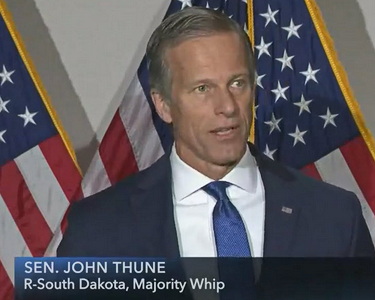
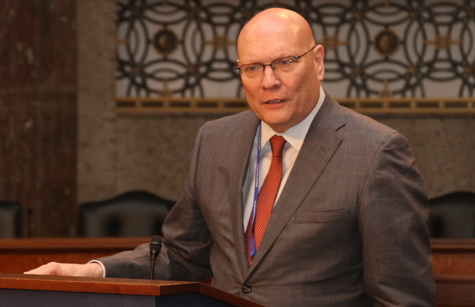
Senator John Thune (R-SD) at podium

  • Tax policy in the new year will be a focus of The Roundtable’s Jan. 25 State of the Industry Meeting (remote) and its Tax Policy Advisory Committee (TPAC) meeting on Jan. 26.
  • Featured speakers at The Roundtable’s business meeting will include: Sen. John Thune (R-SD), the number two position in Senate Republican leadership;

    John Kerry, President Biden’s Special Envoy for Climate and former Secretary of State; and 

    Larry Summers, former Secretary of the Treasury and former Director of the White House National Economic Council. 

Looking Ahead 

CBRE-2022-report-cover

  • The Jan. 11 CBRE podcast – moderated by Spencer Levy, CBRE’s Global Chief Client Officer & Senior Economic Advisor and co-chair of The Roundtable’s Research Committee – also featured Richard Barkham, CBRE’s Global Chief Economist, Head of Global Research & Head of Americas Research. Barkham focused on the economic outlook and forecasts for capital markets and individual CRE sectors. (GlobeSt, Jan. 12)
     
  • CBRE’s recently released publication, U.S. Real Estate Market Outlook for 2022, projects a growing U.S. economy will fuel demand for space and increase real estate investment across all property types – despite uncertainty from the omicron variant and other risks. 

The Real Estate Roundtable’s Policy Agenda for 2022, scheduled for release at the end of this month, will address the tax issues above and several more of importance to CRE in the areas of infrastructure, sustainability, capital and credit, and homeland security. 

#  #  # 

Biden Administration to Redirect Federal Rental Assistance Funds to States, Localities Experiencing Greater Demand

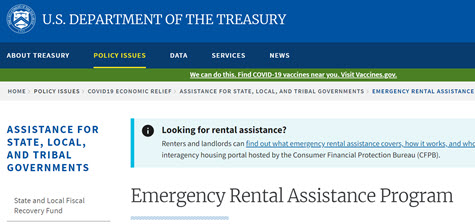
Treasury Department webpage for Emergency Rental Assistance

The Treasury Department plans to redirect millions in federal emergency rental assistance from states and localities with a large amount of unused funds to other geographic areas with a backlog of aid requests. (Wall Street Journal and Treasury Department new release, Nov. 29)

  • Administration officials said the initial reallocation, set to be unveiled early this month, could exceed $800 million. Jurisdictions with large amounts of unused funds (such as Montana and North Dakota) may see redistributions to more populous states (such as New York and Texas) over the coming week and months. Funds may also be redirected within a state depending on the needs of individual cities or other geographic areas. (The Hill, Nov. 29)
  • Treasury data released this week shows that approximately $2.8 billion in emergency rental assistance was distributed in October by state and local governments to keep tenants housed – the same amount distributed the previous month.
  • Forty-one states had spent less than 65 percent of their federal rental assistance funds as of Oct. 31.  Twenty-five of those states spent less than 30 percent of their allocations – and face additional Treasury requirements to avoid clawbacks.
  • Gene Sperling, who leads the implementation of President Joe Biden’s $1.9 trillion coronavirus rescue package, said, “Treasury is using the reallocation process to spur weak performers to up their game and to get more funds into the hands of those who can help the most vulnerable the fastest.” (PBS NewsHour, Nov. 29)

Roundtable President and CEO Jeffrey DeBoer discussed the need to distribute federal rental assistance to property owners and tenants during a September ConnectCRE webinar, which  included National Multifamily Housing Council Chair David Schwartz (Chairman and CEO, Waterton) and NMHC President Doug Bibby. (Connect, Sept. 23) 

#  #  #

The Roundtable’s Homeland Security Task Force Virtual Exercise
Rescheduled from Dec. 9, 2021 to Jan. 20, 2022

The Real Estate Roundtable’s Homeland Security Task Force (HSTF) and Real Estate Information Sharing and Analysis Center (RE-ISAC) has rescheduled its Virtual Exercise from Dec. 9, 2021 to Jan. 20, 2022. The exercise will involve discussion groups addressing winter weather preparedness and hostile events (e.g. communication plans and continuity.) For more information, please contact Roundtable Senior Vice President Chip Rodgers.

#   #  #

House Passes Build Back Better Act, Roundtable Urges Improvements to Green Energy Tax Provisions

Capitol reflective glass morning

House Democrats passed their “sweeping” reconciliation package of tax, health care, education, and climate initiatives Friday morning, a step that advances a “centerpiece” of President Biden’s domestic agenda and represents “the most significant restructuring of the [social] safety net in decades.” (Politico, Nov. 19)

President Biden lauded the House’s action in a statement released by the White House this morning.

Partisan Bill Advances to the Senate

  • All Democrats (except one) supported the $1.7 trillion Build Back Better Act (H.R. 5376), after months of negotiations between Progressives and Moderates debating the breadth of the measure and scaling back its original price tag north of $3.5 trillion. (Roundtable Weekly, Nov. 5) No House Republican voted for the bill.
  • Today’s party-line vote took place after the Congressional Budget Office submitted a cost analysis that satisfied the requirements of a crucial group of Democratic Moderates needed to approve the legislative package. (CBO, Nov. 18 and text of the budget reconciliation bill.)
  • The legislation now moves to the Senate where it will face additional scrutiny and could be reduced further in scope. If the Senate ultimately passes the BBB Act in a manner that changes the House-approved version, the bill would need to go back to the House for another vote before it reaches President Biden’s desk.
  • Passage of the BBB Act follows on the heels of the enactment of the bipartisan bill to upgrade the nation’s transportation, water, grid, broadband, and other “physical” infrastructure. President Biden signed the $1.2 trillion Infrastructure Investment and Jobs Act into law on Monday. (Washington Post, Nov. 15). The Roundtable has strongly supported bipartisan investments to modernize the nation’s physical infrastructure. (Roundtable Weekly, Nov. 12).

Progress on CRE Tax Issues

San Francisco buildings

  • Relative to President Biden’s budget and the initial bill passed by the Ways and Means Committee, the House-passed BBB Act reflects continued progress on a number of tax issues important to real estate and prioritized by The Real Estate Roundtable. (Roundtable Weekly, Oct. 29) Critically, the current bill does not:     
     
    • Limit like-kind exchanges (sec. 1031),
    • Increase the capital gains tax rate,
    • Restrict the 20% pass-through business income deduction (sec. 199A),
    • Tax unrealized gains at death or repeal of the step-up in basis of assets,
    • Change the tax treatment of carried interest, and
    • Restrict estate tax valuation discounts.

Roundtable Recommends Changes to Clean Energy Tax Provisions

Alternative Energy source CRE

  • The BBB Act’s suite of clean energy tax credits and incentives comprise the legislation’s biggest measures to fight climate change. (Roundtable Weekly, Oct. 29)
  • The Roundtable sent a letter to Congressional tax writers on Tuesday detailing five recommendations that aim to improve green energy tax provisions affecting real estate. The Roundtable’s letter urged changes to the BBB Act that would further the objectives to slash GHG emissions and make rapid progress toward a “net zero” economy by mid-century. (Roundtable letter, Nov. 16)
  • The letter’s recommendations, listed below, would increase and scale deployment of low- and zero-carbon technology in the nation’s commercial and multifamily building infrastructure.
  1. Clarify that “thermal energy storage systems” are eligible for incentives under the Section 48 Investment Tax Credit.
  2. Further revise the 30C tax credit to support EV chargers in the non-public, but widely used, parking lots and garages that serve America’s residential and business tenants who seek to conveniently “charge-up” while at home or at work.
  3. Better align the BBB Act with the Biden Administration’s long-term climate strategy – by providing accelerated depreciation and other incentives for heat pumps and other components that “electrify” commercial and multifamily buildings.
  4. Induce more “retrofits” of aging buildings by allowing taxpayers to claim the 179D deduction in the year high-efficiency equipment is placed in service.
  5. The inclusion of Davis-Bacon and apprenticeship hiring will seriously undermine climate goals – because the high costs to comply with these labor standards will more than offset the BBB Act’s “bonus rates” for clean energy projects. Congress should not hinge the “bonus rates” on unrelated labor issues that fail to accelerate achievement of GHG reduction strategies.

Next: The Senate in December

U.S. Capitol evening

  • The Senate will take up the House BBB bill in December. Democrats will need the support of moderate Senators Joe Manchin (D-WV) and Kyrsten Sinema (D-AZ) to pass BBB legislation in the evenly divided upper chamber using budget reconciliation rules. However, Manchin recently stated he may withhold his support of the bill until next year due to rising inflation rates. (Newsweek, Nov. 16 and Axios, Nov. 10)
  • Additionally, House lawmakers included six pages of technical changes in their BBB bill that could help it pass the scrutiny of the Senate Parliamentarian, who can remove certain House provisions if she determines they are incompatible with Senate rules.

Congress is scheduled to return from the Thanksgiving break on Dec. 3. Treasury Secretary Janet Yellen this week warned that if lawmakers do not take action to lift the legal debt ceiling by Dec. 15, they will risk a government default on its debt obligations. (Wall Street Journal, Nov. 16) 

#  #  # 

Commercial Real Estate Executives Report Steady Q4 Market Fundamentals

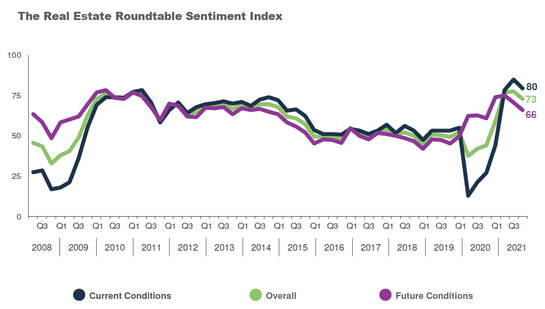
Commercial real estate leaders report positive market fundamentals across asset classes, according to The Real Estate Roundtable’s Q4 2021 Economic Sentiment Index. Industry leaders describe steady supply, demand and financial conditions for multifamily, industrial, life science and other assets while expressing some caution about the strength of office and hotel assets. Leaders also noted conditions vary by geography and local governmental policies.

Topline Findings

Jeffrey DeBoer, Real Estate Roundtable President and CEO

  • The Roundtable’s Overall Q4 2021 Sentiment Index registered a score of 73, which reflects continued optimism about general market conditions despite a slight dip of five points from the previous quarter. The Economic Sentiment Overall Index is scored on a scale of 1 to 100 by averaging the scores of Current and Future Indices. Any score over 50 is viewed as positive. 

  • Roundtable President and CEO Jeffrey DeBoer (above) said, “Our Q4 Sentiment Index score is a 29-point increase over the same time period last year. This is a solid indication of significant progress in the overall economy as more businesses continue to reopen under cautious, local COVID-19 protocols.” 
  • He added, “CRE leaders are encouraged by the safe (albeit slow) return of employees to their work places, robust retail consumer appetites, and the gradual return of domestic and international travelers to hotels, resorts and other hospitality assets. The commercial real estate industry continues to play an active role in accommodating new business and individual preferences that will help the economy adjust post-COVID.” 
  • “Industry leaders are concerned with accelerating inflation, supply chain obstacles and still unclear questions regarding future office space desires,” DeBoer noted. 
  • The Roundtable’s quarterly economic survey also shows that 85 percent of respondents believe that general market conditions today are “much better or somewhat better” versus one year ago – and that 61 percent anticipate conditions will continue to improve one year from now. 
  • The report’s Topline Findings include:
     
    • The Q4 2021 Real Estate Roundtable Sentiment Index registered a score of 73, a decrease of five points from the third quarter of 2021 and a 29-point increase over Q4 2020. Despite the slight downtick from Q3, participants largely expressed optimism regarding the current fundamentals of the commercial real estate market.
    • That said, perceptions vary by property type and geography, with industrial, multifamily, life sciences and data centers most in favor. Delayed return-to-office policies and questions about office space demands have resulted in a degree of uncertainty. 
    • Asset values have trended upward across asset classes compared to the previous quarter.
    • Participants cited a continued availability of debt and equity capital. International investors remain highly interested in opportunities within the United States.

Infrastructure & CRE

Chicago skyline upward

  • DeBoer also noted, “The recent passage of the $1.2 trillion bipartisan infrastructure bill by Congress will help the commercial real estate industry to ramp up its existing suite of climate-friendly practices by reimagining, building and retrofitting America’s built environment.” 
  • He added, “The Roundtable is also encouraged that the bill emphasized the expanded use of public-private partnerships to reach infrastructure goals – as well as measures that will streamline the federal permitting process and improve key federal energy data that support EPA building labels.” 

Data for the Q4 survey was gathered in October by Chicago-based Ferguson Partners on The Roundtable’s behalf.  See the full Q4 report

#  #  # 

Real Estate Industry Weighs in Against Potential Partnership Tax Changes as House Lawmakers Prepare Next Steps for Infrastructure, Tax Bills

The Real Estate Roundtable and 22 other national real estate organizations wrote today to Senate Finance Committee Chairman Ron Wyden expressing significant concerns regarding his draft legislation to overhaul partnership tax rules. The letter was sent after congressional leaders and Treasury Secretary Janet Yellen yesterday announced they had agreed on a framework for moving forward with human infrastructure legislation, which includes a list of tax issues for discussion and potential inclusion in a final reconciliation bill. Additionally, the House Budget Committee announced it would “mark up” the combined $3.5 trillion reconciliation bill tomorrow. (Coalition letter, Sept. 24 and BGov, Sept. 23)

Why It Matters

  • On September 10, Chairman Wyden proposed a far-reaching restructuring of partnership taxation that would raise at least $172 billion over 10 years. Chairman Wyden or others could put forward the partnership proposals as revenue provisions for the reconciliation bill.
  • Real Estate Roundtable President and CEO Jeffrey DeBoer stated, “Partnerships are used to bring parties together to create and grow businesses that propel job creation, new investment, and productive economic activity. Partnerships contribute immensely to the culture of dynamic entrepreneurship and risk-taking that is missing in many parts of the world where business activity is dominated by large, public corporations. In this current environment, Congress should be working on ways to encourage and strengthen partnerships, not cut their knees out from under them.” (Roundtable Weekly, Sept. 10)
  • Nearly half of the four million partnerships in the United States are real estate partnerships. These pass-through businesses are a key driver of jobs, investment, and local tax revenue.
  • Provisions in the draft bill would alter the tax rules that apply when a partnership is formed and property is contributed, creating new barriers to business formation. Other provisions would changes the rules when a partnership borrows to finance its growth and expansion, as well as when a partnership distributes profits and gains to the owners.
  • Many of the provisions in Wyden’s draft would apply retroactively to economic arrangements entered into years, and sometimes decades, earlier. A proposal requiring that partners share all debt in accordance with partnership profits could overturn decades of tax law with respect to nonrecourse borrowing by a partnership.
  • The coalition of 24 real estate organizations stated, “With millions of Americans still unemployed and others who have yet to return to the labor force, we encourage you to focus instead on reforms that will strengthen and expand partnerships’ ability to create jobs and economic opportunities.” (Coalition letter, Sept. 24)

Infrastructure / Reconciliation Developments

  • A vote on the bipartisan infrastructure legislation is expected on Monday, Sept. 27 or Tuesday, Sept. 28, but that could change depending on Democratic leaders’ ability to ensure sufficient votes for passage.
  • The House Budget Committee’s scheduled mark-up the $3.5 trillion reconciliation bill on Saturday afternoon, Sept. 25 will proceed as Democrats race to reach consensus with moderates who object to the bill’s overall price. (PoliticoPro, Sept. 23)
  • The framework deal between House and Senate Leaders reportedly includes an understanding between Senate Finance Committee Chairman Ron Wyden (D-OR) and House Ways and Means Committee Chairman Richard Neal (D-MA) about revenue-raising proposals that could be used to pay for the massive proposal. (The Hill, Sept. 23)
  • Senate Majority Leader Chuck Schumer (D-NY) described the agreement as a “menu of options that will pay for any final negotiated agreement” as Pelosi called it “an agreement on how we can consider, go forward in a way to pay for this.”

Roundtable Resources

Infrastructure bills and tax policy issues in play that may impact commercial real estate will be the focus of discussions during The Roundtable’s Fall Meeting on Oct. 5 in Washington, DC (Roundtable-level members only).

#  #  #

House Democrats Pass Bill to Extend FY22 Government Funding and Suspend Debt Ceiling; Senate Republicans Plan to Oppose

U.S. Capitol from side with clouds

House Democrats on Sept. 21 passed a short-term funding bill that would keep federal agencies open until Dec. 3 while suspending the debt limit through December 2022. The bill, passed on a party-line vote (220-211) faces bleak chances of Senate approval, where 60 votes are needed to avoid a filibuster in the evenly divided upper chamber. Republicans object to linking the debt ceiling to FY22 government funding. 

Shutdown, Default Loom 

  • The short-term bill to extend funding for government operations at current levels, known as a Continuing Resolution (CR), would avoid a partial government shutdown on Oct. 1. Funding for programs affecting national flood insurance and surface transportation are also scheduled to expire Sept. 30.
  • Senate Minority Leader Mitch McConnell (R-KY) stated Democrats need to separate the CR from legislation that would suspend or increase the debt limit, which the GOP will not support. (Louisville Courier-Journal, Sept. 23)
  • Meanwhile, Treasury Secretary Janet Yellen issued a stark warning to policymakers that they must raise or suspend the debt ceiling as soon as possible – or the federal government will default on its financial obligations sometime in October. (Wall Street Journal, Sept. 19 and Reuters, Sept. 22)
     
  • Yellen stated, “Doing so would likely precipitate a historic financial crisis that would compound the damage of the continuing public health emergency. Default could trigger a spike in interest rates, a steep drop in stock prices and other financial turmoil. Our current economic recovery would reverse into recession, with billions of dollars of growth and millions of jobs lost.” 
  • Treasury has been spending down its reserves since Aug. 1, when the current two-year debt ceiling suspension ended. Yellen warned that hitting the debt ceiling would result in a halt of social security payments to nearly 50 million seniors for a time. Additionally, troops could go unpaid and millions of families who rely on the monthly child tax credit could see delays. (Axios, Sept. 23) 
  • A coalition of 13 real estate trade organizations, including The Roundtable, last week urged congressional leaders to raise the statutory debt limit as soon as possible. The letter stated, “Given the more than $8.6 trillion in mortgage debt backed by the federal government through Fannie Mae, Freddie Mac, Ginnie Mae and other federal agencies, the housing and real estate markets are particularly susceptible to any instability stemming from concern about the U.S. meeting its financial obligations.” (Coalition letter, Sept. 16)  

Policymakers face the debt ceiling and FY22 government funding deadlines next week as Democrats struggle to advance sprawling legislative bills on infrastructure (see Infrastructure story above). 

#  #  # 

Positive Transit Measures Included in Reconciliation Package

Infrastructure Virginia highway

The House Transportation and Infrastructure (T&I) Committee this week marked-up its $57.3 billion piece of the reconciliation package with a focus on mass transit and high-speed rail.

  • Many of the T&I measures are now in line with the Biden administration’s original transit priorities, which were pared down in the Senate’s final physical infrastructure bill. (Washington Post, Sept. 10)
  • Roundtable-supported measures in the T&I Committee’s bill include:

    • A competitive federal grant program to support transit access for affordable housing projects and improve mobility for low-income riders; 
    • Grants administered by the Federal Highway Administration to support transportation equity and reconnect communities divided by “existing infrastructure barriers;”
    • Funds to improve high-speed rail corridors;
    • Credit risk assistance to develop rail infrastructure under the Railroad Rehabilitation and Improvement financing (RRIF) program; and
    • Funds to convert federal buildings owned or managed by the General Services Administration to “high-performance green buildings.”    
  • Separately, the Ways and Means Committee’s package also proposed favorable tax-exempt bond financing improvements to attract greater public-private partnership investments in transportation projects.

Timing for a House vote on the sprawling reconciliation bill is uncertain. Modifications to the tax, energy or transportation sections of the bill could be introduced when it is sent to the House Rules Committee, which determines floor action – or through an amendment on the floor. House Speaker Nancy Pelosi (D-CA) can afford to lose only three votes when the final legislation comes to a vote. (Bloomberg, Sept. 15)

#  #  # 

Roundtable Raises Concerns about New and Complex Senate Proposal to Raise Taxes on Real Estate Partnerships

Real Estate Roundtable President and CEO Jeffrey DeBoer expressed strong concerns following the Sept. 10 release of Senate Finance Committee Chairman Ron Wyden’s (D-OR) draft legislation to restructure pass-through tax rules and raise $172 billion in additional tax revenue from the country’s 4 million partnerships and LLCs. (Wyden Draft, Proposal Overview and Summary)

Possible Economic Disruption

  • DeBoer stated, “Partnerships are used to bring parties together to create and grow businesses that propel job creation, new investment, and productive economic activity. Partnerships contribute immensely to the culture of dynamic entrepreneurship and risk-taking that is missing in many parts of the world where business activity is dominated by large, public corporations. In this current environment, Congress should be working on ways to encourage and strengthen partnerships, not cut their knees out from under them.”
  • Over the last several decades, partnerships have grown to become a dominant form of business organization in the United States, accounting for $8.7 trillion in annual business receipts and $34.3 trillion in total assets, according to the IRS.
  • Senator Wyden’s proposal, if enacted, could have enormous and unanticipated consequences for U.S. real estate, capital investment, and economic activity. Real estate, rental, and leasing businesses represent more than half (50.4 percent) of all partnerships.
  • “The Chairman’s proposal is big, comprehensive, and not yet vetted in any meaningful way. Partnership taxation is a complicated area of the law that has evolved over decades. The proposals would apply retroactively to economic arrangements negotiated years ago. Past experience with retroactive changes to partnership tax law, in 1986, generated huge and damaging economic disruption, including massive bankruptcies, stress on all lenders, and the end of the saving and loan industry. We don’t need that kind of rash policy action again,” DeBoer added.

Details Senate Finance Committee Chairman Ron Wyden (D-OR)

  • Proposals in Chairman Wyden’s discussion draft that would have a significant impact on real estate partnerships include:
  • Modifying the rules for determining whether a partner has recourse debt with respect to partnership property. The provision would require all partnership debt to be allocated in accordance with partnership profits except where a partner is the lender (sec. 752).
  • Restricting the methods available for allocating the tax attributes of contributed property among the partners in a partnership by mandating the remedial method under section 704(c).
  • In the case of property contributed to a partnership with built-in gain, requiring gain recognition by the contributing partner if the property is subsequently distributed to another partner, even if the distribution occurs after 7 years (e.g., the “mixing bowl” rule that currently applies for 7 years would apply forever).
  • Mandating partnership basis adjustments that relate to disparities between inside and outside partnership basis that arise due to partnership distributions or transfers of partnership interests. These basis adjustments are currently elective under section 754 and mandated in only certain substantial cases in sections 734 and 743.
  • Other provisions in the draft legislation would: eliminate substantial economic effect as a basis for partnership allocations and instead require partnerships to make allocations in all instances based on the “partners’ interests in the partnership” standard (except in certain “abusive” situations involving related partners). Among the other proposed changes, the bill would also subject publicly traded partnerships that earn qualifying passive income to corporate-level taxation.

The Wyden proposal comes as Congressional Democrats are seeking new revenue sources to finance their ambitious $3.5 trillion human capital initiative.

#  #  #