House Proposal Suggests Gas Tax Increase, Public-Private Partnerships to Fund Infrastructure Improvements

Rep. Bill Shuster (R-PA), the outgoing chairman of the House Transportation and Infrastructure Committee, released “discussion draft” language on July 23 aimed at improving and sustainably financing U.S. transportation and other infrastructure systems.  (Section-by-Section analysis of the proposal)
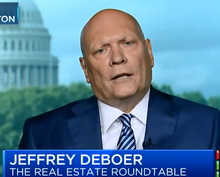
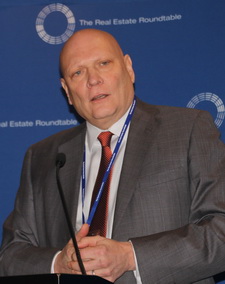
Roundtable President and CEO Jeffrey D. DeBoer appeared last summer on CNBC’s Squawk Box, emphasizing the importance of P3s as a platform to finance the design, building, operation and long-term maintenance of projects across all infrastructure asset classes(CNBC, June 7, 2017).

  • Shuster, who is retiring after the upcoming midterm elections, provided a “vision statement” explaining that the draft “is intended to further the national conversation about the current state of America’s infrastructure and highlight some of the major roadblocks to funding and improving our transportation network.”  He stated his proposal reflects “input from Members of Congress from both sides of the aisle” in an effort to build bipartisan support.
  • The wide-ranging draft proposes to phase-in increases to the “pay at the pump” gas tax and then eliminate it after 10 years; pilot a per-mile travelled “user fee”; shore-up the federal loan and guarantee program for mass transit; establish a public-private partnership (P3) program to construct and rehabilitate federal buildings; and establish a one-stop federal permitting shop to expedite project approvals.  (Eno Transportation Weekly, July 23) 
  • Any broad infrastructure policy conversation would likely address federal-state cost sharing arrangements for mass transit projects – such as the Gateway program to improve bridge and tunnel crossings between New York and New Jersey.  For example, a  June 29 letter from Trump Administration transit officials indicated a change in agency policy – that loans by the U.S. Transportation Department, repaid by state and local governments,  should factor into grant decisions.  The effect would be to reduce the amount of federal grants for mass transit and increase the state/local share. (B-Gov, July 3
  • Anticipating infrastructure as an issue for possible compromise after the upcoming elections, The Roundtable has offered a number of comments to the Administration and Congressional committees on real estate’s role in creating public-private partnerships to help repair roads, transit, broadband, power grid and other systems that are needed to make communities safe, productive and competitive.  (Roundtable Weekly, January 26) 

Roundtable President and CEO Jeffrey D. DeBoer appeared last summer on CNBC’s Squawk Box, emphasizing the importance of P3s as a platform to finance the design, building, operation and long-term maintenance of projects across all infrastructure asset classes.  Policies starting with streamlined permitting and a range of financing platforms should all be considered by lawmakers as layers in the “capital stack” for infrastructure,” DeBoer told Squawk Box. (CNBC, June 7, 2017)

President Trump’s Plans to Slap Global Tariffs on Imported Steel and Aluminum Spark Concerns Regarding Real Estate and Infrastructure Investment

President Trump yesterday said he will sign a formal order next week imposing tariffs of 25 percent on imported steel and 10 percent on aluminum for “a long period of time” – an act that could raise domestic construction costs and create new challenges for real estate development and infrastructure projects. (White House Remarks, March 1)

President Trump yesterday said he will sign a formal order next week imposing tariffs of 25 percent on imported steel and 10 percent on aluminum.

Roundtable President and CEO Jeffrey DeBoer voiced concern about how such a broad international penalty could rebound against the domestic commercial real estate industry. “In the United States, forty-two percent of steel is consumed by the construction industry, which employs millions of Americans directly and millions more indirectly,” said DeBoer.  “Aluminum is also a key material used in energy efficient building construction.  The current healthy state of the U.S. commercial real estate industry could be hard hit with the unintended consequences from such broad penalties targeting metals essential to construction. Tariffs will lead to higher construction costs that make many new projects simply uneconomic and unviable — hurting investment and job creation,” DeBoer noted.
 
Trump’s announcement, made during a White House meeting with U.S. metals industry executives, sparked a bout of stock market volatility and immediate responses from Canada and the European Union promising “countermeasures” to “rebalance” international trade with  the U.S.  
 
Federal Reserve Chairman Jerome Powell, following testimony this week before the House and Senate, said, “The best approach is to deal directly with the people who are affected, rather than falling back on tariffs.” (Wall Street Journal, March 1)
 
According to an analysis by the Cato Institute, more than 200 anti-dumping and countervailing duty orders aimed at preventing unfair competition currently constrain U.S. imports of steel and iron products from a long list of countries. The effect has been an increase in U.S. prices well above global levels to the detriment of the large manufacturing and construction sectors in America that use steel to make higher-value products. (CATO Institute, CNN Commentary, Aug. 2, 2017 and Engineering News-Record, Feb. 22, 2018)
 
The impact of tariff penalties on President Trump’s recent infrastructure proposal are uncertain. Transportation Secretary Elaine Chao yesterday testified before a Senate committee about the Administration’s infrastructure plan, which emphasizes policies to lower project costs and reduce project delays.  Higher tariffs on steel – a material necessary to build and repair bridges, tunnels, pipelines, and rail lines – could further constrain the federal state, local and private funding sources touted by the Administration as necessary to finance U.S. infrastructure repair and modernization.  (Bloomberg, March 1)
 
Infrastructure and national policies affecting economic growth will be discussed during The Roundtable’s Spring Meeting on April 25 in Washington, DC.

House Judiciary Committee Passes Infrastructure Expansion Act to Counter Inequities in “Scaffold Law”

Legislation aimed at lessening the harsh impact of an antiquated 133 year-old labor “Scaffold Law” – an economic burden on infrastructure projects crossing state lines – passed the House Judiciary Committee on Tuesday.  (Committee Mark-up Video, Jan. 30)

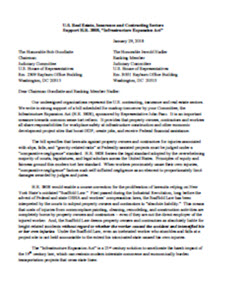
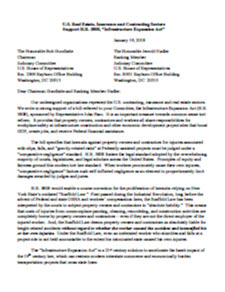
The Jan. 29, 2018 industry coalition letter in support of the Infrastructure Expansion Act (H.R. 3808)

The Infrastructure Expansion Act of 2017 (H.R. 3808), sponsored by Rep. John Faso (R-NY), passed along party lines by a 16-14 vote.  The Real Estate Roundtable, Associated General Contractors, and 17 U.S. organizations representing the contracting, insurance and real estate sectors urged the committee to pass the bill. (Coalition Letter, Jan. 29) 

The coalition letter provides several examples of transportation projects (such as the Northeast Corridor Gateway Program) that would benefit multiple states and the national economy, yet are hindered by application of the Scaffold Law. 

Courts have interpreted the New York law to subject property owners and contractors to “absolute liability” for slips, falls, and height-related accidents that occur during commonplace painting, cleaning, remodeling, and construction activities.  

Under this standard, any negligence by a worker that may cause an accident or intensify his own injuries is disregarded.  As an example, an inebriated worker who stumbles and falls at a project site would not be held accountable to the extent his intoxicated state caused his own injuries. (Roundtable Weekly, Jan. 19).  As a result, absolute liability under the Scaffold Law has caused premiums for general liability insurance at New York development sites to skyrocket. 

H.R. 3808 would deny federal funding to construction projects that use New York’s “absolute liability” standard for workplace injuries caused by falls. The bill does not diminish or alter Federal or state OSHA obligations, nor does it foreclose “no-fault” workers’ compensation.  

Committee Chairman Goodlatte (R-VA) broadened the bill’s scope to require states use either a “comparative negligence” or “contributory negligence” standard for falls on federally subsidized projects.  In a statement, Goodlatte also offered  detailed reasons explaining why the legislation should be enacted. 

Although the Infrastructure Expansion Act may continue to gain predominantly GOP support in the House, its prospects in the Senate are far more challenging.

The Roundtable and 16 Real Estate, Insurance and Contracting Organizations Urge Passage of Infrastructure Expansion Act to Counter Inequities in “Scaffold Law”

The Real Estate Roundtable, Associated General Contractors, and 16 U.S. organizations representing the contracting, insurance and real estate sectors today urged the House Judiciary Committee and key congressional offices to swiftly pass the Infrastructure Expansion Act of 2017 (H.R. 3808), sponsored by Rep. John Faso (R-NY).  (Coalition Letter, Jan. 19)

According to the  coalition letter  , the Infrastructure Expansion Act seeks to provide is a 21st century solution to ameliorate the harsh impact of an outdated 19th century law, which is restraining modern interstate commerce and economically burdening transportation projects that cross state lines.

H.R. 3808 is a common sense tort reform effort aimed at correcting inequities from New York State’s outdated “Scaffold Law.”  Passed during the Industrial Revolution – long before the advent of Federal and state Occupational Safety and Health Administration and workers’ compensation laws – the Law holds property owners, employers, and contractors fully liable for all fall-related injuries at building and infrastructure construction sites. 

As a result, courts have interpreted the New York law to subject property owners and contractors to “absolute liability.”  Under this standard, the costs of injuries from commonplace painting, cleaning, remodeling, and construction activities are completely borne by property owners and contractors, even if they do not directly employ the injured worker.  The Scaffold Law also deems property owners and contractors as absolutely liable for height-related incidents, without regard to whether the worker caused the accident and intensified his or her own injuries.  Under this standard, even an inebriated worker who stumbles and falls at a project site is not held accountable to the extent his intoxicated state caused his own injuries.  (Roundtable Weekly, Oct. 27, 2017) 

The House bill counters the absolute liability standard by specifying that lawsuits against property owners and contractors for injuries associated with slips, falls, and “gravity-related risks” at Federally-assisted projects should instead be held to a “comparative negligence” standard.  When workers proximately cause their own injuries, comparative negligence factors such self-inflicted harm to proportionately limit damages awarded by judges and juries.  H.R. 3808 fosters the comparative negligence legal standard adopted by the overwhelming majority of courts, legislatures, and legal scholars across the United States. 

According to the coalition letter, the Infrastructure Expansion Act seeks to provide is a 21st century solution to ameliorate the harsh impact of an outdated 19th century law, which is restraining modern interstate commerce and economically burdening transportation projects that cross state lines.  

Rep. John Faso (R-NY) introduced the  Infrastructure Expansion Act of 2017 (H.R. 3808)  , intended to counter New York State’s “Scaffold Law.”

Among specific examples offered in the letter showing the economic impacts of the Scaffolding Law is  the Gateway Program, a Department of Transportation-assisted rail tunnel project of overwhelming national significance.  The New York law is estimated to drive-up costs by as much as 300 million dollars for this project, which will modernize the power grid, update a century-old tunnel inundated by Superstorm Sandy, and help eliminate a train “bottleneck” in the Northeast Corridor that contributes $50 billion to US GDP annually.  H.R. 3808 can help reduce the substantial added costs from insurance coverage, excessive litigation pay-outs, and project delays for interstate infrastructure construction like Gateway. 

“On the heels of a major federal infrastructure initiative, Rep. Faso’s bill is welcome news – enacting it would drive down costs of proposed infrastructure projects like the vital Gateway tunnel project between New York and New Jersey, said John Banks, President of the Real Estate Board of New York.  (See REBNY Newsroom, Oct. 25, 2017).  

Additionally, the Infrastructure Expansion Act of 2017 does not diminish or alter Federal or state OSHA obligations, nor does it foreclose “no-fault” workers’ compensation. 

The coalition letter addressed to House Judiciary Committee Chairman Bob Goodlatte (R-VA) and Ranking Member Jerrold Nadler (D-NY) concludes that H.R. 3808 “… simply makes property owners, contractors, and workers accountable for their own choices and conduct at construction sites benefitting from Federal taxpayer dollars. We encourage swift passage of the ‘Infrastructure Expansion Act.'”

Trump’s State of the Union Includes Increased Infrastructure Investment Proposal; New Reports Show Debt Ceiling Will Be Reached in March

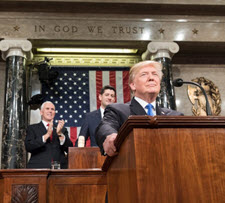
In his State of the Union address this week, President Trump called for a bipartisan approach on infrastructure and immigration – policy issues that could define the second year of his Administration before mid-term elections in November.

In his State of the Union address this week, President Trump called for a bipartisan approach on infrastructure and immigration

The president’s address included a proposed 50 percent increase in infrastructure spending compared to a 1 trillion dollar goal stated earlier. (USA Today, Jan. 5). “Tonight, I am calling on the Congress to produce a bill that generates at least 1.5 trillion dollars for the new infrastructure investment we need.  Every federal dollar should be leveraged by partnering with state and local governments and, where appropriate, tapping into private sector investment, to permanently fix the infrastructure deficit,” Trump said. 

Although the president’s comments did not include details about how to fund the infrastructure initiative, he also emphasized the need to reduce the average permitting time for infrastructure projects from 10 years to two – noting that the Empire State Building was built in one year. 

Roundtable President and CEO Jeffrey DeBoer commented on the positive economic benefits that such an infrastructure program would bring to the nation. “Modernizing our roads, tunnels, mass transit, drinking water, power grid, and telecommunications systems – in rural and urban areas alike – are vitally important to economic growth, productivity and America’s global competitiveness,” DeBoer said. 

He added, “Real Estate Roundtable members are experienced in addressing the financing, permitting and government partnership issues that frequently slow or stop infrastructure projects.  We intend to provide positive feedback and ideas to all policymakers working to facilitate improvements in our nation’s infrastructure.”  (Roundtable Letter on Infrastructure Funding, Jan. 11) 

The White House said on Wednesday that it will offer Congress detailed principles on the infrastructure proposal in the coming weeks. (Bloomberg, Feb. 1).   

Roundtable President and CEO Jeffrey DeBoer noted that both infrastructure and immigration policies could create more jobs and spur higher wages. 

President Trump also made immigration a key focus of his address, proposing a four-point immigration reform and border security framework. A vote may be held next week in Congress on the Deferred Action for Childhood Arrivals (DACA, or “Dreamers”) immigration program. 

The Roundable’s DeBoer noted that both infrastructure and immigration policies could create more jobs and spur higher wages.  “Pro-growth immigration reform that honors our roots as a nation of immigrants and safeguards our nation’s security is also critically important to continue the upward trajectory of our economy,” DeBoer stated. 

Debt Ceiling  

Looming over policy debates on Capitol Hill and a Feb. 8 scheduled expiration of government funding is the nation’s debt ceiling, which will be reached in March according to reports this week from the Treasury Department and Congressional Budget Office. The debt ceiling allows the government to finance commitments that have already been made — it does not authorize new spending. 

Both reports forecast the government will be unable to meet its debt obligations in March. Treasury Secretary Steven Mnuchin on Wednesday urged congressional leaders to “act promptly” to increase the limit. (Reuters, Jan. 31).  

Congressional lawmakers are reportedly working on a fifth Continuing Resolution this fiscal year to fund the government through March 23 — it needs to pass next week to prevent another government shutdown.  (BNA, Feb. 1)

Real Estate Roundtable Testifies Before Senate on Business Tax Reform

Rational Taxation of Real Estate Urged to Spur Job Creation, Encourage Business Expansion and Contribute to GDP Growth

WASHINGTON, DC — Real Estate Roundtable President and Chief Executive Officer Jeffrey DeBoer today testified before the U.S. Senate Finance Committee, encouraging modest changes to the current taxation of commercial real estate that would continue to encourage economic growth while cautioning policymakers on specific business tax reform concepts that could cause severe market dislocation.

During today’s Senate hearing on Business Tax Reform, DeBoer testified, “Importantly, commercial real estate markets are largely in balance with supply, only modestly exceeding demand.  Despite our industry’s relative positive health, we know the underlying economy can and should grow more rapidly.”  DeBoer added that The Roundtable is concerned that some concepts under discussion in tax reform are risky, untested and have the potential to cause severe dislocation – not only in real estate markets but in the nations’ capital markets as well.

In his written testimony and his oral statement, The Real Estate Roundtable’s President and CEO addressed specific elements of potential tax reform.  (See Senate Finance Committee webcast and documents at https://www.finance.senate.gov/hearings/business-tax-reform.) Below is a summary of policy issues covered in his testimony:

  • Business interest deduction.  DeBoer noted that interest, the cost of borrowing, is an ordinary and necessary business expense that has always been deductible.  Today, U.S. capital markets are the deepest in the world, but restrictions would deter business formation and expansion.  The impact would fall disproportionately on entrepreneurs and other developers likely to serve small and medium-sized markets.  As interest rates rise, the harm to the economy will grow.
  • Cost recovery / expensing.  Current cost recovery rules need reform, but 100 percent expensing of real estate is a risky and untested proposal.  Accelerated depreciation of real estate in the early 1980s led to tax-driven, uneconomic investment.  Tax rules should reflect the economic life of structures.  Leading research by MIT suggests existing depreciation schedules for real estate are too long.  Shortening depreciation to 20 years would spur sustainable and economically sound investment.   


  • Pass-through reform.  U.S. pass-through tax rules create a dynamic, flexible business environment that supports entrepreneurship and productive investment.  Tax reform should provide equitable relief for pass-throughs.  A new, reduced tax rate for pass-through business income should avoid “cliffs”, phase-outs, and carve-outs that discriminate against certain taxpayers and create new economic distortions.    


  • Capital gains.  The tax code should encourage entrepreneurial activity and risk-taking through low capital gains rates and continue to recognize that risk can involve more than the contribution of capital.  Reform should also preserve like-kind exchanges, which get properties into the hands of new owners with the time and resources to invest in job-creating property improvements.


  • State and local tax deduction.  Tax reform should retain the deductibility of state and local taxes.  Eliminating the state and local tax deduction would undercut the principal source of financing for schools, roads, law enforcement, and other needed infrastructure and public services.


  • FIRPTA.  Tax reform should boost job growth and domestic investment by repealing outdated tax barriers to foreign investment in U.S. real estate and infrastructure.


  • Infrastructure.  An infrastructure initiative in tax reform is needed to create jobs, reflect the changing transportation needs of Americans and increase productivity, all to benefit the GDP.  

In his testimony, DeBoer said that although tax reform should unleash entrepreneurship, capital formation, and job creation – Congress should also undertake reform with caution, given the potential for economic dislocation and unintended consequences. 

As an example of over-reactive government policies, DeBoer noted past tax reform efforts in 1981 and 1986, which combined, created severe dislocation in real estate markets nationwide; led to job losses and bankruptcies; and contributed to the demise of the savings and loan industry.

The Roundtable’s President and CEO also addressed the federal deduction for state and local property and income taxes. “Ending the federal deduction for state and local property and income taxes could potentially cause significant issues in our nation’s cities, as some businesses relocate for no reason other than taxes. We urge that this idea be rejected,” DeBoer said.

He also testified about the crucial need to preserve interest deductibility.  “Eliminating or limiting the deduction for interest on business debt would cause great dislocation in capital markets, slow economic activity and lessen the unique importance of America’s capital markets,” DeBoer said.

After noting that commercial real estate markets today are estimated to account for nearly 20 percent of America’s GDP and employ millions of Americans, he added that real estate provides local governments with its largest revenue source and plays a key role in the retirement savings and wealth creation of Americans.  “Properly designed tax reform can spur job creation, encourage more robust business expansion and result in a sustainable increase in GDP,” DeBoer testified.  

#  #  #