Roundtable, Trade Organizations Urge Treasury to Withdraw FIRPTA Regulatory Proposal

The Real Estate Roundtable and 16 other trade organizations weighed in this week against a proposed IRS rule that would expand the reach of the Foreign Investment in Real Property Tax Act (FIRPTA) of 1980.

Retroactive Rewrite

  • On December 29, Treasury and the IRS released proposed regulations that would redefine what constitutes a domestically controlled REIT and impose capital gains taxes, through FIRPTA, on investment structures that taxpayers have used for decades when planning real estate and infrastructure investments in the United States.
  • For purposes of FIRPTA and the exemption for domestically controlled REITs, the proposed look-through rule would no longer treat a taxpaying U.S. C corporation (that is a shareholder of a REIT) as a U.S. person if more than 25% of the owners of the C corporation are foreign. The result would be that many REITs previously exempt from FIRPTA would be thrust, retroactively, into the discriminatory tax regime.

Industry Response

  • On Monday, The Roundtable, Nareit, American Investment Council, Managed Funds Association, and ICSC submitted detailed comments to Treasury urging withdraw of the proposed look-through rule. The organizations wrote that the rule would “reverse decades of well-settled tax law, severely misconstrue the statute, and contradict Congressional intent,” as well as potentially “impair real estate’s access to foreign capital at a critical economic juncture and undermine foreign investors’ confidence in the stability and predictability of U.S. tax rules.” (Letter to Treasury, Feb. 27)
  • On Wednesday, The Roundtable and 14 other real estate trade organizations wrote to the congressional tax-writing committees asking Members of Congress to encourage the Treasury Department and IRS to withdraw the rule, which could put property value, jobs, and communities at risk unnecessarily. (Letter to congressional tax committees, March 1)
  • Treasury’s regulatory package also included favorable final rules regarding the FIRPTA foreign pension fund exemption and a helpful proposal related to real estate investments and the tax exemption for foreign governments.

The principal drafters of the Treasury comment letter were Roundtable Tax Policy Advisory Committee (TPAC) members David Levy (Weil Gotshal) and David Polster (Skadden), as well as Nickolas Gianou (Skadden). TPAC members also met virtually with Treasury officials on February 15 to discuss the proposed regulation. TPAC will remain active and engaged with the administration on this issue as the process unfolds.

#  #  #

Remote Work’s Negative Impact on Office Market Cited for Plunge in DC Tax Revenue Forecast

The expansion of remote work in Washington, DC has dramatically reduced tax revenue from office buildings, which poses “a serious long-term risk to the District’s economy and its tax base,” according to a Feb. 28 revenue estimate from the city’s CFO Glen Lee. (Washington Post, March 1)

$464M Revenue Drop

  • DC’s tax revenue is projected to plunge nearly a half-billion dollars from 2024-2026 due to remote work’s influence, reduced office transactions, and dropping asset values. (BisNow and DCist, March 1)
  • The quarterly report notes that tax revenue from District commercial properties —particularly large office buildings valued over $50 million—significantly declined in the past fiscal year and was the main reason for a reduction in overall real property tax revenue in FY 2022.
  • The city’s forecast, according to Lee’s letter to District Mayor Muriel Bowser and Council Chairman Phil Mendelson, has also been “revised downward by $81 million in FY 2024, $183 million in FY 2025, and by approximately $200 million in FY 2026.”
  • The report states that although real property revenue from hotels, restaurants and retail properties is expected to continue on a path of recovery, “this growth is expected to be more than offset by a deeper loss in tax revenue from office properties.”

The Roundtable View

Roundtable Chair John F. Fish (Chairman and Chief Executive Officer, SUFFOLK), left, and Jeffrey DeBoer, Roundtable President and CEO
  • The letter from Real Estate Roundtable Chair John Fish, above right, (SUFFOLK Chairman & CEO) and President & CEO Jeff DeBoer, left, also urged Biden “to direct federal agencies to enhance their consideration of the impact of agency employee remote working on communities, surrounding small employers, transit systems, local tax bases and other important considerations.” (Roundtable letter, Dec. 12, 2022)
  • City officials in New York, Washington, Chicago, Houston, San Francisco, and Boston have also recently encouraged city workers to return to their downtown offices. (Wall Street Journal, Jan. 24)

Economic Consequences

  • The DC revenue forecast also warned, “The population decline observed during the pandemic, coupled with the increasing prevalence of remote work, may lead to demographic shifts and economic repercussions. With fewer commuters, there may be less demand for public transportation and office space, leading to a potential reduction in real estate prices. Policymakers will need to carefully monitor and respond to these changes.”
  • Separately, The Wall Street Journal reported on Feb. 28 that return-to-office rates in Paris and Tokyo have climbed to over 75%, while U.S. office occupancy stands at about half of prepandemic levels, depending on the city. (WSJ, “As Americans Work From Home, Europeans and Asians Head Back to the Office”)

The consequences of remote work on CRE—and potential policy solutions—will continue to be a focus of The Roundtable.

#  #  #

Senate Bill Introduced to Require Federal Guidance on Cybersecurity Insurance

Cybersecurity graphic - image

Federal guidance on cyber insurance policies is the focus of a new bipartisan Senate bill introduced on Feb. 21 that aims to protect businesses and consumers against cyberattacks. (PoliticoPro, Feb. 21)

Cyber Issues

  • The Insure Cybersecurity Act will direct the National Telecommunications and Information Administration (NTIA) to mitigate digital risk by developing recommendations for issuers, agents, brokers, and customers to improve communication over cybersecurity insurance coverage levels.
  • Co-sponsored by Sens. John Hickenlooper (D-CO) and Shelley Moore Capito (R-WV), the bill also directs a NTIA task force to develop policy recommendations relating to ransomware or ransom payments, and the “terminology used in policies to include or exclude losses” due to cyber terrorism or acts of war.
  • Hickenlooper is the new chair of the Commerce Committee’s Subcommittee on Consumer Protection, Product Safety, and Data Security.
  • 2021 Government Accountability Office report found that ambiguity in policy language can result in misunderstandings and litigation between issuers and policyholders—and underestimations of coverage needed to protect against cyber risks.

The Roundtable’s Homeland Security Task Force continues working with the Real Estate Information Sharing and Analysis Center (RE-ISAC), federal officials, and real estate companies about threats to the business cyber environment with the aim of mitigating cyber intrusions.

#  #  #

House Republicans Reintroduce Bill to Make TCJA Deductions and SALT Cap Permanent

House Ways and Means Committee Vice Chairman Vern Buchanan (R-FL)Tax provisions affecting individuals and small businesses originally enacted as part of the Tax Cuts and Jobs Act (TCJA) of 2017—along with the state and local tax (SALT) deduction cap—would be made permanent under legislation reintroduced this month by House Ways and Means Committee Vice Chairman Vern Buchanan (R-FL), above. (The Bond Buyer, Feb. 13 and Legislative Text)

The TCJA Permanency Act

  • Buchanan’s bill (H.R.976) includes a Roundtable-supported provision to make permanent the 20 percent deduction for qualified pass-through business income (Section 199A). The legislation would also permanently lower tax rates for individuals and families and maintain the higher standard deduction.
  • There are currently 83 co-sponsors of The TCJA Permanency Act. Buchanan has led five of the six Ways and Means Subcommittees and currently sits on the Joint Committee on Taxation, a small group of the most senior tax policy writers in Congress. (Buchanan news release, Feb. 13)
  • Without Congressional action, 23 different provisions of the 2017 Republican tax law are set to expire after 2025, including the SALT deduction cap. Buchanan originally filed legislation to make the TCJA cuts permanent last September during the Democratic-controlled 117th Congress.
  • Buchanan stated that funding for the Federal Aviation Administration could be a legislative vehicle to attach the TCJA bill, since no major standalone tax bills are expected this year. (BGov, Feb. 23)

SALT Caucus Relaunched

SALT Caucus 2023

  • ​More than 20 members of the House relaunched the SALT Caucus this month as part of their push to repeal the $10,000 cap limit on the federal deduction for state and local taxes. (News conference video, Feb. 8 and Tax Notes, Feb. 9)
  • The cap is scheduled to sunset after 2025, but SALT caucus members want relief sooner while pledging to fight attempts to extend the cap. (Rep. Gottheimer news release, Feb. 9)
  • “I like the odds of having a bunch of new Republicans from states that need to restore SALT,” said SALT Caucus Co-Chair Josh Gottheimer (D-NJ). “So if you want to talk, this is the caucus to talk to to get this done, to restore SALT and make life more affordable.” (Roll Call, Feb. 8)

More than 30 states and local jurisdictions have enacted a SALT workaround for pass-through businesses, S-corporations, and some LLCs. (CNBC video Feb. 13)

#  #  #

New Study Forecasts Remote Work Will Restructure Office Sector

Cushman & Wakefield demand chart

The profound impact of remote work on the office sector—and the resulting negative consequences for municipal tax revenues—were the focus of reports this week on current marketplace pressures and long-term office forecasts.

Office Vacancy

  • A weak return-to-office rate for employees working under hybrid arrangements, combined with rising interest rates and asset value pressures, have led to increased office vacancy rates and loan defaults in many cities, according to a Feb. 21 Wall Street Journal report.
  • Roundtable Board Member Scott Rechler (Chairman & CEO, RXR) is quoted by the Journal on how the office sector may eventually emerge from the current cycle. “There’s a transition period that takes time. You have to cross the chasm into the new regime,” Rechler said. (WSJ, “Office Landlord Defaults Are Escalating as Lenders Brace for More Distress”)
  • A Feb. 22 Cushman & Wakefield report forecasts that the overall level of office vacancy by 2030 will be 55% higher than prior to the pandemic (Q4 2019)—a trend that could be countered by repositioning and repurposing current space usage in coordination with public-private efforts at the local, state, and federal levels. (C&W’s “Obsolesence Equals Opportunity” and Fortune, Feb. 22)
  • The report also states that as much as 25% of all U.S. office space is “growing increasingly undesirable and will need to be reimagined and made relevant for the future,”—and that approximately 60% of all current office stock is “facing competitive obsolescence.” (BisNow, Feb. 23)
  • The Cushman & Wakefield report concludes, “Eventually, the remote working dynamic will flow completely through the marketplace as pre-pandemic leases expire and as firms shed the space to meet new-era, hybrid work requirements.”

The Roundtable View

Real Estate Roundtable President and CEO Jeffrey DeBoer

  • The Real Estate Roundtable’s Q1 Economic Sentiment Index released last week shows that Class B office properties are struggling, asset values have fallen year-over-year, and availability of debt and equity capital have declined.
  • Roundtable President and CEO Jeffrey DeBoer, above, said, “Fundamentally, our Q1 index illustrates that the trends accelerated by the pandemic have led to mixed performances across asset classes. In the office sector, remote work policies, concerns over crime and transportation are driving record-high vacancy rates throughout the country, hurting city budgets and small businesses.” (Roundtable news release, Feb. 17)
  • DeBoer added, “Policymakers should emphasize the need to return to the workplace while considering other innovative solutions such as legislation to convert underutilized offices to housing.” (Roundtable Weekly, Feb. 17)
  • DeBoer and Roundtable Chairman John Fish (Chairman & CEO, SUFFOLK) submitted comments last Dec. to President Biden encouraging support for legislation that could help facilitate “the increased conversion of underutilized office and other commercial real estate to much-needed housing.” (Roundtable Weekly, Dec. 16, 2022)
  • The Roundtable’s letter to Biden emphasized that work-from-home policies are damaging the economy, cities, and communities. “We are concerned that certain Administration policy guidance is encouraging federal agencies to adopt permanent work-from-home policies for federal employees and thereby actually magnifying negative economic and social consequences for cities,” the letter stated. 

Tax Incentives & Remote Work

Chicago cityscape sky view

  • Private companies may be motivated to enforce stronger employee return-to-office policies if they wish to qualify for city and state tax incentive agreements.
  • Provisions built into some existing municipality agreements were designed to ensure that private sector jobs would boost local revenue from income, sales and property taxes, and bolster downtown economies. (Bloomberg, Feb. 21) 

The Bloomberg report offers several examples of how state and city officials are reevaluating current incentive agreements and designing new ones that detail the scope of employee location requirements for companies to qualify for tax breaks.

#  #  # 

Roundtable and Coalition Partners Launch Industry-Wide Initiative to Advance “Supplier Diversity” in Real Estate

CREDS Founding Organizations include The Real Estate Roundtable

The Real Estate Roundtable and six national real estate trade associations this week announced a first-of-its-kind alliance that aims to foster supplier diversity throughout the industry. (News release, Feb. 14)

The Commercial Real Estate Diverse Supplier (CREDS) Consortium

  • The Roundtable is joined by CREW Network, ICSC, Mortgage Bankers Association, NAIOP, Nareit, and the National Multifamily Housing Council in the CREDS Consortium.

  • The CREDS Consortium aims to improve and accelerate opportunities for “MWBEs”—shorthand for firms owned by minorities, women, veterans, LGBTQ+ persons, and persons with disabilities – in the chain of vendors, service providers, and other suppliers that support the real estate industry. (CREDS Frequently Asked Questions)

  • The CREDS Consortium has initiated a pilot program with SupplierGATEWAY—a leading supplier management software platform and minority-owned firm that automates and simplifies supplier and vendor management. (Roundtable Weekly, Feb. 10)

  • SupplierGATEWAY provides software tools and a robust vendor database that allows real estate companies to track, report, and procure services and materials from MWBEs. Members of the CREDS associations can subscribe to SupplierGATEWAY’s platform at discounted rates through the end of 2024.

  • Upon this week’s CREDS Consortium launch, Real Estate Roundtable board member and chair of its Equity, Diversity, and Inclusion Committee, Jeff T. Blau (CEO, Related Companies), said, “Diversifying the supply chain in real estate must be a collective effort – and I am proud to be a part of this deeply impactful program. This vital work will help us lift up MWBEs and provide the industry with real tools to connect with these businesses and track spending. With partners like my fellow Roundtable board member, Ken McIntyre (CEO, Real Estate Executive Council) and the RER staff, together, we are on the road to expanding opportunity across the industry.”

  • Real Estate Roundtable President and CEO Jeffrey DeBoer said, “Owners, developers, and financiers of commercial and multifamily real estate are committed to help minority, women, and other historically under-represented entrepreneurs prosper in our great industry.”

  • “The CREDS Consortium can help our members realize their intentions to advance economic opportunities across the vast and varied supply chain that serves real estate, makes our buildings productive, and strengthens the fabric of our communities,” DeBoer added.

DEI and ESG Goals

  • SupplierGATEWAY tools that measure and track MWBE procurement spending can support companies’ efforts to advance environmental social and governance (ESG) and diversity, equity, and inclusion (DEI) goals. Hiring companies can also post their purchase orders and other contracting opportunities through the CREDS portal to be matched with potentially qualified MWBE firms.

  • CREDS associations’ members can subscribe—at a discounted price—to SupplierGATEWAY’s vendor management software and a comprehensive database of more than 1 million MWBE suppliers through the Consortium’s portal page.

  • SupplierGATEWAY Founder and CEO Ade Solaru said, “Our partnership with the CREDS Consortium is an important component of our mission to generate meaningful economic impact at scale for our customers. Each member of the CREDS associations can now create meaningful social impact at the local level without sacrificing efficiency, cost or risk.”

Next Steps

  • The CREDS Consortium also hopes to gain insights from the pilot program about supplier diversity trends across the commercial real estate industry to strengthen the program in the future.

  • Learn more about the CREDS Consortium pilot program. Interested companies can contact Julian So ( julian@suppliergateway.com) to schedule a demo of the system.

More information on the initiative can also be provided by Roundtable Senior Vice President and Counsel, Duane Desiderio, and other points of contact listed at the end of the CREDS Consortium’s “ Frequently Asked Questions” document.

#   #  #

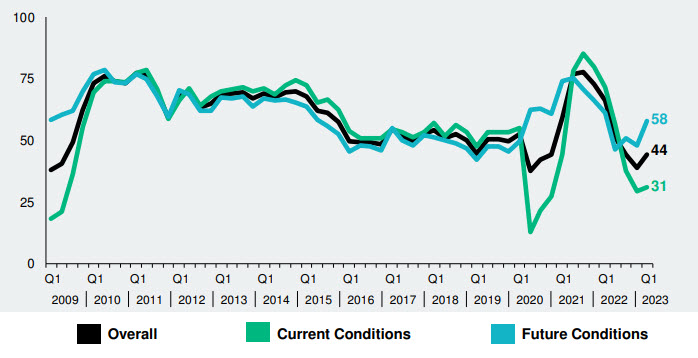
While Uncertainty Remains, Commercial Real Estate Executives Are Optimistic About Future Market Conditions

The Real Estate Roundtable’s Q1 Economic Sentiment Index reports that industry executives, while optimistic about the future, remain uncertain about current market conditions, citing inflation, rising interest rates, and supply chain disruptions as concerns. However, executives also express that perceptions and outlooks differ across asset classes, as some remain strong and others show concerns.

  • Roundtable President and CEO Jeffrey DeBoer said, “Fundamentally, our Q1 index illustrates that the trends accelerated by the pandemic have led to mixed performances across asset classes. Multifamily and industrial assets have maintained steady growth due to increased housing demand and supply chain needs, while hospitality and student housing are regaining momentum. But in the office sector, remote work policies, concerns over crime and transportation are driving record-high vacancy rates throughout the country, hurting city budgets and small businesses.”
  • “Looking forward, industry leaders are anticipating the landscape to improve throughout the year, despite recent declines in asset values and the decreased availability of debt and equity capital compared to a year ago. Policymakers should emphasize the need to return to the workplace while considering other innovative solutions such as legislation to convert underutilized offices to housing to entrench this optimism, create jobs, spur economic activity, and increase housing supply and tax revenue,” DeBoer added.
  • The Roundtable’s Economic Sentiment Index—a measure of senior executives’ confidence and expectations about the commercial real estate market environment—is scored on a scale of 1 to 100 by averaging the scores of Current and Future Economic Sentiment Indices.­­­­ Any score over 50 is viewed as positive. ­­­­

Top Line Findings

  • The Q1 2023 Real Estate Roundtable Sentiment Index registered an overall score of 44, an increase of five points from the previous quarter. The Current Index registered at 31, a two-point increase from Q4 2022, and the Future Index posted a score of 58 points, an increase of ten points from the previous quarter.
  • Several survey respondents acknowledged the dangers of generalizing trends across the commercial real estate industry as the disparities between asset classes grow; multifamily and industrial continue to attract interest, hospitality and student housing are beginning to bounce back, meanwhile Class B office is struggling.
  • Nearly all survey participants (93%) expressed that asset values have fallen year-over-year. That said, conversations with industry leaders suggest that the market is still in a period of price discovery. With low transaction volume and a limited supply of debt capital, there is lingering uncertainty as to where asset prices will ultimately land.
  • Survey participants overwhelmingly indicated that the availability of debt and equity capital is worse today compared to one year ago (93% and 82% respectfully). However, over half of participants expect the capital markets landscape to improve over the next 12 months.

Data for the Q1 survey was gathered in January by Chicago-based Ferguson Partners on The Roundtable’s behalf.  See the full Q1 report

#    #    #

Congressional Budget Office Issues Warning on Debt Limit

This week, the nonpartisan Congressional Budget Office (CBO) reported that the government would exhaust its ability to borrow using extraordinary measures between July and September if Congress fails to raise the $31.4 trillion debt limit. (CBO, Federal Debt and the Statutory Limit, Feb. 15). (Washington Post, Jan. 15)

Looming Standoff

  • When the U.S. reached the current debt limit in January, Treasury Secretary Janet Yellen notified congressional leaders of the implementation of so-called “extraordinary measures” to avoid a default, such as suspending the reinvestment of federal employees’ retirement plans. (Roundtable Weekly, Jan.13) (Yellen letter, Jan. 13)
  • While the CBO noted these measures are expected to last until at least July, it also highlighted the difficulty in determining an exact date of default.  The projected exhaustion date is uncertain, CBO notes, because the timing and amount of revenue collections and outlays over the intervening months could differ from current projections. (The Hill, Feb. 15)
  • Thus far, discussions between the Republican-led House, Democratic Senate, and Administration have generated little, if any, progress towards a resolution. The new warning from the nonpartisan CBO reinforces the urgency for congressional leaders to reach an agreement to avoid a default. (Politico, Jan.15)

Roundtable Call-to-Action

U.S. Capitol

  • In January, Real Estate Roundtable Chair John Fish (Chairman and CEO, SUFFOLK) and President and CEO Jeffrey DeBoer called on Roundtable members to proactively reach out to federal lawmakers to urge that they act expeditiously to raise the debt ceiling. “We now believe the risk of a default on the federal debt in 2023 is a real and meaningful concern that must not be taken lightly.” (Roundtable Weekly, Jan. 20)
  • “Some threats to the U.S. economy are unavoidable, others are ones of our own making and entirely unnecessary. The potential for a default on the federal debt is a needless and inexcusable risk with potentially dire consequences for U.S. real estate, workers and retirees, and the entire economy,” said DeBoer. “The full faith and credit of the United States government should not be open to negotiation.”

Roundtable leaders continue to strongly encourage members to contact policymakers in Congress and the White House and appeal to them to raise the debt ceiling soon.

#  #  #

News Release: While Uncertainty Remains, Commercial Real Estate Executives Are Optimistic About Future Market Conditions

(WASHINGTON, D.C.) — The Real Estate Roundtable’s Q1 Economic Sentiment Index reports that industry executives, while optimistic about the future, remain uncertain about current market conditions, citing inflation, rising interest rates, and supply chain disruptions as concerns. However, executives also express that perceptions and outlooks differ across asset classes, as some remain strong and others show concerns.

Roundtable President and CEO Jeffrey DeBoer said, “Fundamentally, our Q1 index illustrates that the trends accelerated by the pandemic have led to mixed performances across asset classes. Multifamily and industrial assets have maintained steady growth due to increased housing demand and supply chain needs, while hospitality and student housing are regaining momentum. But in the office sector, remote work policies, concerns over crime and transportation are driving record-high vacancy rates throughout the country, hurting city budgets and small businesses.”

“Looking forward, industry leaders are anticipating the landscape to improve throughout the year, despite recent declines in asset values and the decreased availability of debt and equity capital compared to a year ago. Policymakers should emphasize the need to return to the workplace while considering other innovative solutions such as legislation to convert underutilized offices to housing to entrench this optimism, create jobs, spur economic activity, and increase housing supply and tax revenue,” DeBoer added.

The Roundtable’s Economic Sentiment Index—a measure of senior executives’ confidence and expectations about the commercial real estate market environment—is scored on a scale of 1 to 100 by averaging the scores of Current and Future Economic Sentiment Indices.­­­­ Any score over 50 is viewed as positive. ­­­­

The Q1 Sentiment Index topline findings include:

  • The Q1 2023 Real Estate Roundtable Sentiment Index registered an overall score of 44, an increase of five points from the previous quarter. The Current Index registered at 31, a two-point increase from Q4 2022, and the Future Index posted a score of 58 points, an increase of ten points from the previous quarter.
  • Several survey respondents acknowledged the dangers of generalizing trends across the commercial real estate industry as the disparities between asset classes grow; multifamily and industrial continue to attract interest, hospitality and student housing are beginning to bounce back, meanwhile Class B office is struggling.
  • Nearly all survey participants (93%) expressed that asset values have fallen year-over-year. That said, conversations with industry leaders suggest that the market is still in a period of price discovery. With low transaction volume and a limited supply of debt capital, there is lingering uncertainty as to where asset prices will ultimately land.
  • Survey participants overwhelmingly indicated that the availability of debt and equity capital is worse today compared to one year ago (93% and 82% respectfully). However, over half of participants expect the capital markets to improve over the next 12 months.

Data for the Q1 survey was gathered in January by Chicago-based Ferguson Partners on The Roundtable’s behalf.  See the full Q1 report.

The Real Estate Roundtable brings together leaders of the nation’s top publicly-held and privately-owned real estate ownership, development, lending and management firms with the leaders of major national real estate trade associations to jointly address key national policy issues relating to real estate and the overall economy

#    #    #

The Real Estate Roundtable and Partner Real Estate Associations Join Together for the First Time to Expand Supplier Diversity Opportunities

CREDS Founding Organizations include The Real Estate Roundtable

The Commercial Real Estate Diverse Supplier (CREDS) Consortium is a first-of-its-kind coalition to provide more opportunities for minority- and women-owned businesses in the industry’s supply chain.

Washington, D.C. — Today, an industry-wide group of seven real estate trade associations announced a first-of-its-kind alliance to foster supplier diversity in real estate. The Commercial Real Estate Diverse Supplier (CREDS) Consortium aims to expand economic opportunities for businesses owned by minority- and women-owned businesses (MWBEs) in the chain of providers that supply the real estate industry.

In addition to The Real Estate Roundtable, CREDS Consortium associations include CREW Network, ICSC, Mortgage Bankers Association, NAIOP, Nareit and the National Multifamily Housing Council. CREDS Consortium associations will highlight tools that their members can use to identify, track, report, and procure products and services from MWBEs and companies owned by veterans, LGBTQ+ persons, and persons with a disability.

The Real Estate Roundtable’s President and CEO, Jeffrey DeBoer, said, “Owners, developers, and financiers of commercial and multifamily real estate are committed to help minority, women, and other historically under-represented entrepreneurs prosper in our great industry. The CREDS Consortium can help our members realize their intentions to advance economic opportunities across the vast and varied supply chain that serves real estate, makes our buildings productive, and strengthens the fabric of our communities.”

The CREDS Consortium has launched a two-year pilot program that will run through the end of 2024 with SupplierGATEWAY, a leading supplier management software platform and minority-owned firm that automates and simplifies supplier and vendor management. SupplierGATEWAY’s products include supplier sourcing, registration, risk management, compliance, and management—and provide support for corporate social responsibility, diversity, and inclusion goals.

Members of the CREDS associations can subscribe—at a discounted price—to SupplierGATEWAY’s software platform to search for, connect with, and potentially hire MWBEs as contractors, service providers, vendors, and joint venture partners. CREDS associations’ subscribing members can access the vendor management software and a comprehensive database of MWBE suppliers through the Consortium’s portal page, hosted by SupplierGATEWAY.

Hiring companies can also post their purchase orders and other contracting opportunities through the CREDS portal. Tools available on the platform that measure and track MWBE procurement spending will support companies that intend to advance environmental social, and governance (ESG) and diversity, equity, and inclusion (DEI) goals.

During the pilot program, the Consortium also hopes to gain broad insights into supplier diversity trends across the commercial real estate industry.

Visit Supplier Gateway to learn more about the CREDS Consortium pilot program. An FAQ document can be found here.   

What CREDS Consortium partners are saying:

  • Wendy Mann, CEO, CREW Network

“As a global organization focused on accelerating success for all women in commercial real estate, CREW Network supports this partnership and initiative as an important business strategy to elevate ESG and DEI and create a more equitable industry for all. Women- and minority-owned businesses are a driving force behind economic growth and bringing this diverse talent to the industry is a business imperative. Companies that increase their diverse spend also see an increase in innovation and market share. It’s a win-win.”

  • Tom McGee, ICSC President & CEO

“ICSC is committed to advancing diversity, equity and inclusion in the Marketplaces Industry and giving our members ways to identify and source MWBEs is one way we can do this. The CREDS Consortium helps meet the growing demand for diversity in service providers and offers our members direct access to the tools and resources they need to support their own DEI goals.  We are proud to be a founding member of the Consortium and look forward to working closely with the partner organizations to further this important initiative.”

  • Bob Broeksmit, CMB, President and CEO of the Mortgage Bankers Association

 “The Commercial Real Estate Diverse Supplier Consortium is a great resource for expanding DEI and ESG opportunities in the real estate finance industry. Our members will benefit from the consortium’s work to identify minority- and women-owned suppliers that provide essential products and services. MBA and its members are dedicated to supporting and promoting supplier diversity.”

  • Marc Selvitelli, CAE, NAIOP, the Commercial Real Estate Development Association

 “NAIOP is proud to be a founding member of this important initiative. By working together, we believe this powerful alliance of real estate associations can propel our member companies’ success in achieving their important ESG goals. Facilitating access to a minority- and women-owned supplier database is an important first step in creating future opportunities between diverse vendors and developers and owners of commercial real estate.”

  • Steven A. Wechsler, President and CEO, Nareit

“Increasing the use of diverse service providers is an industry-wide priority that requires an industry-wide approach, which is why we are proud to be a founding member of the CREDS Consortium. The CREDS-SupplierGATEWAY partnership will enable Nareit’s members to leverage existing software and tools to more quickly increase diversity and inclusivity in their respective supply chains.”

  • Sharon Wilson Géno, President, National Multifamily Housing Council

“As a founding member of the Consortium, NMHC proudly continues our longstanding commitment to DEI as a business imperative that drives innovation and success. NMHC knows that connecting more buyers with more sellers, and measuring those connections, are essential steps toward a more robust market that benefits both multifamily firms and MBWE partners that help power the industry. As an alliance, the Commercial Real Estate Diverse Supplier (CREDS) Consortium can amplify our efforts to strengthen industry access for diverse suppliers, and support the ESG and DEI goals of our members.”

  • Ade Solaru, Founder and CEO, SupplierGATEWAY

 “Our partnership with the CREDS Consortium is an important component of our mission to generate meaningful economic impact at scale for our customers. Each member of the CREDS associations can now create meaningful social impact at the local level without sacrificing efficiency, cost or risk.”

About The Real Estate Roundtable

The Real Estate Roundtable brings together leaders of the nation’s top publicly held and privately-owned real estate ownership, development, lending, and management firms with the leaders of major national real estate trade associations to jointly address key national policy issues relating to real estate and the overall economy.

#  #  #