House Democrats Outline Climate Legislation, Address Buildings and Energy Efficiency

HouseEandC-framework-image-x475

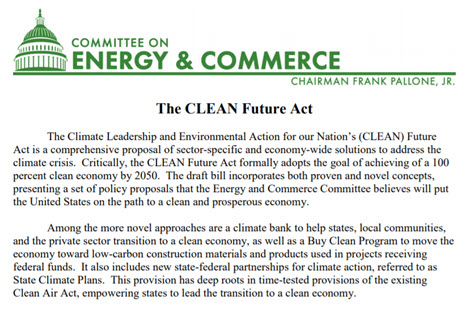
House Democrats on Jan. 8 released a legislative framework on climate policy that addresses buildings and energy efficiency among its sector-specific proposals. The goal for the House Energy and Commerce Committee’s Climate Leadership and Environmental Action for Our Nation’s (CLEAN) Future Act is to achieve overall net-zero greenhouse gas emissions (GHG) for the United States by 2050.

  • The legislative text of the draft CLEAN Future Act will be released by the end of this month while hearings and stakeholder meetings continue throughout the year. (Committee news release, Jan. 8).
  • The proposal addresses the efficiency of new and existing buildings, as well as the equipment and appliances that operate within them.  The bill proposes national energy savings targets from continued stringency of model building energy codes (frequently adopted into law at the state and local level), with a requirement of “zero-energy-ready buildings” by 2030.
  • The legislative framework also proposes requirements on utilities and other retail electricity suppliers to de-carbonize the U.S. electric grid.  Under the proposal, they must provide an increasing supply of clean electricity to consumers starting in 2022, rising to 100 percent clean energy by 2050.
  • The legislative framework will also direct the Federal Energy Regulatory Commission (FERC) to facilitate the integration of localized distributed energy, energy storage, and renewable energy resources into the electric grid.
  • While the CLEAN Future Act proposal is not expected to garner support from Republicans, measures that would “clean” the electric grid and direct FERC to modernize energy markets could theoretically impact emerging obligations on building owners to comply with certain local-level carbon reduction mandates (such as New York City’s Local Law 97.)  (See Roundtable Weekly, April 19, 2019)
  • Meanwhile, the House Select Committee on the Climate Crisis is expected to issue legislative policy recommendations by March 31, 2020.  (See Roundtable Weekly, October 25, 2019)
  • The Real Estate Roundtable submitted detailed energy and climate policy recommendations to the House Select Committee on November 21, 2019.  The comments offer a suite of priorities developed by The Roundtable’s Sustainability Policy Advisory Committee (SPAC), including:

* Improve the model building energy codes process by enacting the Portman-Shaheen Energy Savings and Industrial Competitiveness (ESIC) Act. (Roundtable Weekly, September 27, 2019)
 

* Enhance EPA’s voluntary ENERGY STAR incentive programs for both commercial buildings and tenants.

* Create meaningful accelerated depreciation periods to encourage investments in high performance equipment to retrofit existing commercial and multifamily buildings. (Roundtable Weekly, May 10, 2019)

  • House Speaker Nancy Pelosi (D-CA) has stated the House will act on a climate bill in 2020 (Bloomberg Environment, Dec. 6, 2019).  Majority Leader Steny Hoyer (D-MD) also told reporters this week that climate policy would be a “huge issue” this year. (E&E News, Jan. 9)
  • In the Senate, a different approach to energy policy has evolved over the past year.  The Senate Energy and Natural Resources (ENR) Committee passed 52 bills in 2019 on a largely bipartisan basis.  Several of these bills address commercial and residential real estate, including the Energy Savings and Industrial Competitiveness Act (ESIC) Act (Portman-Shaheen), long-supported by The Real Estate Roundtable.
  • The ESIC Act “is exactly the kind of smart, forward-looking policy that will help building owners respond to our modern, evolving economy” Roundtable President and CEO Jeffrey DeBoer stated in a Senate news release upon the bill’s introduction this past summer.  (Roundtable Weekly, July 19) (Video of DeBoer’s statement)

Energy and climate legislation will be a focus of discussion during The Roundtable’s upcoming January 28 State of the Industry Meeting in Washington.  The Roundtable’s Sustainability Policy Advisory Committee (SPAC) will also meet on January 29.

#  #  #

Roundtable Submits Comments to House Climate Crisis Committee; House Democrats Unveil Green Energy Tax Draft

Logo House Select Commtt Climate x485W edit

The Roundtable submitted energy and climate policy recommendations to the House Select Committee on the Climate Crisis on Thursday, while members of the House Ways and Means Committee unveiled a draft legislative package of more than 20 energy tax incentives – including incentives to promote commercial and residential building energy efficiency.  

The Roundtable’s climate letter submitted Nov. 21 responds to a request for information from the Select Committee. This panel has no authority to write legislation but is authorized to study climate change and issue legislative policy recommendations (expected by March 31, 2020).

In its study and review of climate policy recommendations, the Select Committee has held a series of hearings featuring various stakeholders – including one focused on Cleaner, Stronger Buildings.”  (Roundtable Weekly, October 25, 2019) .

The Roundtable’s comments to the Select Committee highlighted the priorities advocated by its Sustainability Policy Advisory Committee (SPAC) to:       

  • Improve the model building energy codes process by enacting the Portman-Shaheen Energy Savings and Industrial Competitiveness (ESIC) Act. (Roundtable Weekly, September 27, 2019)
     
  • Enhance EPA’s voluntary ENERGY STAR incentive programs for both commercial buildings and tenants.
  • Improve the quality and reliability of the national data collected by the federal Commercial Building Energy Consumption Survey.
  • Create meaningful accelerated depreciation periods to encourage investments in high performance equipment to retrofit existing commercial and multifamily buildings. (Roundtable Weekly, May 10, 2019)
  • Foster public-private partnerships to finance safety and resiliency improvements to the electricity grid, the natural gas pipeline network, and other energy infrastructure assets.

Meanwhile, a discussion draft of the Growing Renewable Energy and Efficiency Now (GREEN) Act was released Nov. 19 by the chairman of the House Ways and Means Subcommittee on Select Revenue Measures – Rep. Mike Thompson (D-CA). 

The GREEN Act would extend and revise a number of expired tax incentives, including provisions aimed at encouraging taxpayers to improve the energy efficiency of homes and commercial buildings. Specifically, the discussion draft includes:

  • An updated and enhanced deduction for capital expenditures on energy-efficient commercial building property (section 179D)
  • An expanded tax credit for the developers of new, energy-efficient homes (section 45L)
  • A modified tax credit for energy-efficient improvements to existing homes (section 25C)

Under the bill, the revised tax incentives would be available through 2024. Following release of the draft legislation, House Ways and Means Committee Chairman Richie Neal (D-MA) stated, “The climate crisis requires bold action, and I’m pleased that we’re using the legislative tools at Ways and Means’ disposal to create green jobs, reduce carbon emissions, and help heal our planet.” We look forward to hearing from stakeholders to ensure this bill is effective in helping improve energy efficiency and eliminating carbon emissions.”

Prospects for passing the GREEN Act are unclear as it is a Democratic initiative that currently lacks Republican support. 

Additionally, The Roundtable and coalition partners continue to lay the research and data foundation for a new tax incentive that would provide accelerated depreciation for high performance, HVAC, lighting, windows, and other equipment to retrofit existing commercial and multifamily buildings, known as “E-QUIP.” (See Roundtable Weekly, May 10, 2019).  The coalition’s objective is for bipartisan introduction of an E-QUIP bill in early 2020.

The Roundtable’s Tax Policy Advisory Committee (TPAC) plans to analyze the proposed measures and respond to any eventual energy tax legislation that may be introduced in the New Year.

#  #  #

Senate Committee Advances Portman-Shaheen Energy Efficiency Bill

Senators Rob Portman (R-OH) and Jeanne Shaheen (D-NH)

The Senate Energy and Natural Resources (ENR) Committee passed a bill on Wednesday that emphasizes voluntary measures and incentives to drive energy efficiency improvements in U.S. buildings, manufacturing, and other economic sectors. 

  • The Energy Savings and Industrial Competitiveness (ESIC) Act (S. 2137)sponsored by Senators Rob Portman (R-OH), above left, and Jeanne Shaheen (D-NH), right, and long endorsed by The Real Estate Roundtable – was advanced by the panel, along with several other energy bills.
  • Senator Lisa Murkwoski (R-AK), chairman of the ENR Committee, noted during the hearing, “For several Congresses now, [S. 2137] has been the Senate’s flagship effort on energy efficiency.  I’m hopeful that we are going to be able to see this into law.”
  • The ESIC Act passed the committee by a substantial margin (14-6), although provisions regarding voluntary building energy codes failed to garner a majority of Republican votes.  Murkowski added that the codes sections still needed more work to gain fuller bipartisan support.  She was optimistic that the “prevailing concerns” of industry stakeholders could be resolved.  (Committee video, Sept. 25)
  • The ESIC Act would improve current laws by adding “open government” and transparency provisions that do not currently apply to the development of building energy codes.  Real estate and other stakeholders would be provided a platform to comment on DOE code proposals affecting the industry. The measure also includes a new requirement that would compel the U.S. Department of Energy (DOE) to consider costs and small business impacts as part of the codes development process.  (Roundtable support letter for S. 2137)
  • S. 2137 would also direct the two federal agencies that separately collect critical nationwide data on building energy use – namely, the Energy Information Administration and the Environmental Protection Agency – to coordinate on their respective programs and take steps to ensure higher quality, more consistent data.
  • The ESIC Act “is exactly the kind of smart, forward-looking policy that will help building owners respond to our modern, evolving economy” Roundtable President and CEO Jeffrey DeBoer stated in a Senate news release upon the bill’s introduction this summer.  (Roundtable Weekly, July 19) (Video of DeBoer’s statement)

Further negotiations to refine the ESIC Act are anticipated in the coming weeks before it might advance to the full Senate for a vote.  Companion legislation is pending in the House (H.R. 3962), sponsored by Peter Welch (D-VT) and David McKinley (R-WV).

#  #  # 

Portman-Shaheen Energy Efficiency Bill Considered In Senate Hearing

Senators Jeanne Shaheen (D-NH) and Rob Portman (R-OH)

The Senate’s Energy Subcommittee on Wednesday held a hearing that considered bipartisan legislation to help further advance energy efficiency in U.S. buildings without federal regulations – but through data-driven, voluntary measures.

  • The Senate panel assessed the Energy Savings and Industrial Competiveness (ESIC) Act (S. 2137) – co-sponsored by Senators Jeanne Shaheen (D-NH), above at left, and Rob Portman (R-OH), right,  –along with nine other energy policy bills at the subcommittee’s Wednesday hearing. The Roundtable is a strong supporter of the Portman-Shaheen bill.
  • Sen. Portman testified at the hearing, noting that the ESIC Act passed the Senate by an overwhelming margin in a prior session of Congress.  He remarked that the legislation contains no “heavy-handed mandates” and that its building code sections are “completely voluntary.”  He added that the measure would result in “greenhouse gas emissions reductions [that] are equivalent to taking about 11 million cars off the road.”  (Portman press release, Sept. 11.)
  • Sen. Shaheen’s testimony emphasized that “energy efficiency is the cheapest, fastest way to deal with our energy needs,” and that the bill would produce a policy trifecta to reduce emissions, protect the environment, and create jobs.  (Shaheen press release, Sept. 11.)
  • The Roundtable submitted a letter for the hearing’s record to reiterate its support for the bill.  Roundtable President and CEO Jeffrey D. DeBoer also spoke in support of the bill when it was announced at a press conference in July.  (Video of DeBoer’s statement on Portman-Shaheen)
  • The ESIC Act “is exactly the kind of smart, forward-looking policy that will help building owners respond to our modern, evolving economy” DeBoer stated in a Senate news release upon the bill’s introduction this summer.  “The needs of business tenants have changed dramatically since the turn of the century to power the data centers, IT, and communications systems upon which our workforce depends.  Building owners are meeting their tenants’ 24/7 energy demands while constructing and managing their assets more efficiently – and reducing their carbon footprints.” (Roundtable Weekly, July 19, 2019)  

Companion legislation to S. 2137 is pending in the House (H.R. 3962), sponsored by Peter Welch (D-VT) and David McKinley (R-WV).  As the next step in the Senate’s process, a mark-up of S. 2137 by the full Senate Energy Committee is expected this fall.

#   #   #