
Shutdown Stretches Into Second Month as Washington Stalemate Hardens

The government shutdown, now in its sixth week, continues to strain markets. Despite some bipartisan progress, the path to reopening remains uncertain as the economic fallout spreads across housing, infrastructure, and other sectors.

State of Play

  • Early this week, bipartisan senators began exploring a short-term compromise to pair a continuing resolution (CR) with a vote on extending Affordable Care Act (ACA) subsidies. (CBS News, Nov. 5) 
  • Senate Minority Leader Chuck Schumer (D-NY) and House Minority Leader Hakeem Jeffries (D-NY) requested a meeting with President Trump, Senate Majority Leader John Thune (R-SD), and House Speaker Mike Johnson (R-LA) to discuss expiring ACA subsidies and a reopening framework. (Politico, Nov. 5)
  • By midweek, a group of Senate Democrats signaled openness to a GOP plan that would extend government funding through January, include an appropriations package, and advance an ACA subsidy vote. (PoliticoPro, Nov. 6)
  • President Trump urged Republicans to “get the government back open immediately,” linking GOP election losses to the stalemate, while Democratic leaders encouraged colleagues not to “cave” to pressure to compromise on key priorities. (CBS News | Politico, Nov. 5)
  • Majority Leader Thune said Republicans are finalizing a “minibus” to serve as the vehicle for a deal, though hurdles remain on both sides. (PoliticoPro, Nov. 6)
  • Expected travel delays remain a potential flashpoint in negotiations, as Transportation Secretary Sean Duffy and FAA Administrator Bryan Bedford said the federal government would reduce airline traffic by 10 percent at 40 locations beginning on Friday if the shutdown continues. (CBS News, Nov. 5)
  • Majority Leader Thune intends to hold a vote to advance a funding package on Friday. Democrats have not signaled broad support for the measure, with progressives pushing to hold out while moderates grow weary of the shutdown’s toll on food aid and travel. (Axios, Nov. 6)

Implications for the Economy & CRE

  • The Congressional Budget Office estimates the shutdown could lower U.S. GDP by $7-$14 billion, contingent on its length. It also anticipates that some losses will be permanent and that fourth-quarter growth may decline by 1-2 percentage points. (CBO, Oct. 29 | Reuters, Oct. 29)

  • As the shutdown continues, federal permitting and financing pipelines remain frozen at HUD and EPA, slowing approvals, infrastructure tie-ins, FHA/HUD loan processing, and other critical CRE project milestones. (CRE, Oct. 29)

  • HUD confirmed this week that it will extend funding for public housing operations and housing voucher payments through December. The move provides short-term relief for property managers and lenders in affordable housing markets, though funding beyond December remains uncertain. (Politico, Nov. 4)

  • CRE leaders note that the economic strain is increasingly tied not to liquidity but to confidence and timing disruptions. CREFC characterizes the situation as a “confidence and timing headwind,” with capital still available yet deployed more cautiously amid growing uncertainty. (CRE Daily, Oct. 29)

  • The ongoing blackout of federal economic data—including jobs and inflation reports—is reinforcing market caution, forcing lenders and investors to rely on private indicators and adopt more conservative underwriting and wider bid-ask spreads. (Bloomberg Law, Nov. 4)

  • Property owners with federal tenants have reported delayed lease renewals and rent payments, creating operational friction and valuation uncertainty. (ENR, Nov. 1)

Supreme Court Weighs Limits on Presidential Tariff Powers

  • Beyond Capitol Hill, the Supreme Court heard oral arguments on Tuesday over whether the International Emergency Economic Powers Act (IEEPA) permits the president to unilaterally impose sweeping tariffs on imports. (ABC News, Nov. 5 | Axios, Nov. 6)

  • A majority of justices, including Amy Coney Barrett and Neil Gorsuch, expressed skepticism that Congress intended to delegate such expansive authority, questioning whether the power to “regulate” imports extends to imposing duties without explicit legislative approval. (New York Times Nov. 5)

  • If the Court ultimately strikes down the broad tariff strategy, market attention will shift to the administrations contingency plan for reimbursing billions in duties already paid, a move that could deliver meaningful near-term cash-flow relief for import-reliant developers, operators, and suppliers. (AP News | ConnectCRE, Nov. 5)

  • However, uncertainty surrounding the scope and timing of any refund mechanism may continue to influence procurement and budgeting decisions across the CRE sector.

RER continues to urge Congress to move swiftly toward a bipartisan funding agreement that reopens the government, restarts critical permitting and data functions, and ensures continuity for housing, infrastructure, and financial programs essential to real estate investment and economic growth.

Commercial Real Estate Confidence Holds Steady as Market Stabilizes, Q4 Sentiment Index Shows

The Real Estate Roundtable’s (RER) Q4 2025 Sentiment Index registered an overall score of 67, equivalent to the prior quarter, reflecting that commercial real estate executives’ sentiment has shifted from caution toward guarded optimism as markets stabilize, transaction activity resumes, and expectations build for easing interest rates in 2026.

Topline Findings

The Q4 Sentiment Index topline findings include:

  • The Q4 2025 Real Estate Roundtable Sentiment Index registered an overall score of 67, equivalent to the previous quarter. The Current Index registered a score of 64, a 1-point increase from Q3 2025. The Future Index posted a score of 69 points, a 2-point decrease from the previous quarter, reflecting sentiment that the market has largely stabilized and is now transitioning from caution to guarded optimism. Many participants anticipate stronger transaction activity in 2026 as interest rates ease and confidence builds, yet acknowledge that political and policy uncertainty continue to temper near-term enthusiasm.
  • Although perspectives vary by asset class, overall market sentiment remains positive. Only 13% of respondents believe that general market conditions are worse than this time last year, while 63% believe that general market conditions are better than this time last year. More than two-thirds (70%) of Q4 survey participants expect general market conditions to show improvement one year from now. Leaders reported continued strength in residential sectors, alongside steady improvement in retail and hospitality. Office remains the most challenged asset class, though signs of stabilization are emerging in top-tier markets.
  • 43% of respondents believe asset values are roughly unchanged compared to a year ago. A large minority of participants see green shoots, with 42% believing asset prices have increased and only 15% believing they have declined. Looking ahead, the outlook is optimistic: 72% expect asset prices to rise over the next year, 24% believe asset values will remain stable, and only 4% anticipate a slight decline.
  • Perceptions on the availability of equity capital relative to last quarter are muted, although nearly half (48%) of respondents still believe equity availability is better compared to a year ago. On the other hand, sentiment around debt capital has risen significantly, as 78% said the availability of debt capital has improved from last year. Looking forward, 64% of respondents believe that equity capital availability will be better in one year and 56% believe debt capital availability will be better.

Roundtable View

  • RER President and CEO Jeffrey DeBoer said, “Real estate executives see encouraging momentum. Roundtable members are reporting steady improvement and renewed confidence across sectors. Despite improvements, tariffs continue to drive up development costs and complicate business planning. Moreover, the record-long government shutdown is disrupting infrastructure and construction permitting, and access to current economic data that companies rely on to plan”
  • He added, “Clear, consistent, and coordinated policies from Washington are essential to unlock capital and support long-term economic growth in communities nationwide.”

Data for the Q4 survey was gathered by Chicago-based Ferguson Partners on RER’s behalf in October. See the full Q4 report.

CRE Leaders Convene in Washington to Discuss Policy Priorities, Market Trends, and Bipartisan Solutions

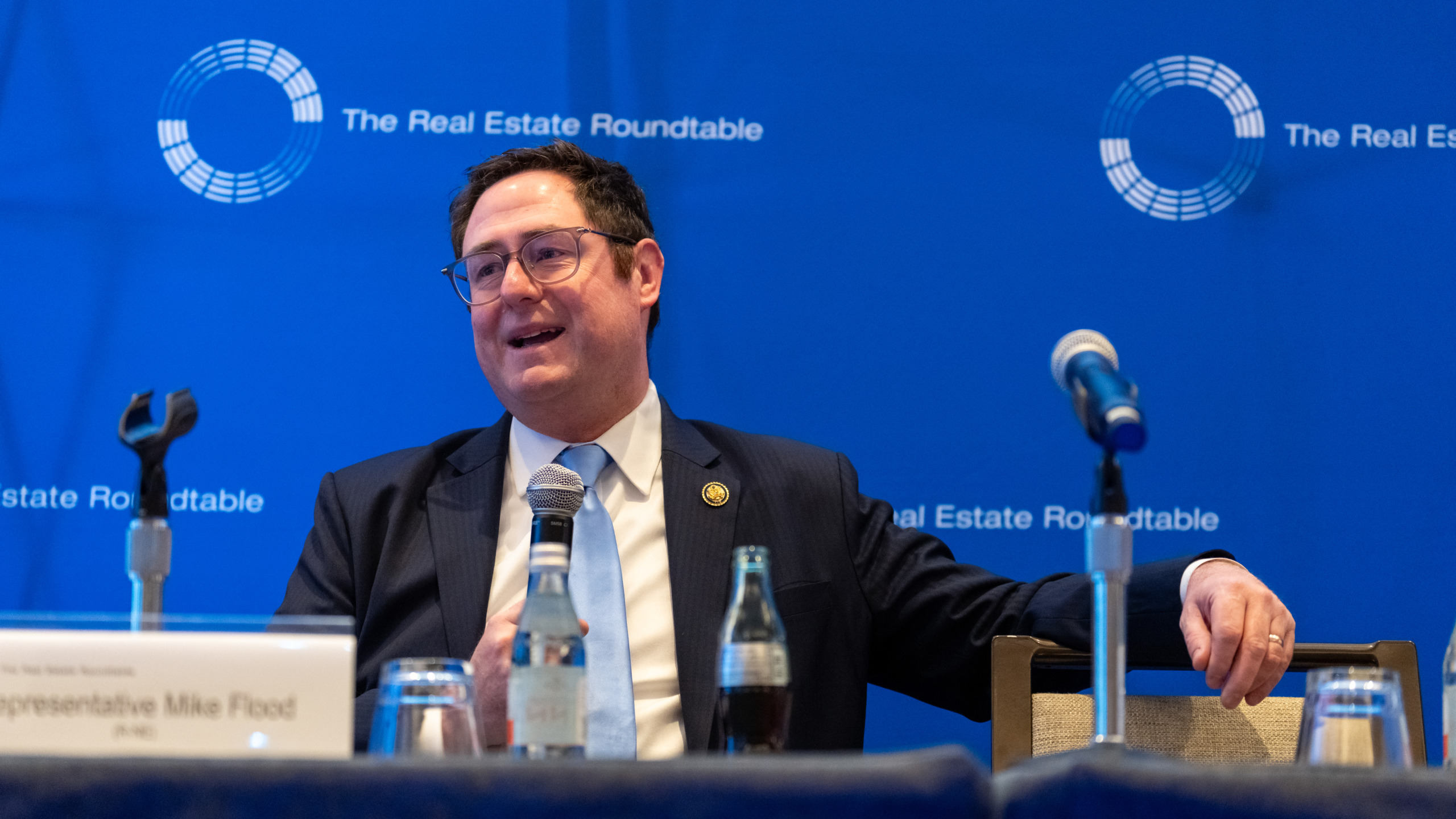
Industry leaders convened with policymakers at this week’s Fall Roundtable Meeting to address national policies impacting commercial real estate and the broader economy.

Fall Roundtable Meeting

  • The timely discussions focused on bipartisan opportunities in AI, immigration, and permitting reform; as well as tax policy; tariffs and trade relations, persistent inflation and energy costs, and housing supply affordability. (RER’s Fall 2025 Policy Priorities and Executive Summary)
  • Permitting reform and electric grid reliability were top of mind throughout the meeting, with members and policymakers emphasizing the urgent need to modernize infrastructure to meet growing energy demand.
  • The discussions coincided with a bipartisan letter sent to Congress from 13 governors led by Pennsylvania Gov. Josh Shapiro (D) and Oklahoma Gov. Kevin Stitt (R), urging Congress to streamline federal permitting rules, expand interstate transmission, and accelerate the nation’s energy transition. (PoliticoPro | NGA Press Release, Oct. 28)
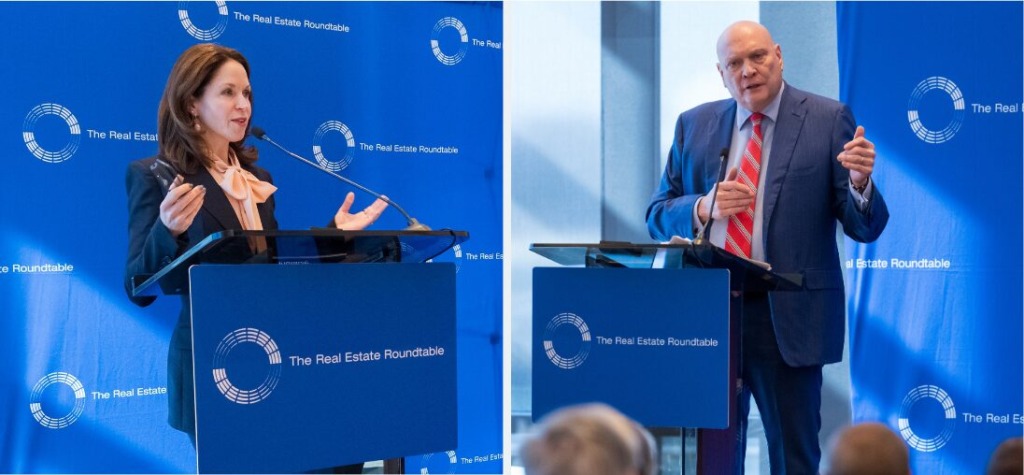
  • RER Board Chair Kathleen McCarthy (Global Co-Head of Blackstone Real Estate, Blackstone) emphasized connectivity through Roundtable on the Road and member engagement in policy committees. “These touchpoints keep our priorities aligned and ensure we are speaking with one powerful, fact-based voice,” McCarthy said.
  • RER President and CEO Jeffrey DeBoer highlighted RER’s positive advocacy efforts around the One Big Beautiful Bill Act (OB3), including preservation of carried interest, permanent Opportunity Zones, and expansion of the Low-Income Housing Tax Credit. “Those outcomes only happen because of sustained, credible advocacy, backed by the expertise and perspectives our members bring to every discussion,” DeBoer said.

Speakers & Policy Issues

Roundtable members engaged in policy issue discussions with the following guests:

  • Sen. Michael Bennet (D-CO) (Committees: Finance; Select Committee on Intelligence; Rules; Agriculture, Nutrition and Forestry) discussed bipartisan cooperation on immigration reform, housing affordability, and fiscal policy, calling the nation’s housing situation “an affordability crisis.”
  • Sharon Wilson Géno (President, National Multifamily Housing Council) highlighted the Housing Solutions Coalition’s work to educate policymakers on the consequences of rent control and promote data-driven, pro-housing reforms at federal and state levels.
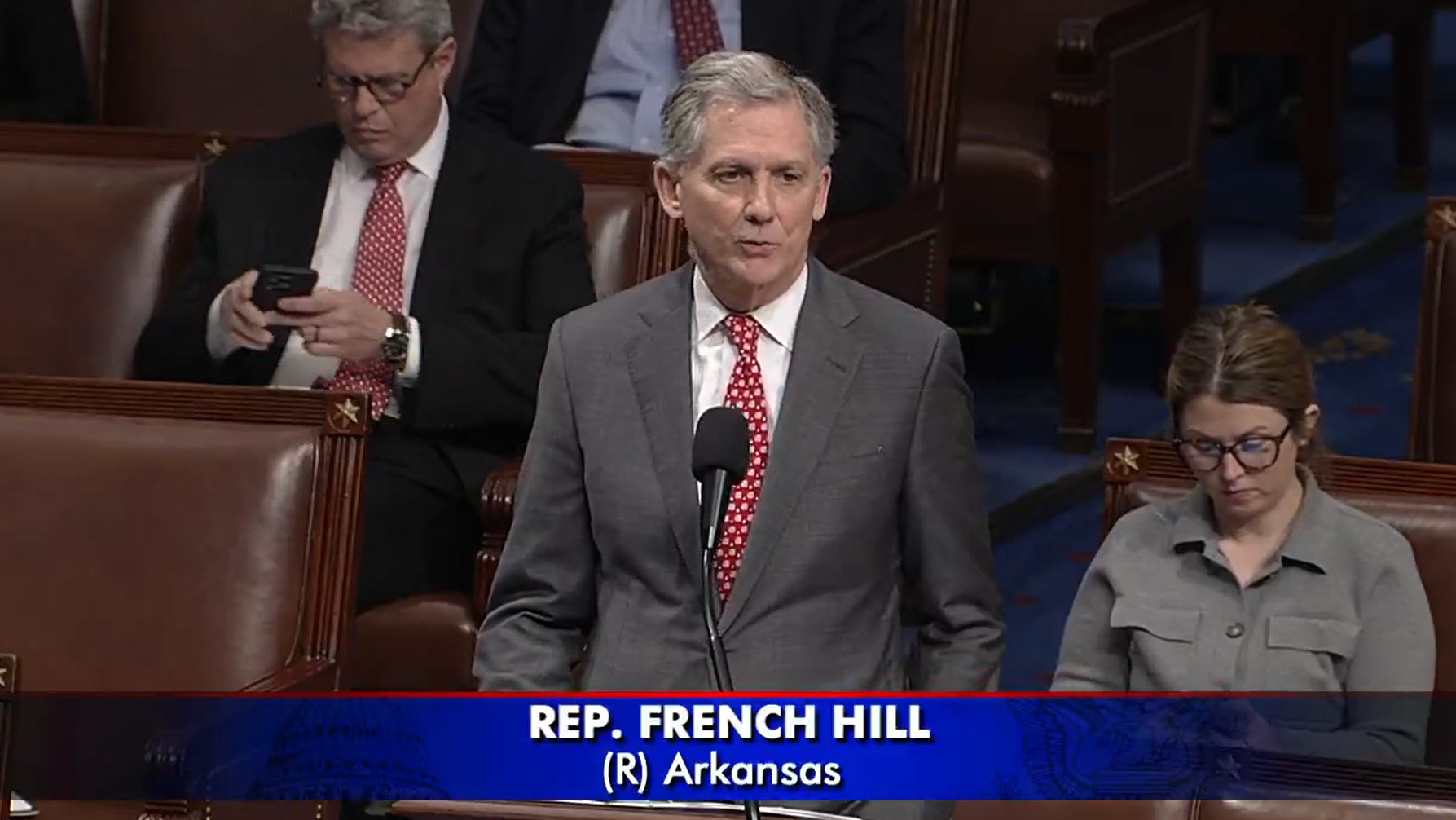
  • Rep. French Hill (R-AR) (Chair, House Financial Services Committee; Permanent Select Committee on Intelligence) outlined congressional priorities on capital formation, digital assets, simplifying federal regulation for community banks, and reauthorization of the Terrorism Risk Insurance Act (TRIA).
  • Rep. Josh Gottheimer (D-NJ) (Committees: Financial Services; Permanent Select Committee on Intelligence) emphasized pragmatic governing coalitions to advance permitting and immigration reforms while maintaining fiscal discipline and strengthening global competitiveness.
  • Ambassador Timmy Davis (Ret.) (Former U.S. Ambassador to Qatar; President & Partner, Irth Capital Management; Senior Advisor, Mavik Capital) and Vik Uppal (Founder and CEO, Mavik Capital) shared insights on international capital flows and global geopolitical factors influencing cross-border real estate investment.

Next on RER’s meeting calendar is the all-member State of the Industry (SOI) Meeting, which will include policy advisory committee sessions, on January 21–22, 2026, in Washington, DC.

Fed Cuts Rates Again as CRE Eyes Relief; Coalition Supports FSOC Reform

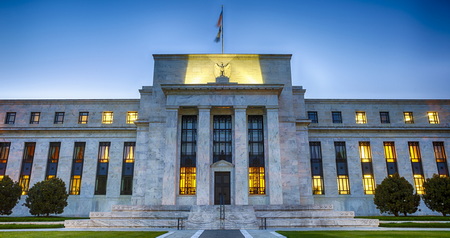
The Federal Reserve on Wednesday approved a second consecutive quarter-point rate cut, lowering the federal funds rate to 3.75-4 percent. Chair Jerome Powell cautioned that another reduction in December is uncertain, suggesting the pace of easing could soon slow.

Fed’s Decision

  • The 10-2 vote saw Governor Stephen Miran favor a deeper half-point cut, while Kansas City Fed President Jeffrey Schmid opposed any reduction. (CNBC, Oct. 29)
  • Policymakers cited rising downside risks to employment amid persistent inflation near 3 percent.
  • Chair Powell noted “strongly differing views” on whether further easing is warranted, signaling a potential pause in December. “A further reduction in the policy rate at the December meeting is not a foregone conclusion. Far from it,” he said. (Watch Press Conference)
  • The chair also acknowledged the limited availability of economic data as the ongoing government shutdown has suspended federal data collection and reports.

Housing and CRE Outlook

  • At this week’s Fall Roundtable Meeting, House Financial Services Chair Rep. French Hill (R-AR) noted that persistent inflation continues to weigh on markets, though gradual rate cuts are beginning to ease conditions for housing and credit.
  • Continued monetary easing and the Fed’s balance sheet pivot may still bring modest relief to mortgage costs heading into 2026. (HousingWire, Oct. 29)
  • Economists note that improved credit conditions could stimulate purchase demand and support CRE transaction activity, though affordability challenges persist.

RER Advocacy

  • RER and coalition partners submitted a comment letter to the U.S. House of Representatives this week in support of H.R. 3682, the Financial Stability Oversight Council (FSOC) Improvement Act of 2025. (Letter, Oct. 28)
  • The bill, approved 47-4 by the House Financial Services Committee in Sept, would require FSOC to consult with a company and its primary regulator before designating a nonbank as a Systemically Important Financial Institution (SIFI), which would be subject to heightened prudential regulation and supervision by the Federal Reserve Board. (House Financial Services Committee Vote No. FC-198, Sept. 16)
  • The letter emphasized the importance of an activities-based approach to systemic risk, transparent cost-benefit analysis, and clear procedural guardrails to ensure predictability in financial oversight.
  • This follows a similar letter RER signed in July supporting efforts to restore due-process standards and coordination between FSOC and primary regulators. The letter urged FSOC to rescind its 2023 interpretive guidance and reinstate the Council’s 2019 framework for designating nonbank financial companies. (Letter, July 14)

Basel III Endgame

  • The Fed is circulating a revised Basel III Endgame proposal that would increase capital charges for large banks by 3-7 percent instead of the originally proposed 19 percent. (Bloomberg, Oct. 22)
  • RER strongly opposed the Fed’s original proposal, pointing out the significant economic costs it would incur without clear benefits to the economy, recommending that it be withdrawn and only reissued after further study. (Roundtable Weekly, June 27)

RER will continue to track developments on monetary policies and support measures that preserve liquidity and lending capacity as rate relief remains gradual.

Economic Strain Mounts as Pressure Builds on Congress to End Record Shutdown

The federal government shutdown, now nearing its fifth week and on pace to become the longest in U.S. history, is showing early signs of bipartisan negotiation after weeks of stalemate. Lawmakers are facing mounting pressure to reach an agreement before critical deadlines affect food assistance and healthcare programs.

State of Play

  • Bipartisan conversations have modestly increased this week as senators search for a path to end the impasse. Senate Majority Leader John Thune (R-SD) said talks “have picked up,” noting that deadlines often spur action. (PoliticoPro, Oct. 29)
  • Despite limited optimism, lawmakers view progress onFY2026 appropriations as a potential vehicle to rebuild trust and advance a reopening framework. Still, with the Senate adjourned and the House out of session, finalizing a deal before key programs lapse remains difficult. (Roll Call, Oct. 29)
  • Near-term pressure points include the exhaustion of Supplemental Nutrition Assistance Program (SNAP) and WIC benefits by the end of October, the start of Affordable Care Act (ACA) open enrollment on Nov. 1, and worsening transportation delays as air traffic controllers and TSA staff miss additional paychecks.
  • Senate Minority Leader Chuck Schumer (D-NY) told reporters Tuesday that he believes Republicans will face “increased pressure to negotiate with us.” (Politico, Oct. 29)
  • House Speaker Mike Johnson (R-LA) has kept the chamber out for more than a month, insisting that Democrats must first agree to reopen the government before broader spending or healthcare talks resume.
  • However, rank-and-file senators from both parties report renewed engagement, with some GOP leaders predicting that centrist Democrats may soon support a compromise. (Politico, Oct. 29)
  • Leader Thune said moderate Democrats are seeking an “off-ramp,” and he is willing to negotiate on extending ACA subsidies but only once the government reopens. Proposals include offering Democrats a vote on their own plan to continue the tax credits beyond December, and a possible meeting with President Trump to discuss ACA subsidies as early as next week. (The Hill, Oct. 30)
  • In a series of Truth Social posts on Thursday, President Trump urged Republicans to eliminate the Senate filibuster, which currently requires 60 votes to advance legislation. Leader Thune has previously rejected changing the rule, calling the threshold “a bulwark against a lot of really bad things.” (CBS News, Oct. 31)

Economic Fallout

  • The Congressional Budget Office (CBO) estimates the shutdown will cost the U.S. economy between $7 billion and $14 billion, depending on its duration, according to a new report released Wednesday. (CBO Letter, Oct. 29)
  • In a letter from CBO Director Phillip Swagel to the Chairman of the House Budget Committee, the nonpartisan agency acknowledged that the real economic impact of the shutdown remains uncertain. (Politico, The Hill Oct. 29)
  • A four-week shutdown would reduce real GDP by $7 billion, rising to $11 billion after six weeks and $14 billion after eight. (Bloomberg, Oct. 29)
  • The CBO estimates the shutdown will reduce real GDP growth by 1 to 2 percentage points, with overall growth expected to recover after 2026—but some losses, particularly from federal worker furloughs, will be permanent.
  • Lawmakers from both parties warn that the economic fallout will deepen if the impasse continues, threatening programs vital to housing, infrastructure, and financial markets.

Path Forward

  • GOP leaders are exploring a continuing resolution (CR) that could extend government funding into mid-January or March, though several versions remain under discussion.
  • Democrats oppose any measure that carries funding into next year without renewing the enhanced ACA subsidies set to expire in December.

RER continues to urge Congress to act responsibly to reopen the government and restore critical housing, insurance, and economic programs essential to real estate investment and growth.

Senate Hearing Highlights Bipartisan Push to Expand Housing Supply and Cut Costs

The Senate Banking Subcommittee on Housing, Transportation, and Community Development held a hearing this week, “Innovation in U.S. Housing: Solutions and Policies for America’s Future,” which examined the nation’s housing shortage, the impact of rising regulatory costs, and innovative approaches such as modular and off-site construction, accessory dwelling units (ADUs), and pre-disaster mitigation to help address the housing crisis.

Hearing Highlights

  • Subcommittee Chair Katie Britt (R-AL) and Ranking Member Tina Smith (D-MN) framed the housing crisis as a bipartisan priority, citing the ROAD to Housing Act’s unanimous 24-0 passage through the Senate Banking, Housing, and Urban Affairs Committee as proof of momentum for federal housing reform. (Watch Hearing)
  • Among the measures Senators raised were proposals to ease permitting rules, streamline approvals, and modernize FHA and USDA programs to speed construction.
  • Members also discussed Opportunity Zones and expanding the Low-Income Housing Tax Credit (LIHTC as levers to spur investment in underserved areas, particularly when paired with state and local zoning reforms.
  • Witnesses emphasized regulatory and financing barriers, noting that government requirements add roughly 24 percent to the cost of new single-family homes and 40 percent to multifamily developments
  • Mary Tingerthal, founder of Construction Revolution, highlighted modular and off-site construction as key innovations to lower costs and timelines, reducing project durations by up to 50 percent and costs by 10-20 percent.

By the Numbers

  • A new report published by Goldman Sachs Research estimates the U.S. must add 3-4 million homes—about 2-2.6 percent of current housing stock.
  • The firm found that restrictive land-use regulations are the biggest barrier to growth, and that easing them could generate up to 2.5 million additional units over the next decade. (Goldman Sachs, Oct. 21)
  • Separately, Goldman Sachs economists reported that U.S. consumers are bearing about 55 percent of the costs from tariffs this year, with businesses and foreign exporters absorbing smaller shares. (ABC News, Oct. 14)
  • The firm said U.S. companies are expected to pass on more of those costs to consumers as the tariffs remain in effect.  (The Hill, Oct. 13)

RER Advocacy

  • The bill focuses on streamlining regulations, incentivizing construction, modernizing housing finance and disaster recovery programs, and supporting vulnerable populations such as veterans and the homeless.   

Roundtable on the Road – Chicago

  • This week, RER Chair Kathleen McCarthy (Blackstone), RER Treasurer Michelle Herrick (JPMorgan Chase), and RER President and CEO Jeffrey D. DeBoer hosted members in Chicago for Roundtable on the Road, featuring discussions on housing policy, market innovation, and federal priorities.
  • “Our Chicago stop underscored the value of Roundtable on the Road—real-time dialogue among industry leaders on housing, the economy, and market trends,” said DeBoer. These on-the-ground insights strengthen our advocacy in Washington, helping to shape practical, fact-based solutions that expand housing, fuel growth, and ensure policymakers understand the real-world impact of their decisions.”

Housing, GSE reform, and solutions to improve housing affordability will be key topics of discussion during RER’s Fall Roundtable Meeting next week in Washington, D.C., on Oct. 27-28 (Roundtable-level members only).

Washington Gridlock Deepens Amid Prolonged Shutdown

U.S. Capitol at sunset

The federal government shutdown—now in its fourth week and the second-longest in U.S. history—shows no sign of ending as partisan divisions deepen and the House remains in recess. (Punchbowl News, Oct. 24)

State of Play

  • House Republicans have no plans to reconvene before next week, as negotiations remain stalled over renewing enhanced Affordable Care Act (ACA) subsidies, which expire at year’s end. (PoliticoPro, Oct. 23)
  • Speaker Mike Johnson (R-LA) has kept the chamber out of session for more than a month, insisting that Democrats must first agree to reopen the government before any negotiations on broader health care or spending issues resume.
  • In the Senate, lawmakers have rejected short-term funding bills 12 times since Oct. 1. The latest GOP-led continuing resolution (CR) to fund operations through Nov. 21 failed earlier this week.
  • Senate Majority Leader John Thune (R-SD) has suggested separate votes to fund active-duty military members and air traffic controllers in an effort to increase pressure on Democrats, but the measures have also failed. (Politico | Washington Post, Oct. 23)

Economic and Operational Strains

  • The most recent consumer price index showed annual inflation at 3% in September, keeping the Federal Reserve on track to cut rates next week. The shutdown has halted new economic data releases, prompting Fed Chair Jerome Powell to warn that the prolonged “data blackout” could complicate monetary policy. (PoliticoPro, Oct. 24 | Axios, Oct.24)
  • Lawmakers on both sides warn that the economic fallout will deepen if the impasse continues, threatening programs vital to housing, infrastructure, and financial markets.
  • EY-Parthenon Chief Economist Gregory Daco estimates that the shutdown will cost the U.S. economy roughly $7 billion per week. (BisNow, Oct. 12)
  • U.S. GDP could decline by 15-20 basis points per week, though the near-term impact on commercial real estate remains limited, according to Marcus & Millichap. (Marcus & Millichap)
  • Cybersecurity risks are rising as agencies such as the Cybersecurity and Infrastructure Security Agency (CISA) operate with minimal staff. Businesses report limited federal coordination following the expiration of the Cybersecurity Information Sharing Act of 2015, which had allowed companies to share threat data with the government. (Bloomberg, Oct. 22)

Looking Ahead & What’s at Stake

  • Mounting political and economic pressure points are expected to intensify around Nov. 1, when funding shortfalls for Supplemental Nutrition Assistance Program (SNAP) and WIC nutrition benefits are projected, ACA open enrollment begins, and federal workers miss another paycheck—factors that could force both parties back to the negotiating table.
  • Federal workforce: Hundreds of thousands of employees will miss a paycheck this week. The Trump administration has reprogrammed limited funds to pay military personnel and some law enforcement officers, yet mass layoffs are underway, and litigation over the firings has already begun.
  • Transportation delays: Shortages of air traffic controllers and TSA employees are worsening as paychecks lapse. Speaker Johnson said he will not recall the House to vote on a standalone bill to fund these workers, while Senate leaders may soon force votes on military pay and nutrition benefits ahead of the Nov. 1 cutoff.
  • Public assistance: Existing funding for the SNAP program is expected to run out by the end of October. The administration is assessing whether it can reallocate funds to sustain the program, which serves 42 million Americans.
  • Health coverage: The start of ACA open enrollment on Nov. 1 is another flashpoint, as Democrats warn that expiring subsidies could drive higher premiums and intensify voter pressure to end the shutdown.

Path Forward

  • Lawmakers have floated extending the current stopgap into December or early 2026, but no consensus has emerged. Democrats oppose any measure that provides funding into next year without renewing enhanced ACA subsidies that expire in December.
  • The Senate is set to leave Washington until Monday, while the president departs for a 10-day trip to Asia, further dimming hopes for a near-term deal.

RER continues to urge Congress to act responsibly to reopen the government and restore critical housing, insurance, and economic programs essential to real estate investment and growth.

Treasury Proposes Repeal of FIRPTA Look-Through Rule for Domestically Controlled REITs

IRS building in Washington, DC

The Treasury Department and the Internal Revenue Service (IRS) on Monday released a new Notice of Proposed Rulemaking that would repeal the FIRPTA “look-through” rule for domestically controlled real estate investment trusts (REITs)—a significant policy shift strongly supported by The Real Estate Roundtable (RER).

Proposed Change

  • Under the proposed regulation, the domestic corporation look-through rule would be removed, treating all domestic C corporations as non-look-through persons when determining whether a REIT is domestically controlled, and thus exempt from FIRPTA. (National Law Review, Oct. 23)
  • Once finalized, taxpayers could elect to apply the new rule retroactively to transactions occurring on or after April 25, 2024, when the prior regulations were finalized. (Thomas Reuters, Oct. 21)

RER Advocacy

  • RER was a vocal critic of the look-through rule when it was first proposed in 2022, and urged its removal from the regulations.
  • The rule was finalized last year with only modest transition relief. In March, RER submitted a letter to Treasury outlining concerns with the regulation and again calling for its repeal. (Roundtable Weekly, March 21)
  • Those issues were also raised and discussed with Treasury at RER’s Tax Policy Advisory Committee (TPAC) meeting this summer.
  • Backed by detailed data on foreign capital flows provided by CBRE, RER’s March submission emphasized the chilling impact that the regulations were having on foreign investment into U.S. real estate. TPAC member David Polster (Skadden) and his colleague Nick Gianou drafted RER’s legal and technical arguments with significant input from the RER’s FIRPTA Working Group.

Treasury Acknowledges Industry Concerns

  • In its release, Treasury cited the practical difficulty of tracing upstream ownership without reliable data and acknowledged the legal uncertainty, operational complexity, and potentially negative effect on investment in U.S. real estate generated by the 2024 regulations.
  • The preamble also notes that stakeholders argued the look-through rule conflicted with congressional intent, as Section 897(h)(4)(B) does not include explicit corporate look-through provisions.

Roundtable on the Road

  • RER SVP and Counsel Ryan McCormick discussed the recent FIRPTA developments and other real estate and pass-through tax policy issues this week at NYU’s Institute on Federal Taxation in New York City.
  • His presentation highlighted key provisions of the One Big Beautiful Bill Act,  potential future legislation, implementation priorities, and major tax litigation affecting partnerships and real estate.

RER will continue to engage with Treasury on areas where further guidance or regulatory changes are needed.

Government Shutdown Stalemate Deepens, Raising CRE Concerns

The federal government remains shut down for a second week as partisan gridlock over spending and health care continues in Washington. (Punchbowl News Oct. 15, 17 | Roll Call Oct. 14)

State of Play

  • Republicans and Democrats remain deadlocked, with no signs of progress toward reopening the government. The Senate on Thursday failed for the 10th time to advance a short-term funding bill passed by the House since the shutdown began Oct. 1. (NPR, Oct. 16)
  • In a 51–44 vote, senators again rejected a GOP-led continuing resolution (CR) that would have funded the government through Nov. 21. (CNBC, Oct. 15)
  • Democrats continue to insist that any funding measure must include an extension of enhanced Affordable Care Act (ACA) subsidies that are set to expire at the end of the year.
  • GOP leaders also remain at a standstill until the government reopens—Speaker Mike Johnson (R-LA) refusing to recall the House without a funding deal, and Senate Majority Leader John Thune (R-SD) said discussions on health care tax credits can begin only after the shutdown ends. (NPR, Oct. 9 | PoliticoPro, Oct. 6)
  • The Trump administration’s plan to lay off more than 10,000 federal employees during the shutdown has been temporarily blocked after a judge ruled the firings likely exceeded executive authority. (Roll Call, Oct. 15 | Bloomberg, Oct. 16)

Path Forward

  • As the shutdown enters its third week, lawmakers are weighing several potential exit paths, including a short-term CR, a handful of Democrats could defect to advance the GOP bill, a Trump–Schumer compromise, or a bipartisan “dual-vote” plan led by Sen. Jeanne Shaheen (D-NH) to reopen the government and extend ACA subsidies for one year. (Punchbowl News, Oct. 16 | Bloomberg, Oct. 14)
  • The White House appears prepared for a prolonged shutdown, redirecting funds to sustain key programs and betting that public pressure will eventually force Democrats to adjust strategy. (Punchbowl News, Oct. 16)
  • Lawmakers on both sides warn the economic fallout will deepen if the impasse stretches into November, threatening programs vital to housing, infrastructure, and financial markets.

CRE Impact

  • Economy: Each week the government remains shut down is projected to cost the U.S. economy roughly $7 billion, according to EY-Parthenon Chief Economist Gregory Daco. (BisNow, Oct. 12)
  • GDP: U.S. gross domestic product could fall by 15 to 20 basis points for each week the shutdown persists, according to Marcus & Millichap, which noted that the immediate impact on CRE remains limited for now. (Marcus & Millichap)
  • Housing: The U.S. Department of Housing and Urban Development (HUD) reportedly has confirmed federal funding for rental voucher assistance is available through the end of 2025, consistent with HUD’s contingency plan for certain programs to continue operations during the shutdown. (NAHRO, Oct. 16 | Roundtable Weekly, July 25)
  • Energy: EPA’s Portfolio Manager building energy benchmarking tool remains up and running. However, the agency’s website explains that ENERGY STAR resources “will not be updated regularly” during the lapse in appropriations and “many services may not be available.”
  • NFIP: The lapse of the National Flood Insurance Program (NFIP) continues to delay property closings and financing in flood-prone regions. While existing claims can still be paid, new policies and renewals cannot be issued, complicating sales and dampening confidence in affected markets. (Roundtable Weekly, Oct. 10)
  • Sen. John Kennedy (R-LA) is urging GOP leaders to hold a stand-alone vote to reopen the NFIP. Speaker Johnson and Majority Leader Steve Scalise (R-LA) have resisted, saying the program will be reauthorized once the government reopens. (PoliticoPro, Oct. 16)
  • RER supports a long-term, sustainable NFIP reauthorization to avoid recurring market disruptions. (Roundtable Weekly, Sept. 19)

RER continues to urge Congress to act responsibly to reopen the government and restore critical housing, insurance, and economic programs essential to real estate investment and growth.

Senate Passes Bipartisan ROAD to Housing Act

The U.S. Senate passed the Renewing Opportunity in the American Dream (ROAD) to Housing Act of 2025 (S. 2651) on Oct. 9, as part of its version of the National Defense Authorization Act (NDAA)—marking the first bipartisan, comprehensive housing package advanced in more than a decade. (MultiFamily Dive, Oct. 15)

ROAD to Housing Act

  • Introduced by Senate Banking Committee Chair Tim Scott (R-SC) and Ranking Member Elizabeth Warren (D-MA), the bipartisan bill passed the committee 24–0 in July before its inclusion in the NDAA. (CRE Daily, Oct. 14)
  • The legislation builds on years of bipartisan committee work, stakeholder engagement, and multiple hearings. It focuses on streamlining regulations, incentivizing construction, modernizing housing finance and disaster-recovery programs, and supporting vulnerable populations such as veterans and the homeless. (HousingWire, Oct. 10)
  • The bill incentivizes states and cities to boost housing supply by cutting red tapestreamlining federal inspections, and eliminating duplicative regulations. (The Hill, July 29)
  • Key pillars of the bill focus on expanding and preserving supply, improving affordability and access, enhancing accountability and fiscal responsibility, and strengthening oversight of federal housing programs. (Press Release, Oct. 9 | Roundtable Weekly, Aug. 1)
  • The legislation contains more than 40 provisions contributed by every committee member and reflects a coordinated effort to modernize housing policy at the federal level. (Politico, July 29 )
  • Sen. Warren said, “This landmark legislation—the first of its kind in more than a decade—takes important steps to boost the nation’s housing supply, improve housing affordability, and increase oversight and efficiency of federal regulators and housing programs. I look forward to working with my colleagues in the House to get the bill to the President’s desk.” (Press Release, Oct. 9)

What’s Next

  • The bill now heads to the House of Representatives for consideration before going to the President’s desk to be signed into law.

Roundtable on the Road

  • This week, RER President and CEO Jeffrey D. DeBoer was a featured speaker at NYU Stern’s Chen Institute National Apartment Finance & Investment Summit, where he was interviewed by Gregg Gerken (Former Head of Commercial Real Estate and Executive Vice President, TD Bank) on national policy outlook, housing affordability, housing finance reform and agency privatization, and capital availability.
  • “Safe, affordable housing is essential to strong communities and a healthy economy,” said DeBoer. “The nation’s chronic underbuilding has created an affordability crisis that demands coordinated action. The ROAD to Housing Act that recently passed reflects the kind of public-private collaboration needed to address the housing shortage by aligning federal incentives with local action to unlock private capital, expand supply, and strengthen communities nationwide.”

RER will continue engaging with policymakers and industry leaders to promote bipartisan solutions and regulatory reforms that expand housing supply, improve affordability, and strengthen economic stability.