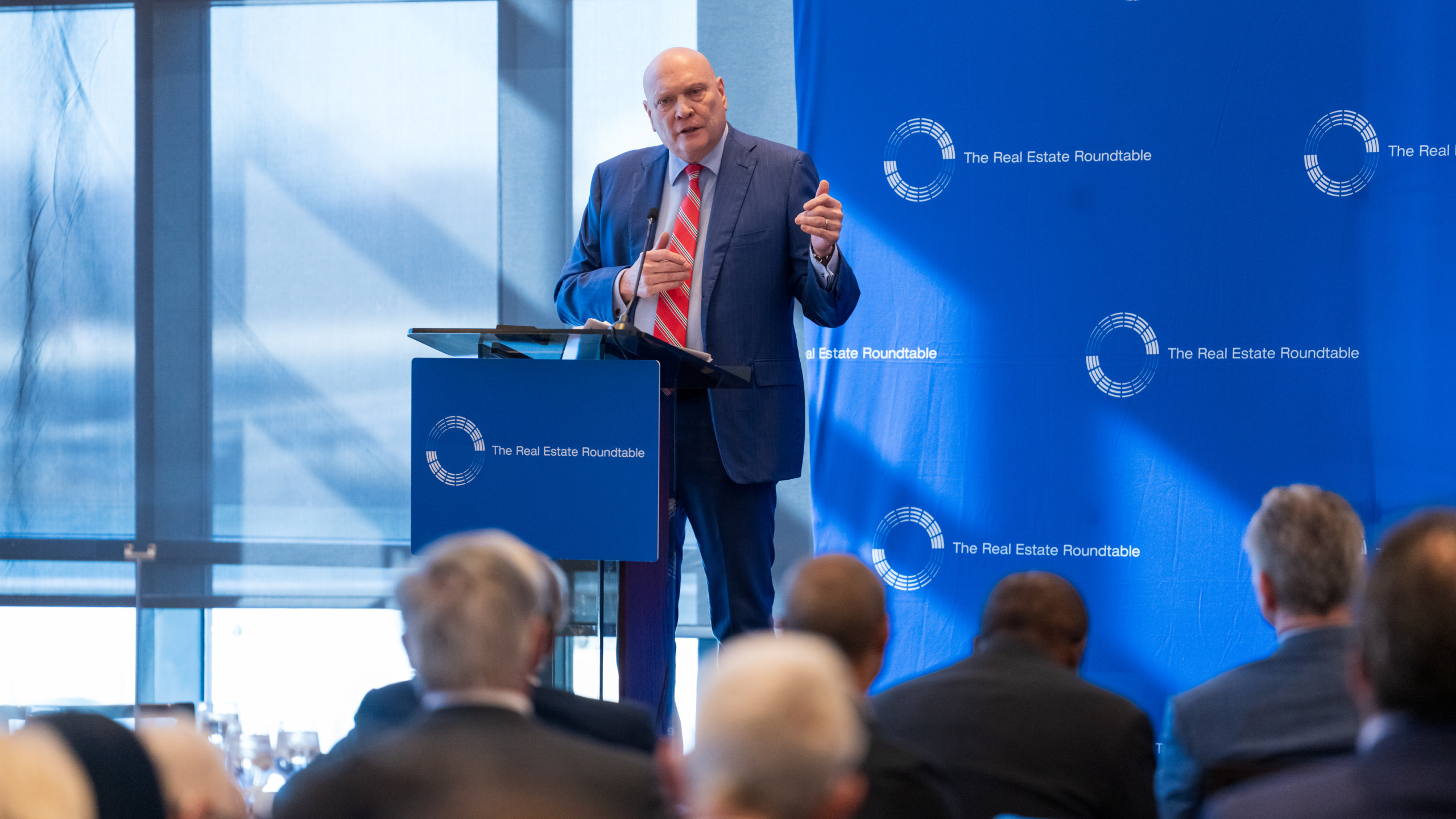

RER White Paper Raises Constitutional Concerns With Senate Housing Bill’s Section 901

The Real Estate Roundtable (RER) this week released a white paper authored by Paul Clement of Clement & Murphy, PLLC, adding significant constitutional concerns to the growing case against Section 901 of Title IX of the Senate-passed 21st Century ROAD to Housing Act (H.R. 6644). While the broader legislation contains several constructive provisions to help boost housing supply, the Senate bill’s restrictions on certain institutional investors would undermine new development, disrupt the build-to-rent (BTR) market, and raise serious legal questions. (White Paper, April 14)

Why It Matters

  • The Senate provision would apply to corporate entities that own more than 350 single-family homes. It would largely prohibit those entities from purchasing additional single-family homes and require them to sell newly constructed single-family rentals (SFR) after seven years.
  • The investor “purchase ban” on single-family homes and the “forced sale” of new single-family rentals would amount to an unprecedented federal intervention in housing markets at a time when the country needs policies that encourage development—not deter it.

What the White Paper Says

  • The white paper released by RER argues that the forced-sale requirement for build-to-rent housing raises serious constitutional problems under the Fifth Amendment’s Takings Clause. (White Paper, April 14)
  • The paper concludes government cannot force one private owner to sell its homes to another without trampling on the Constitution’s “public-use” and “just-compensation” requirements. Furthermore, the Senate’s bill provides no mechanism for the government to pay just compensation to investors whose homes would be taken.
  • The paper also raises equal protection concerns by singling out a narrow category of corporate owners for special burdens.
  • While Congress has broad authority to regulate economic activity, the paper notes that it cannot arbitrarily target a specific class of property owners—particularly where the ownership and disposition of private property are at stake.
  • In addition, the paper argues that the proposal departs from the traditional state and local roles in land use and housing policy, raising broader federalism concerns.

Roundtable Advocacy

  • RER has consistently supported policies that expand housing availability, reduce barriers to development, and improve affordability.
  • At the same time, RER has warned that Section 901 would do the opposite by discouraging new investment in housing and weakening a growing source of supply.
  • RER shared the white paper with members of Congress in a letter urging lawmakers to preserve the bill’s pro-supply provisions while removing Title IX.
  • Since the Senate passed its version of the bill, progressive and conservative groups alike have cited numerous benefits that SFR owners and builders deliver for U.S. housing markets, in terms of increasing supply, maintenance, and upkeep of units, and providing opportunities for families to live in communities with strong education systems, where they can’t afford to buy. (Progressive Policy Institute, February 2026; Competitive Enterprise Institute, February 2026)

  •  As lawmakers work to address the housing shortage, the focus should remain on expanding supply and lowering barriers to development—not on punitive restrictions that threaten new investment, weaken build-to-rent housing, and make affordability challenges worse.

The constitutional concerns surrounding Section 901, and the broader policy debate over how best to expand housing supply, will be part of the discussion at RER’s Spring Roundtable Meeting (Roundtable-level members only) next week in Washington.

White House Economic Report Underscores Supply Gap as ROAD to Housing Act Stalls

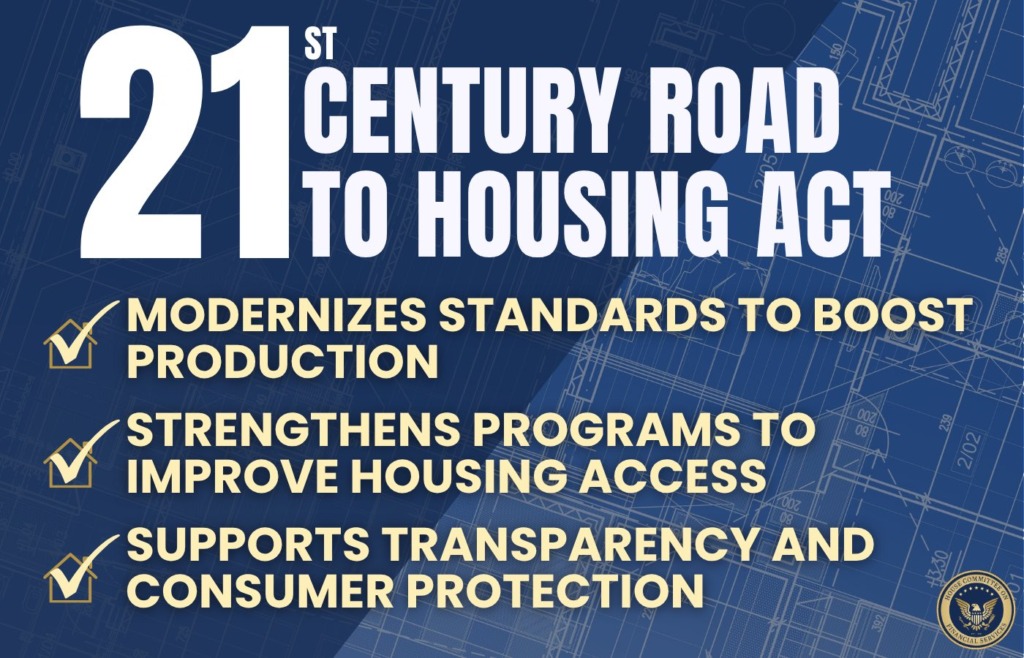
Congress returned to Washington this week after a two-week recess with little visible movement on the 21st Century ROAD to Housing Act, even as House Financial Services Committee staff continued work on a bipartisan response to the Senate-passed bill.

State of Play

  • House and Senate lawmakers remain at odds over how to reconcile the competing housing packages, with the Senate bill’s treatment of institutional investment in single-family housing still one of the biggest sticking points. (Politico, April 14)
  • RER and other housing advocates continue to press lawmakers to preserve the bill’s pro-supply provisions while removing language that could reduce rental housing production and discourage new investment.

Why It Matters

  • The report says that if single-family homebuilding had continued at its historical pace after 2008, the U.S. would have “10 million or more additional single-family homes today”—a striking measure of the nation’s housing shortfall and the scale of lost supply. (CRE Daily, April 14)
  • White House economists reached that figure by asking how many homes would exist today if construction had continued at its pre-2008 pace, making the estimate as much about lost capacity as current demand. (Propmodo, April 13)
  • The findings reinforce that improving affordability will require more building, more investment, and fewer barriers to supply—and that policies constraining new housing production could worsen affordability rather than improve it.

New Research

  • Updated research continues to undercut the argument that institutional ownership is the main source of today’s affordability challenges.
  • An AEI report released last week says large institutional investors own less than 1 percent of the nation’s single-family homes and concludes that Section 901 of the Senate’s bill would reduce the supply of newly constructed and rehabilitated homes while burdening low- and middle-income renters. (AEI, April 10)
  • Separate Realtor.com research published in March also found that the institutional investor footprint has been shrinking from its 2022 peak. (Politico, April 14 | Realtor, March 13)
  • Recent market data points in the same direction. If institutional investment were the main cause of the nation’s housing affordability problems, the markets with the heaviest investor activity would be consistently posting the strongest price growth. (Roundtable Weekly, April 10 | GAO Report, April 6 | GAO Report, 2024)
  • The latest Case-Shiller data show the opposite pattern: Chicago and New York led annual home-price gains in December 2025, while several Sun Belt metros where institutional investors have been more prominent—including Tampa, Phoenix, Dallas, and Miami—saw prices decline. That divergence reinforces the broader point that supply constraints, not institutional investment alone, are the bigger force shaping affordability. (S&P Global, December 2025 | Realtor, October 2025)

New Housing Legislation Introduced

  • Separate from the House-Senate standoff, Sen. Bill Hagerty (R-TN) this week introduced the Freedom to Build Act, a proposal backed by The Real Estate Roundtable (RER) that would create a HUD “Freedom to Build” certification for localities adopting pro-supply policies such as faster approvals, regulatory streamlining, and other measures to expand housing construction. (Sen. Hagerty Press Release, April 14)
  • The bill is intended to incentivize deregulation, expand housing supply, and make homes more affordable by aligning existing federal incentives with communities that reduce barriers to building.
  • Jeffrey D. DeBoer, President & CEO of RER said, “This legislation would be a meaningful step toward expanding housing supply and improving affordability for working families. The Freedom to Build Act would align federal incentives with local decision-making to help unlock private capital, enhance housing supply, and support long-term economic growth. The Real Estate Roundtable has long supported policies that promote housing affordability—for renters and homeowners—and strengthen the connection between housing, jobs, and transportation.”

Sen. Hagerty will also be a featured guest at RER’s upcoming Spring Roundtable Meeting next week (Roundtable-level members only), where housing supply, affordability, and related policy developments will be among the topics discussed.

New GAO Data, Rising Cost Pressures Undercut Case for Build-to-Rent Restrictions

As the Senate-passed 21st Century ROAD to Housing Act awaits House action, new federal data and rising development cost estimates are reinforcing a key point in the housing debate: affordability challenges are driven by supply constraints, and federal policy should not make it harder or more expensive to build. (Washington Post, April 6)

What the Data Shows

  • At the center of the debate is Section 901, which would force large institutional investors to sell certain newly built single-family rental homes after seven years—a provision that could undermine build-to-rent housing and reduce supply. (Roundtable Weekly, April 3)
  • A new GAO report found that institutional investor ownership of single-family rental homes increased in six metro areas from 2018 to 2024, but still accounted for a very small share of all single-family homes in those markets—ranging from less than 1 percent to 3 percent. (GAO Report, March 24 | Highlights, March 24)
  • The findings add new weight to the argument that institutional ownership is not the main driver of the nation’s affordability challenges.
  • The Washington Post noted this week that forcing build-to-rent homes to be sold within seven years would weaken a fast-growing source of new single-family housing. (Washington Post, April 6)
  • A separate February report from the Progressive Policy Institute (PPI) reached a similar conclusion, finding that institutional investors own less than 1 percent of all single-family homes nationwide and account for less than 2 percent of all home purchases, and concluding that the broader affordability problem is rooted in supply-demand imbalances rather than investor concentration. (Progressive Policy Institute, February 2026)
  • The reports undercut the argument that restricting institutional investment is likely to meaningfully improve affordability, particularly when housing shortages, financing costs, regulatory barriers, and construction expenses remain the primary constraints on supply.

Market Impact

  • As Barron’s reported this week, Section 901’s proposed restrictions on institutional investors are already having a chilling effect on investments in single-family housing, with investment managers indicating that pension funds and other large investors may pause or reconsider deals until there is greater clarity around housing policy. (Barron’s, April 7)
  • Research from John Burns Research & Consulting suggests the Senate bill has “already paralyzed” the build-to-rent development industry, with new development slowing and capital “now frozen,” impacting project viability “from day one, not just in seven years.” (Barron’s, April 7)

Tariffs & Construction Costs

  • A new Cushman & Wakefield report found that tariff rates in effect as of April 7 would raise construction materials costs by 6.0 percent relative to a 2024 baseline and increase total project costs by roughly 3.0 percent, adding more pressure to housing and commercial real estate development. (Cushman & Wakefield, April 8)

RER & Industry Advocacy

  • RER and broad housing coalitions have consistently emphasized that housing affordability is driven by supply shortages, construction costs, and mortgage rates—not institutional ownership levels—and that restricting institutional capital would only make it harder to meet the nation’s growing housing needs. (Roundtable Weekly, Jan. 9 | Jan. 16 | Jan. 23 | Feb. 27March 6 | March 13 | March 20 | March 27 | April 3) (Letter, March 5 | Letter, March 13)
  • Research continues to show that restricting institutional capital is unlikely to improve affordability and could create new supply constraints. The PPI report, for example, notes that build-to-rent development is becoming an increasingly important source of new housing supply. (Progressive Policy Institute, February 2026)

What’s Next

  • Congress returns next week with a robust agenda. The Senate is set to return April 13 and the House on April 14, with unresolved DHS funding, a possible new reconciliation push, and the administration’s budget request all competing for floor time and political attention.
  • That packed schedule could make it harder for housing legislation to advance quickly.

The Senate-passed ROAD to Housing Act and broader housing policy will be a major focus at the upcoming Spring Roundtable Meeting April 20-21 in Washington, D.C. (Roundtable-level members only).

IRS and Treasury Issue Guidance on Opportunity Zone Nominations

The IRS and Treasury Department released new guidance Monday outlining the process for states to nominate census tracts for designation as Qualified Opportunity Zones (QOZs) under the expanded, permanent program enacted in the One Big Beautiful Bill (OB3) Act. (Treasury News Release, April 8)

Proposed Guidance

  • Treasury and IRS released new guidance establishing the process for chief executive officers of any state, the District of Columbia, and U.S. territories to nominate eligible low-income census tracts for QOZ designation, as well as a list of 25,332 census tracts that meet the low-income requirements. (Treasury dataset | Politico Pro, April 6)
  • The guidance is a step toward implementing the Opportunity Zone (OZ) changes enacted in the OB3 Act, which made the incentive permanent and expanded it to provide enhanced tax benefits for investments in rural OZs. Rural OZs have lower investment requirements than urban tracts. (IRS News Release, April 6 | Politico Pro, April 6)
  • Under the statute, states generally may designate no more than 25 percent of their eligible low-income communities as QOZs, subject to special rules for states with fewer qualifying tracts. (IRS News Release, April 6)
  • The new designations will take effect on Jan. 1, 2027, and future designation rounds will occur every 10 years, replacing the original one-time map established under the 2017 Tax Cuts and Jobs Act (TCJA). (IRS News Release, April 6)
  • Treasury is developing an online nomination tool to streamline the designation process. (Bloomberg, April 6)

Roundtable Advocacy

  • Following the passage of the OB3 Act, RER actively engaged Treasury and IRS to support a smooth transition from OZs 1.0 to 2.0, including submitting a detailed comment letter and providing draft guidance for consideration. (Letter, Dec. 19)
  • RER’s December 2025 comment letter requested urgent tax guidance to ensure investment and capital continue to flow to low-income communities during the transition from the TCJA OZ regime to the new OB3 Act rules. (Letter, Dec. 19)
  • RER urged policymakers to confirm that contributions to existing TCJA qualified opportunity funds and businesses would continue to qualify for OZ benefits after current zone designations lapse, provided certain conditions are met. (Letter, Dec. 19)
  • Without clear transition rules, investors could delay or redirect capital, creating unnecessary uncertainty and slowing affordable housing development and economic activity in distressed communities. (Letter, Dec. 19)
  • OZ incentives have already mobilized more than $120 billion in capital to support housing, retail, and mixed-use development in underserved areas. (Letter, Dec. 19)

What’s Next

  • The QOZs nomination window opens on July 1, 2026 and runs for 90 days, subject to a single 30-day extension. (IRS News Release, April 6)
  • Treasury and IRS expect to issue additional guidance identifying designated QOZs before the Jan. 1, 2027 effective date. (IRS News Release, April 6)
  • New OZ designations will run through Dec. 31, 2036, with new nomination rounds occurring every 10 years thereafter. (IRS News Release, April 6)

RER will continue to engage with policymakers to support clear, workable implementation of the new OZ framework, ensure continuity for existing projects, and encourage tax policies that incentivize long-term investment in underserved communities.

The Department of Labor Proposes 401(k) Alternative Investment Rule

The Department of Labor (DOL) proposed a new rule this week that would make it easier for 401(k) plans to offer investment options with exposure to alternative assets, including private equity, real estate, digital assets, and other nontraditional products—if fiduciaries follow a prudent, process-based framework. The proposal stems from President Trump’s Aug. 7, 2025 Executive Order directing regulators to expand access to alternative assets in defined contribution retirement plans. (DOL News Release, March 30)

Proposed Rule

  • The proposed rule would clarify fiduciary duties under the Employee Retirement Income Security Act (ERISA) and establish a safe harbor for selecting designated investment alternatives, including asset allocation funds that contain alternative assets. (PoliticoPro, March 30)
  • DOL says the rule is intended to reduce regulatory uncertainty and litigation risk that have discouraged plan sponsors from offering broader exposure to private markets and other alternatives in 401(k) plans, even though such investments are not expressly prohibited today.
  • Under the proposal, fiduciaries would need to evaluate factors such as performance, fees, liquidity, valuation, benchmarks, and complexity through an objective and analytical process. (DOL News Release, March 30)

Background

  • While alternative investments have long played a role in defined-benefit plans such as pensions, fiduciary obligations and litigation concerns have made it more difficult to include them in participant-directed defined contribution plans like 401(k)s.
  • Since the Executive Order, regulators and administration officials have signaled growing support for expanding access to alternative investments—including real estate—while emphasizing the need for appropriate guardrails. (Reuters, March 30)

What to Watch

  • The proposal would mark a meaningful shift in the federal government’s approach to alternative investments in retirement plans, particularly by replacing a more cautious posture with a framework centered on fiduciary process rather than asset-class restrictions. (CNBC, March 30)
  • The rule could have important implications for real estate and other alternative asset managers if it leads to broader access to private-market exposure through participant-directed retirement plans.
  • The proposal does not endorse any specific asset class, and fiduciaries would still be expected to determine whether a particular investment is appropriate for plan participants.

What’s Next

  • The proposal is subject to a 60-day public comment period, with DOL signaling it hopes to finalize the rule by year’s end.

Comments are due on June 1, 2026.  RER is working on comments and welcomes input from members. 

Research Continues to Reinforce Case Against Build-to-Rent Provision in Housing Bill

As the 21st Century ROAD to Housing Act remains in limbo in the House, new research is strengthening the case for removing the Senate bill’s build-to-rent (BTR) provision. The findings suggest the provision could curb housing supply without improving affordability.

State of Play

  • At the center of the debate is Section 901, which would require newly built single-family rental homes developed by large institutional investors to be sold to after seven years. (Roundtable Weekly, March 27 | The Atlantic, March 30)
  • Industry groups, researchers, and The Real Estate Roundtable (RER) warn that the mandate would disrupt a growing source of housing supply, raise serious constitutional concerns, and potentially trigger years of litigation involving property owners, tenants, and the federal government. (Roundtable Weekly, March 13 |  CNBC, March 29)

New BTR Research

  • Other recent studies are reinforcing concerns about the provision. A new AEI analysis found the bill’s investor restrictions could reduce supply and hurt lower-income families. (AEI study, March 27)
  • An Urban Institute case study found that single-family rental investors have developed renovation and property-management capabilities that could help rehabilitate more homes and expand the supply of affordable housing. (Urban Institute Case Study, March 30)

Roundtable & Industry Advocacy

  • RER and a broad real estate coalition have spent weeks urging lawmakers to preserve the bill’s pro-supply provisions while removing or revising Section 901, warning that the seven-year sale requirement would effectively eliminate build-to-rent housing production. (Roundtable Weekly, Jan. 9 | Jan. 16 |  Jan. 23 | Feb. 27March 6 | March 13 | March 20 | March 27) (Letter, March 5 | Letter, March 13)
  • That case was reinforced again last week in an open letter from housing researchers, who said the mandate would undermine a growing source of supply and is especially unworkable because many BTR communities are not designed to be sold unit by unit. (Letter, Mar. 26 | MultifamilyDive, Mar. 31)

New Cost Pressures

  • Rising aluminum prices are adding new strain to an already challenging development environment, pushing construction costs higher and threatening project viability.
  • “The conflict in the Middle East is further driving up materials prices and making construction that much less affordable and many projects that much less financially viable,” said Anirban Basu, the chief economist for Associated Builders and Contractors. (PoliticoPro, March 27)
  • The pressure comes on top of elevated rates, tariff uncertainty, and labor shortages that have already slowed homebuilding and weighed on new investment. (PoliticoPro, March 27)

What’s Next

  • Congress is in recess until April 13, leaving the package’s next steps uncertain for now.

RER will continue urging Congress to protect the bill’s supply-focused provisions while removing language that would make it harder to build rental housing.

Roundtable and Coalition Support ENERGY STAR Transition to the Department of Energy

The Real Estate Roundtable (RER) joined a broad coalition of organizations representing the consumer products, manufacturing, real estate, and retail sectors this week to support the Department of Energy’s (DOE) new role as lead federal agency for ENERGY STAR, following the recent Memorandum of Agreement with the Environmental Protection Agency (EPA). (RER News Release, March 31 | Memorandum of Agreement, March 3)

ENERGY STAR Coalition Letter

  • In a coalition letter sent this week to DOE, the groups said they look forward to collaborating with the agency to ensure an effective transition that maintains and evolves the voluntary ENERGY STAR public-private partnership. (Letter, March 30 | PoliticoPro, March 31)
  • The coalition emphasized that DOE is well-positioned to lead a modernized ENERGY STAR program that continues to provide consumers and businesses with access to efficient products and buildings with the performance they have come to expect from the ENERGY STAR brand.
  • The letter also reaffirmed strong support for keeping ENERGY STAR within the federal government. (Letter, March 30)
  • “Our longstanding partnership with the federal government’s ENERGY STAR program remains a top priority as DOE assumes the lead implementation role,” said RER’s President & CEO Jeffrey D. DeBoer. “DOE has the data, talent, lab research, and other resources to run all facets of ENERGY STAR efficiently and effectively. Down the years, ENERGY STAR for buildings has saved families and businesses hundreds of billions of dollars in energy costs, and helps create greater capacity on the grid to boost economic growth. We will continue to partner in the evolution of ENERGY STAR to support the economic growth in our buildings, plants, and consumer products.” (RER News Release, March 31)
  • Congress provided approximately $33 million for ENERGY STAR to EPA in the FY’26 appropriations bill (H.R. 6938), signed into law on Jan. 23, preserving the program through Sept. 30 following earlier reports that it could be privatized or defunded. (Roundtable Weekly, Jan. 9 | Utility Dive, March 10) 
  • Additionally, the letter noted that the program has helped save families and businesses more than $500 billion in energy costs since 1992. (Letter, March 30)

Roundtable View

Tony Malkin (Chairman and CEO, Empire State Realty Trust, Inc.), chair of The Roundtable’s Sustainability Policy Advisory (SPAC) Committee.
RER’s Sustainability Policy Advisory Committee (SPAC) Chair Anthony E. Malkin (Chairman and CEO, Empire State Realty Trust, Inc.)
  • RER has long made the business case for ENERGY STAR and, with coalition partners, emphasized that it is a federal program required by law—not one that can be privatized or operated outside the U.S. government by agency decree. (Roundtable Weekly, Mar. 6)
  • Last year, RER joined dozens of industry groups in a letter to Congress to support the ENERGY STAR. The multi-industry letter cited federal statutes that compel ENERGY STAR to be a program run by federal agencies, with DOE and EPA authorized to assign program responsibilities between themselves. (Roundtable Weekly, Jun. 6, 2025)
  • “DOE has always been a key part of the ENERGY STAR ecosystem and is ideally suited to assume the role as the program’s primary steward and ensure its vitality and progress forward,” said RER’s Sustainability Policy Advisory Committee (SPAC) Chair Anthony E. Malkin (Chairman and CEO, Empire State Realty Trust, Inc.).
  • “ENERGY STAR has long enhanced the profitability of buildings and established a voluntary reporting structure for real estate assets. It helps our industry attract investors from all over the world to the United States. ENERGY STAR works better than any other building energy ‘label’ on the market because it is grounded in quantifiable metrics and deploys standard software geared to save money on utility bills and avoid wasted energy,” added Malkin.
  • Malkin continued, “Our industry coalition with leading organizations in the real estate, manufacturing, consumer tech, and retail sectors will continue to advocate to Congress and the Executive branch the critical role ENERGY STAR plays to advance America’s energy dominance and global competitiveness.”

RER will continue working with policymakers and aligned stakeholders to help ensure a smooth and productive transition for ENERGY STAR.

David Simon, Transformative Leader in Retail Real Estate

The Real Estate Roundtable mourns the passing of David Simon, the longtime chairman, chief executive officer, and president of Simon Property Group, who died on March 22. Simon transformed his family’s business into the world’s leading retail property company and was one of the most influential figures in modern retail real estate. (WSJ | Simon Property Group Press Release, March 23)

Cost Recovery Reform to Spur New Housing Supply Gains Traction in Washington

A new report from the influential Center for American Progress (CAP) suggests that allowing immediate expensing for new multifamily rental housing could spur a major increase in multifamily construction and bring down housing costs over the next decade. (CAP Report, March 11)

Report Findings

  • The CAP report found that immediate expensing for new multifamily rental housing, with a per-unit cap of $150K-$250K, could spur the creation of 706,000 to 1.06 million new homes over 10 years, at a cost of up to $206 billion. (PoliticoPro, March 12)
  • The researchers claim that faster cost recovery would lower the cost of capital, improve project cash flow, and help move more rental developments from infeasible to financeable.
  • The research also shows that full or partial expensing could increase housing supply at a lower cost per unit than many direct subsidy programs. (Tax Policy Center, March 17)
  • The researchers’ preferred approach would cap immediate expensing at $150,000 per unit, paired with a refundable credit option to address the fact that many real estate investors are tax-exempt or otherwise unable to use additional tax deductions. They estimate the proposal could produce roughly 755,000 new homes over a decade for about $154 billion.
  • The proposal also parallels last year’s One Big Beautiful Bill Act, which provided full expensing for new factories. The Tax Foundation called that change a step forward, but said its economic benefits would be limited because it is temporary and narrowly targeted. (Tax Foundation, Oct. 27, 2025)
  • The Tax Foundation published a reply to the CAP report that generally supports the approach while outlining a variety of cost recovery reform options for policymakers to consider, including: neutral cost recovery, and investment tax credit, tax deduction transferability, shorter asset lives, and partial expensing. (The Tax Foundation, Mar. 23)
  • The recent reports by the two influential think tanks are further evidence that policymakers are open to new approaches aimed at addressing housing affordability challenges.

On the Hill

  • Sen. Lisa Blunt Rochester (D-DE) introduced the Rental Housing Investment Act on March 12, which would allow builders to immediately deduct a portion of new multifamily construction costs rather than recover them over 27.5 years. (Sen. Rochester News Release, Mar. 12)
  • The bill would allow builders to immediately deduct up to $150,000 per unit in construction costs, with an enhanced deduction of up to $250,000 per unit for projects that include income-restricted units under long-term attainability commitments. The incentive would apply only to newly constructed multifamily rental housing. (USA Today, Mar. 11)
  • The measure is intended to support efforts to expand rental supply and address affordability pressures by improving the tax treatment of new multifamily development, as high interest rates and rising construction costs continue to weigh on housing production.

Property Conversions

  • Office conversions now account for nearly half of all future adaptive reuse projects. (CRE Daily, Mar. 25)
  • RentCafe reported that 90,300 apartments were in the conversion pipeline nationwide at the start of 2026, up 28% from 70,600 a year earlier, as the trend continues to gain momentum in both major and mid-sized markets. (RentCafe, Mar. 24)
  • New York leads the pipeline, followed by Washington, D.C., and Chicago. (Bisnow, March 26 | Cushman & Wakefield, Feb. 2026)
  • New research from Pew and Gensler highlights office-to-residential conversions, particularly lower-cost co-living microapartments in underused downtown buildings.  (Pew Research, Mar. 24)
  • Pew found the model could cut per-unit development costs by more than half in some markets and deliver nearly four times as many affordable homes per subsidy dollar compared to traditional studio development. (Pew Research, Mar. 24)
  • RER has strongly backed the bipartisan Revitalizing Downtowns and Main Streets Act of 2025 (H.R. 2410), which would create a market-based tax incentive for converting older commercial buildings to residential use to help expand housing and support the recovery of downtowns and neighborhoods still feeling the effects of the pandemic. (Roundtable Weekly, Mar. 2025)

RER will continue working with policymakers to advance tax and regulatory policies that encourage property conversions, reduce barriers to development, and help expand the nation’s housing supply.

Policymakers Continue Focus on Grid Reliability, Electricity Affordability 

Congress and the White House are elevating questions around energy infrastructure, cost allocation, and the ability of the power sector to meet the needs of AI in a rapidly evolving economy.

Hearing Spotlights Grid Strain

  • On March 25, the Senate Energy and Natural Resources (ENR) Committee held a hearing on the state of the U.S. bulk power system. Lawmakers and witnesses pointed to growing strain from rising electricity demand, infrastructure delays, and reliability concerns. (Senate ENR Hearing, Mar. 25)
  • Witnesses agreed the U.S. is entering a new phase of electricity demand growth not seen in decades—driven by a combination of AI applications, domestic manufacturing, and electrification—creating both reliability risks and investment uncertainty. (Senate ENR Hearing, Mar. 25)
  • Lawmakers and witnesses suggested several solution pathways, including permitting reform to accelerate project approvals, expanded transmission buildout to relieve congestion, and improved interconnection processes to bring new generation online faster. (Senate ENR Hearing, Mar. 25)
  • Dr. Liza Reed (Niskanen Center) emphasized the central role of transmission, stating, “We need more energy and transmission to move that energy,” and warning that “a shortage of grid capacity is the primary barrier to the cost-effective and swift deployment of AI in this country.” (Reed Testimony, Mar. 25)
  • As The Real Estate Roundtable’s (RER) Policy Guide on building performance standards states, the transition to a digital economy raises serious concerns about electricity availability, as “[v]ast swaths of the U.S. are at risk of running short of power.” (Roundtable Weekly, Oct. 11, 2024)

Executive Action

  • On March 20, the White House released its National Policy Framework for Artificial Intelligence, accelerating congressional attention on these issues by directly linking data center growth to energy policy. (White House AI Framework, Mar. 20)
  • The framework calls on Congress to “ensure that residential ratepayers do not experience increased electricity costs as a result of new AI data center construction and operation” while also urging policymakers to “streamline federal permitting for AI infrastructure construction and operation.” (White House AI Framework, Mar. 20)
  • The administration’s approach builds on its earlier ratepayer protection pledge, which requires major technology companies to provide or pay for their own power. White House officials have urged Congress to codify that commitment into law. (E&E News, Mar. 23)
  • Congressional leaders quickly signaled alignment with the framework. In a joint statement, House Republican leaders said Congress must “enact a national framework that unleashes the full potential of AI… and provides important protections for American families.” (E&E News, Mar. 23)
  • At the same time, divisions remain, with some lawmakers raising concerns about federal preemption and the broader scope of the proposal. (E&E News, March 23)

State of Play – Permitting Reform

  • Lawmakers have been advancing multiple legislative approaches to address permitting delays, transmission bottlenecks, and the growing energy demands of data centers.
  • Notably, the RER-backed, bipartisan SPEED Act (H.R. 4776,), which passed the House in December 2025, would provide permitting certainty, codify certain NEPA reforms, and streamline environmental reviews for energy infrastructure. (Roundtable Weekly, Dec. 19, 2025)
  • RER believes permitting reform is essential for advancing our economy’s energy transition. The current fragmented system of administrative reviews and approvals hinders the delivery of quick, low-cost, reliable electricity to our nation’s homes and commercial buildings. (Roundtable Weekly, Oct. 10, 2025)
  • Permitting reform talks remain active but unsettled. Bipartisan negotiations continue and some Republicans consider narrower reconciliation options, though procedural constraints and the GOP’s narrow majority leave the path forward uncertain. (E&E News, Mar. 26)

Data Centers

  • Separately, lawmakers have introduced a range of proposals addressing data center energy use and cost allocation.
  • Recently introduced bills would require federal studies on ratepayer impacts (H.R. 6529), expand FERC oversight (H.R. 8033), ensure large-load customers cover their electricity costs (H.R. 7977), and mandate dedicated power sources for new data centers (S. 3852)—reflecting growing congressional focus on preventing cost shifts to consumers. (E&E News, Mar. 23)
  • On March 25, Sen. Dick Durbin (D-IL) introduced the Data Center Water and Energy Transparency Act, which would require data center developers and operators to disclose energy and water use to state and local officials considering new projects. (Sen. Durbin Press Release, Mar. 25)
  • Meanwhile, Senators Elizabeth Warren (D-MA) and Josh Hawley (R-MO) joined in a letter to the Energy Department’s data gathering arm, urging the agency to “establish a mandatory annual reporting requirement for data centers and other large loads.” (Sens. Warren, Hawley press release |  The Verge, Mar. 26)

RER will continue to engage with members of Congress and the administration to advance policies that streamline project approvals, support efficient cost allocation, and enable the energy infrastructure needed to power the real estate sector and the broader economy.